
Key facts at a glance
This guide is for Cheshire owners who have more than one offer, or expect several, and need to pick the best one. It is the Cheshire chapter of our guide on how to sell a house in Connecticut. The general offer-comparison method is in how to compare offers on a house in Connecticut; this page goes deeper on one question: how much each contingency is worth against price, on Cheshire numbers, and how to run a best-and-final round.
| Fact | Number | Source |
|---|---|---|
| Cheshire single-family median, arm’s-length sales Oct 2024 to Sep 2025 | $550,000 (202 sales); middle half $441,500 to $680,000 | data.ct.gov sales dataset (OPM), our count |
| Busiest closing months | June to August: 70 of 202 single-family closings | data.ct.gov, our count |
| Median single-family house, year built | 1972; colonials 36%, ranches 26%, capes 14% | 2025 CT Parcel and CAMA Data |
| Single-family homes heated with oil | 72% | 2025 CT Parcel and CAMA Data |
| Mill rate | 31.36 (fiscal 2027) | CT OPM mill rates |
| Conveyance tax a Cheshire seller pays | 0.75% state + 0.25% town = 1.00% ($5,500 on $550,000) | CGS 12-494 |
| Disclosure report due | Before the buyer signs a binder or contract, or a $500 credit at closing | CGS 20-327b, 20-327c |
How do you choose the best offer on a Cheshire, CT house?
To choose the best offer on a Cheshire, CT house, net each offer after fees, credits and the 1% conveyance tax, then put a dollar cost on every contingency: each month a home-sale contingency could add costs about $1,456 in Cheshire carrying costs (est.), and every dollar of appraisal shortfall without gap coverage comes off your price. The best offer is the highest net that survives its own contingencies.
In a Cheshire multiple-offer weekend, the offer with the biggest number often carries the most strings: a buyer who must sell their own house first, a thin down payment, no protection if the appraisal comes in low. A slightly lower offer with fewer strings can put more money in your account on closing day.
We buy houses ourselves, so we are one of the possible offers. For most well-kept Cheshire colonials in a busy month, a financed buyer will net you more than we will, and this page shows why; our cash buyer vs realtor comparison covers the cases where it goes the other way.
Why does picking one offer feel so hard?
Picking one offer feels hard because the stakes are high and the information is uneven: each buyer’s agent says their client is the strongest, you see the price instantly but not the risk, and Cheshire prices are high enough that a wrong choice can cost tens of thousands of dollars. Feeling torn is a sign you are taking it seriously.
Sellers in a multiple-offer situation tell us they feel pressured by deadlines, afraid of leaving money on the table, suspicious of escalation clauses and glowing buyer letters, and guilty about saying no to a family who wrote that they love the backyard. Some feel overwhelmed by contract terms they have never seen. And under all of it, most feel cautiously hopeful: more than one buyer wants their house.
This page is for you. It turns each contingency into a number you can weigh, so the choice stops being a feeling and becomes arithmetic.
What do four offers on a Cheshire colonial really net?
Four offers on a Cheshire colonial listed at $550,000 net very differently: a $585,000 offer that depends on the buyer selling their house nets about $539,332, a $570,000 offer with 20% down and a $15,000 appraisal gap clause about $530,266, a $560,000 low-down-payment offer with a 2% credit about $506,816, and a $520,000 cash offer about $499,872. Example (illustrative), before your mortgage payoff.
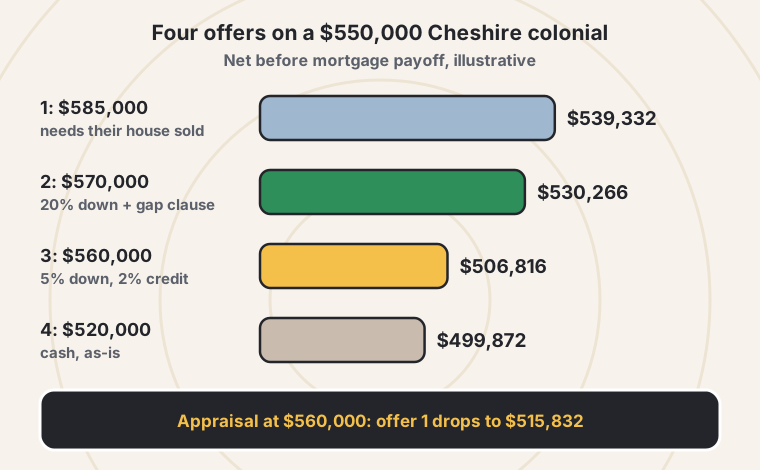
The setup (illustrative). A four-bedroom 1970s Cheshire colonial with oil heat, listed at $550,000, the town’s single-family median. You pay your listing agent 2.5%. Your carrying costs are about $1,456 a month (est.): property tax of about $1,006 (70% of $550,000 x 31.36 mills, divided by 12) plus about $450 for insurance, utilities and upkeep. Four offers arrive before a Monday deadline:
- Offer 1: $585,000. Conventional, 10% down. Contingent on the sale of the buyer’s current house, which is not yet under contract. Asks you to pay their agent 2.5%. Ten-day inspection. Realistic closing in about 90 days.
- Offer 2: $570,000. Conventional, 20% down. Will cover an appraisal shortfall of up to $15,000. Asks for 2% to their agent. Seven-day inspection. Closing in 45 days.
- Offer 3: $560,000. Conventional, 5% down. Asks for a 2% closing-cost credit and 2.5% to their agent. Fourteen-day inspection including an oil tank test. Closing in 45 days.
- Offer 4: $520,000. Cash, as-is, no buyer’s agent, no inspection or financing contingency, proof of funds attached. Closing in about two weeks.
| Line | Offer 1 | Offer 2 | Offer 3 | Offer 4 (cash) |
|---|---|---|---|---|
| Price | $585,000 | $570,000 | $560,000 | $520,000 |
| Listing agent (2.5%) | -$14,625 | -$14,250 | -$14,000 | -$13,000 |
| Buyer’s agent fee requested | -$14,625 | -$11,400 | -$14,000 | $0 |
| Closing-cost credit | $0 | $0 | -$11,200 | $0 |
| Conveyance tax (1%) | -$5,850 | -$5,700 | -$5,600 | -$5,200 |
| Your attorney (est.) | -$1,200 | -$1,200 | -$1,200 | -$1,200 |
| Inspection credit (est.) | -$5,000 | -$5,000 | -$5,000 | $0 (as-is) |
| Carrying costs to closing (est. $1,456/month) | -$4,368 (3 months) | -$2,184 (1.5 months) | -$2,184 (1.5 months) | -$728 (half a month) |
| Net before your mortgage payoff | $539,332 | $530,266 | $506,816 | $499,872 |
| If the appraisal comes in at $560,000 | $515,832 (price cut to $560,000) | $530,266 (buyer covers $10,000) | $506,816 (at value) | No appraisal |
On paper, offer 1 wins by about $9,066. But it has two contingencies that can take that lead away, and the next sections price them.
How much would you walk away with?
Slide the numbers to match your house. It works in your browser; nothing is saved or sent.
Estimates for planning. Conveyance tax per CGS 12-494 (state 0.75% up to $800,000, 1.25% to $2.5M, 2.25% above, plus the town rate). Seller attorney about $1,200 to $1,500; flat-fee MLS about $400; listings include three months of taxes, insurance and utilities, a cash sale about two weeks. Your attorney gives you the final numbers.
How much is each contingency worth against price in Cheshire?
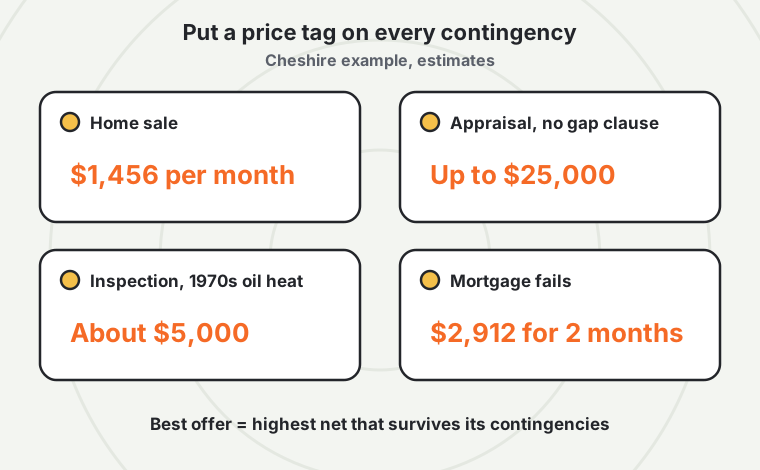
Each contingency is worth what it would cost you if it is used. In Cheshire, a home-sale contingency costs about $1,456 for every extra month you carry the house (est.) and more if the deal fails; an appraisal contingency without gap coverage can cost the full shortfall; an inspection contingency on a 1970s oil-heated colonial often costs a few thousand dollars in credits; and a mortgage contingency costs a relaunch if the loan fails.
| Contingency | What it lets the buyer do | What it can cost you in Cheshire (est.) | How to shrink it |
|---|---|---|---|
| Sale of the buyer’s home | Cancel if their own house does not sell by a date | About $1,456 a month while you wait; a failed deal means relisting after the busy months | Ask for a short deadline and a kick-out clause, or for the buyer to remove it |
| Appraisal (no gap clause) | Renegotiate or cancel if the appraisal is below the price | Up to the whole shortfall: $25,000 if offer 1 appraises at $560,000 | Ask for gap coverage, and check that the buyer’s cash can back it |
| Inspection | Ask for repairs or credits, or cancel within the window | Often a few thousand dollars on a 1972 colonial: oil tank, boiler, roof, radon (we use $5,000) | Short window; pre-listing inspection; tank records in hand |
| Mortgage | Cancel and get the deposit back if no loan commitment by a date | About $2,912 for two more months on the market, plus a weaker relaunch | Verified pre-approval; larger down payment; short commitment date |
Two Cheshire details make the inspection line real. First, 72% of Cheshire single-family homes heat with oil, and Connecticut’s disclosure report asks whether there is an underground storage tank, its age and location, and whether one was ever removed (CGS 20-327b). Buyers test or ask about tanks, so have your records ready. Our guide to oil tanks, septic, wells and radon when selling in Connecticut covers what buyers check. Second, the median Cheshire house was built in 1972, so a buyer’s inspector will often flag a boiler, a roof or windows near the end of their life.
Should you accept an offer that depends on the buyer selling their house?
You should accept an offer that depends on the buyer selling their house only if their house is already under contract or priced to sell fast, the deadline is short, and you keep the right to take another offer with a kick-out clause. Otherwise a home-sale contingency turns your sale into two sales, and you carry the risk of the one you do not control.
Many Cheshire buyers are move-up buyers who own a house somewhere else, so this contingency shows up often. Questions to ask the buyer’s agent before you weigh it:
- Is their house listed? At what price, and for how long?
- Is it under contract? With what kind of buyer and what closing date?
- Can they buy without selling first? A lender’s answer, not the agent’s.
- Will they accept a deadline of 30 days or less to remove the contingency?
- Will they accept a kick-out clause: you keep marketing, and if you get another acceptable offer, they have a short period (often 48 to 72 hours, by agreement) to remove the contingency or step aside?
Back to the example. If offer 1’s buyer cannot remove the contingency, you are holding a $585,000 promise that may become a relaunch in late fall. Carrying the house two extra months costs about $2,912 (est.), and Cheshire’s closings thin out in winter: January and February together had 16 of the year’s 202 single-family closings.
How should an appraisal gap change your choice?
An appraisal gap should change your choice whenever an offer is well above recent Cheshire sales. The lender lends on the appraised value, so on offer 1 at $585,000, an appraisal of $560,000 leaves a $25,000 gap with no clause to cover it. Offer 2’s $15,000 gap clause covers a $10,000 shortfall in full and keeps its $570,000 price.
Run the numbers both ways. At a $560,000 appraisal, offer 1 nets about $515,832 if you agree to cut the price, which is about $14,434 below offer 2. Offer 2’s buyer, with 20% down and a gap clause, brings the extra $10,000 and closes at $570,000. That is the point of a gap clause: it moves appraisal risk from you to the buyer.
Check that the clause has cash behind it. A buyer with 20% down who has also promised $15,000 of gap coverage needs both amounts in the bank. Ask the buyer’s lender to confirm assets, not only income. Our guide to low appraisals when selling in Connecticut covers reconsiderations of value and your options if the gap is bigger than the clause.
How do you run a best-and-final round in Cheshire?
You run a best-and-final round in Cheshire by telling every buyer the same thing at the same time: that you have multiple offers, the deadline for final terms, and what matters to you beyond price, such as gap coverage, a short inspection window or no home-sale contingency. Then you compare the final offers on net and risk, counter one if needed, and accept in writing after your attorney has read it.
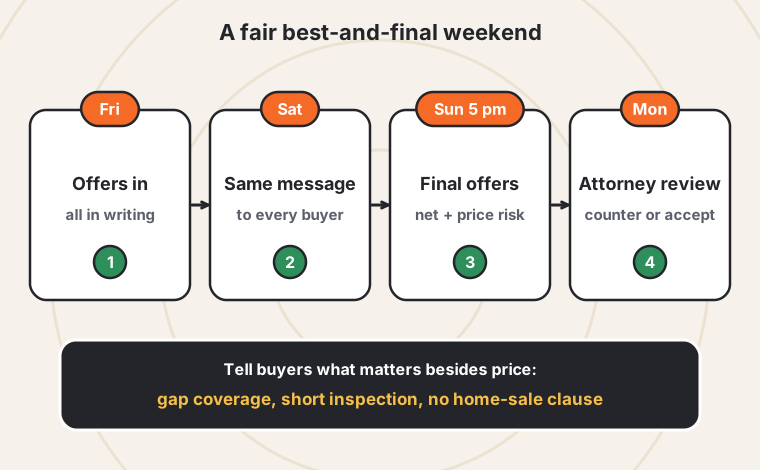
Collect every offer in writing
Price, loan type, down payment, deposit, every contingency with its date, credits, the buyer’s agent fee they want you to pay, and the closing date.
Send one message to all buyers
Same words, same time, through your agent or attorney. Name the deadline and what you value: “The seller is reviewing multiple offers. Please submit your highest and best terms by Sunday at 5 p.m. The seller values appraisal gap coverage, a short inspection period and no home-sale contingency.”
Net and price the final offers
Use the tables above: net each offer, then put a price on each remaining contingency.
Verify the top two
Call each lender. Confirm the pre-approval was underwritten and the down payment and gap cash are verified. For cash, have your attorney check proof of funds.
Counter if one term is weak
A strong offer with one weak term is worth a counter: “Seller will accept $585,000 if the home-sale contingency is removed” or “if you add $15,000 of appraisal gap coverage.”
Accept in writing, keep a backup
Have your Connecticut attorney review the contract before you sign. Tell the runner-up you would like to keep their offer as a backup.
Two rules keep a best-and-final fair and legal. Treat all buyers the same: do not share one buyer’s terms with another to start a bidding war, and verify any escalation clause against the actual competing offer. And choose on terms, never on who the buyer is: Connecticut’s fair housing law forbids refusing to sell because of race, religion, national origin, sex, familial status, disability and other protected classes (CGS 46a-64c). A buyer’s love letter can be warm; it cannot be the reason you pick them.
Does the time of year change which Cheshire offer is best?
The time of year changes which Cheshire offer is best because it changes what a failed deal costs. In June to August, when 70 of the year’s 202 single-family closings happened, a buyer who walks away is easier to replace. In late fall and winter, when January and February had only 16, a relaunch can mean months of carrying costs, so certainty is worth more.
That is a practical rule, not a law of nature. A spring offer with a home-sale contingency is a smaller risk than the same offer in November. A cash offer that looks low in July can look reasonable in December. Our guide to the best time to sell a house in Connecticut has the statewide monthly data.
When should you NOT take a cash offer on your Cheshire house?
You should not take a cash offer on your Cheshire house when it is in good condition, it is a busy month, and you have strong financed offers. In our example, offer 2 nets about $30,394 more than the $520,000 cash offer and carries little risk thanks to 20% down and a gap clause. That is real money, and a well-kept Cheshire colonial in spring usually earns it.
A cash offer makes more sense when:
- The house has a problem financed buyers will not accept: an old underground oil tank, a failing septic, major water in the basement, or a kitchen and baths untouched since 1972.
- Financed deals have already fallen through, or the house is going on the market in the slow months.
- You are settling an estate through the Cheshire-Southington Probate Court, relocating, or carrying two houses, and a sure close in about two weeks is worth the difference.
- You do not want showings, an inspection list or a 45-day wait.
To see how cash offers are built, read why cash offers are lower, and compare the two routes in cash buyer vs realtor in Connecticut. If you want a written cash number as a floor while you weigh financed offers, our Cheshire page starts with the address. No fees, no repairs, and the offer does not expire while you decide.
What are the steps to choose the best offer in Cheshire?
The steps to choose the best offer in Cheshire are: prepare before offers arrive (disclosure report, oil tank and heating records), net every offer, put a price on each contingency, verify the top two buyers, run one fair best-and-final round if you have several, counter the weakest term of your favorite, and sign only after your attorney has reviewed the contract.
Prepare
Give buyers the property condition report before they sign anything (CGS 20-327b), and gather oil tank, boiler, roof and radon records.
Net every offer
Subtract commissions, credits, the 1% conveyance tax, your attorney, likely inspection credits and carrying costs to each closing date.
Price the contingencies
Home sale, appraisal, inspection, mortgage: what does each cost you if it is used?
Verify
Call lenders, check proof of funds, confirm the deposit and who holds it.
Best and final, then counter
One message to all buyers, then a counter on the one term that keeps the best offer from being the safest.
Sign and close
Your attorney reviews and closes; Connecticut closings are conducted by attorneys (CGS 51-88a). The seller costs every offer shares are in the cost to sell a house in Connecticut.
See the house together.
Pick a time that works.
Choose a time for us to walk through the property with you, or ask for a quick call first. We confirm every request personally.
Tuesday, January 13
No open times in the next few weeks. Please call us.
We will confirm by email. Nothing is booked until we do.
View my requestQuestions Cheshire sellers ask about choosing an offer
Should I take the highest offer on my Cheshire house?
You should not automatically take the highest offer on your Cheshire house. After fees, credits and carrying costs, and after pricing its contingencies, a lower offer with 20% down and appraisal gap coverage can net more and is more likely to close.
What is a kick-out clause?
A kick-out clause lets you keep marketing a house under contract with a home-sale contingency. If you receive another acceptable offer, the first buyer gets a short, agreed period to remove the contingency or let the contract end. Have your attorney draft it.
What does highest and best mean?
Highest and best means you ask every buyer for their final price and terms by one deadline. It is not only price: buyers can improve their down payment, gap coverage, inspection window or closing date.
Is an appraisal gap clause worth more than a higher price?
An appraisal gap clause can be worth more than a higher price when the offers are above recent Cheshire sales. In our example, a $570,000 offer with $15,000 of gap coverage nets about $14,434 more than a $585,000 offer if both appraise at $560,000.
What is the conveyance tax in Cheshire?
The conveyance tax in Cheshire is 1% of the price up to $800,000: 0.75% to the state and 0.25% to the town (CGS 12-494). On a $550,000 sale that is $5,500, paid by the seller at closing.
What is the median home price in Cheshire, CT?
The median single-family price in Cheshire, CT was $550,000 across 202 arm’s-length sales recorded from October 2024 to September 2025, with the middle half between $441,500 and $680,000, by our count of the state’s data.ct.gov sales file.
Can I choose an offer because I like the buyer?
You can choose an offer on its terms, such as price, financing and dates, but you may not refuse a buyer because of race, religion, national origin, sex, familial status, disability or another protected class under Connecticut’s fair housing law (CGS 46a-64c).
Do I have to tell buyers about my oil tank?
Yes, you have to tell buyers about an underground oil tank you know of. Connecticut’s property condition report asks whether there is an underground storage tank, its age and location, any problems, and whether one was removed (CGS 20-327b).
How long do I have to answer an offer?
You have as long as the offer allows; most offers set a response deadline. Ask for a few hours to call lenders and your attorney. A buyer who will not wait a reasonable time is telling you something.
Related guides
- How to compare offers on a house in Connecticut
- Comparing offers on a New Haven multi-family with tenants
- Negotiating the sale of your house in Connecticut
- Seller disclosure in New Britain: lead, oil tanks, flood and tenants
- What to look for in a Cheshire real estate agent
- The Connecticut property condition disclosure, question by question
For how a sale with us works from first call to closing, see how selling your house in Connecticut works.
Plain-English information, not legal advice. Have a Connecticut attorney review any contract before you sign.
Sources (checked on October 27, 2026)
- Connecticut OPM Real Estate Sales dataset (data.ct.gov): Cheshire sales, Oct 2024 to Sep 2025 (our query).
- 2025 Connecticut Parcel and CAMA Data (data.ct.gov): year built, styles, heating fuel.
- Connecticut OPM mill rates (data.ct.gov).
- CGS 12-494 (conveyance tax).
- CGS 20-327b and 20-327c (property condition report; $500 credit).
- CGS 46a-64c (discriminatory housing practices).
- CGS 51-88a (closings conducted by attorneys).
- Fannie Mae Selling Guide B3-4.1-02 (seller credit limits).
- Connecticut Probate Courts (Cheshire-Southington Probate Court).

Who wrote this
Jerryll Noorden
Jerryll has bought and sold Connecticut houses since 2016 and has sat at more closing tables than he can count, on both sides. Before real estate he was a robotics scientist at NASA, IHMC and IIT. He wrote this guide because the national sites that rank for it skip the Connecticut rules that cost sellers money. When listing or selling it yourself would get you more than a cash offer, he says so.
This guide explains Connecticut rules in plain English. It is not legal or tax advice. Laws change; for your sale, talk to a Connecticut real estate attorney and a tax professional.
