
Key facts at a glance
| Fact | Number | Source |
|---|---|---|
| Homes sold in Hartford, Oct 2024 to Sep 2025 | 825, median $290,000 | CT OPM real estate sales, data.ct.gov |
| Two- to four-family homes among them | 285 (about 35%) | CT OPM real estate sales, data.ct.gov |
| Median three-family sale | $410,000 (155 sales) | CT OPM real estate sales, data.ct.gov |
| Median two-family sale | $335,000 (117 sales) | CT OPM real estate sales, data.ct.gov |
| Conveyance tax the seller pays | 1.25% (0.75% state + 0.50% Hartford) | CGS 12-494; OLR 2020-R-0020 |
| HUD Fair Market Rent, 2-bedroom, Hartford area, FY2027 | $1,933 a month (including utilities) | HUD FY2027 Fair Market Rents |
| Probate court and Superior Court | Hartford Probate District (No. 1); Hartford Judicial District | CGS 45a-2; CGS 51-344 |
Listing with an agent is the default way to sell, but in Hartford it is far from the only one. This guide is part of our guide to how to sell a house in Connecticut, and it lays out every realistic alternative to listing for a Hartford owner, with the city’s own numbers: a market where about a third of sales are two- to four-family houses and the seller pays 1.25% in conveyance tax.
Why are Hartford owners looking for alternatives to listing?
Hartford owners look for alternatives to listing because many of the city’s houses are older two- and three-families with tenants, repairs or both, which makes showings, inspections and a buyer’s mortgage harder. Some owners cannot afford to wait months; others want monthly income instead of a lump sum; others simply do not want strangers walking through occupied units.
You might be a landlord with a tenant who will not leave and a porch that needs work. You might live on the first floor of a three-family on Zion Street or in the South End and want to retire somewhere smaller. You might have inherited a two-family in the North End and never wanted to be a landlord. People in these spots tell us they feel overwhelmed by the repairs, boxed in by the tenants, suspicious of anyone who calls with an offer, embarrassed about the condition, and unsure whether there is a smarter path than a listing.
There often is. This page is for you. It explains each option plainly, says who it suits, and is honest about when listing is still the best answer.
What are the alternatives to listing a home in Hartford, CT?
The alternatives to listing a home in Hartford, CT are selling it yourself (FSBO), a flat-fee MLS listing, a direct sale to a cash buyer, a lease option (rent-to-own), seller financing, keeping it and renting it out, and selling it to your current tenant. Each trades price, speed, effort and risk differently, and a Hartford two- or three-family fits some of them unusually well.
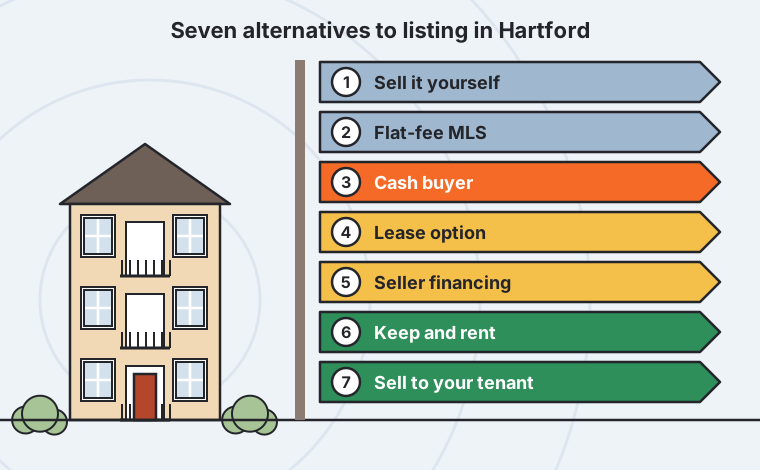
| Alternative | When you get paid | Speed | Your work | Best for |
|---|---|---|---|---|
| Sell it yourself (FSBO) | At closing | Months | High | A house in good shape and an owner with time |
| Flat-fee MLS listing | At closing | Months | Medium | Owners who want MLS exposure without a full commission |
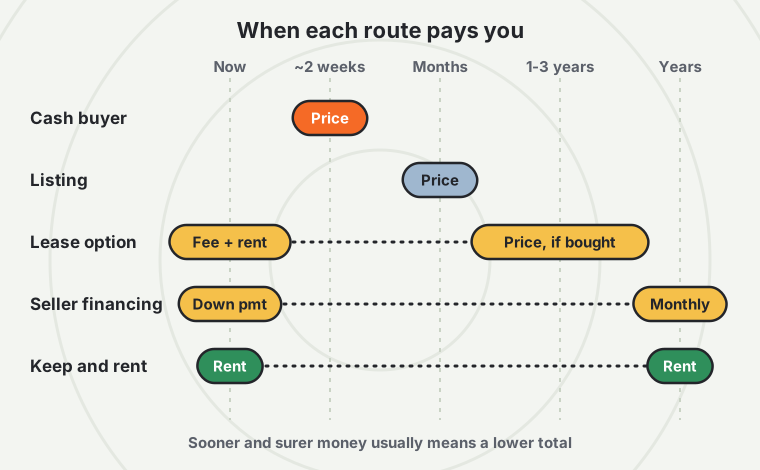
| Direct sale to a cash buyer | At closing, about 2 weeks | Fast | Low | Repairs, tenants, estates, deadlines |
| Lease option (rent-to-own) | Option fee and rent now; price later, if the tenant buys | 1-3 years | Medium | Owners who can wait and keep maintaining the house |
| Seller financing | Down payment now; monthly payments for years | Months to sell; years to be paid | Medium | Free-and-clear owners who want income |
| Keep it and rent it | Monthly rent; sale later | Not a sale | High | Owners who want to be landlords |
| Sell to your tenant | At closing | Weeks to months (tenant’s mortgage) | Low to medium | Good tenants who can get a loan |
Below, each one with what it means in Hartford specifically. If you want the statewide view of every route, the cluster pillar on how to sell a house in Connecticut covers them side by side.
Why does Hartford’s housing stock change which alternative fits?
Hartford’s housing stock changes which alternative fits because about 35% of the city’s recorded home sales are two- to four-family houses, many with tenants in place. A multi-family can produce rent while you wait, can be sold to an owner-occupant who lives in one unit, and is a common purchase for direct buyers, so the menu of options is wider than for a single-family home.
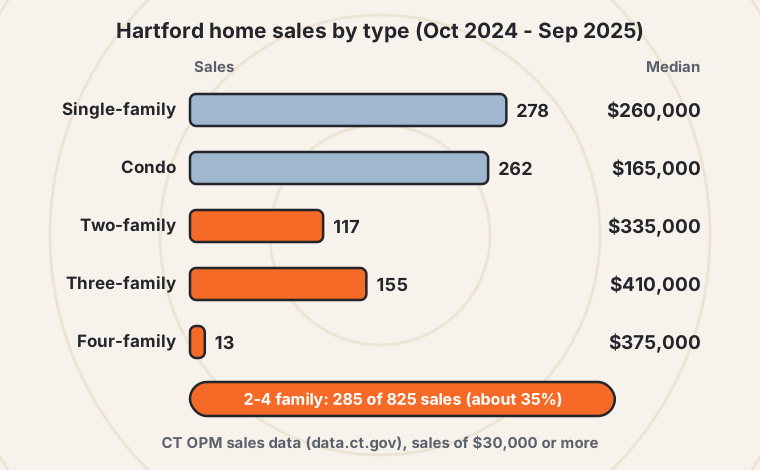
| Type | Sales, Oct 2024 to Sep 2025 | Median price |
|---|---|---|
| Single-family | 278 | $260,000 |
| Condo | 262 | $165,000 |
| Two-family | 117 | $335,000 |
| Three-family | 155 | $410,000 |
| Four-family | 13 | $375,000 |
| All homes | 825 | $290,000 |
A note on taxes before you compare options: Hartford’s fiscal 2027 mill rate is 69.95 (OPM), but the city has assessed one- to three-family homes at a reduced ratio under special rules, so the formula used for other towns overstates a Hartford homeowner’s bill. Use your actual tax bill in any math, including the carrying cost of waiting.
Can you sell a Hartford house yourself or with a flat-fee MLS listing?
Yes, you can sell a Hartford house yourself or with a flat-fee MLS listing. You still need a Connecticut attorney for the closing, the property condition report or a $500 credit (CGS 20-327c), the lead paint disclosure for homes built before 1978, and the 1.25% conveyance tax. You save the listing commission but do the marketing, showings and negotiating yourself.
For sale by owner works best on a house that a buyer’s lender will finance without fuss. Nationally, only about 5% of sellers sell this way (NAR 2025 profile). For a three-family with tenants, the hard part is showings: you need tenant cooperation and proper notice, and buyers will want leases, rent rolls and security deposit records. Our step-by-step guide on how to sell a house without a realtor in Connecticut covers the paperwork in order.
A flat-fee MLS listing puts the house on the same database agents search for a set fee, usually without full service. You may still offer a buyer’s agent a fee to attract buyers who have one; since August 17, 2024 that is negotiated separately.
How does a direct sale to a cash buyer work for a Hartford house?
A direct sale of a Hartford house to a cash buyer works by getting a written offer, one walkthrough, an attorney-run closing and a payout in about two weeks, with no repairs, no showings and tenants allowed to stay. The price is lower than a well-prepared listing because the buyer pays for repairs and resale, so it suits houses with problems or owners with deadlines.
In Hartford the direct sale solves three common problems at once: deferred repairs that would fail a lender’s inspection, tenants who will not cooperate with showings, and a seller who cannot afford months of holding costs. The trade-off is price. Our pages on cash buyer vs. realtor and why cash offers are lower show the math. If the house has tenants, our guide to selling a rental with tenants explains what happens to leases and deposits.
Whoever you talk to, check them: the company should be registered with the Connecticut Secretary of the State, show proof of funds, and close through attorneys. Our guide to how an investor sale works step by step shows how to vet the buyer.
Is a lease option (rent-to-own) a good alternative in Hartford?
A lease option is a good alternative in Hartford only if you can wait one to three years, keep paying the mortgage and maintaining the house, and accept that the tenant-buyer may never buy. You collect an option fee and rent now, and a sale price later if the option is exercised. If it is not, you keep the fee and still own a rental.
The appeal is real: a tenant-buyer who wants to own usually treats the house better, and you may get a higher price than an as-is sale. The risks are also real: the tenant-buyer is still a tenant under Connecticut landlord-tenant law, so if payments stop you face eviction, not a quick exit, and any repairs stay your responsibility unless the contract says otherwise. Our honest guide to lease options and rent-to-own walks through the contract terms that protect a seller. Have a Connecticut attorney draft it.
Should a Hartford owner offer seller financing instead of listing?
A Hartford owner should offer seller financing instead of listing only if the house is paid off (or will be at closing), the buyer puts a meaningful amount down, and an attorney records a note and mortgage in the Hartford land records. You become the lender: you get a down payment now and monthly payments for years, and if the buyer stops paying you must foreclose.
Seller financing can widen the buyer pool for a multi-family that banks do not like, and it can spread out the tax on your gain. But it is a loan, with a loan’s risk. If you still owe a mortgage, most loans have a due-on-sale clause that lets the lender call the loan when you transfer the house. Our guide on whether owner financing is a good idea for a Connecticut seller explains the terms, the risks and when it works.
Should you keep your Hartford house and rent it instead?
You should keep your Hartford house and rent it only if you want to be a landlord, have reserves for repairs and vacancies, and are ready for Connecticut’s landlord rules: security deposits capped at two months’ rent (one month for tenants 62 and older) under CGS 47a-21, lead disclosure for homes built before 1978, and a court eviction process if a tenant stops paying.
The numbers can look attractive. HUD’s fiscal 2027 Fair Market Rent for a two-bedroom in the Hartford area is $1,933 a month, and $2,303 for a three-bedroom; those figures include utilities and sit at the 40th percentile, so they are a benchmark, not your rent. Against that come taxes, insurance, water and sewer, repairs, turnover and vacancy. Plenty of Hartford owners do it well. Plenty of others end up as accidental landlords who sell later anyway, after a hard tenant. Our guide to being a landlord in Connecticut lays out the real workload before you decide.
Can you sell your Hartford house to your tenant?
Yes, you can sell your Hartford house to your tenant if the tenant can get a mortgage or pay cash. A tenant in a two- to four-family can often use an owner-occupant loan, such as FHA, to buy the building and live in one unit. You skip showings and the commission, but the sale still depends on the tenant’s loan, appraisal and inspection.
A sale to a tenant is often the kindest exit for a long-time renter and the simplest for you. Treat it like any sale: a written contract, your own attorney, the condition report and lead disclosure, and a realistic price. If the tenant’s loan falls through, you have lost time, so set a firm mortgage-commitment date in the contract. Selling to a tenant also tends to work only for houses in decent condition, because the lender’s appraiser still inspects it.
How do the alternatives compare on a $410,000 Hartford three-family?
On a $410,000 Hartford three-family, a listing at a 5% commission leaves about $382,875 after the $5,125 conveyance tax and an attorney (est.), before repairs and holding costs. An illustrative $330,000 direct offer leaves about $324,375 with no repairs and no wait. Lease options and seller financing can pay more in total, but over years and with risk.
| Line | List with an agent | Direct buyer (illustrative) |
|---|---|---|
| Price | $410,000 (Hartford three-family median) | $330,000 |
| Commission, 5% (est.) | -$20,500 | $0 |
| Conveyance tax, 1.25% | -$5,125 | -$4,125 |
| Your attorney (est.) | -$1,500 | -$1,500 |
| Before repairs and holding costs | $382,875 | $324,375 |
The listing column wins on paper by about $58,500. Whether it wins in real life depends on what comes out of it next: porch, roof or electrical work the buyer’s lender requires, months of taxes and insurance, and the chance a tenant makes showings impossible. Run your own numbers with the calculator below.
How much would you walk away with?
Slide the numbers to match your house. It works in your browser; nothing is saved or sent.
Estimates for planning. Conveyance tax per CGS 12-494 (state 0.75% up to $800,000, 1.25% to $2.5M, 2.25% above, plus the town rate). Seller attorney about $1,200 to $1,500; flat-fee MLS about $400; listings include three months of taxes, insurance and utilities, a cash sale about two weeks. Your attorney gives you the final numbers.
When is listing still the best choice for a Hartford owner?
Listing is still the best choice for a Hartford owner when the house is in good repair, vacant or with cooperative tenants, and financeable by an FHA or conventional buyer, and when you have a few months to wait. In that case a well-priced listing usually nets more than any alternative here, and you should not sell to a cash buyer.
Many Hartford two- and three-families sell well on the open market to owner-occupants. If yours is updated, rented at fair rents with clean records, and passes a lender’s inspection, list it. The alternatives on this page exist for the houses and situations where a listing stalls.
How do you choose the right alternative for your Hartford house?
To choose the right alternative for your Hartford house, write down your deadline, how much cash you need at closing, whether you want income or a lump sum, and the house’s honest condition, then compare a listing estimate with a written direct offer. That takes about a week and commits you to nothing.
Pin down your deadline and goal
Do you need money in weeks, months or years? A lump sum or monthly income?
Gather the house’s paperwork
Deed, mortgage statement, tax bill, leases, rent roll, security deposit records and any open permits or code notices.
Get a listing estimate
Ask a Hartford agent for a written estimate of price and time on market for a house in its current condition.
Get a direct offer
Ask for a written cash number. Compare nets, not prices. You can request one on our Hartford page.
Talk to a Connecticut attorney
Especially before a lease option or seller financing, which are contracts you will live with for years.
Frequently asked questions
What are the alternatives to listing my house in Hartford?
The alternatives to listing a house in Hartford are selling it yourself, a flat-fee MLS listing, a direct sale to a cash buyer, a lease option, seller financing, renting it out, or selling it to your tenant.
What is the conveyance tax in Hartford?
The conveyance tax in Hartford is 1.25% of the price for most homes: 0.75% to the state and 0.50% to the city. On a $410,000 sale that is $5,125, paid by the seller at closing (CGS 12-494).
Can I sell my Hartford multi-family with tenants in it?
Yes, you can sell a Hartford multi-family with tenants in it. The leases and security deposits transfer to the buyer. A direct buyer or an investor will usually buy with tenants in place; an owner-occupant buyer will usually want a unit empty.
Do I need a lawyer to sell my house without an agent in Connecticut?
In practice yes: Connecticut real estate closings are conducted by attorneys, and buyer and seller each usually have their own, whether or not an agent is involved.
Is rent-to-own legal in Connecticut?
Yes, rent-to-own (a lease with an option to buy) is legal in Connecticut. The tenant-buyer is still a tenant under Connecticut landlord-tenant law until the purchase closes, so have an attorney draft the lease and option together.
What happens if my seller-financed buyer stops paying?
If a seller-financed buyer stops paying, you must foreclose on the mortgage the buyer gave you, through the Connecticut Superior Court. For a Hartford property that is the Hartford Judicial District.
Can my tenant buy my house with an FHA loan?
Often, yes. FHA loans can be used to buy a one- to four-unit home if the buyer will live in one unit. The house must still pass the FHA appraisal, and three- and four-unit buildings face an extra rental-income test.
How much rent could my Hartford unit earn?
As a benchmark, HUD’s fiscal 2027 Fair Market Rent for the Hartford area is $1,933 a month for a two-bedroom and $2,303 for a three-bedroom, including utilities. Actual rents vary by street and condition.
Is a cash offer always lower than listing?
A cash offer is usually lower than the gross price of a successful listing, but not always lower than the net. Repairs, commission, holding costs and a deal that falls through can close the gap, which is why you compare nets.
Which probate court handles a Hartford estate?
A Hartford estate is handled by the Hartford Probate District, district 1 under CGS 45a-2, which serves only the city of Hartford.
Related guides
Routes
For the full process, see how to sell a house in Connecticut. To get a no-obligation number for a Hartford house, visit our Hartford page.
Plain-English information, not legal or tax advice. Talk to a Connecticut attorney before signing a lease option or seller-financing agreement.
Sources (checked on October 27, 2026)
- Connecticut OPM Real Estate Sales (Hartford, recorded Oct 2024 to Sep 2025), data.ct.gov.
- OPM mill rates, fiscal 2027, data.ct.gov.
- CGS 12-494 (conveyance tax) and OLR report 2020-R-0020 (towns with the 0.50% rate).
- CGS 20-327b and 20-327c (property condition report).
- CGS 47a-21 (security deposits).
- EPA and HUD lead-based paint disclosure rule.
- HUD Fair Market Rents, FY2027.
- CGS 45a-2 (probate districts) and CGS 51-344 (judicial districts).
- NAR Profile of Home Buyers and Sellers 2025 (FSBO share).
See the house together.
Pick a time that works.
Choose a time for us to walk through the property with you, or ask for a quick call first. We confirm every request personally.
Tuesday, January 13
No open times in the next few weeks. Please call us.
We will confirm by email. Nothing is booked until we do.
View my request
Who wrote this
Jerryll Noorden
Jerryll has bought and sold Connecticut houses since 2016 and has sat at more closing tables than he can count, on both sides. Before real estate he was a robotics scientist at NASA, IHMC and IIT. He wrote this guide because the national sites that rank for it skip the Connecticut rules that cost sellers money. When listing or selling it yourself would get you more than a cash offer, he says so.
This guide explains Connecticut rules in plain English. It is not legal or tax advice. Laws change; for your sale, talk to a Connecticut real estate attorney and a tax professional.
