
Key facts at a glance
| Fact | Number | Source |
|---|---|---|
| Single-family homes sold in Oxford, Oct 2023 to Sep 2024 | 105, median $487,000 (the latest year Oxford sales appear in the state dataset) | CT OPM real estate sales, data.ct.gov |
| Condo sales in the same year | 47, median $601,000 | CT OPM real estate sales, data.ct.gov |
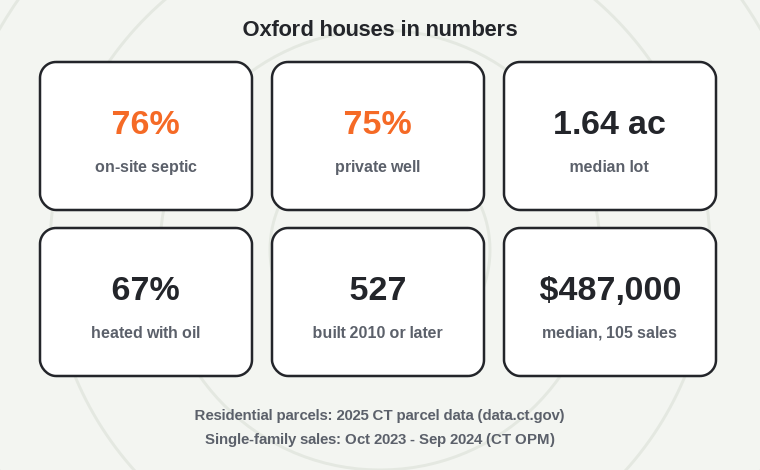
| Residential parcels with on-site septic / private well | 76% / 75%; median lot 1.64 acres | 2025 CT parcel (CAMA) data, data.ct.gov |
| Newer competition | 527 residential parcels built in 2010 or later; median year built 1987; 67% oil heat | 2025 CT parcel (CAMA) data, data.ct.gov |
| Mill rate, fiscal 2027 | 20.55 (about $7,006 a year, or $584 a month, on a $487,000 house) | CT OPM mill rates, data.ct.gov; CGS 12-62a |
| Conveyance tax the seller pays | 1.00% up to $800,000: $4,870 on $487,000 | CGS 12-494 |
| Well notice before any sale | Seller tells the buyer where the state’s well-testing material is | CGS 19a-37(d) |
| Probate court and Superior Court | Probate district for Bethlehem, Oxford, Roxbury, Southbury, Washington, Watertown and Woodbury; Ansonia-Milford Judicial District | CGS 45a-2; CGS 51-344 |
Selling an Oxford house is not the same as selling a house on a city street. Most Oxford homes sit on more than an acre, draw water from their own well and send waste to their own septic system, and many still heat with oil. A buyer’s lender, inspector and attorney will ask about all of it. This guide walks through a direct sale step by step for that kind of house, runs the numbers on Oxford’s $487,000 median, and shows when listing is the better choice. For the whole selling process, see our guide on how to sell a house in Connecticut.
How does a direct sale work, step by step, for an Oxford, CT house?
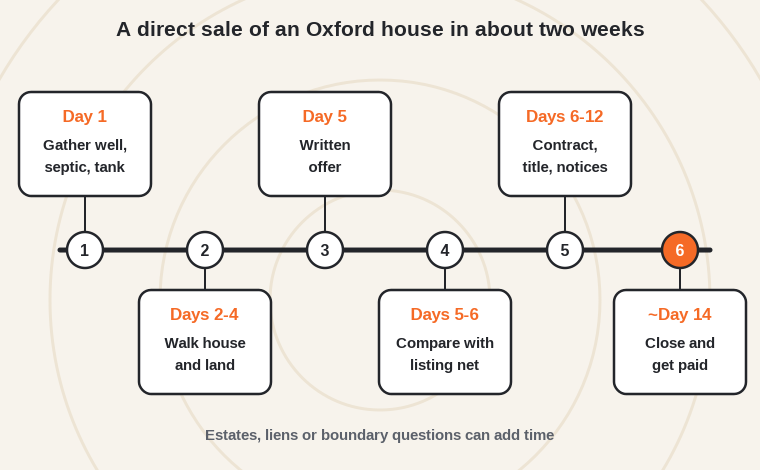
A direct sale of an Oxford, CT house works in six steps: gather what you know about the well, septic and oil tank; have the buyer walk the house and land; get a written offer; compare it with what listing would net; sign a contract your attorney reviews; and close through attorneys, usually in about two weeks. The buyer takes the house as it is, with no repairs and no showings.
A direct sale means you sell to one buyer who buys the house itself, without listing it on the MLS. Our explainer on what a direct sale is and how it differs from hiring an agent covers the basics and the contract. This page is about the steps, and about what changes when the house has a well, a septic system and a large lot.
Why does selling a house with a well and septic feel harder?
Selling a house with a well and septic feels harder because the systems are out of sight, expensive to fix and easy for a buyer’s inspector to question. You may not know when the tank was last pumped or what the well water would test like, and a single bad result can stall a sale or cost thousands at the last minute.
Maybe the house is more than you need now, or it was a parent’s and you are handling the estate from out of town. Maybe the septic has been sluggish, or the oil tank is older than your kids. You may feel uncertain about what is underground, embarrassed that the house is dated next to the newer homes nearby, anxious about a deal falling apart over a water test, tired of the upkeep of a big lot, and wary of buyers who promise a lot.
Each worry has a practical answer, some pointing to a direct sale and some to listing. This page is for you either way.
What makes an Oxford house different to sell?
What makes an Oxford house different to sell is its systems and its competition: about three in four residential parcels have their own septic system and well, the median lot is 1.64 acres, two in three homes heat with oil, and newer construction gives buyers an alternative. Each of those shapes how a buyer prices your house and how long a listing takes.
- Wells. Connecticut does not make a well test a condition of sale, but before any sale the seller must tell the buyer that the Department of Public Health’s well-testing material is available (CGS 19a-37(d)). Most buyers’ lenders and inspectors ask for a water test anyway.
- Septic. The condition report asks the system type, the service company, the date last pumped and any problems (CGS 20-327b). Buyers often order a septic inspection. Records for your system are kept by the local health district; Oxford is served by the Housatonic Valley Health District (formerly Pomperaug).
- Oil tanks. The condition report also asks whether there is or was an underground tank, its age and location. Buyers ask about the age of any tank, and by custom they reimburse the seller for oil left in it at closing.
- Larger lots. More land means more questions about boundaries, easements, outbuildings and shared driveways. Your attorney’s title search covers recorded rights; an old survey helps.
- New construction. 527 of Oxford’s residential parcels were built in 2010 or later, and 47 condos sold at a $601,000 median in the year studied. Buyers compare a dated colonial with something new, and pay less for the dated one.
Our guide to oil tanks, septic, wells and radon when selling a Connecticut house covers each system in depth. In a direct sale, the buyer takes these unknowns on, and that is part of why the price is lower.
What should you gather before you ask for a direct offer?
Before you ask for a direct offer, gather what you know about the house: septic pumping receipts and any repair permits, any well water test results, the oil tank’s age and location, your deed and any survey, your mortgage payoff and the last tax bill. You do not need to fix or test anything first; the point is to answer questions quickly.
A buyer who has to guess will price the guess. A recent pumping receipt or proof the tank was replaced lowers the risk they cover. If you have no records, say so; that is common with estates.
- Septic: pumping receipts, system location, any repair or replacement permits from the health district
- Well: any water test results and the well’s location
- Oil tank: age, location (basement or buried) and any removal papers
- Deed, any survey, and any easement or shared-driveway agreement
- Mortgage payoff estimate, home equity line, and the latest tax bill
- For an estate: the probate certificate showing who can sign
If the house is in an estate, the probate court for Oxford is the district shared with Bethlehem, Roxbury, Southbury, Washington, Watertown and Woodbury (CGS 45a-2). Our guide to selling an inherited house in Connecticut explains when the executor can sign.
What happens at the walkthrough of an Oxford house?
At the walkthrough of an Oxford house, the buyer looks at the structure, roof, heating system and oil tank, the well equipment and the septic area, and walks the land and outbuildings. It usually takes under an hour. Nothing needs to be cleaned or emptied first, and you do not have to answer questions you cannot answer.
Expect questions about where the septic tank and leach field are, water pressure, and the age of the boiler and electrical panel. These are the things a financed buyer’s inspector would check, but there is no list of repair requests afterwards; the buyer prices what they see into one number.
How is a direct offer on an Oxford house figured?
A direct offer on an Oxford house is figured backward from what the house would sell for once updated: the buyer subtracts the repair cost, resale commission, conveyance tax, closing costs, months of taxes, insurance and financing, and a profit margin. On a $487,000 Oxford house needing $40,000 of work, that formula gives about $326,000.
| Line | Amount | How it was figured |
|---|---|---|
| Value once updated | $487,000 | Oxford single-family median, Oct 2023 to Sep 2024 |
| Repairs | -$40,000 | Septic component, oil tank, kitchen and bath updates (est.) |
| Resale commission (5%) | -$24,350 | (est.) |
| Conveyance tax on the resale (1.00%) | -$4,870 | CGS 12-494 |
| Purchase and resale closing costs | -$3,700 | $2,500 and $1,200 (est.) |
| Property tax, 5 months | -$2,920 | $584 a month: 20.55 mills on 70% of $487,000 |
| Insurance, utilities and oil, 5 months | -$2,500 | $500 a month (est.) |
| Interest at 11% and 2 points | -$24,100 | On about $366,000 borrowed (est.) |
| Margin (12%) | -$58,440 | (est.) |
| Formula offer | About $326,000 | About 67% of the updated value |
The repair line is where Oxford houses differ most: a passing septic and a newer tank cut it, a failed leach field or buried tank raises it. Our explainer on why cash offers are so low walks through each line, and the pillar on how to sell a house in Connecticut shows where a direct offer sits among your other routes.
How do you compare a direct offer with listing your Oxford house?
To compare a direct offer with listing your Oxford house, net both out the same way. In our illustration, fixing the house and listing it at $487,000 nets about $410,076 after $40,000 of repairs, commission, conveyance tax and six months of carrying, while a $326,000 direct offer nets about $321,540. Listing wins by about $88,500 if you can fund the repairs and wait.
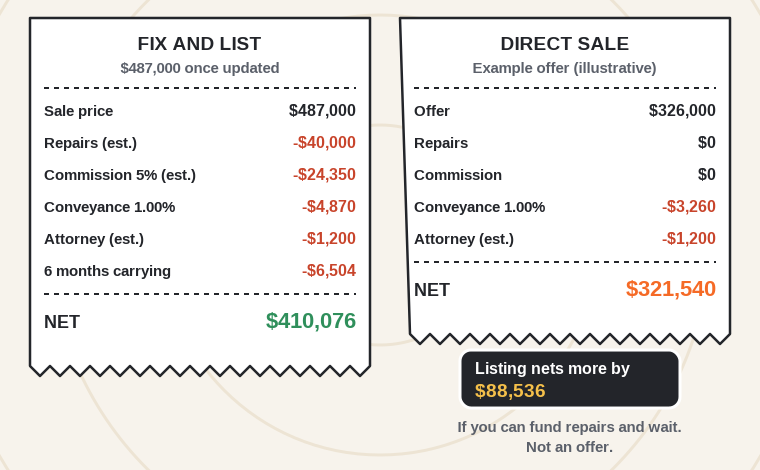
| What you net | Fix and list | Direct sale |
|---|---|---|
| Price | $487,000 | $326,000 |
| Repairs you pay (est.) | -$40,000 | $0 |
| Commission (5%, est.) | -$24,350 | $0 |
| Conveyance tax (1.00%) | -$4,870 | -$3,260 |
| Your attorney (est.) | -$1,200 | -$1,200 |
| Carrying, 6 months: 2 to fix, 4 to sell ($584 tax + $500 insurance, utilities and oil, est.) | -$6,504 | $0 |
| Net before mortgage payoff | $410,076 | $321,540 |
Run your own numbers in the calculator below. The statewide comparison of a cash buyer vs. a realtor shows the same trade-off on a typical Connecticut house.
How much would you walk away with?
Slide the numbers to match your house. It works in your browser; nothing is saved or sent.
Estimates for planning. Conveyance tax per CGS 12-494 (state 0.75% up to $800,000, 1.25% to $2.5M, 2.25% above, plus the town rate). Seller attorney about $1,200 to $1,500; flat-fee MLS about $400; listings include three months of taxes, insurance and utilities, a cash sale about two weeks. Your attorney gives you the final numbers.
What goes into the contract and paperwork for an Oxford direct sale?
The contract and paperwork for an Oxford direct sale include a purchase agreement your attorney reviews, the property condition report or a $500 credit, the well-testing notice, the lead paint disclosure if the house was built before 1978, and at closing the signed smoke and carbon monoxide detector affidavit and the conveyance tax return.
| Item | What it means in a direct sale | Statute or source |
|---|---|---|
| Property condition report | Give it before the buyer signs, or credit $500 at closing; it includes water supply, sewage system and tank questions | CGS 20-327b; 20-327c |
| Well-testing notice | Tell the buyer the Department of Public Health’s well-testing material is available | CGS 19a-37(d) |
| Lead paint disclosure | For houses built before 1978 | Federal rule (EPA/HUD) |
| Smoke and CO detector affidavit | The seller signs it at closing; the old $250 credit option is gone (PA 23-164) | CGS 29-453 |
| Conveyance tax | 1.00% in Oxford up to $800,000, paid from your proceeds | CGS 12-494 |
| As-is terms | No repair contingency; say in writing whether the buyer may inspect and still cancel | Your contract |
A fair direct contract lets you leave belongings, sets a closing date you choose, holds the deposit with an attorney, and charges you no fee. Watch for an “and/or assigns” clause, which lets the buyer sell your contract. Since July 1, 2026, anyone who does that without taking title must be registered with the Department of Consumer Protection as a wholesaler. We buy houses ourselves and close in our own name. Our guide to checking a cash home buyer lists what to ask.
How does closing work on an Oxford direct sale?
Closing on an Oxford direct sale works like any Connecticut closing: attorneys for both sides run it, your attorney pays off your mortgage and any liens from the proceeds, files the conveyance tax return, prorates the property tax, and you sign the deed and the smoke and CO affidavit. With clear title, a direct sale typically closes in about two weeks.
Property tax is paid in arrears, so the closing statement usually credits the buyer for tax owed up to closing, and oil left in the tank is usually reimbursed to you. If you need more time to move, agree on a later date in writing. Our guide to the Connecticut closing process explains the day itself.
When does listing your Oxford house beat a direct sale?
Listing your Oxford house beats a direct sale when the septic and well are sound, the house is in decent shape or you can fund the repairs, and you can wait four months or more. In those cases a financed buyer will pay close to market value, and our illustration shows listing netting about $88,500 more on a $487,000 house.
We would rather say that plainly than buy a house that should have been listed. A direct sale earns its place when:
- the septic system has failed or the well has a problem, and you cannot pay for the fix before selling;
- the house is in an estate, the heirs live far away, and carrying costs and oil deliveries keep coming;
- the house needs more than cosmetic work and newer homes nearby make it hard to sell as-is to a financed buyer;
- a move, a health change or a divorce sets a date you cannot miss;
- you cannot manage showings, or simply want one buyer, one number and one closing date.
If the house needs work, see our guide to selling a house that needs repairs in Connecticut. If you want the full list of routes, including flat-fee listings and auctions, see modern ways to sell a house and every way to sell in Connecticut, compared.

On a country house, the first questions I ask are where the septic is, when it was last pumped, and whether the oil tank is in the basement or in the ground. If you know those three answers, any buyer can give you a firmer number.
Questions about a direct sale of an Oxford house
What is a direct sale of a house?
A direct sale of a house is a sale to one buyer, usually a local cash buyer, without listing it on the MLS. The buyer takes the house as it is and sets a closing date with you; attorneys still close it.
Do I have to test my well before selling in Connecticut?
You do not have to test your well before selling in Connecticut; state rules do not make a test a condition of sale. You must tell the buyer that the Department of Public Health’s well-testing material is available (CGS 19a-37(d)). Many buyers test anyway.
Do I need a septic inspection to sell my Oxford house?
You generally do not need a septic inspection to sell an Oxford house, but you must answer the septic questions on the condition report, and most financed buyers order an inspection. In a direct sale, the buyer prices the system as it is.
How long does a direct sale take in Oxford?
A direct sale in Oxford typically takes about two weeks from a signed contract to closing when title is clear. An estate, a lien or a boundary question can add time; you can also choose a later date.
What is the conveyance tax on an Oxford sale?
The conveyance tax on an Oxford sale is 1.00% of the price up to $800,000: 0.75% to the state and 0.25% to the town (CGS 12-494). On $487,000 that is $4,870, paid by the seller.
Do I still fill out the property condition report in a direct sale?
You still owe the buyer the property condition report in a direct sale, or a $500 credit at closing if you do not provide it (CGS 20-327b and 20-327c). Selling as-is does not change that rule.
Can I sell my Oxford house directly if it has an old oil tank?
You can sell your Oxford house directly with an old oil tank. A direct buyer counts the cost of testing or removing it in the offer, so you do not pay for it upfront; a financed buyer would usually ask about it at inspection.
Why is there no newer Oxford sales data?
The state’s sales dataset had no Oxford sales recorded after September 2024 when we checked on October 27, 2026, so this guide uses October 2023 to September 2024. Ask a local agent for recent sales on your street.
Related guides
Direct sales
Other towns, other questions
For every step from pricing to closing, see how to sell a house in Connecticut. We also buy in nearby Southbury, Seymour and Naugatuck; for a no-obligation direct offer on an Oxford house, visit our Oxford page.
Plain-English information, not legal advice. Talk to a Connecticut attorney about your contract and title.
Sources (checked on October 27, 2026)
- Connecticut OPM Real Estate Sales (Oxford, recorded Oct 2023 to Sep 2024, residential sales of $30,000 or more; no later Oxford records in the dataset), data.ct.gov.
- OPM mill rates, fiscal 2027, data.ct.gov.
- 2025 Connecticut Parcel and CAMA Data (Oxford septic, well, lot size, year built, heating fuel), data.ct.gov.
- CGS 19a-37 (private well testing; notice before sale).
- CGS 20-327b and 20-327c (property condition report, $500 credit).
- CGS 12-494 (conveyance tax) and CGS 12-62a (70% assessment).
- CGS 29-453 (smoke and carbon monoxide detector affidavit).
- CGS 45a-2 (probate districts) and CGS 51-344 (judicial districts).
- CT Department of Consumer Protection: real estate wholesalers required to register (2026).
- CT Department of Public Health: health districts in Connecticut (April 2024).
- EPA: lead-based paint disclosure for sellers.
See the house together.
Pick a time that works.
Choose a time for us to walk through the property with you, or ask for a quick call first. We confirm every request personally.
Tuesday, January 13
No open times in the next few weeks. Please call us.
We will confirm by email. Nothing is booked until we do.
View my request
Who wrote this
Jerryll Noorden
Jerryll has bought and sold Connecticut houses since 2016 and has sat at more closing tables than he can count, on both sides. Before real estate he was a robotics scientist at NASA, IHMC and IIT. He wrote this guide because the national sites that rank for it skip the Connecticut rules that cost sellers money. When listing or selling it yourself would get you more than a cash offer, he says so.
This guide explains Connecticut rules in plain English. It is not legal or tax advice. Laws change; for your sale, talk to a Connecticut real estate attorney and a tax professional.
