
Key facts at a glance
| Fact | Number | Source |
|---|---|---|
| Single-family homes sold in Shelton, Oct 2024 to Sep 2025 | 344, median $546,500 | CT OPM real estate sales, data.ct.gov |
| Middle half of those sales | $431,225 to $650,000 | CT OPM real estate sales, data.ct.gov |
| Assessed value compared with sale price | Median single-family sale assessed at about 51% of its price | CT OPM real estate sales (sales ratio), data.ct.gov |
| Mill rate, fiscal 2027 | 15.51 (about $5,933 a year, or $494 a month, on a $546,500 house) | CT OPM mill rates, data.ct.gov; CGS 12-62a |
| Housing age and heat | Median year built 1976; 54% of residential parcels built before 1978; 61% oil heat | 2025 CT parcel (CAMA) data, data.ct.gov |
| Conveyance tax the seller pays | 1.00% up to $800,000: $5,465 on $546,500 | CGS 12-494 |
| Probate court and Superior Court | Shelton Probate District (Shelton only); Ansonia-Milford Judicial District | CGS 45a-2; CGS 51-344 |
When an investor walks through your Shelton house and then sends an offer far below what your neighbor sold for, it can feel like a guess or an insult. It is neither. Investors run the same five checks on every house before they offer, and once you know them you can read any offer line by line. This guide shows each check on Shelton numbers, so you can see where the money goes and decide whether the offer is worth taking. For the whole selling process, see our guide on how to sell a house in Connecticut.
How do investors evaluate a house in Shelton, CT before they make an offer?
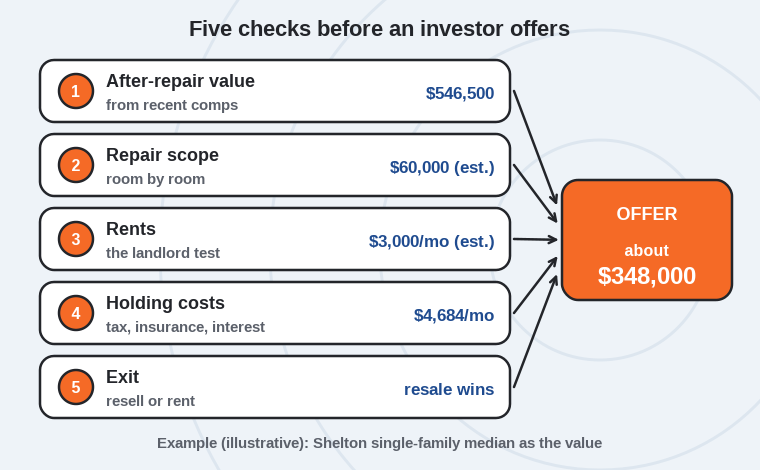
Investors evaluate a house in Shelton, CT with five checks: the value once repaired, taken from recent comparable sales; the repair scope; the rent it could earn; the holding costs while they own it; and the exit, meaning resale or renting. On a house worth $546,500 once updated that needs $60,000 of work, those checks give an offer of about $348,000.
Every check is a cost or a risk the investor takes on in your place. The value sets the ceiling. The repairs, holding costs and resale costs come off. The margin pays for the risk that something goes wrong. The full formula is in our pillar on cash home buyers in Connecticut; this page explains what investors look at in your house to fill it in.
Why does an investor’s offer on your Shelton house feel so low?
An investor’s offer on your Shelton house feels so low because you compare it with the price of a finished house, while the investor prices yours as it is today, with the repairs, months of carrying, resale costs and risk still ahead. The gap is real money, and seeing where it goes is the only way to judge whether it is fair.
Maybe the house was your parents’, with the 1970s kitchen and the oil tank in the basement. Maybe you are behind on payments, or just got your third postcard this month. You may feel insulted by a low number, suspicious that you are being played, confused by terms like ARV, pressured to decide quickly, and protective of a house that holds a lot of memories.
You do not have to accept any offer to learn from it. This page is for you.
How does an investor estimate what your Shelton house is worth after repairs?
An investor estimates what your Shelton house is worth after repairs by finding recent sales of similar updated houses nearby, adjusting for size, bedrooms, baths, lot and condition, and settling on an after-repair value, or ARV. In Shelton the middle half of single-family sales ran from $431,225 to $650,000, so the comps chosen matter a great deal.
Shelton is a big, varied town: 344 single-family homes sold in a year, from older houses near downtown to newer colonials on larger lots. A careful investor uses sales from the last three to six months, within the same part of town, of houses that look like yours will look once finished. A careless one uses the town median. In this guide we use the median, $546,500, as the example ARV; your own comps could be higher or lower.
This is the check most worth testing yourself. Ask any buyer which sales they used. Our guide to checking whether a cash offer is fair shows how to pull your own comps from the state’s sales data.
Does your assessed value tell an investor what your Shelton house is worth?
Your assessed value does not tell an investor what your Shelton house is worth. Connecticut assesses at 70% of the value set at the town’s last revaluation (CGS 12-62a), and values have moved since then: in the year studied, the median Shelton single-family house sold for about twice its assessed value. Investors use recent sales, not the tax card.
An old rule of thumb says a house priced near its assessed value is a bargain. In Shelton that would mean a house selling for about half its market value, which tells you something is badly wrong with it, not that it is a good deal. If someone uses your assessment to justify a low offer, ask them for comparable sales instead. Our explainer on market value vs. assessed value in Connecticut goes deeper.
How does an investor scope the repairs on a Shelton house?
An investor scopes the repairs on a Shelton house by walking it room by room and pricing what it takes to match the comps: kitchen, baths, flooring and paint, plus the big systems such as roof, heating, oil tank, electrical and windows. With a 1976 median build year and 61% oil heat, Shelton houses often need system work as well as cosmetic updates.
| Repair line in our example | Amount (est.) | Why an investor counts it |
|---|---|---|
| Kitchen | $25,000 | Updated comps have updated kitchens |
| Two bathrooms | $20,000 | Original baths in a 1970s house |
| Flooring and paint | $10,000 | Needed to show like the comps |
| Heating and oil tank contingency | $5,000 | Older boiler or tank; 61% of Shelton homes use oil |
| Total | $60,000 | Example (illustrative) |
Investors also add a cushion for what they cannot see: wiring behind walls, a leaking tank, a roof that looked fine from the ground. Houses built before 1978 bring lead paint rules for the renovation itself. The bigger the unknowns, the bigger the cushion. If you have receipts for a newer roof, furnace or tank, show them; each one lowers the repair line. Our guide to selling a house that needs repairs in Connecticut covers the as-is side.
What title and zoning problems does an investor check for?
The title and zoning problems an investor checks for are liens that must be paid at closing, such as a second mortgage, unpaid taxes or a contractor’s lien, plus open permits, unpermitted additions or apartments, and zoning limits on how the house can be used. Each one either comes off the price or must be cleared before closing.
Liens do not usually kill a sale; they are paid from your proceeds at closing, as long as the price covers them. Unpermitted work is harder: an investor who has to permit an old finished basement or legalize an in-law apartment will price that time and cost. If you know of any of these, say so early. Surprises found by the title search are what delay closings. Our guide to selling a house with liens in Connecticut explains how payoffs work.
Why do rents matter so little to an investor’s offer in Shelton?
Rents matter little to an investor’s offer in Shelton because house prices are high compared with what a single-family house rents for. At an estimated $3,000 a month in rent, a renovated $546,500 house is far from the investor’s “1% rule”, which would need about $5,465 a month. A buy-and-hold investor would pay about $280,000, less than a flip buyer.
The 1% rule says a rental should bring in about 1% of its all-in cost each month. It is a rough screen, not a law, and in higher-priced towns few houses pass. Here is the longer version a landlord would run:
| Rental check | Amount | How it was figured |
|---|---|---|
| Rent, 12 months | $36,000 | $3,000 a month (est.) |
| Vacancy (5%) | -$1,800 | (est.) |
| Property tax | -$5,933 | 15.51 mills on 70% of $546,500 |
| Insurance | -$2,400 | (est.) |
| Maintenance and replacements (10% of rent) | -$3,600 | (est.) |
| Net operating income | $22,267 | |
| Value at a 6.5% return (est.) | $342,569 | All-in, including repairs |
| Offer after $60,000 repairs and $2,500 closing | About $280,000 | Example (illustrative) |
This matters for you: if a buyer tells you they plan to rent the house out, their offer will often be lower, not higher. The exception is a two- or three-family house, where rents carry more weight; our guide to selling a rental with tenants covers those.
What holding costs does an investor count on a Shelton house?
The holding costs an investor counts on a Shelton house are property tax of about $494 a month, insurance and utilities of about $450 a month (est.), and interest on short-term money, about $3,740 a month at 11% (est.) on $408,000. That is roughly $4,684 for every month between buying and reselling, plus points paid upfront.
That is why investors care about time. A six-month project in our example carries about $2,964 of tax, $2,700 of insurance and utilities, and $30,600 of interest and points. A permit delay or a slow resale market adds a month at a time. If your house needs work that can be done quickly, the holding line is smaller and the offer can be higher. Our worksheet on carrying costs of a vacant house shows the same math for an owner.
How does the investor’s exit plan set the offer on a Shelton house?
The investor’s exit plan sets the offer on a Shelton house because the offer is figured backward from how they will get their money out. A resale after renovation supports about $348,000 in our example; a rental supports about $280,000. The investor offers the higher of the two that they can actually carry out, minus a margin for risk.
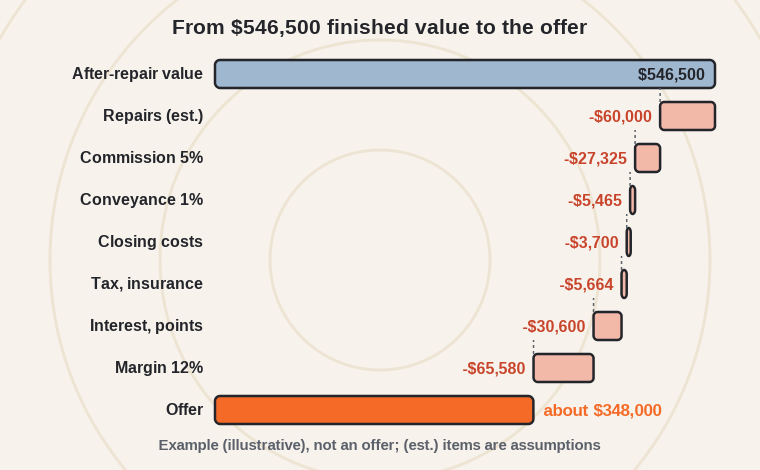
| Line | Amount | How it was figured |
|---|---|---|
| After-repair value | $546,500 | Shelton single-family median, Oct 2024 to Sep 2025 |
| Repairs | -$60,000 | Repair table above (est.) |
| Resale commission (5%) | -$27,325 | (est.) |
| Conveyance tax on the resale (1.00%) | -$5,465 | CGS 12-494 |
| Purchase and resale closing costs | -$3,700 | $2,500 and $1,200 (est.) |
| Property tax, insurance and utilities, 6 months | -$5,664 | $494 + $450 a month |
| Interest at 11% and 2 points | -$30,600 | On about $408,000 borrowed (est.) |
| Margin (12%) | -$65,580 | (est.) |
| Offer from the resale exit | About $348,000 | About 64% of the after-repair value |
There is a third exit you should know about. Some buyers plan to sell your contract to another investor for a fee instead of buying the house. Since July 1, 2026, anyone who does that in Connecticut must be registered with the Department of Consumer Protection as a wholesaler and give you a disclosure before you sign. We are not wholesalers; we buy the houses ourselves and close in our own name. Our guide to selling your house to a wholesaler explains the difference, and our explainer on why cash offers are so low walks through every line above.
How can you use the five checks to judge an offer on your Shelton house?
You can use the five checks to judge an offer on your Shelton house by asking the buyer for each number: the comps behind the ARV, the repair list, the months they plan to hold, the costs they counted and the margin. If the ARV is too low or the repairs are padded, you have a specific reason to push back, and a fair buyer will show the math.
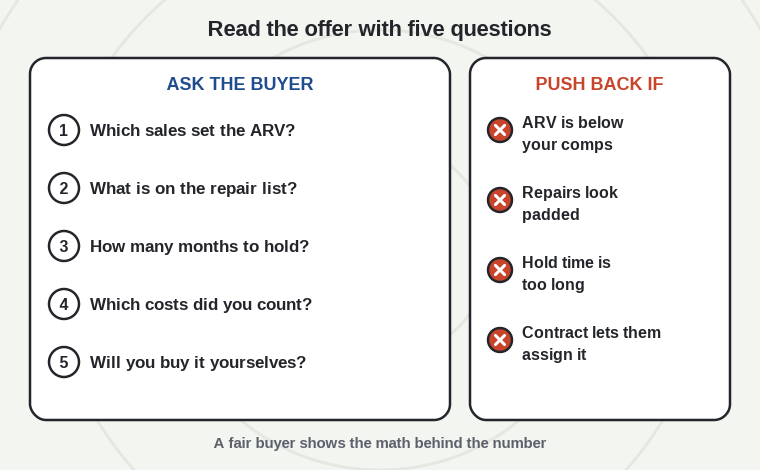
- Which three to five sales did you use for the after-repair value, and why?
- What is on your repair list, and what did you price each item at?
- How many months do you expect to hold the house?
- What did you count for commission, closing and financing?
- Will you buy the house yourselves, or assign the contract?
Compare at least two offers, and compare both with what listing would net, as in our cash buyer vs. realtor guide. Our guides to selling to an investor and to when an investor will pay close to asking cover the next steps.
When should you not sell your Shelton house to an investor?
You should not sell your Shelton house to an investor when it needs little work, you can wait a few months, and you can handle showings. In our example, paying for the $60,000 of repairs and listing nets about $446,846 after commission, conveyance tax, your attorney and six months of carrying, against about $343,320 from a $348,000 investor offer, a gap of about $103,500. Shelton sells about 344 single-family homes a year, so a sound house usually finds a financed buyer.
An investor sale makes sense when the repairs are more than you can fund or manage, when a deadline such as a foreclosure, an estate or a move is close, when the house cannot pass a lender’s appraisal, or when you value one certain closing over the last dollar. The statewide comparison of a cash buyer vs. a realtor lays out that trade-off, and our guides on modern ways to sell a house and a direct sale step by step show the other routes. If you are behind on payments in Shelton, start with foreclosure mediation in Shelton before selling.

I am happy to show a seller the comps and the repair list behind my number. If your house would net clearly more on the market, I would rather tell you that than buy it. A good offer is one you can check.
Questions about how investors evaluate a Shelton house
What is ARV in real estate?
ARV in real estate means after-repair value: what a house would sell for once it is fixed up to match recent comparable sales. Investors start every offer from it and subtract their costs and margin.
What is the 70% rule investors use?
The 70% rule investors use says to offer no more than 70% of the after-repair value minus the repairs. On a $546,500 Shelton house needing $60,000, that is $322,550. It is a quick screen; a line-by-line formula can come out higher or lower.
Why do investors offer less than market value?
Investors offer less than market value because they pay for repairs, months of taxes, insurance and interest, the cost of reselling, and a margin for risk. In our Shelton example those costs add up to about $198,500 on a $546,500 house.
Is my assessed value what my Shelton house is worth?
Your assessed value is not what your Shelton house is worth. Connecticut assesses at 70% of the value from the last revaluation (CGS 12-62a), and in the year studied the median Shelton single-family house sold for about twice its assessment.
What is the 1% rule for rentals?
The 1% rule for rentals says a property should rent each month for about 1% of its all-in cost. A $546,500 Shelton house would need about $5,465 a month, so most Shelton single-family houses do not pass it.
How much does it cost an investor to hold a Shelton house each month?
It costs an investor about $4,684 a month to hold a Shelton house in our example: about $494 of property tax, $450 of insurance and utilities (est.), and $3,740 of interest on $408,000 at 11% (est.).
Can I negotiate an investor’s offer?
You can negotiate an investor’s offer. Ask for the comps and repair list behind it; if the after-repair value is too low or repairs are padded, point to the specific line. Getting a second written offer is the strongest lever.
How do I know if an investor will actually buy my house?
To know if an investor will actually buy your house, ask for proof of funds, check that the contract does not let them assign it without your consent, and make sure the deposit is held by an attorney. Since July 1, 2026, wholesalers must register with the state.
What is the conveyance tax on a Shelton sale?
The conveyance tax on a Shelton sale is 1.00% of the price up to $800,000: 0.75% to the state and 0.25% to the city (CGS 12-494). The seller pays it at closing.
Related guides
Understand the offer
Other towns, other questions
For every step from pricing to closing, see how to sell a house in Connecticut. We also buy in nearby Derby, Trumbull and Monroe; to see the five checks run on your own house, visit our Shelton page.
Plain-English information, not legal or financial advice. Figures marked (est.) are assumptions.
Sources (checked on October 27, 2026)
- Connecticut OPM Real Estate Sales (Shelton, recorded Oct 2024 to Sep 2025, residential sales of $30,000 or more; sales ratios), data.ct.gov.
- OPM mill rates, fiscal 2027, data.ct.gov.
- 2025 Connecticut Parcel and CAMA Data (Shelton year built), data.ct.gov.
- CGS 12-62 and 12-62a (revaluation; 70% assessment).
- CGS 12-494 (conveyance tax).
- CGS 45a-2 (probate districts) and CGS 51-344 (judicial districts).
- CT Department of Consumer Protection: real estate wholesalers required to register (2026).
- HUD Fair Market Rents (to check rents for your area).
- EPA: lead-based paint disclosure for sellers.
See the house together.
Pick a time that works.
Choose a time for us to walk through the property with you, or ask for a quick call first. We confirm every request personally.
Tuesday, January 13
No open times in the next few weeks. Please call us.
We will confirm by email. Nothing is booked until we do.
View my request
Who wrote this
Jerryll Noorden
Jerryll has bought and sold Connecticut houses since 2016 and has sat at more closing tables than he can count, on both sides. Before real estate he was a robotics scientist at NASA, IHMC and IIT. He wrote this guide because the national sites that rank for it skip the Connecticut rules that cost sellers money. When listing or selling it yourself would get you more than a cash offer, he says so.
This guide explains Connecticut rules in plain English. It is not legal or tax advice. Laws change; for your sale, talk to a Connecticut real estate attorney and a tax professional.
