
Key facts at a glance
This is the Waterbury chapter of our guide to how to sell a house in Connecticut: the local numbers a Waterbury seller usually does not see until a buyer, an inspector or a lender points them out.
| Fact | Number | Source |
|---|---|---|
| Waterbury residential sales, Oct 2024 to Sep 2025 | 1,305 sales, median $270,000 (up 9%) | data.ct.gov sales dataset (OPM) |
| Median single-family house, year built | 1955; 56% built before 1960, 33% before 1940 | 2025 CT Parcel and CAMA Data |
| Homes in two- to four-unit buildings | 29.2% | U.S. Census ACS 2020-2024 |
| Homes that are rented | 52.8% | U.S. Census ACS 2020-2024 |
| Mill rate, fiscal 2027 | 43.34 (49.44 in fiscal 2025) | CT OPM mill rates |
| Conveyance tax a Waterbury seller pays | 0.75% state + 0.50% city = 1.25% ($3,375 on $270,000) | CGS 12-494 |
| Probate court | Waterbury Probate Court, district PD-20 (Waterbury and Wolcott) | ctprobate.gov |
What should you know before selling a house in Waterbury, CT?
Before selling a house in Waterbury, CT, know five local facts: most houses are old (the median single-family house was built in 1955), multi-families are a large share of the market, prices rose about 9% in the latest year, the city charges the higher 0.50% conveyance tax, and the mill rate has fallen to 43.34 but still adds up every month the house sits. Each one changes your price, your buyer or your costs.
Selling in Waterbury follows the same steps as anywhere in the state; our cluster guide on every route, step and cost of selling in Connecticut covers them. This page is about what is different here, with the city’s own data, so you can set a realistic price and pick the right route. We buy houses ourselves, and we will tell you where listing nets more; the full comparison is in cash buyer vs. realtor in Connecticut.
Why does selling in Waterbury feel harder than people expect?
Selling in Waterbury feels harder than expected because many owners are selling an older house, a multi-family with tenants or a family home, and the numbers they hear do not agree: a neighbor’s price, an online estimate, an investor’s mailer. Feeling unsure, protective of the house and wary of being lowballed is normal, and the city’s own sales data takes much of the guesswork out.
Many Waterbury sellers feel protective: the house on the hill has been in the family since the brass mills were running, and a low number feels like a judgment on it. Others feel tired, after years of being a landlord in a two- or three-family. Some feel anxious about repairs they cannot afford, and many are skeptical of everyone, including agents who quote high and buyers like us who quote low.
If that is you, this page is for you. Nothing here asks you to fix anything or decide today. It gives you the facts buyers already use, so the decision is yours.
How old are Waterbury houses, and why does that matter to buyers?
Waterbury houses are old: the median single-family house was built in 1955, 56% were built before 1960 and 33% before 1940. That matters to buyers because older houses bring lead paint rules, oil tanks, old wiring and pipes, and repairs that inspectors and lenders flag, so they price the age in whether or not you do.
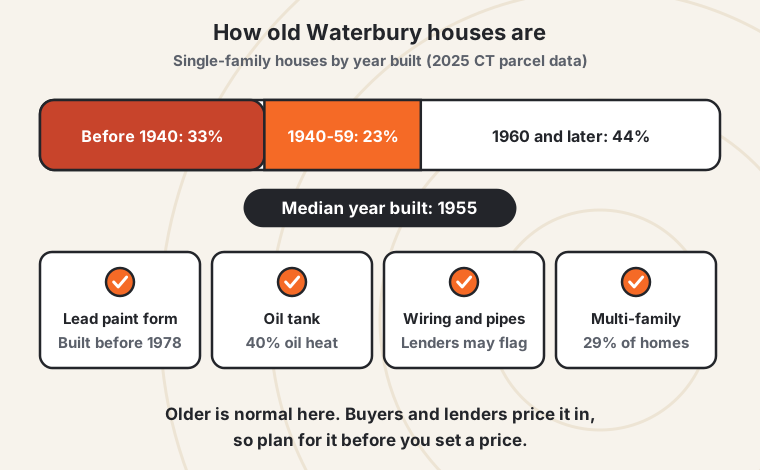
Waterbury was the leading brass center of the country for the first half of the 20th century, until plastics, aluminum and overseas competition closed the big mills. Much of the city’s housing went up in those decades, and it shows in the data: a third of single-family houses predate 1940. For a seller, that means four things to plan for:
- Lead paint disclosure. Any house built before 1978 needs the federal lead-based paint disclosure and a 10-day chance for the buyer to test, unless they waive it.
- Heating and oil tanks. About 40% of single-family houses heat with oil. A buried or aging tank is a common inspection item; our guide to oil tanks, septic, wells and radon covers what to check.
- Wiring, plumbing and roofs. Original wiring or galvanized pipes can stall a buyer’s insurance or loan.
- Disclosure. You report what you know on the Property Condition Disclosure Report (CGS 20-327b), or give the buyer a $500 credit (CGS 20-327c).
None of this stops a sale. It changes who buys and at what price. A house that will pass a lender’s appraisal sells to the widest pool of buyers; one that will not sells to cash buyers and renovators, at a price that reflects the work. Our guide on what to fix before selling in Connecticut helps you decide which repairs pay back.
What are Waterbury houses selling for right now?
Waterbury houses are selling for a median of $270,000 across all 1,305 residential sales recorded from October 2024 to September 2025, up about 9% from the year before. Arm’s-length sales alone had a median of $285,000, with single-family houses at $290,000, two-families at $346,000, three-families at $369,000 and condos at $182,000.
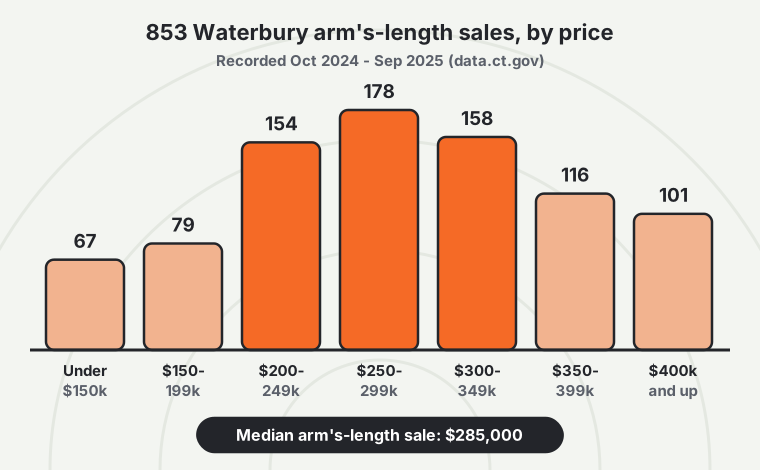
We pulled every Waterbury sale from the state’s data.ct.gov dataset and kept the arm’s-length ones, leaving out foreclosures, family transfers and sales the town coded as not reflecting market value. That left 853 sales. Two things in the data surprise sellers:
- The top end grew fast. Sales of $350,000 and up rose from 130 to 217 in a year, and the three-family median went from $330,000 to $369,000.
- One citywide number hides five markets. A condo, a ranch and a three-family are priced on different things. Compare your house with the same type on nearby streets.
The method for turning comparable sales into an asking price is in our guide on how to price your house to sell in Connecticut.
How big is the Waterbury multi-family market, and who buys there?
The Waterbury multi-family market is large: 29.2% of the city’s homes are in two- to four-unit buildings, and 193 of the 853 arm’s-length sales in the latest year (23%) were two- to four-families. Buyers are owner-occupants who live in one unit and rent the others, local landlords, and investors, and each prices the building partly on its rents.
With 52.8% of Waterbury homes rented, a sale with tenants in place is ordinary. The leases stay with the building, and at closing you hand the tenants’ security deposits plus interest to the buyer (CGS 47a-21). Have a rent roll, the leases and the deposit records ready before you talk to anyone; it speeds up every route.
If a tenant is not paying, eviction cases for Waterbury go to the Housing Session at Waterbury, 300 Grand Street. You do not have to finish an eviction to sell, but a financed buyer usually wants paying tenants or empty units. Our guides to selling a two- to four-family house in Connecticut and selling a rental with tenants go deeper.
What does the Waterbury mill rate mean for a seller?
For a seller, the Waterbury mill rate of 43.34 for fiscal 2027 means a typical single-family house pays about $5,151 a year, or about $429 a month, in property tax while it is on the market. The rate has fallen from 49.44 two years earlier, which helps, and at closing you credit the buyer for the tax that covers your months, because Connecticut taxes are paid in arrears.
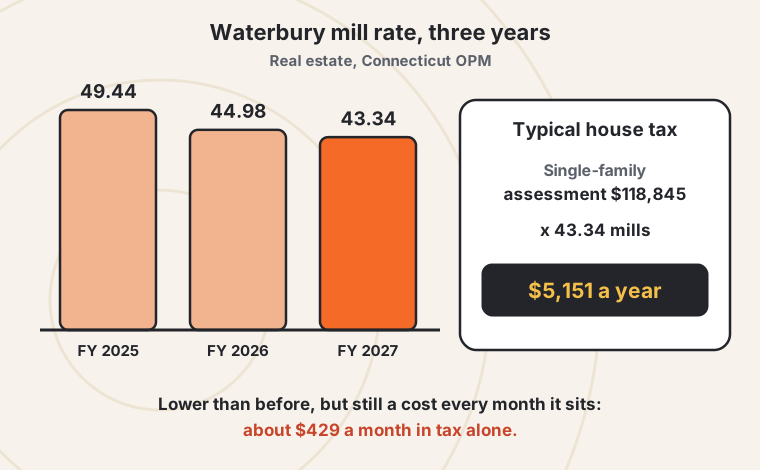
We used the median assessment of Waterbury’s arm’s-length single-family sales, $118,845, rather than a percentage of today’s price, because assessments reflect the city’s last revaluation, not current values. Your own bill is on the tax collector’s records; your attorney will figure the exact closing credit.
What does it cost to sell a house in Waterbury?
Selling a house in Waterbury costs the 1.25% conveyance tax (0.75% state plus 0.50% city), your attorney, any commission, preparation, and carrying costs while it is listed. On a $290,000 single-family house listed with an agent for three months, those costs come to about $24,463 (est.), leaving about $265,537 before your mortgage payoff.
Example (illustrative), built only from public numbers:
| Line | Input | Amount |
|---|---|---|
| Sale price | Waterbury single-family median (arm’s-length) | $290,000 |
| Commissions | 5% total (est.) | -$14,500 |
| Conveyance tax | 0.75% state + 0.50% Waterbury (CGS 12-494) | -$3,625 |
| Seller’s attorney | Flat fee (est.) | -$1,200 |
| Prep and cleaning | (est.) | -$2,500 |
| Property tax, 3 months | $5,151 a year at 43.34 mills | -$1,288 |
| Insurance, utilities, upkeep, 3 months | $450 a month (est.) | -$1,350 |
| Left before your mortgage payoff | $265,537 |
A cash sale skips the commission, prep and waiting but pays the same conveyance tax and attorney, so a cash offer would need to be about $270,600 to match. For a house that is ready to list, most cash offers will be below that, so listing usually nets more. For a house that needs a roof, an oil tank removed or lead work before a lender will finance it, the comparison often flips; our cash buyer vs. realtor guide shows where the line falls. Run your own numbers:
How much would you walk away with?
Slide the numbers to match your house. It works in your browser; nothing is saved or sent.
Estimates for planning. Conveyance tax per CGS 12-494 (state 0.75% up to $800,000, 1.25% to $2.5M, 2.25% above, plus the town rate). Seller attorney about $1,200 to $1,500; flat-fee MLS about $400; listings include three months of taxes, insurance and utilities, a cash sale about two weeks. Your attorney gives you the final numbers.
Which courts handle Waterbury estates, foreclosures and evictions?
Waterbury estates go to the Waterbury Probate Court (district PD-20), which serves Waterbury and Wolcott. Foreclosures and other civil cases go to the Superior Court for the Waterbury Judicial District at 300 Grand Street, and evictions go to the Housing Session at Waterbury in the same building.
If you inherited the house, an executor or administrator can sell during probate with the court’s authority after notice and a hearing (CGS 45a-164); you do not have to wait for the estate to close. See our guide to selling an inherited house in Connecticut. If you are behind on the mortgage, get help first: owner-occupants can request the state’s free foreclosure mediation, and our Connecticut foreclosure guide explains Law Day and every way out.
Should you list your Waterbury house or sell it for cash?
You should list your Waterbury house if it will pass a lender’s appraisal and inspection and you have two to four months, because financed buyers usually pay the most. You should consider a cash sale if the house needs major work, has tenants or an estate attached, or carrying costs and certainty matter more to you than the top price.
List with an agent
Highest likely priceBest for a house in good condition.
- About 2-4 months
- Commission, prep, showings
- Appraisal and inspection risk
Direct cash sale
About 2 weeks typicalBest for an older house that needs work, or with tenants.
- No repairs, no showings, leave what you do not want
- You pick the closing date
- Trade-off: below the price of a fixed-up house
When you should not sell to a cash buyer
Do not sell to a cash buyer, including us, if the house is in good shape and you can wait: list it. Do not sell if mediation or a loan modification could solve a missed payment. And walk away from anyone who asks for a fee, will not put an offer in writing, or plans to assign your contract without telling you; our page on we-buy-houses scams and red flags lists the signs, and why cash offers are lower explains how any offer is built.
What are the steps to sell a house in Waterbury?
The steps to sell a house in Waterbury are: gather your deed, tax bills and any leases; price the house against same-type Waterbury sales; complete the Connecticut disclosures, including lead paint for a pre-1978 house; choose your route; and close with Connecticut attorneys, paying the 1.25% conveyance tax. A direct cash sale typically takes about two weeks.
Gather the paperwork
Deed, latest tax bill, mortgage statement, and for a multi-family the leases, rent roll and deposit records. Our list of documents you need to sell a house in Connecticut has the rest.
Price it against the right houses
Use recent nearby sales of the same type and adjust for age and condition, honestly.
Complete the disclosures
Property condition report (CGS 20-327b), smoke and CO affidavit (CGS 29-453), and the federal lead paint disclosure for a house built before 1978.
Choose a route
Listing, selling by owner, or a written as-is cash offer. Compare the nets, not the headline prices.
Close with attorneys
Connecticut closings are conducted by attorneys (CGS 51-88a). Yours pays off the mortgage, files the conveyance tax return, credits the buyer for taxes and transfers any tenant deposits.
If you want a written cash number to compare with a listing, start on our page to sell your house in Waterbury, CT for cash. No repairs, no showings, and you choose the date.
See the house together.
Pick a time that works.
Choose a time for us to walk through the property with you, or ask for a quick call first. We confirm every request personally.
Tuesday, January 13
No open times in the next few weeks. Please call us.
We will confirm by email. Nothing is booked until we do.
View my requestQuestions people ask about selling a house in Waterbury
What is the median home price in Waterbury, CT?
The median home price in Waterbury, CT was $270,000 across 1,305 residential sales recorded from October 2024 to September 2025, up about 9%. Arm’s-length single-family sales had a median of $290,000 (data.ct.gov).
How much is the conveyance tax in Waterbury?
The conveyance tax in Waterbury is 1.25% of the price under $800,000: 0.75% to the state and 0.50% to the city (CGS 12-494). On a $270,000 sale that is $3,375, paid by the seller at closing.
What is the Waterbury mill rate for 2026-2027?
The Waterbury mill rate for fiscal 2027 is 43.34 for real estate, down from 44.98 in fiscal 2026 and 49.44 in fiscal 2025 (CT OPM). A typical single-family assessment of $118,845 pays about $5,151 a year.
Do I need a lead paint disclosure to sell my Waterbury house?
You need a lead paint disclosure to sell your Waterbury house if it was built before 1978, which covers most of the city. Federal rules require the disclosure form, any known lead reports, and a 10-day chance for the buyer to test unless they waive it.
Can I sell a Waterbury multi-family with tenants?
Yes, you can sell a Waterbury multi-family with tenants. The leases stay with the building, and you deliver the tenants’ security deposits plus interest to the buyer at closing (CGS 47a-21). Many Waterbury buyers want the rental income.
Which probate court handles a Waterbury estate?
The Waterbury Probate Court, district PD-20, handles estates for Waterbury and Wolcott. The fiduciary can sell the house during probate with the court’s authority (CGS 45a-164).
Is Waterbury a good market to sell in right now?
Waterbury has been a good market for sellers of houses in good condition: the median rose about 9% in the latest year of state data and sales above $350,000 grew sharply. Houses that need major work still sell, mostly to cash buyers at prices that reflect the repairs.
How fast can I sell my house in Waterbury?
You can sell your house in Waterbury in about two weeks to a cash buyer, because there is no lender or appraisal. A listed sale usually takes two to four months, including 30 to 45 days from contract to closing with a mortgage buyer (est.).
Related guides
- How to sell a house in Connecticut: every route, step and cost
- How to sell a house in Hartford, CT, step by step
- The East Hartford housing market for sellers
- Selling a house in Plantsville and Southington
- Selling a house as-is in Connecticut
For how a sale works with us from first call to closing, see how selling your house in Connecticut works.
Plain-English information, not legal or tax advice. For an estate, a foreclosure or a tenant dispute, talk to a Connecticut attorney.
Sources (checked on October 27, 2026)
- Connecticut OPM Real Estate Sales dataset (data.ct.gov): Waterbury sales, Oct 2023 to Sep 2025 (our query).
- 2025 Connecticut Parcel and CAMA Data (data.ct.gov): single-family year built and heating fuel.
- Connecticut OPM mill rates (data.ct.gov).
- U.S. Census Bureau ACS 2020-2024 via Census Reporter: units in structure, tenure.
- ConnecticutHistory.org: Birth of the Brass Valley.
- Connecticut Probate Courts, court locator.
- Connecticut Judicial Branch directory: Waterbury Judicial District and Housing Session, 300 Grand Street.
- CGS 12-494 (conveyance tax).
- CGS 20-327b and 20-327c (property condition disclosure).
- CGS 29-453 (smoke and CO affidavit).
- CGS 47a-21 (security deposits on transfer).
- CGS 45a-164 (sale of real property by a fiduciary).
- CGS 51-88a (closings conducted by attorneys).
- EPA lead-based paint disclosure.

Who wrote this
Jerryll Noorden
Jerryll has bought and sold Connecticut houses since 2016 and has sat at more closing tables than he can count, on both sides. Before real estate he was a robotics scientist at NASA, IHMC and IIT. He wrote this guide because the national sites that rank for it skip the Connecticut rules that cost sellers money. When listing or selling it yourself would get you more than a cash offer, he says so.
This guide explains Connecticut rules in plain English. It is not legal or tax advice. Laws change; for your sale, talk to a Connecticut real estate attorney and a tax professional.
