
Key facts at a glance
| Fact | Number | Source |
|---|---|---|
| Southington single-family closings, December to February | 219 of 1,137 (19.3%), median $375,000, Oct 2022 to Sep 2025 | data.ct.gov, OPM real estate sales (5mzw-sjtu) |
| Southington single-family closings, June to August | 401 (35.3%), median $410,000 | data.ct.gov (5mzw-sjtu) |
| Southington mill rate, fiscal 2027 | 23.29 mills: about $6,530 a year ($540 a month) on a $400,250 house | CT OPM mill rates; CGS 12-62a (70% assessment) |
| Conveyance tax on a Southington sale | 1.25% total: 0.75% state + 0.50% town (up to $800,000) | CGS 12-494 |
| How Southington homes are heated | Gas 48%, oil 43% | 2025 Connecticut parcel (CAMA) data |
| Connecticut residential heating oil price | $6.154 a gallon, week of October 19, 2026 (before taxes) | U.S. Energy Information Administration |
| Credit to the buyer if you skip the property condition report | $500 | CGS 20-327b, 20-327c |
This is part of our guide to how to sell a house in Connecticut. For the statewide calendar, see the best time to sell a house in Connecticut. This page stays in Southington, including Plantsville and the rest of town, which are counted together in the state’s sales records. It covers the town’s winter sales, what a winter inspection can miss, and how to keep an empty house from freezing while it is for sale.
Can you sell a house in winter in Southington, CT?
You can sell a house in winter in Southington, CT, but it is the town’s slowest season. Over three years, December through February held 219 of 1,137 single-family closings (19.3%), at a $375,000 median, against 401 closings (35.3%) at $410,000 in summer. Southington swings more than the state as a whole, so a winter seller faces fewer buyers but also fewer competing houses.
Two things change in winter: the buyer’s inspection is harder, and an empty house must be kept warm and safe for weeks of showings. Both are manageable.
Why does selling in a Southington winter feel so daunting?
Selling in a Southington winter feels daunting because everything seems to work against you: the driveway needs plowing before every showing, the yard is buried, the photos look gray, and every cold snap makes you wonder about the pipes. If the house is empty, you are paying to heat rooms nobody uses while waiting for a buyer who may wait for spring.
Maybe you have already moved for work and the house sits on a quiet street off Route 10. Maybe it was your parents’ ranch, and you are the one who drives over after every storm. Maybe you just cannot face another winter in a house that is too big. Each of those owners feels stuck, anxious about every week’s cost, worried about what the inspector will find, and embarrassed that the house does not look its best.
That is all normal. This page is for you if you want Southington’s real numbers and a practical list, not a slogan. You can sell in winter. You just need to know what changes.
What do Southington’s winter sales numbers show?
Southington’s winter sales numbers show a strong summer peak and a long winter lull. Single-family closings ran from 151 in August and 144 in July down to 58 in February and 55 in March over three sales years. The winter median was $375,000 and February’s was the lowest of the year at $347,500, while summer closings had a $410,000 median.
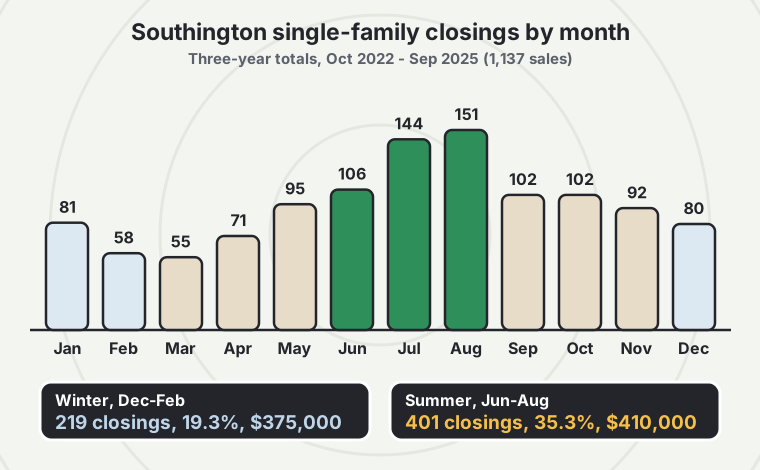
| Southington, single-family | Closings (3 years) | Share of year | Median price |
|---|---|---|---|
| December | 80 | 7.0% | $377,500 |
| January | 81 | 7.1% | $375,000 |
| February | 58 | 5.1% | $347,500 |
| March | 55 | 4.8% | $380,000 |
| Winter, December to February | 219 | 19.3% | $375,000 |
| Summer, June to August | 401 | 35.3% | $410,000 |
| All months | 1,137 | 100% | $390,000 |
Southington is a family-suburb market. Statewide, summer holds about 31% of single-family closings; in Southington it is 35%. Families time moves around the school year, so fewer of them shop in January. Winter buyers are more often downsizers, relocations, renters whose lease is ending, and investors.
As with every monthly median, part of the summer-winter gap is which houses sell, not what each house is worth. Statewide, the same house sells only a few percent lower in midwinter (est.). Do not read the $35,000 gap between the winter and summer medians as your own loss.
What can a winter inspection miss on a Southington house?
A winter inspection on a Southington house can miss what snow and frozen ground cover: the roof shingles, flashing and gutters, the septic system and leach field, the grading and the outdoor faucets, and the air conditioning, which an inspector usually will not run in the cold. Buyers know this, so a winter contract often adds a re-inspection in spring or an escrow holdback at closing.
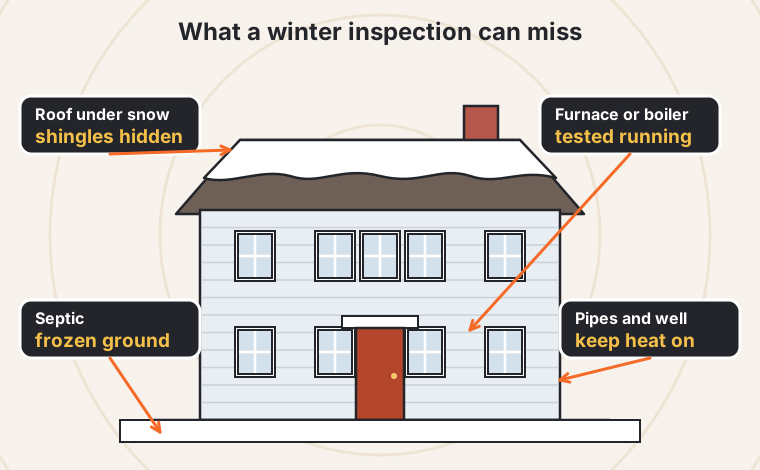
Southington’s housing is mostly 1960s to 1980s colonials, ranches and capes; the typical single-family house was built in 1972 and about 30% predate 1960 (2025 parcel data). Houses of that age often have an older roof, a boiler or furnace near the end of its life and, in some neighborhoods, a septic system rather than public sewer. Each of those is harder to judge under snow.
What changes in winter, item by item
| Item | Winter problem | What a buyer may ask | What you can do |
|---|---|---|---|
| Roof | Snow hides shingles and flashing | Re-inspection after melt, or a holdback | Give receipts for the last roof job; share fall photos |
| Septic (if not on sewer) | Frozen ground makes digging and some tests hard | Test later, or a holdback | Have the last pumping report ready; mark the tank cover in fall |
| Heating system | Gets a real test in cold weather | Service records; repair credit if it struggles | Have it serviced before listing; keep the tag on the unit |
| Oil tank | Age and location matter to insurers | Tank age, buried or not | Know the install date; see our oil tank and septic guide |
Whatever the season, Connecticut sellers must give the buyer the Residential Property Condition Report before the buyer signs, or credit the buyer $500 at closing (CGS 20-327b and 20-327c). Snow does not change what you must disclose: if you know the roof leaked, say so. Our guide to the Connecticut property condition disclosure walks through the form.
How do you protect a vacant Southington house from frozen pipes?
You protect a vacant Southington house from frozen pipes by keeping the heat on and the fuel supply secure, knowing where the main water shutoff is, opening sink cabinets on outside walls, adding a temperature alarm, and having someone check inside every few days. If the house will sit empty for months, you can instead have a plumber winterize it, but then it must be de-winterized for every inspection.
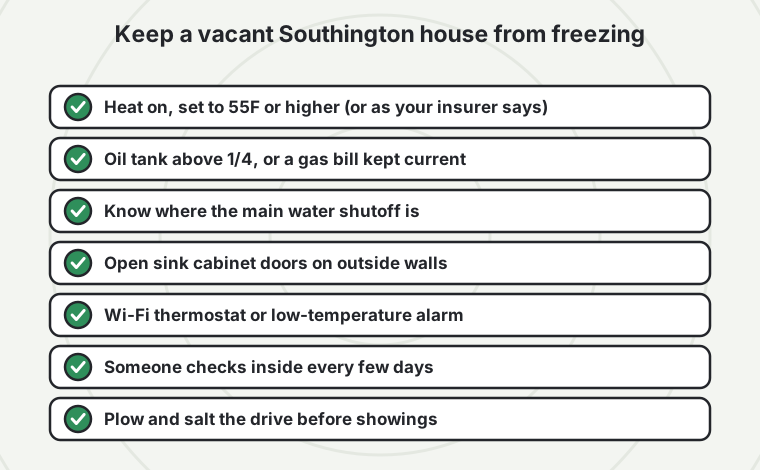
In Southington, 48% of houses heat with gas and 43% with oil (2025 parcel data). The risk differs:
- Oil heat: an empty house can run out of oil without anyone noticing. Set up automatic delivery, keep the tank above a quarter, and check the gauge on every visit. Connecticut heating oil cost $6.154 a gallon the week of October 19, 2026 (EIA), so 100 gallons is about $615. At closing, Connecticut custom is that the buyer reimburses you for the oil left in the tank.
- Gas heat: keep the account current; a missed bill can mean a January shutoff.
Many homeowners policies limit or exclude coverage, including for frozen pipes, once a house has been vacant for a set period, often 30 to 60 days, unless you kept the heat on or drained the system. Read your policy, tell your agent the house is empty, and ask whether you need a vacancy endorsement. The Connecticut Insurance Department can help if you have a dispute.
Two Southington rules matter for an empty house in winter. The town’s sidewalk ordinance (Sec. 17-2) makes the owner or occupant clear adjoining public sidewalks after a storm and treat ice within a few hours, with a fine for missing it. Connecticut lets towns shift sidewalk-ice liability to the abutting owner (CGS 7-163a), so an icy walk in front of an empty house is also a liability risk. Southington also runs a winter on-street parking ban, so tell buyers’ agents where to park.
The full monthly math of an empty house is in our carrying-cost worksheet for a vacant house. In Southington, the property tax alone is about $540 a month on a $400,250 house; add heat, insurance, utilities, plowing and checks.
What does a winter sale cost in Southington?
A winter sale in Southington costs the same at closing as a summer one, plus whatever you spend carrying the house until then. The fixed costs include the 1.25% conveyance tax, one of the higher rates in Connecticut because Southington is a 0.50% town: about $4,688 on the $375,000 winter median. The variable cost is time: about $540 a month in property tax alone, more with heat and a mortgage.
| Line | Winter sale at $375,000 | Notes |
|---|---|---|
| State conveyance tax, 0.75% | $2,813 | CGS 12-494 |
| Southington conveyance tax, 0.50% | $1,875 | One of 16 towns at 0.50% |
| Property tax per month owned | About $540 | 23.29 mills on a $400,250 house |
| Heating oil per 100 gallons | About $615 (est. usage) | EIA price, week of Oct 19, 2026 |
| Attorney fee, commission, payoff, credits | Your own numbers | Use the calculator below |
How much would you walk away with?
Slide the numbers to match your house. It works in your browser; nothing is saved or sent.
Estimates for planning. Conveyance tax per CGS 12-494 (state 0.75% up to $800,000, 1.25% to $2.5M, 2.25% above, plus the town rate). Seller attorney about $1,200 to $1,500; flat-fee MLS about $400; listings include three months of taxes, insurance and utilities, a cash sale about two weeks. Your attorney gives you the final numbers.
The question to ask is simple: will waiting for spring raise your price by more than the months cost you? If you live in the house and it shows well, often yes. If it is empty, heated and insured as vacant, often no. Our cash buyer vs. realtor guide shows how to put both nets side by side.
How do you make a Southington house show well in winter?
You make a Southington house show well in winter by making it safe, warm and bright: a plowed drive and salted walk, the heat at a comfortable level for showings, every light on, a boot tray at the door, and photos of the yard taken before the snow. Buyers forgive a gray sky; they do not forgive an icy step or a cold house.
In practice: plow, shovel and salt the drive, walk and steps before every showing; raise the thermostat before buyers arrive, even if you keep an empty house at 55 degrees; turn on every light and open every blind; put a mat outside, a mat inside and a boot tray by the door; add fall or summer photos of the yard to the listing; and keep decorations to a wreath.
For room-by-room staging ideas, see how to stage a house for a winter sale in Connecticut.
Should you sell this winter, wait for spring or sell for cash in Southington?
You should sell this winter in Southington if the house is ready and you can wait 60 to 90 days, wait for spring if you live there and the house will show better in May, and consider a cash sale if the house is empty, needs work a buyer’s lender would flag, or a date matters more than top price. In a family-suburb market like Southington, spring brings the most buyers.
List this winter
Fewer buyers, fewer rivalsBest for a ready house and a seller who can wait.
- Plowing, heat and showings for 2 to 3 months
- Inspection may add a spring re-check
- Commission and a lender’s timeline
Wait for spring
35% of closings in summerBest if you live there and nothing forces the date.
- Most family buyers
- Yard and roof show as they are
- Months of tax, heat and upkeep
Sell for cash, as-is
No winter showingsBest for an empty, inherited or worn house.
- No lender, no inspection contingency
- You pick the closing date
- Below a retail price
If your Southington house is in good shape, you live in it and you can list in March, do that. A cash offer, including ours, will be lower than a well-prepared spring listing. A cash sale is the right tool when the winter itself is the problem: an empty house to heat, repairs you cannot fund, or a date you cannot move.
Before you choose, put a listing net and a cash net side by side with our cash buyer vs. realtor comparison. If the empty house came from a parent’s estate, our page on selling an inherited house covers probate timing, and selling a vacant house covers selling from out of state.
How do you sell a Southington house in winter, step by step?
You sell a Southington house in winter in five steps: protect the house first (heat, fuel, insurance, plowing), gather the paperwork a winter buyer will ask for, decide between listing now, waiting and a cash sale with real numbers, set a closing date, and keep the house safe until that day. A cash sale shortens the middle to about two weeks.
Protect the house
Fuel delivery or gas account, a temperature alarm, a plow service and a call to your insurer about vacancy.
Gather the winter paperwork
Roof receipts, heating service records, septic pumping reports, oil tank age, and the property condition report.
Run both numbers
A listing net after commission and months of carrying, and a cash net after no commission and no repairs. Compare them.
Pick the closing date
A financed buyer needs 30 to 45 days after contract. A cash buyer like us typically needs about two weeks, and you can choose a later date.
Close and hand over the keys
Your attorney handles the deed, payoff and conveyance tax return. The buyer credits you for the oil left in the tank.
To get a written cash offer to compare, start on our Southington page.
See the house together.
Pick a time that works.
Choose a time for us to walk through the property with you, or ask for a quick call first. We confirm every request personally.
Tuesday, January 13
No open times in the next few weeks. Please call us.
We will confirm by email. Nothing is booked until we do.
View my requestQuestions about selling a house in Southington in winter
Is winter a bad time to sell a house in Southington, CT?
Winter is a slow time to sell a house in Southington, CT, not a bad one. December through February held 19.3% of single-family closings over three years, against 35.3% in summer, so expect fewer showings and a longer wait, with fewer competing houses.
Can a home inspection be done in winter in Connecticut?
A home inspection can be done in winter in Connecticut, and the heating system gets its best test then. Snow can hide the roof and frozen ground can delay septic work, so buyers may ask for a spring re-inspection or an escrow holdback.
What temperature should I keep a vacant house at in winter?
A vacant house in winter is commonly kept at 55 degrees or higher, but follow your insurance policy’s wording, which may require heat to be maintained or the water drained. Add a temperature alarm so you hear about a failure before the pipes freeze.
Who pays for the heating oil left in the tank at closing?
The buyer usually pays for the heating oil left in the tank at a Connecticut closing; by custom the attorneys add a credit to the seller based on the gallons in the tank and the current price. At $6.154 a gallon, a half-full 275-gallon tank is worth about $846.
What is the conveyance tax in Southington?
The conveyance tax in Southington is 1.25% of the price up to $800,000: 0.75% to the state and 0.50% to the town (CGS 12-494). On a $375,000 sale that is about $4,688, paid by the seller at closing.
Do I have to shovel the sidewalk at a vacant house in Southington?
You do have to clear the public sidewalk in front of a house you own in Southington, even if it is empty. The town’s sidewalk ordinance (Sec. 17-2) sets deadlines after a storm and a fine for missing them. Hire a plow and shovel service.
Should I wait until spring to sell my Southington house?
You should wait until spring to sell your Southington house if you live there, it will show better in May and nothing forces the date. If the house is empty and costs you tax, heat and insurance every month, the spring gain may not cover the wait.
Can I sell my Southington house as-is in the winter?
You can sell a Southington house as-is in the winter to a cash buyer, with no repairs, no lender and no inspection contingency. Expect a lower price than a retail listing; the trade is speed, certainty and no winter showings.
Related Connecticut guides
Timing
Southington and nearby
For every route, step and cost in one place, see how to sell a house in Connecticut.
Plain-English information, not legal, insurance or inspection advice. Estimates are labelled (est.).
Sources (checked on October 27, 2026)
- Connecticut OPM, Real Estate Sales 2001-2024 GL, data.ct.gov dataset 5mzw-sjtu (Southington, arm’s-length single-family sales recorded Oct 2022 to Sep 2025; queried October 2026).
- CGS 12-494 (conveyance tax; Southington among the 0.50% towns).
- CGS 20-327b and 20-327c (property condition report; $500 credit).
- CGS 7-163a (ice and snow on public sidewalks; owner liability where a town adopts it).
- CGS 12-62a (assessment at 70% of value).
- Connecticut OPM, mill rates (Southington fiscal 2027).
- Town of Southington, Winter parking ban and ordinances (sidewalk snow and ice, Sec. 17-2).
- EIA, Weekly Connecticut No. 2 heating oil residential price (week of October 19, 2026).
- Connecticut Insurance Department (consumer help).
- Connecticut parcel (CAMA) data, 2025, via our town data (year built, heating fuel).

Who wrote this
Jerryll Noorden
Jerryll has bought and sold Connecticut houses since 2016 and has sat at more closing tables than he can count, on both sides. Before real estate he was a robotics scientist at NASA, IHMC and IIT. He wrote this guide because the national sites that rank for it skip the Connecticut rules that cost sellers money. When listing or selling it yourself would get you more than a cash offer, he says so.
This guide explains Connecticut rules in plain English. It is not legal or tax advice. Laws change; for your sale, talk to a Connecticut real estate attorney and a tax professional.
