
Key facts at a glance
| Fact | Number | Source |
|---|---|---|
| CT single-family closings in November and December | 17.4% (11,166 of 64,175, Oct 2022 to Sep 2025) | data.ct.gov, OPM real estate sales (5mzw-sjtu) |
| Median price, Nov / Dec / Jan closings | $395,000 / $390,000 / $365,000 | data.ct.gov (5mzw-sjtu), same period |
| Single-family closings recorded December 24 to 31 | 943 over three Decembers (2022 to 2024) | data.ct.gov (5mzw-sjtu) |
| New listings in Connecticut, December 2025 vs. June 2026 | 1,648 vs. 4,418 | Realtor.com via FRED (NEWLISCOUCT) |
| Median days on market, December 2025 vs. May 2026 | 57 vs. 28 days | Realtor.com via FRED (MEDDAYONMARCT) |
| Interest on a late property tax installment | 18% a year (1.5% a month) from the due date | CGS 12-146 |
| Date of sale for your income tax | The closing date (Form 1099-S, box 1) | IRS Publication 523 |
This is one piece of our guide to how to sell a house in Connecticut. If you want the full month-by-month picture for the whole year, read the best time to sell a house in Connecticut. This page answers one question: what really changes if you sell between Thanksgiving and New Year’s Day?
Is it a good idea to sell a house during the holidays in Connecticut?
Selling a house during the holidays in Connecticut is a reasonable idea if you need the date more than the last few percent of price. The market slows but does not stop: November and December still hold 17.4% of the state’s single-family closings. A house listed after mid-November usually closes in January or February, the two lowest-priced months of the year, so expect fewer showings and a slightly lower price than in spring.
That is the honest trade. The holidays bring fewer buyers, but also far fewer competing sellers. They bring messy showings and short days, but the buyers who do come out in December are usually the ones who have to move. And the closing date you choose in December or January can move your income tax bill by a full year, which matters more for some sellers than the sale price.
Below we go through each disadvantage, what the Connecticut numbers say about it, the year-end tax timing most guides skip, and who should list now, wait for spring, or sell for cash.
Why does selling a house over the holidays feel so hard?
Selling a house over the holidays feels hard because two big things land on the same weeks: the season that is supposed to be about family, and a decision that ends a chapter of your family’s life. You may feel guilty for “ruining” the holidays, worried that you are selling at the worst time, and pressured by a deadline that does not care what month it is.
Maybe a new job starts in January and the house has to go. Maybe a parent passed in the fall and the family is gathering in a house you all know will be sold. Maybe you are divorcing and the thought of one more Christmas in that house is too much. Or maybe you simply looked at the calendar, saw it was November, and someone told you “nobody buys in December.”
Here is what people in your spot tell us they feel:
- Guilty, because showings and boxes collide with the dinners and the decorations.
- Anxious about money, because they have heard winter is the “worst” season and fear leaving thousands on the table.
- Exposed, because strangers will walk through the house while family is visiting.
- Rushed, because a lease, a job or a tax year ends on December 31 whether they are ready or not.
- Doubtful, because every piece of advice they find is national and none of it talks about Connecticut.
All of that is normal. This page is for you if you have to make a holiday-season decision and want real Connecticut numbers instead of slogans. Nothing here asks you to sell to us. Where listing in the spring is the better choice, we say so.
What does Connecticut’s data show for November, December and January?
Connecticut’s data shows that November and December are ordinary months for closings, and January and February are the slow ones. Over three sales years, November held 8.8% of single-family closings and December 8.6%, against 6.4% in January and 5.0% in February. Median prices fall from $395,000 for November closings to $365,000 for January closings, statewide.
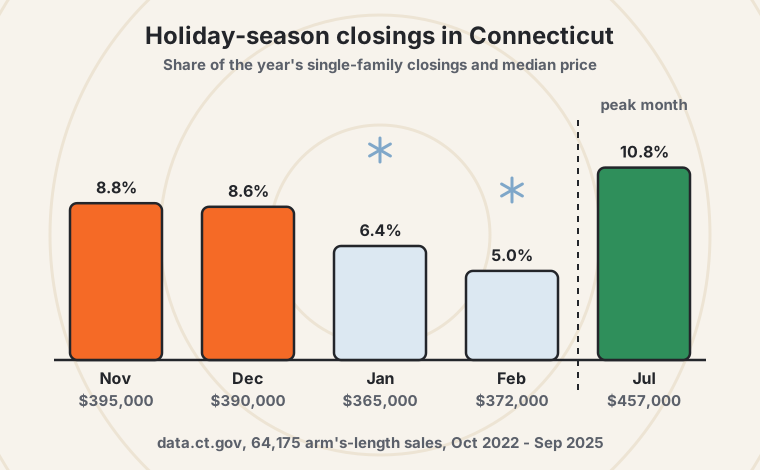
The numbers come from the Office of Policy and Management’s real estate sales file on data.ct.gov. We kept arm’s-length single-family sales of $30,000 or more, recorded from October 1, 2022 to September 30, 2025, and counted them by the month the deed was recorded. That is the same filter our best-time-to-sell guide uses, so the two pages agree.
| Closing month | Closings (3 years) | Share of year | Median price | Same-house index (est.) | Contract likely signed |
|---|---|---|---|---|---|
| October | 6,307 | 9.8% | $390,000 | +0.8% | Aug to Sep |
| November | 5,626 | 8.8% | $395,000 | 0.0% | Sep to Oct |
| December | 5,540 | 8.6% | $390,000 | −1.0% | Oct to Nov |
| January | 4,119 | 6.4% | $365,000 | −2.3% | Nov to Dec |
| February | 3,232 | 5.0% | $372,000 | −1.8% | Dec to Jan |
| July (peak, for comparison) | 6,932 | 10.8% | $457,000 | +1.7% | May to Jun |
Read the table by the contract column. A deed recorded in December is usually a contract signed 30 to 45 days earlier. So the December closings are mostly fall deals. The houses that actually go under contract during the holidays close in January and February. Those are the months with the fewest closings and the lowest medians.
Part of the lower median is mix: big family homes tend to close in summer, smaller and older houses close all year. That is why we also show the same-house index. It compares each sale with the house’s own assessment, so it strips most of the mix out. On that measure, a January closing sits about 2.3% below an average month and a July closing about 1.7% above (est.). The real holiday discount for the same house is a few percent, not the 10% or 20% the raw medians suggest.
What are the real disadvantages of selling a house during the holiday season?
The real disadvantages of selling a house during the holiday season are four: fewer buyers, so the house takes longer to go under contract; a slightly lower price for the same house; showings that collide with family plans, snow and short days; and a calendar with fewer working days for inspectors, lenders and attorneys. None of them stops a sale. Each one costs time or a little money.
1. Fewer buyers, so it takes longer
Connecticut’s median listing sat on the market 57 days in December 2025 and 61 days in January 2026, against 28 days in May 2026 (Realtor.com, via the St. Louis Fed). A house that would get an offer in a month in spring can take two in winter. If you list the week before Thanksgiving and need to close by December 31, that math rarely works with a financed buyer.
2. A slightly lower price for the same house
The same-house index above puts January closings about 2.3% below an average month and February about 1.8% below (est.). On a $400,000 house, 2.3% is about $9,200. That is real money. It is also smaller than many sellers fear, and it can be less than the cost of carrying an empty house for four months (we do that math below).
3. Showings collide with the holidays
Buyers want to see the house when they are free, which is often the weekend you have family over. Snow, salt and slush come inside on every pair of boots. Daylight is short in late December, so after-work showings happen in the dark. If the house is vacant, you also have to keep it heated for showings, and heating oil is expensive this year: $6.154 a gallon in Connecticut the week of October 19, 2026 (EIA).
4. Fewer working days, not a shutdown
The old version of this page said banks “shut down” between Christmas and New Year’s. That is not what the records show. Connecticut recorded 943 single-family closings between December 24 and December 31 across three years, and 1,716 more between December 16 and 23.
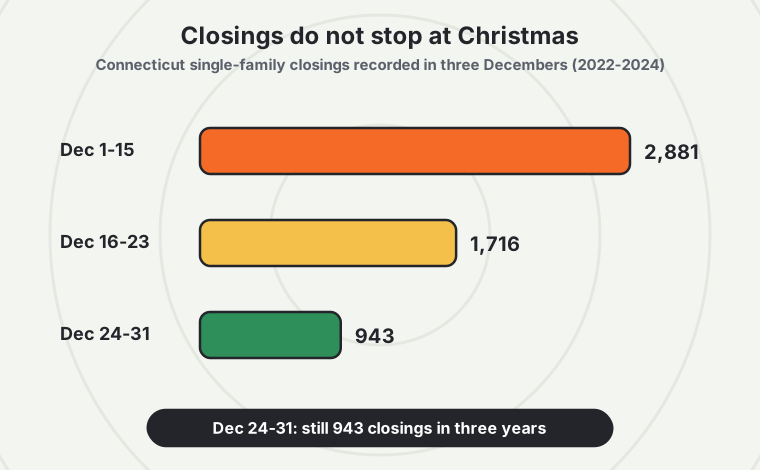
What is true: December 25 and January 1 are bank holidays, town halls close, and many appraisers, home inspectors, lenders and attorneys take vacation in between. In 2026 both holidays fall on a Friday, so the two weeks around them are short. A financed deal that needs an appraisal and an underwriter’s sign-off is the one most likely to slip. A cash deal with no lender has fewer people to wait on.
Have the contract signed by about the middle of November with a financed buyer, or early December with a cash buyer. Ask both attorneys in writing whether they are available the week of December 28. Book the closing for a weekday before December 24 if you can, so a one-day delay does not push you into January.
Are holiday buyers more serious, and what are the advantages?
Holiday buyers in Connecticut are usually more serious, because few people tour houses in December for fun. Many have a job starting in January, a lease ending or a sale of their own to finish. The bigger advantage is less competition: Connecticut had 1,648 new listings in December 2025 against 4,418 in June 2026, so a buyer who is looking sees fewer houses and your house stands out.
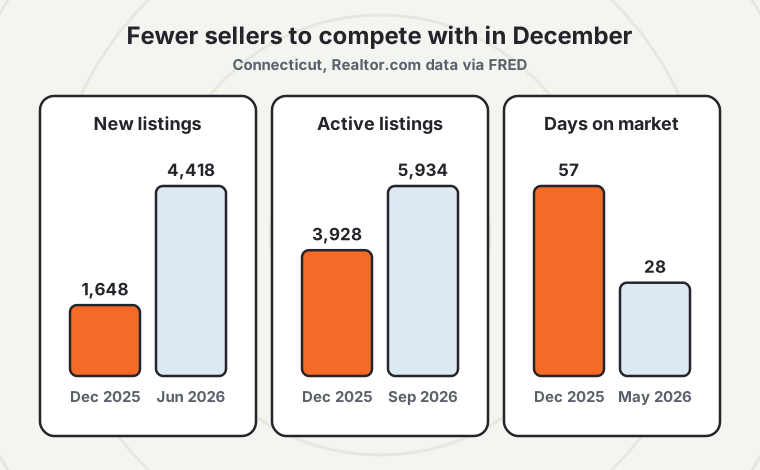
There is no public count of “serious” buyers, so treat that part as judgment, not data. What the data does show is supply. Active listings in Connecticut fell to 3,928 in December 2025, from 5,327 in October 2025, and new listings fell by more than a third from November (2,664) to December (1,648). Fewer houses for sale means a motivated buyer has fewer alternatives, and a well-priced house gets a closer look.
Other honest advantages:
- Your house can look its best. Warm lights and a lit fireplace show well in photos taken at dusk. Keep decorations light and neutral; buyers need to picture their own holidays there.
- Relocation buyers moving for a January start date often have employer deadlines and little room to haggle about timing.
- Investors and cash buyers keep buying through the holidays, because their timing is not tied to school years.
- You get a head start on spring. If the house does not sell, you have photos, a disclosure report and a price reaction to adjust before March.
Should I close in December or January for tax reasons?
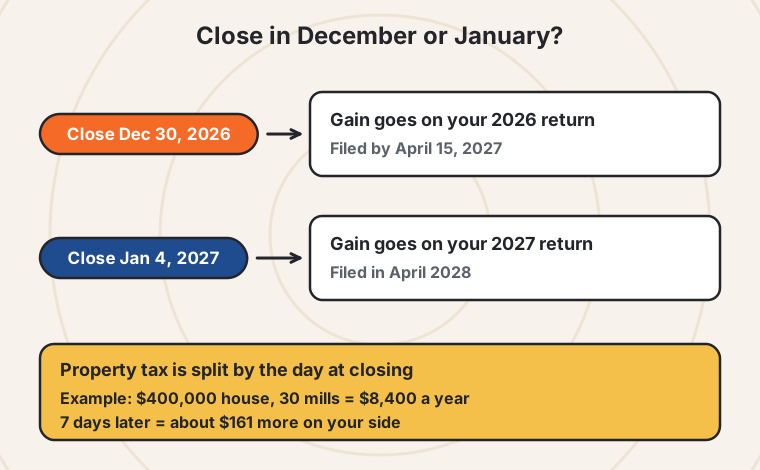
Whether you should close in December or January for tax reasons depends on your gain, not on property tax. Your closing date is your date of sale for the IRS (Publication 523), so a December 30 closing puts any taxable gain on this year’s return and a January 4 closing pushes it a full year later. Property tax barely changes: Connecticut closings split it by the day, so a week’s delay moves only about a week of tax.
Capital gains: which year the gain lands in
IRS Publication 523 says your date of sale is the date in box 1 of Form 1099-S, which your closing attorney files, or otherwise the earlier of the day title passed or the day the buyer took on the burdens and benefits of ownership. For a normal Connecticut closing that is the closing day.
For most people selling their own home, this does not matter, because the gain is under the $250,000 exclusion ($500,000 for a married couple filing jointly) and no tax is due. It matters when:
- The gain is taxable. A rental, a second home, an inherited house that rose in value after the date of death, or a home gain above the exclusion. Connecticut taxes the gain as ordinary income (top rate 6.99%), in the same year as the federal return.
- Your income changes between years. If you retire in December, or your income drops next year, a January closing can put the gain in the lower-income year. If this year is the low year, close in December.
- You are close to the two-year line. The exclusion needs 24 months of ownership and use in the five years before the date of sale. If you hit 24 months on January 10, a December closing can cost you the whole exclusion. Count the days with your tax preparer.
- You are close to the one-year line on a non-home property. Gains on property held more than one year are long-term and taxed at lower federal rates.
Timing of payment matters too. If you close in December with a large taxable gain, the IRS expects estimated tax soon; the fourth-quarter estimated payment for individuals is usually due January 15. Close in January and the first estimate is not due until April. Ask a tax preparer before you pick the date; our guide to taxes when selling a house in Connecticut covers the rules in full.
Property tax: prorated by the day
Connecticut towns decide whether property tax is paid in one, two or four installments (CGS 12-142). Many, including Shelton and Southington, bill twice a year, with installments due July 1 and January 1. At closing, the attorneys split the year’s tax so each side pays for the days it owned the house, following local custom.
So the closing date moves property tax by days, not by installments. Example: a $400,000 house in a town with a 30-mill rate pays $400,000 × 70% × 30 ÷ 1,000 = $8,400 a year, or about $23 a day. Closing on January 4 instead of December 28 costs about 7 days, or $161. Do not let a tax bill decide your closing date.
If you close in January after the second installment came due, make sure it is paid, at or before closing. An unpaid installment becomes delinquent after the grace period and carries interest at 18% a year from the due date (CGS 12-146). Your attorney checks this, but if the closing slips into February, ask.
What does not change
The conveyance tax does not care about the season. The state rate is 0.75% up to $800,000 plus a town rate of 0.25% in most towns and 0.50% in sixteen towns (CGS 12-494); see Connecticut conveyance tax by town. Attorney fees and the commission are the same in December and May.
What does holiday timing cost or save on a typical Connecticut house?
Holiday timing costs or saves you the difference between the seasonal price change and what the extra months cost you. On a $400,000 house, listing in mid-November and closing in January may mean about 2.3% less than an average month, or about $9,200 (est.). Waiting to list in March and close in June may mean about 1.9% more (est.). If the house is empty, four winter months of tax, heat and insurance can eat most of that gap.
Here is the worked comparison. Every price input is labelled.
| Line | List in November, close in January | Wait, list in March, close in June |
|---|---|---|
| Price of an average-month sale (example) | $400,000 | $400,000 |
| Seasonal effect, same house (est.) | −2.3% = −$9,200 | +1.9% = +$7,600 |
| Expected price | $390,800 | $407,600 |
| Difference before costs | $16,800 in favor of waiting (est.) | |
| Extra months owned (if you live there anyway) | — | About 5 months of property tax you would pay as rent elsewhere; often a small real cost |
| Extra months owned (if the house is empty) | — | 5 × about $1,800 to $2,400 a month = $9,000 to $12,000 (est.) |
| Net advantage of waiting | Occupied: most of the $16,800. Empty: roughly $4,800 to $7,800, before any risk of frozen pipes or a price cut (est.) | |
So the honest answer is: if you live in the house, it shows well and nothing forces the date, waiting for spring usually pays. If the house is empty and must be heated, the gain from waiting shrinks fast, and with a mortgage payment on top it can disappear. Our carrying-cost worksheet for a vacant Connecticut house walks through each monthly line. Then check your own net with the calculator below.
How much would you walk away with?
Slide the numbers to match your house. It works in your browser; nothing is saved or sent.
Estimates for planning. Conveyance tax per CGS 12-494 (state 0.75% up to $800,000, 1.25% to $2.5M, 2.25% above, plus the town rate). Seller attorney about $1,200 to $1,500; flat-fee MLS about $400; listings include three months of taxes, insurance and utilities, a cash sale about two weeks. Your attorney gives you the final numbers.
Should I list now, wait for spring or sell for cash during the holidays?
You should list now if the house shows well and you can wait 60 to 90 days for a closing, wait for spring if you live there and have no deadline, and sell for cash if you need a fixed date, the house is empty or needs work a lender would flag. The holidays do not change which route nets the most; they change how long each one takes.
List now, over the holidays
Market price, minus a littleBest when the house is ready and you can close in January or February.
- Fewer competing listings
- Slower: 57 to 61 median days on market in Dec to Jan
- Commission and buyer’s lender timeline
Wait and list in spring
About +2% to 4% (est.)Best when you live there, the house shows well and nothing forces the date.
- Most buyers, fastest market in April and May
- Months of tax, interest and upkeep
- Not a win if the house is empty and costly to heat
Sell for cash, as-is
Lower price, fixed dateBest when a date, a vacant house or repairs matter more than top price.
- No lender, no appraisal, no showings
- You choose the closing date, before or after January 1
- Below retail: that is the trade-off
Compare the two net numbers side by side in our cash buyer vs. realtor guide before you decide.
Do not sell to a cash buyer, including us, if your house is in good shape, you live in it, and you can wait until spring. A cash offer is below what a well-prepared listing nets in a normal market; our page on why cash offers are lower explains why. A cash sale makes sense when time, condition or carrying costs are the real problem, not because it is December. If you call us and listing is clearly better for you, we will say so.
Is a cash sale right for you, or should you list?
Seven quick questions. There is no wrong answer, and we will tell you honestly if listing would leave you more.
- Does the house need repairs you would rather not pay for or manage?
- Do you need to close by a certain date, or within the next month or two?
- Would showings be hard: tenants, belongings, privacy, or you live out of state?
- Is there a complication: an estate or probate, a divorce, foreclosure, liens or back taxes?
- Could you comfortably cover the mortgage, taxes and utilities for three or more months?
- Is getting the highest possible price more important to you than speed and certainty?
- Would a buyer's bank lend on the house as it is (no major roof, foundation, oil tank or code issues)?
How do you sell a house during the holidays, step by step?
You sell a house during the holidays by deciding first which closing date you need, working backward to a contract date, and then choosing the route that can meet it. A financed sale needs a contract by mid-November to close in December; a cash sale needs about two weeks. Then you set showing rules around your family plans and line up your attorney before the vacation weeks.
Pick the closing year first
Ask your tax preparer whether a December or January closing is better for you, especially if the gain is taxable or you are near the two-year line. That choice sets every date after it.
Work back to a contract date
A financed buyer usually needs 30 to 45 days from contract to closing. For a December 31 closing, that means a signed contract by mid-November. For a cash buyer like us, about two weeks from first call to closing is typical.
Hire your closing attorney now
Connecticut closings are handled by attorneys. Book yours before Thanksgiving and ask about vacation dates. Gather your deed, mortgage statement and the property condition report early; our document checklist lists them.
Set showing rules that protect your holidays
Block out the days you are hosting. Allow showings on short notice on the other days. Keep the walk shoveled and salted, the lights on and the decorations simple.
Price for the season, not for April
Holiday buyers compare your house with the few others on the market. Price against the last 90 days of sales, not against last spring’s peak.
Get a cash number as a floor
Even if you plan to list, a written cash offer tells you the worst case. If the listing stalls into February, you already know your fallback and its closing date.
See the house together.
Pick a time that works.
Choose a time for us to walk through the property with you, or ask for a quick call first. We confirm every request personally.
Tuesday, January 13
No open times in the next few weeks. Please call us.
We will confirm by email. Nothing is booked until we do.
View my requestQuestions about selling a house during the holidays in Connecticut
Is December a bad month to sell a house in Connecticut?
December is not a bad month to close a house in Connecticut; it held 8.6% of single-family closings over three years, close to an average month. It is a slow month to list, because a house listed in December usually closes in January or February, when closings and prices are lowest.
Do houses sell between Christmas and New Year’s in Connecticut?
Houses do sell and close between Christmas and New Year’s in Connecticut. The state recorded 943 single-family closings from December 24 to 31 across 2022, 2023 and 2024. Christmas Day and New Year’s Day are the only full days off for banks and town clerks.
Will I get less money if I sell during the holidays?
You will probably get a little less money if your house sells during the holidays. Our same-house estimate puts January closings about 2.3% below an average month (est.). The raw median drop looks bigger because larger homes tend to sell in summer.
Should I take my house off the market for the holidays?
You should take your house off the market for the holidays only if showings would be impossible and you plan to relaunch in early spring. Pulling it resets days on market, but you lose the few serious buyers looking in December. A middle path is to block out your hosting dates and keep the listing live.
Is it better to close on a house in December or January?
Closing in December or January is better depending on your taxes. The closing date is your IRS date of sale, so it sets the tax year of any taxable gain. If the gain is excluded or you have no gain, the difference is small; property tax moves only by the days owned.
Does closing in January change my Connecticut property tax?
Closing in January changes your Connecticut property tax only by the extra days you own the house. Attorneys prorate the tax by the day at closing. Make sure the January 1 installment is paid if it came due before closing, because a late installment carries 18% yearly interest (CGS 12-146).
Are holiday home buyers more serious?
Holiday home buyers are usually more serious, because December tours are rarely casual; many buyers have a job, lease or sale deadline. There is no official count of motivated buyers, so treat this as experience, not data. The measurable advantage is fewer competing listings.
How many homes are listed in Connecticut in December?
About 1,648 new listings came on the Connecticut market in December 2025, the lowest month of the year, against 4,418 in June 2026 (Realtor.com via FRED). Active listings fell to 3,928 in December 2025.
Should I decorate my house for the holidays if it is for sale?
You should decorate a house for sale lightly and neutrally. Warm lights, a wreath and a clear entry help photos and showings. Skip personal items with names, crowded displays and anything that blocks windows or floors buyers want to see.
Can I sell my house fast during the holidays?
You can sell your house fast during the holidays if the buyer does not need a lender. A financed buyer usually needs 30 to 45 days to close. A cash buyer can usually close in about two weeks, and you pick the date, before or after January 1.
Do I need the house empty to sell it in December?
You do not need the house empty to sell it in December. With a listing, you live there through showings. With a cash sale, you can usually leave furniture and belongings you do not want and set a move-out date that fits your holidays.
Is it better to wait until spring to sell in Connecticut?
Waiting until spring to sell in Connecticut is better if you live in the house, it shows well and nothing forces the date; the seasonal gain is about 2% to 4% (est.). It is often not better if the house is empty and costs $1,800 or more a month to carry.
Related Connecticut guides
Timing
Money and taxes
We buy houses all over the state; see where we buy houses in Connecticut. For every route, step and cost in one place, start with how to sell a house in Connecticut.
Plain-English information, not tax or legal advice. Estimates are labelled (est.). Talk to a Connecticut attorney and a tax preparer about your own closing date.
Sources (checked on October 27, 2026)
- Connecticut OPM, Real Estate Sales 2001-2024 GL, data.ct.gov dataset 5mzw-sjtu (single-family, arm’s-length, recorded Oct 2022 to Sep 2025; queried October 2026).
- Realtor.com new listing count, Connecticut (FRED NEWLISCOUCT).
- Realtor.com active listing count, Connecticut (FRED ACTLISCOUCT).
- Realtor.com median days on market, Connecticut (FRED MEDDAYONMARCT).
- CGS 12-142 and 12-146 (tax installments set by each town; 18% yearly interest on delinquent tax).
- CGS 12-62a (assessment at 70% of value).
- CGS 12-494 (real estate conveyance tax).
- IRS Publication 523, Selling Your Home (date of sale, 24-month tests, exclusion).
- IRS Topic 409, Capital gains and losses (one-year holding period).
- IRS, Estimated taxes (quarterly due dates).
- EIA, Weekly Connecticut No. 2 heating oil residential price (week of October 19, 2026).
- U.S. OPM, Federal holidays (Christmas and New Year’s Day 2026-2027).

Who wrote this
Jerryll Noorden
Jerryll has bought and sold Connecticut houses since 2016 and has sat at more closing tables than he can count, on both sides. Before real estate he was a robotics scientist at NASA, IHMC and IIT. He wrote this guide because the national sites that rank for it skip the Connecticut rules that cost sellers money. When listing or selling it yourself would get you more than a cash offer, he says so.
This guide explains Connecticut rules in plain English. It is not legal or tax advice. Laws change; for your sale, talk to a Connecticut real estate attorney and a tax professional.
