
Key facts at a glance
This Ledyard guide is part of our guide to how to sell a house in Connecticut. It answers one question: will you have to bring money to the closing table when you sell your Ledyard house, and if so, what can you do about it?
| Fact | Number | Source |
|---|---|---|
| Ledyard residential sales, Oct 2024 to Sep 2025 | 257 | CT OPM Real Estate Sales, data.ct.gov |
| Ledyard median single-family sale price, Oct 2024 to Sep 2025 | $390,000 | CT OPM Real Estate Sales |
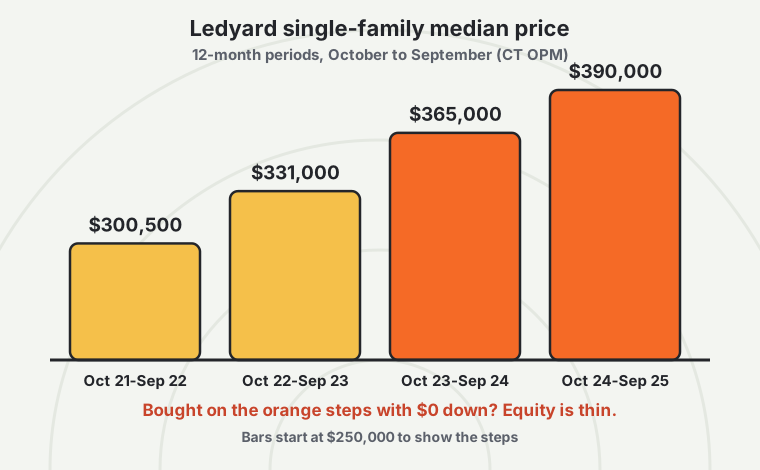
| Same median, the three earlier 12-month periods (Oct 2021 to Sep 2024) | $300,500, $331,000, $365,000 | CT OPM Real Estate Sales (our query) |
| Ledyard mill rate, fiscal 2027 | 25.87 mills | CT OPM mill rates |
| Property tax on a $390,000 Ledyard house | About $7,060 a year ($589 a month) | Mill rate × 70% assessment (CGS 12-62a) |
| Conveyance tax on a $390,000 Ledyard sale | $3,900 (0.75% state + 0.25% town) | CGS 12-494 |
| VA funding fee, first use, less than 5% down | 2.15% of the loan | U.S. Department of Veterans Affairs |
Why does selling a Ledyard house you just bought feel so risky?
Selling a Ledyard house you just bought feels risky because the numbers that worked when you bought, a small or zero down payment and a financed funding fee, leave little room for a 5% commission and a 1% conveyance tax. Sellers in this spot often feel blindsided, embarrassed, trapped by orders or a job they did not choose, worried about their credit, and unsure whether anyone will tell them the truth.
Ledyard borders Groton, home of Naval Submarine Base New London. Many Ledyard owners are military families who bought with a VA loan, often with nothing down, knowing a permanent change of station (PCS) could come in two or three years. Others bought in 2024 or 2025, near the top of a fast rise in prices, and now face a job change, a divorce or a growing family.
I am Jerryll Noorden. I have bought houses across Connecticut since 2016, about ten a year, and I buy for cash. If you are underwater, a cash sale usually makes your problem bigger, not smaller, and I will show you why with Ledyard numbers. What I can give you is the honest math and the options that actually help.
If you own a Ledyard house with thin equity and need to know whether selling will cost you money, this page is for you.
Will selling your house cost you money in Ledyard, CT?
Selling your house will cost you money in Ledyard, CT when your mortgage payoff is higher than the price minus selling costs. On a $390,000 Ledyard sale, a 5% commission (est.), the 1% conveyance tax (CGS 12-494), an attorney, prep and three months of carrying costs take about $29,270, so your payoff must be below about $360,730 for you to walk away with anything.
Most Ledyard owners who bought before 2022 have plenty of room: the single-family median rose from $300,500 to $390,000 in three years. The owners at risk are those who bought recently with little or nothing down. The full statewide list of selling costs is in our guide to seller closing costs in Connecticut; this page focuses on the break-even point and what to do if you are below it.
When does a Ledyard seller have to bring money to closing?
A Ledyard seller has to bring money to closing when the lender’s payoff plus every selling cost is larger than the sale price. That happens most often after a recent purchase with a low or zero down payment, a refinance or home equity loan that pulled cash out, a financed VA funding fee, or a house that needs repairs that lower its price. The mortgage must be paid in full for the lender to release it.
Here are the four Ledyard situations I see most:
- A VA loan with nothing down, two years ago. The 2.15% funding fee is usually added to the loan (VA), so on day one you owe more than you paid. In the first years of a 30-year loan, most of each payment is interest, so the balance falls slowly.
- A purchase in 2024 or 2025. Ledyard’s single-family median rose about 7% from the October 2023 to September 2024 period to the next one. If prices flatten, a recent buyer has had little time to gain equity.
- A cash-out refinance or home equity line. Money pulled out for a car, college or repairs is added to the payoff.
- A house that needs work. Ledyard’s homes have a median build year of 1970, and 86% heat with oil (2025 state parcel data). An old tank, roof or septic system lowers what a buyer will pay.
Connecticut adds one cost that surprises people from other states: the seller pays the conveyance tax, 1% in Ledyard on homes up to $800,000. On $390,000 that is $3,900, owed even when you are losing money on the sale.
What is the break-even sale price on a Ledyard house?
The break-even sale price on a Ledyard house is your payoff plus your fixed selling costs, divided by what is left after the percentage costs. With a 5% commission and the 1% conveyance tax, that is (payoff + fixed costs) ÷ 0.94. In our two examples it comes to about $391,351 for a 2024 buyer and $419,011 for a 2025 buyer, against a $390,000 Ledyard median.
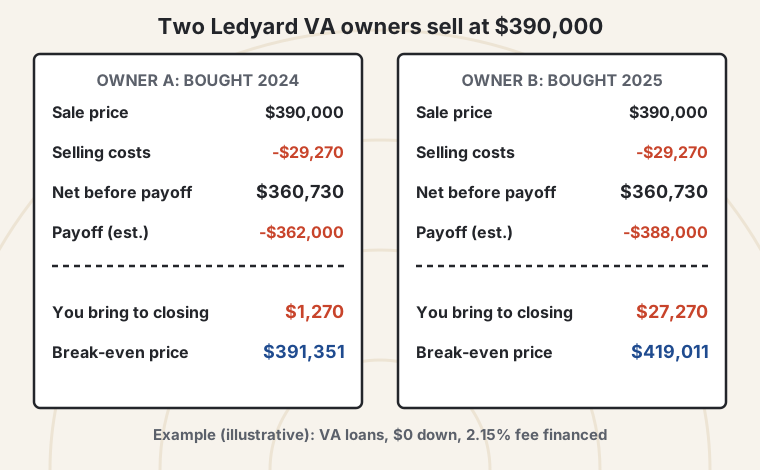
Example (illustrative). Two Ledyard owners each sell a house at $390,000, the town’s single-family median. Both bought with a VA loan and no down payment, with the 2.15% funding fee financed. The interest rates, payoffs and costs are estimates for illustration, not anyone’s real loan.
| Line | Owner A: bought 2024 for $365,000 | Owner B: bought 2025 for $385,000 |
|---|---|---|
| Sale price | $390,000 | $390,000 |
| Commission, 5% (est.) | -$19,500 | -$19,500 |
| Conveyance tax, 1% (CGS 12-494) | -$3,900 | -$3,900 |
| Seller’s attorney (est.) | -$1,200 | -$1,200 |
| Prep and cleaning (est.) | -$2,000 | -$2,000 |
| 3 months of tax, insurance, utilities at $890 (est.) | -$2,670 | -$2,670 |
| Net before payoff | $360,730 | $360,730 |
| Mortgage payoff (est.; 6.75% and 6.5% 30-year loans) | -$362,000 | -$388,000 |
| You bring to closing | $1,270 | $27,270 |
| Break-even sale price | $391,351 | $419,011 |
The formula, so you can run it on your own numbers:
- Add your payoff and your fixed costs. For Owner A: $362,000 + $1,200 attorney + $2,000 prep + $2,670 carrying = $367,870.
- Subtract the percentage costs from 1. With 5% commission and 1% conveyance tax: 1 − 0.06 = 0.94.
- Divide: $367,870 ÷ 0.94 = $391,351. Any price above that, and you walk away with something.
Your real payoff comes from your lender’s payoff statement, not your monthly statement; it includes interest to the closing day. Your attorney can request it. If you want the full step-by-step method for every number, see our guide to calculating your net proceeds, or put your numbers in here:
How much would you walk away with?
Slide the numbers to match your house. It works in your browser; nothing is saved or sent.
Estimates for planning. Conveyance tax per CGS 12-494 (state 0.75% up to $800,000, 1.25% to $2.5M, 2.25% above, plus the town rate). Seller attorney about $1,200 to $1,500; flat-fee MLS about $400; listings include three months of taxes, insurance and utilities, a cash sale about two weeks. Your attorney gives you the final numbers.
What should a military owner with PCS orders near Groton know before selling?
A military owner with PCS orders near Groton should know that a VA loan can be kept and the house rented, sold, or in some cases assumed by a qualified buyer, and that each choice affects your VA entitlement differently. Before you list, get a payoff statement, run the break-even math, and talk to your lender and your base’s housing or legal assistance office about renting versus selling.
Points worth checking before you decide:
- Your VA entitlement. If you sell and the loan is paid off, your entitlement can usually be restored for your next VA purchase. If you rent the house and keep the loan, part of your entitlement stays tied to it. Ask the VA or your lender how much remains for your next duty station.
- Renting it out. VA loans require that you intend to live in the house when you buy. A later move on orders is a normal reason to rent it out, but tell your lender and switch to a landlord insurance policy. Being a long-distance landlord has its own costs; see the truth about being a landlord in Connecticut.
- A VA loan assumption. VA loans can be assumed by a buyer the lender approves. The buyer pays a 0.5% VA funding fee for the assumption (VA). Federal law lets you be released from liability if the loan is current, you notify the lender, and the buyer qualifies (38 U.S.C. 3714). Unless the buyer is a veteran who substitutes their own entitlement, yours stays tied to the loan. An assumption mainly helps when your rate is lower than today’s rates.
- Your timeline. A listing usually takes about three months from prep to closing. If your report date is sooner, plan for a remote closing: Connecticut attorneys can close with a power of attorney or by mail. See selling when you are relocating.
What are your options if you are underwater on a Ledyard house?
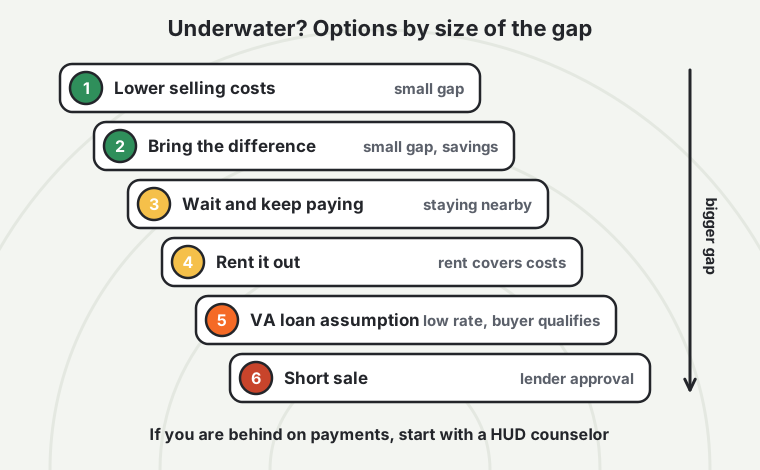
Your options if you are underwater on a Ledyard house are to wait and keep paying, rent it out, sell and bring the difference in cash, lower your selling costs, let a qualified buyer assume a VA loan, or ask your lender for a short sale. Which one fits depends on the size of the gap, your timeline, and whether you are current on payments.
| Option | Fits when | The catch |
|---|---|---|
| Lower selling costs | The gap is small (Owner A) | At a 4% commission, Owner A’s break-even falls to about $387,232 |
| Bring the difference | You have savings and want a clean exit | The money is gone; a loss on a home is not tax-deductible (IRS Pub. 523) |
| Wait and keep paying | You are staying in the area for now | Each payment pays down the loan slowly; prices may or may not rise |
| Rent it out | Rent covers the payment, tax and insurance | Landlord duties from far away; part of your VA entitlement stays in use |
| VA loan assumption | Your rate is low and a buyer qualifies | Lender approval; entitlement stays tied unless the buyer substitutes theirs |
| Short sale | The gap is large and you have a hardship | Lender approval, months of paperwork, credit impact |
A short sale means the lender agrees to accept less than the full payoff. It takes time and paperwork, and the lender decides whether to forgive the rest. Our short sale vs. foreclosure guide explains how it works in Connecticut. If you are already behind on payments, start with a free HUD-approved housing counselor before you list or sign anything.
Does a cash sale help if you are underwater in Ledyard?
A cash sale usually does not help if you are underwater in Ledyard, because a lower price makes the gap bigger. For Owner B in our example, a cash offer at 80% of value ($312,000, example) nets about $307,680 after conveyance tax and attorney, which would mean bringing about $80,320 to closing instead of $27,270 when listing.
A cash sale can still make sense with thin equity in narrow cases: the house needs repairs that would cost more than the price difference, it is vacant and costing you every month, or you must close before orders take effect and cannot manage a listing from away. Our cash buyer vs. realtor page shows that trade-off with break-even math, and why cash offers are lower explains how buyers price.
When should you NOT sell your Ledyard house to a cash buyer?
You should not sell your Ledyard house to a cash buyer when you have little or no equity and the house is in decent shape. A listing gets you closer to break-even, and a lower cash price only increases what you bring to closing. You should also never pay a fee to anyone who promises to “fix” negative equity or to take over your payments without the lender’s approval.
Be careful with offers to “take over your payments” while the loan stays in your name. If the new owner stops paying, the late payments and any foreclosure land on your credit and, with a VA loan, on your entitlement. Our pages on subject-to deals and their risks and red flags in home-buying offers explain what to watch for.

When a seller calls me with a payoff close to the price, the first thing I do is the break-even math with them. Often the honest answer is “list it, negotiate the commission, and you’ll walk away even.” That conversation costs nothing, and it beats guessing.
What should you do first if you think selling will cost you money?
If you think selling will cost you money, first get your real payoff from your lender, then estimate a realistic price from recent Ledyard sales, run the break-even formula, and compare the options before you sign a listing agreement. If you are behind on payments, talk to a free housing counselor first. The whole check takes about a week.
Request a payoff statement
Not your monthly statement: the lender’s figure with interest to a closing date.
Price it from Ledyard sales
Use recent sales of similar houses in similar condition, not the price you paid.
Run the break-even
(Payoff + fixed costs) ÷ (1 − commission − 1% conveyance tax).
Compare the options
Lower costs, wait, rent, assume, bring cash or short sale, using the gap you found.
Get help on the paperwork
Your lender for assumption or short sale rules, a Connecticut attorney for the closing (CGS 51-88a), and a HUD-approved counselor if you are behind.
If you have real equity and want a cash number to compare, our Ledyard page is where to ask for one.
Questions about losing money on a Ledyard sale
Will selling my house cost me money in Ledyard, CT?
Selling your house will cost you money in Ledyard, CT if your payoff is higher than the price minus selling costs. On a $390,000 sale, costs of about $29,270 in our example mean you need a payoff under about $360,730 to walk away with anything.
How much does it cost to sell a house in Ledyard?
It costs about $29,270 to sell a $390,000 Ledyard house by listing in our example: a 5% commission (est.), $3,900 of conveyance tax, an attorney, prep and three months of carrying costs. Your mortgage payoff is subtracted after that.
What happens if I owe more than my house is worth?
If you owe more than your house is worth, you can bring the difference to closing, wait, rent it out, or ask the lender for a short sale. The lender will not release the mortgage at closing unless it is paid in full or the lender agrees to accept less.
Can I sell my house after two years with a VA loan?
Yes, you can sell your house after two years with a VA loan; there is no minimum time. With no down payment and a financed funding fee, though, your equity may be thin, so run the break-even math before you list.
Can someone take over my VA loan in Ledyard?
Someone can take over your VA loan in Ledyard if the lender approves the buyer. The buyer pays a 0.5% VA funding fee, and you can request a release of liability (38 U.S.C. 3714). Your entitlement stays in use unless the buyer is a veteran who substitutes theirs.
Do I pay conveyance tax if I sell at a loss?
Yes, you pay conveyance tax even if you sell at a loss. In Ledyard it is 1% of the price on homes up to $800,000 (CGS 12-494), paid by the seller, on $390,000 that is $3,900.
Is a loss on selling my home tax-deductible?
A loss on selling your main home is not tax-deductible, according to IRS Publication 523. A loss on a rental property is treated differently, so ask a tax professional if you rented the house out.
What is the property tax on a Ledyard house?
The property tax on a $390,000 Ledyard house is about $7,060 a year at the fiscal 2027 mill rate of 25.87, assuming a 70% assessment, or about $589 a month. Ledyard bills in two installments, July 1 and January 1.
Should I rent my Ledyard house instead of selling when I PCS?
Renting your Ledyard house instead of selling can make sense when the rent covers the payment, tax, insurance and upkeep, and you can manage it from away. It keeps part of your VA entitlement in use, so compare it with selling first.
Related guides
The cost series
Thin equity and moves
For every step from first decision to closing, see how to sell a house in Connecticut.
Plain-English information, not legal, tax or financial advice. The Ledyard examples use public data and labelled estimates; your loan, your rate and your numbers will differ.
Sources (checked on October 27, 2026)
- Connecticut OPM, Real Estate Sales (data.ct.gov dataset 5mzw-sjtu): Ledyard residential sales, October 2021 to September 2025.
- Connecticut OPM mill rates (Ledyard, fiscal 2027: 25.87).
- Town of Ledyard Tax Collector (installments due July 1 and January 1).
- CGS § 12-62a (assessment at 70% of market value).
- CGS § 12-494 (conveyance tax).
- CGS § 51-88a (closings conducted by Connecticut attorneys).
- U.S. Department of Veterans Affairs, VA funding fee and closing costs.
- 38 U.S.C. § 3714 (assumption and release from liability).
- IRS Publication 523, Selling Your Home.
- HUD, find a housing counselor.

Who wrote this
Jerryll Noorden
Jerryll has bought and sold Connecticut houses since 2016 and has sat at more closing tables than he can count, on both sides. Before real estate he was a robotics scientist at NASA, IHMC and IIT. He wrote this guide because the national sites that rank for it skip the Connecticut rules that cost sellers money. When listing or selling it yourself would get you more than a cash offer, he says so.
This guide explains Connecticut rules in plain English. It is not legal or tax advice. Laws change; for your sale, talk to a Connecticut real estate attorney and a tax professional.
