
Key facts at a glance
This Seymour guide is part of our guide to how to sell a house in Connecticut. It teaches you to calculate your own net proceeds, the money you actually walk away with, step by step, and shows where each number comes from, worked on a typical Seymour house.
| Fact | Number | Source |
|---|---|---|
| Seymour residential sales, Oct 2023 to Sep 2024 (latest reported) | 186 | CT OPM Real Estate Sales, data.ct.gov |
| Seymour median sale price, all residential | $350,000 | CT OPM Real Estate Sales |
| Seymour median single-family sale price | $372,000 | CT OPM Real Estate Sales |
| Seymour mill rate, fiscal 2027 | 28.64 mills | CT OPM mill rates |
| Property tax on a $372,000 Seymour house | About $7,460 a year, two installments of $3,730 | Mill rate × 70% assessment (CGS 12-62a) |
| Seymour tax installments | Due July 1 and January 1 (bills over $100) | Seymour Tax Collector |
| Conveyance tax on a $372,000 Seymour sale | $3,720 (0.75% state + 0.25% town) | CGS 12-494 |
Why is it hard to know what you will walk away with when you sell in Seymour?
It is hard to know what you will walk away with when you sell in Seymour because the number depends on documents most sellers have never seen: a lender’s payoff statement, a tax adjustment, a conveyance tax return. Sellers at this stage often feel uncertain, a bit overwhelmed by the paperwork, wary of being told only what someone wants them to hear, and eager to plan their next move with a real number.
Maybe you own a ranch up on the hill above the Naugatuck River, or a cape near downtown that has been in the family for decades. You know roughly what houses on your street sell for. What you do not know is how much of that price is yours after everyone is paid. Agents and buyers will each give you a number, and each has a reason to make it look a certain way.
I am Jerryll Noorden. I have bought houses across Connecticut since 2016, about ten a year. I would rather you check my numbers, and everyone else’s, than take them on faith. So this page teaches you the method. Once you can run it yourself, no one can confuse you with a percentage.
If you own a house in Seymour and want to calculate your own net proceeds before you talk to anyone, this page is for you.
How do you calculate net proceeds on a house sale in Seymour, CT?
You calculate net proceeds on a house sale in Seymour, CT by starting with the sale price and subtracting the commission, the 1% conveyance tax (CGS 12-494), your attorney’s fee, any property tax owed or adding any tax you prepaid, other closing charges, and your mortgage payoff. On a $372,000 Seymour house in our example, that leaves about $170,190 after a $180,000 payoff.
In one line: Net proceeds = price − commission − conveyance tax − attorney ± tax adjustment − other charges − payoff. The rest of this page shows where each of those numbers comes from and works the formula on Seymour figures. The full list of costs a Connecticut seller can face is in our seller closing costs guide; you do not need all of them, only the ones that apply to you.
Where does each number in the net proceeds formula come from?
Each number in the net proceeds formula comes from a specific document: the price from your contract or recent Seymour sales, the commission from your listing agreement, the conveyance tax from the state rate table, the attorney fee from your attorney’s quote, the tax adjustment from your Seymour tax bill, and the payoff from your lender’s written payoff statement. Gather those six and you can calculate it yourself.
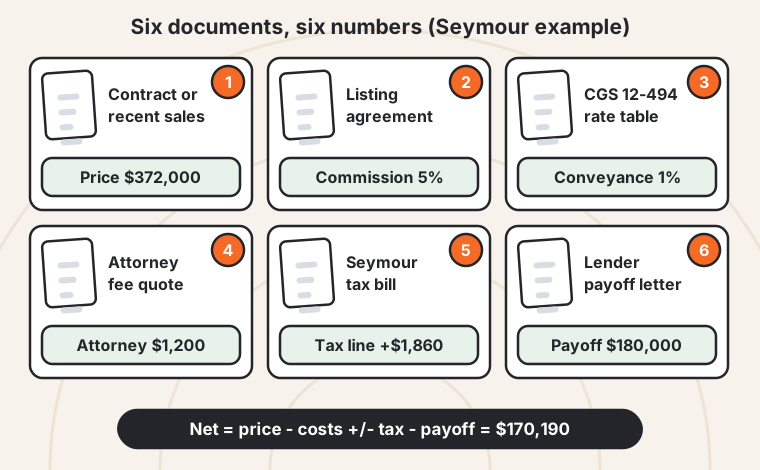
| Input | Where it comes from | Who gives it to you | Seymour example |
|---|---|---|---|
| Sale price | Signed contract; before that, recent sales of similar Seymour houses | You, your agent, or the state sales data | $372,000 |
| Commission | Listing agreement and any buyer-agent arrangement | Your agent (negotiable, CGS 20-325b) | 5% (est.) = $18,600 |
| Conveyance tax | State rate table: 0.75% state + 0.25% Seymour | Your attorney files Form OP-236 | 1% = $3,720 |
| Attorney fee | Written fee quote | Your Connecticut attorney | $1,200 (est.) |
| Tax adjustment | Your Seymour tax bill and the closing date | Seymour Tax Collector; your attorney | +$1,860 (credit) |
| Other charges | Final utility bills, liens, association dues | Utilities, your attorney’s title search | $150 (est.) |
| Mortgage payoff | Written payoff statement with a “good through” date | Your lender, at your attorney’s request | $180,000 (example) |
What are the net proceeds on a typical Seymour house?
The net proceeds on a typical Seymour house, sold at the $372,000 single-family median with a 5% commission (est.) and a $180,000 mortgage payoff, come to about $170,190 in our example. The selling costs total about $23,670, the property tax adjustment returns about $1,860 to the seller, and the payoff takes the rest. Your own number will move most with your price and your payoff.
Example (illustrative). A Seymour single-family house sells at the median of $372,000 and closes on March 31, 2027. The seller has paid both installments of the tax bill due July 1, 2026 and January 1, 2027, and owes $180,000 on the mortgage, including interest to the closing day.
| Step | Calculation | Running total |
|---|---|---|
| 1. Start with the price | $372,000 | $372,000 |
| 2. Subtract the commission | $372,000 × 5% = $18,600 | $353,400 |
| 3. Subtract the conveyance tax | $372,000 × 1% = $3,720 | $349,680 |
| 4. Subtract your attorney | $1,200 (est.) | $348,480 |
| 5. Add the tax credit for prepaid days | 91 days (April 1 to June 30) × $20.44 = $1,860 | $350,340 |
| 6. Subtract other charges | Final water and sewer reading, $150 (est.) | $350,190 |
| 7. Subtract the payoff | $180,000 (example) | $170,190 |
A shortcut for steps 2 and 3: commission and conveyance tax are both percentages, so you can multiply once. With 5% commission and 1% conveyance tax, price × 0.94 gives you the same $349,680. Then handle the fixed amounts. Try your own numbers here:
How much would you walk away with?
Slide the numbers to match your house. It works in your browser; nothing is saved or sent.
Estimates for planning. Conveyance tax per CGS 12-494 (state 0.75% up to $800,000, 1.25% to $2.5M, 2.25% above, plus the town rate). Seller attorney about $1,200 to $1,500; flat-fee MLS about $400; listings include three months of taxes, insurance and utilities, a cash sale about two weeks. Your attorney gives you the final numbers.
If you are listing, add the costs that happen before closing to your plan, such as paint, cleaning and the months of tax and insurance while the house is for sale. Our guide to what listing costs beyond the commission prices those. For a full seller closing statement laid out line by line, see the Farmington net sheet.
How do you calculate the property tax line for a Seymour closing?
You calculate the property tax line for a Seymour closing by dividing your annual tax bill by 365 to get a daily rate, then counting the days between closing and the end of the installment period. Seymour bills over $100 in two installments, due July 1 and January 1. If you prepaid days after closing, the buyer credits you; if an installment is due and unpaid, it comes out of your proceeds.
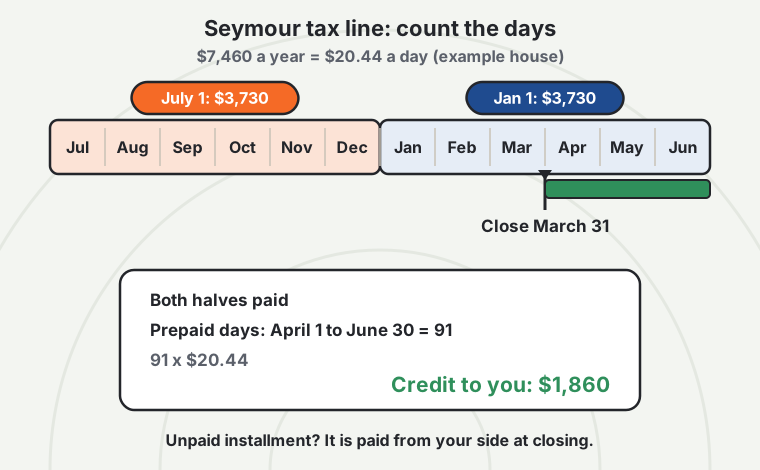
On a $372,000 Seymour house, the annual tax is about $372,000 × 70% × 28.64 ÷ 1,000 = $7,460, or $20.44 a day. Your actual bill uses your assessment from Seymour’s last revaluation, so use the number on your bill, not this estimate. Then:
- Find the period. Connecticut attorneys usually treat the July installment as covering July 1 to December 31 and the January installment as covering January 1 to June 30.
- Check whether it is paid. Seymour gives you until August 1 and February 1 to pay without interest. After that, interest is 1.5% a month (Seymour Tax Collector). An unpaid installment is paid at closing from your side.
- Count the days. Days you prepaid after closing come back to you as a credit; days you owned the house but have not paid for are charged to you.
Practices can differ, and your contract may set its own rule, so ask your attorney to confirm the tax line a week before closing. One Seymour detail: about 83% of homes in town heat with oil (2025 state parcel data). If yours does, the buyer usually pays you for the oil left in the tank, a Connecticut custom, so get a reading before closing.
How do you read a mortgage payoff statement?
You read a mortgage payoff statement by finding three things: the total payoff amount, the “good through” date it is valid until, and the per-diem interest added for each day after that date. The total is your unpaid principal plus interest to that date plus any fees. It is usually higher than the principal balance on your monthly statement, because mortgage interest is paid in arrears.
Your attorney orders the official payoff before closing, but you can call your servicer earlier for an estimate. When you get it, check:
- Escrow balance. If you pay taxes and insurance through escrow, the leftover escrow is usually refunded to you after the loan is paid off. It is not usually subtracted from the payoff.
- Second loans. A home equity line of credit has its own payoff, and it must be closed, not just paid to zero, so it is released.
- Other liens. Your attorney’s title search shows any judgment or unpaid tax lien, which must be paid at closing. See selling a house with a lien in Connecticut.
If the payoff is close to or above your price minus costs, you may need to bring money to closing. Our guide to when selling costs you money shows how to find your break-even price.
How do you run the same numbers on a cash offer?
You run the same numbers on a cash offer by using the same formula with the offer price, a zero commission line, and fewer months of carrying costs. The conveyance tax is still 1%, charged on the lower price, and you still pay your attorney and settle the tax and payoff. Then compare the two nets, not the two prices.
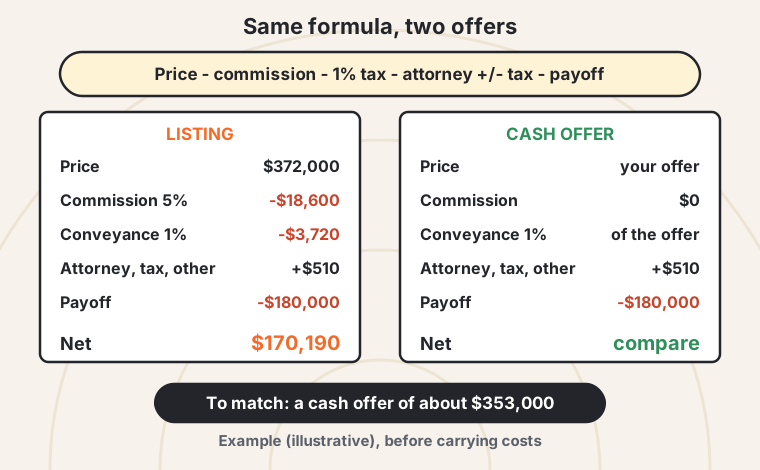
Here is the cash version with a placeholder offer, so you can plug in any number you receive: offer − 1% conveyance tax − $1,200 attorney ± tax adjustment − other charges − payoff. If your listing net in the example is $170,190, a cash offer has to come in at roughly $353,000 (about 95% of the price) to match it before carrying costs. That is more than buyers who renovate and resell usually pay for a house that needs nothing. Our cash buyer vs. realtor page shows the full break-even, including months of carrying costs, and our page on why cash offers are lower explains why the gap exists.
When should you NOT sell your Seymour house to a cash buyer?
You should not sell your Seymour house to a cash buyer when your own net proceeds calculation shows that listing leaves you meaningfully more, the house is in good shape, and you have about three months. A cash sale fits better when repairs, vacancy or a deadline would cut your listing net. You should also walk away from any buyer who will not show you their math or charges a fee.
Seymour has an older housing stock: 41% of homes were built before 1960 (2025 state parcel data). If yours needs a roof, a new heating system or an oil tank removal you cannot fund, the listing net drops, and a cash sale can come out closer than it first looks. See selling a house that needs repairs in Seymour and selling a house that needs repairs.

When I make an offer, I show the seller the same line-by-line math I would run for myself. If an agent or a buyer gives you a number without the lines behind it, ask for them. Anyone with an honest number can show their work.
How do you calculate your Seymour net proceeds yourself, step by step?
To calculate your Seymour net proceeds yourself, gather six documents, set a realistic price from recent Seymour sales, multiply it by 0.94 for a 5% commission and 1% conveyance tax, subtract your attorney’s fee, add or subtract the tax adjustment, subtract other charges and your payoff. It takes about an hour once the payoff estimate arrives.
Gather the documents
Your last tax bill, a mortgage statement, any home equity statement, and a recent utility bill.
Set a realistic price
Recent Seymour sales of similar houses in similar condition, from your agent or the state sales data.
Apply the percentage costs
Price × (1 − commission rate − 1% conveyance tax).
Subtract the fixed costs
Attorney fee, final utility bills, any association dues or liens.
Adjust for property tax
Annual bill ÷ 365 × the prepaid or unpaid days for your closing date.
Subtract the payoff
Use the lender’s payoff estimate, not your monthly statement balance.
If you would like a cash number to run through the same formula, our Seymour page is where to request one, with no fee and no deadline.
Questions about net proceeds in Seymour, CT
How do I calculate net proceeds from selling my house in Seymour?
You calculate net proceeds from selling your house in Seymour as price − commission − 1% conveyance tax − attorney ± property tax adjustment − other charges − mortgage payoff. On a $372,000 house with a $180,000 payoff, our example nets about $170,190.
What is the conveyance tax in Seymour, CT?
The conveyance tax in Seymour, CT is 1% of the price on homes up to $800,000: 0.75% state and 0.25% town (CGS 12-494). The seller pays it at closing; on $372,000 it is $3,720.
When are Seymour property taxes due?
Seymour property taxes over $100 are due in two installments, July 1 and January 1, with no interest until August 1 and February 1. Late payments carry interest of 1.5% a month (Seymour Tax Collector).
What is the property tax on a Seymour house?
The property tax on a $372,000 Seymour house is about $7,460 a year at the fiscal 2027 mill rate of 28.64, assuming a 70% assessment. Your bill uses your assessment from the last revaluation, so check your own.
How do I get my mortgage payoff amount?
You get your mortgage payoff amount by asking your lender or servicer for a written payoff statement; your closing attorney orders the official one. It shows the total, a good-through date and the per-day interest after that date.
Is my escrow balance subtracted from my payoff?
Your escrow balance is usually not subtracted from your payoff. After the loan is paid off at closing, the servicer typically refunds any leftover escrow to you, often within a few weeks.
What percentage of the sale price do Seymour sellers keep?
Seymour sellers keep about 94% of the price before fixed costs and the payoff when they pay a 5% commission and the 1% conveyance tax. After an attorney and other small charges, selling costs in our example are about 6.4% of the price, partly offset by any prepaid tax credit.
Do I pay capital gains tax when I sell my Seymour house?
You usually do not pay capital gains tax when you sell your Seymour home if you lived in it two of the last five years and your gain is under $250,000, or $500,000 for a married couple (IRS Publication 523). Larger gains and rentals are taxed.
How much cash offer do I need to match listing in Seymour?
You need a cash offer of roughly $353,000, about 95% of the price, to match the listing net on a $372,000 Seymour house in our example, before carrying costs. Run your own numbers with the same formula.
Related guides
The cost series
The inputs in detail
Near Seymour
For every step from first decision to closing, see how to sell a house in Connecticut.
Plain-English information, not legal or tax advice. The Seymour example uses public data and labelled estimates; your attorney’s settlement statement is the final word on your numbers.
Sources (checked on October 27, 2026)
- Connecticut OPM, Real Estate Sales (data.ct.gov dataset 5mzw-sjtu): Seymour residential sales recorded October 2023 to September 2024, the latest period Seymour has reported.
- Connecticut OPM mill rates (Seymour, fiscal 2027: 28.64).
- Town of Seymour Tax Collector (installments, grace periods, interest).
- CGS § 12-62a (assessment at 70% of market value).
- CGS § 12-494 (conveyance tax).
- CGS § 20-325b (commission not fixed by law).
- CGS § 51-88a (closings conducted by Connecticut attorneys).
- IRS Publication 523, Selling Your Home.

Who wrote this
Jerryll Noorden
Jerryll has bought and sold Connecticut houses since 2016 and has sat at more closing tables than he can count, on both sides. Before real estate he was a robotics scientist at NASA, IHMC and IIT. He wrote this guide because the national sites that rank for it skip the Connecticut rules that cost sellers money. When listing or selling it yourself would get you more than a cash offer, he says so.
This guide explains Connecticut rules in plain English. It is not legal or tax advice. Laws change; for your sale, talk to a Connecticut real estate attorney and a tax professional.
