
Key facts at a glance
| Fact | Number | Source |
|---|---|---|
| Manchester single-family median sale price, 2008 | $197,000 | CT OPM sales, data.ct.gov 5mzw-sjtu (our calculation) |
| Manchester median, 2015 and 2019 | $172,500 and $195,000 | data.ct.gov 5mzw-sjtu (our calculation) |
| Manchester median, 2024 | $312,000 | data.ct.gov 5mzw-sjtu (our calculation) |
| Enfield single-family median, 2008 vs 2024 | $196,000 vs $300,000 (2015: $170,000) | data.ct.gov 5mzw-sjtu (our calculation) |
| Manchester mill rate, fiscal 2027 | 41.0 mills (about $746 a month on a $312,000 house) | CT OPM; assessment at 70% (CGS 12-62a) |
| Conveyance tax on a $312,000 Manchester sale | $3,120 (0.75% state + 0.25% town) | CGS 12-494 |
| Typical time sellers had owned their home | 11 years, a record (national) | NAR 2025 Profile of Home Buyers and Sellers |
This page is one chapter of our guide to how to sell a house in Connecticut. It answers one question: why selling your own home stirs up so much emotion, and how to make clear decisions anyway. It is not about staging tricks or buyer psychology; for what buyers look for, read what buyers look for in a house in Connecticut. This one is about you.
Why does selling your home feel so emotional?
Selling your home feels so emotional because you are not only selling a building. You are ending a chapter, putting a price on years of your life, and taking a financial risk all at once. Research on loss aversion, the endowment effect and anchoring shows that ordinary, sensible people value what they own above what buyers will pay, and fear a loss more than they welcome an equal gain.
None of that is a flaw in you; it is how judgment works under stress. Once you know the pattern, you can plan around it. Four forces do most of the damage:
- Attachment. You value the house more because it is yours and because you put work into it.
- Loss aversion. Selling below what you paid, or below a number you had in your head, hurts more than an equal gain pleases.
- Anchoring. The first number you heard, the price you paid or a neighbor’s sale, pulls your price toward it.
- Decision overload. A sale is dozens of decisions in a few weeks, on top of a move and a job.
What are you feeling right now, and is it normal?
What you are feeling right now, whether it is grief, guilt, anxiety, defensiveness or quiet relief, is normal for someone selling a home. Sellers nationally had owned their homes for a record 11 years before selling (NAR 2025), and in Connecticut many have owned far longer. A decade of birthdays, repairs and holidays does not let go on a schedule set by a listing date.
Maybe you are walking through the Cape you bought in Manchester the year your first child was born. Maybe it is your parents’ house in Hamden, and every closet still smells like them. Maybe you love the house but the taxes, the stairs or the oil bill have become too much. Sellers in this spot usually feel some mix of these:
- Grief. You are losing a place, and the life that happened in it. Back in 1967, Holmes and Rahe put “change in residence” on their life-stress scale; it was stressful long before anyone listed a house online.
- Guilt. Selling Mom’s house, or the house the kids grew up in, can feel like a betrayal. It is not, but the feeling is real.
- Fear of losing money. “What if I sell too low?” can keep you up at night, especially if you remember what you paid.
- Defensiveness. A buyer’s agent calls your kitchen “dated.” An inspector writes up the roof you replaced. It feels personal because it is your home.
- Overwhelm. Repairs, paperwork, showings, the move and a job, all at once.
- Relief, and then guilt about the relief. Many sellers are glad to be done with upkeep, then feel bad for being glad.
This page is for you if you want to name those feelings, see how they bend your decisions, and make a choice in October you still agree with in March.
Why does attachment make your house feel worth more than buyers will pay?
Attachment makes your house feel worth more than buyers will pay because people value things more once they own them, a pattern psychologists call the endowment effect. In a classic experiment, owners asked about twice what buyers would pay for the same coffee mug. Add years of memories and your own work on the house, and the gap between your number and a stranger’s number grows.
The mug study (Kahneman, Knetsch and Thaler, 1990) is small, but the idea scales. A buyer sees a 1962 ranch with a 2009 kitchen; you see the deck your father built and the height marks on the pantry door. Only one of you is pricing the memories.
Two related effects make it worse:
- Effort makes things feel more valuable. Researchers found people valued furniture they assembled themselves more than identical pre-built pieces (Norton, Mochon and Ariely, 2012). The $40,000 kitchen you managed yourself feels like a $40,000 addition to the price. Buyers usually pay for what is there now, not for what it cost.
- Your taste is not the market’s taste. The finished basement bar, the koi pond and the wallpaper you chose are features to you and work orders to many buyers.
Write two lists. On the first, put what you love about the house. On the second, put only what a stranger could see in a 30-minute showing and a home inspection. Price from the second list. Keep the first list; it belongs to you, not to the sale.
How does loss aversion keep sellers stuck?
Loss aversion keeps sellers stuck because a loss feels roughly twice as painful as an equal gain feels good, so sellers hold out to avoid “losing” against their purchase price. In a study of Boston condominium sellers in the 1990s, owners facing a loss set higher asking prices, got somewhat higher prices when they sold, and were much less likely to sell at all.
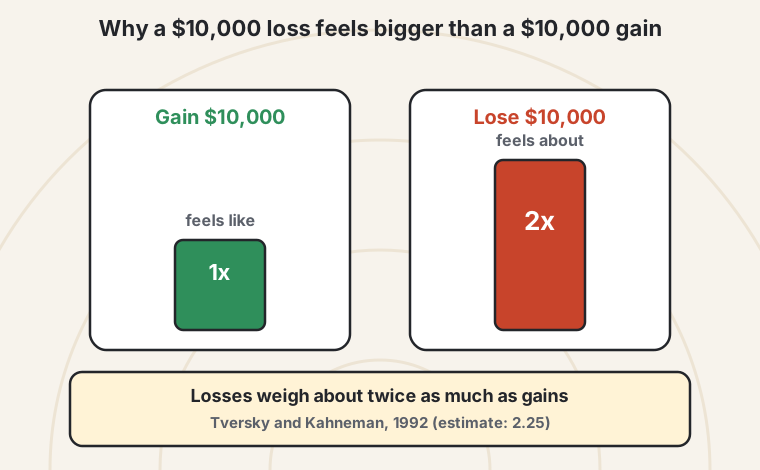
Loss aversion comes from prospect theory (Kahneman and Tversky, 1979). In their 1992 follow-up, Tversky and Kahneman estimated that losses weigh about 2.25 times as much as gains. Economists David Genesove and Christopher Mayer then tested it on real homes. Downtown Boston condo owners who would have sold at a loss set asking prices higher by 25% to 35% of the gap between the expected price and what they had paid. They did get a bit more when they sold, but they sold much less often. Many simply stayed stuck.
Connecticut sellers know this pattern well, because prices here took a long time to recover after 2008. In Manchester, the single-family median was $197,000 in 2008. It fell to $172,500 by 2015 and only returned to $195,000 in 2019. An owner who bought at the 2008 median and had to sell in 2015 faced a real loss on paper; one who waited could not know the 2020s jump was coming.
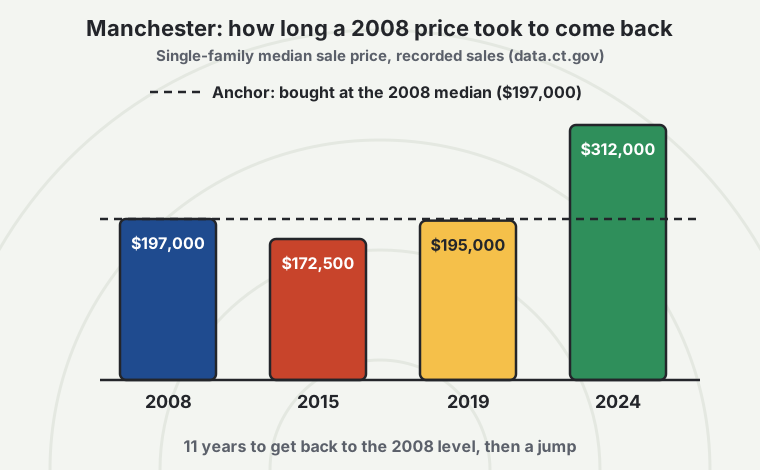
Enfield followed the same shape: $196,000 in 2008, $170,000 in 2015, $300,000 in 2024. Today most long-time Connecticut owners are sitting on gains, but loss aversion has a new target: the peak number. If a neighbor sold in spring for $40,000 more than your best offer, that gap can feel like a loss even when you are far above what you paid.
The fix is to compare the options you have today, after costs, not today’s offer with a number from the past. A loss against your memory is not a loss against your bank account.
Why do the price you paid and your neighbor’s sale anchor your thinking?
The price you paid and your neighbor’s sale anchor your thinking because the first number you see pulls later estimates toward it, even when it is irrelevant. Tversky and Kahneman showed this in 1974; in 1987 Northcraft and Neale found that even real estate agents’ value estimates moved with the listing price they were shown, while the agents said it had no effect on them.
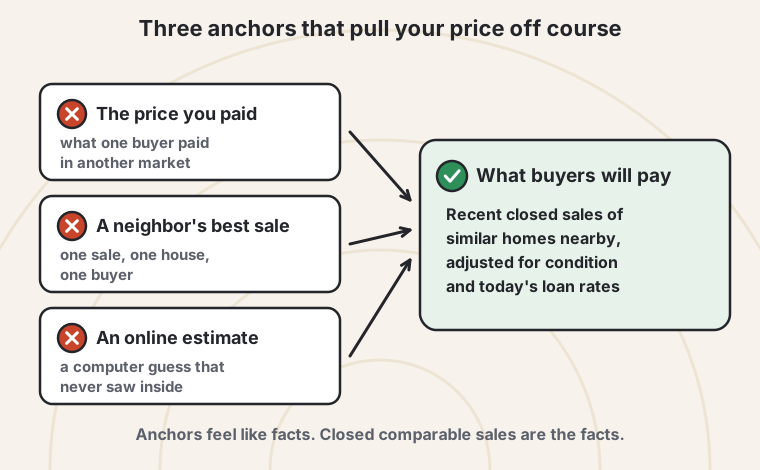
Here are the anchors Connecticut sellers bring to the kitchen table most often:
- The price you paid. It tells you what one buyer paid in a different year, with different rates and a newer house. Buyers do not know it and would not care.
- A neighbor’s best sale. One sale, one house, one buyer. It may have had a new roof, a bigger lot or a bidding war in April. It also may have closed for less than the number you heard at the mailbox.
- An online estimate. A computer model that never saw the inside of your house, the oil tank or the water stain in the basement.
- The first offer. A low first offer can make a mediocre second one feel like a win.
To loosen an anchor, replace it with better evidence: three to six recent, closed sales of similar homes nearby, adjusted for condition. Connecticut’s sales records are public on data.ct.gov, and our guide to how to price your house to sell shows how to use them step by step. Your assessment is not a price either; see assessed value vs market value.
What is decision fatigue, and how does it show up when you sell?
Decision fatigue is the idea that the quality of your choices drops after you have made many of them, and selling a house piles dozens of decisions into a few weeks. The research behind the idea is mixed: a large 2016 replication effort found little evidence for the “willpower runs out” version. But being stressed, tired and rushed reliably makes people fall back on defaults, delay or grab the nearest exit.
A lot of advice overstates the science. A 23-lab replication of “ego depletion” (Hagger and colleagues, 2016) found an effect close to zero, and a 2010 review of “choice overload” studies found a near-zero average effect too.
What is not in doubt is the workload: a route, a price, repairs, showings, offers, inspection requests, a closing date, movers and 30 years of belongings. In Connecticut you also hire an attorney, answer the condition report and sign a smoke and carbon monoxide affidavit at closing. Under that load, people tend to:
- Freeze. The listing date slides from April to June to “after the holidays.”
- Take the default. The first agent, the first price, the first offer, without comparing.
- Bail out. Accept anything to make it stop.
The answer is not more willpower. It is fewer live decisions: decide the big things once, in writing, before the pressure starts. The tools below do exactly that.
What does indecision cost a Connecticut seller?
Indecision costs a Connecticut seller real money every month the house sits, and property tax is the easiest part to measure. On a $312,000 house in Manchester, the town’s 2024 single-family median, the fiscal 2027 mill rate of 41.0 means about $746 a month in property tax alone, or $8,954 a year, before insurance, heat, utilities and upkeep.
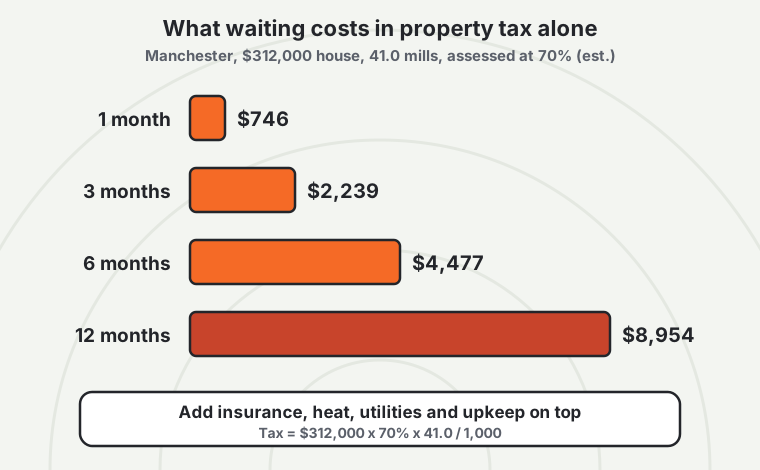
Example (illustrative). Here is the arithmetic, using public numbers only:
| Input or result | Manchester example |
|---|---|
| House value used | $312,000 (2024 single-family median) |
| Assessment (70% of value) | $218,400 |
| Mill rate, fiscal 2027 | 41.0 |
| Property tax per year | $8,954 (est.) |
| Property tax per month | $746 (est.) |
| Six months of indecision, tax only | $4,477 (est.) |
| Conveyance tax when you do sell | $3,120 (0.75% state + 0.25% town) |
Waiting is sometimes the right call. If you need time to grieve, to let a market season turn, or to finish probate, take it. The point is to choose to wait on purpose, with the monthly cost in front of you, instead of drifting. Our guide to what hesitating to sell really costs works the same math for a rural town. To see what you would actually walk away with after every cost, use the calculator:
How much would you walk away with?
Slide the numbers to match your house. It works in your browser; nothing is saved or sent.
Estimates for planning. Conveyance tax per CGS 12-494 (state 0.75% up to $800,000, 1.25% to $2.5M, 2.25% above, plus the town rate). Seller attorney about $1,200 to $1,500; flat-fee MLS about $400; listings include three months of taxes, insurance and utilities, a cash sale about two weeks. Your attorney gives you the final numbers.
How do you make a clear-headed decision about selling?
You make a clear-headed decision about selling by deciding the important numbers before emotions peak, writing them down, and comparing real options after costs instead of comparing offers with memories. Set a walk-away net figure, get two or three written numbers from different routes, name your anchors out loud, and give big decisions a 24-hour pause with one trusted person who is not emotionally tied to the house.
- Write your walk-away net before you list. Not a price: the cash you need after commission, conveyance tax, attorney and payoff. (Counters loss aversion.)
- Name your anchors out loud, then set them aside and look at closed sales. (Counters anchoring.)
- Get two real numbers from two routes, such as an agent’s pricing opinion and a written as-is offer. Our side-by-side of every way to sell lays them out.
- Use the friend test: “If my best friend owned this house, what would I tell them?”
- Run a pre-mortem. Imagine the sale went badly a year from now, write down why, and fix the top two reasons now.
- Batch small decisions into one sitting instead of the gaps of a workday.
- Pause 24 hours on anything irreversible, unless a real deadline forbids it.
- Bring one neutral person, not someone emotionally tied to the house or paid by the size of the sale.
- Keep the memories separate: photograph every room and take the keepsakes, so the sale does not have to carry the grief.
If you are still deciding whether to sell at all, that is a different question with its own guide: should I sell my house in Connecticut?
How do you handle the hardest moments: showings, low offers, inspections and closing day?
You handle the hardest moments of a sale by expecting them, because the same few moments hurt almost every seller: strangers walking through, a low first offer, the inspection report, and the last walk-through. Treat each as a business step with a plan made in advance, and keep your written walk-away number nearby so a single bad day does not decide the sale.
- Showings. Leave the house. Hearing a buyer criticize your bathroom helps no one. If open houses feel unbearable, see whether you need one at all.
- A low first offer. It is information, not an insult. Counter with evidence; our negotiating guide covers counters and credits.
- The inspection report. Every older Connecticut house produces a long one. Read it as items to price, credit or refuse, not as a verdict on how you cared for the house.
- Closing day. Say goodbye before the final walk-through. Connecticut closings run through attorneys, and you can often sign ahead of time; see the closing process guide.
What are your options, and when should you not sell to a cash buyer?
Your options are to list with an agent, sell by owner, or sell as-is to a cash buyer, and the right one depends on the house, your timeline and how much of the process you can carry. You should not sell to a cash buyer if the house is in good shape, you have time to prepare and show it, and your main obstacle is emotion rather than condition or deadline.
List with an agent
Top priceBest when the house shows well and you can live through a few weeks of showings.
- Commission and prep costs
- Showings, inspection, appraisal
- A professional between you and the buyer
Sell by owner
Most controlBest when you already know a buyer or enjoy running the process.
- You handle pricing and negotiation yourself
- Emotions sit closest to the deal
- See FSBO pros and cons
Sell as-is for cash
Fewest decisionsBest when repairs, distance, a deadline or exhaustion make the open market the harder road.
- No showings, no repairs, leave what you do not want
- Typically about 2 weeks to close
- Lower price; see why cash offers are lower
We buy Connecticut houses for cash ourselves, so here is the honest version from our side of the table: do not sell to us, or to any cash buyer, just because selling feels hard. Grief and anxiety pass; a lower price does not. If the house is sound and you have time, an agent, a clear plan and the tools above will usually leave you with more money. Our comparison of a cash buyer vs a realtor in Connecticut shows the trade-off in dollars.
A cash sale makes sense when the hard part is the house or the calendar, not only the feelings: repairs you cannot fund, an inherited house full of belongings, a move with a start date, or a situation where months of showings would cost more than the price difference. If that is you, a written as-is number is one more data point for the table, not a commitment.
Is a cash sale right for you, or should you list?
Seven quick questions. There is no wrong answer, and we will tell you honestly if listing would leave you more.
- Does the house need repairs you would rather not pay for or manage?
- Do you need to close by a certain date, or within the next month or two?
- Would showings be hard: tenants, belongings, privacy, or you live out of state?
- Is there a complication: an estate or probate, a divorce, foreclosure, liens or back taxes?
- Could you comfortably cover the mortgage, taxes and utilities for three or more months?
- Is getting the highest possible price more important to you than speed and certainty?
- Would a buyer's bank lend on the house as it is (no major roof, foundation, oil tank or code issues)?
How do you sell your home with a clear head, step by step?
To sell your home with a clear head, separate the goodbye from the business, set your numbers in writing first, compare at least two real options, and then follow a plan with dates. The steps below take about a week of thinking before you list, and they work whether you sell with an agent, by owner, or to a cash buyer.
Name what you feel (day 1)
Write down the two or three loudest emotions, so you notice when they try to decide for you.
Plan the goodbye (days 1 to 3)
Photos, keepsakes, a last gathering. Give the memories their own plan so the price does not have to carry them.
Write your walk-away net (days 2 to 4)
Payoff, commission, conveyance tax and attorney fees, then the minimum cash you need.
Replace anchors with evidence (days 3 to 5)
Find three to six closed sales of similar homes nearby. Set the price you paid, your neighbor’s sale and online estimates aside.
Get two real numbers (days 4 to 7)
An agent’s pricing opinion and, if it fits, a written as-is offer. Compare net, time and work.
Decide once, with one neutral person (day 7)
Pick the route, the price range and the walk-away number. After that, only new facts reopen the decision, not new feelings.

The sellers who look calmest at closing are rarely the ones who felt nothing. They are the ones who decided their number before anyone made an offer, and who said goodbye to the house before the last walk-through instead of during it. Do those two things and most of the hard days get shorter.
Questions about the emotions of selling your home
Is it normal to feel sad about selling your house?
It is normal to feel sad about selling your house. You are leaving the place where years of your life happened, and sellers nationally had owned their homes for a typical 11 years (NAR 2025). Grief, guilt and relief can all show up together. Plan a goodbye so the sadness has somewhere to go besides the price.
How do I emotionally detach from my home before selling?
To emotionally detach from your home before selling, start thinking of it as “the house” instead of “my home,” photograph every room, pack personal items early, and write down what a stranger would see in a showing. Detaching does not mean caring less; it means keeping the memories and the business decision separate.
Why do I think my house is worth more than buyers do?
You think your house is worth more than buyers do because owners value what they own above what buyers will pay, a pattern called the endowment effect. In a classic study, owners asked about twice what buyers offered for the same mug. Memories and your own work on the house widen that gap.
Should I sell my house for less than I paid?
Whether to sell your house for less than you paid depends on today’s options, not on the purchase price. Compare what you would net now with what waiting costs each month in tax, insurance and upkeep. In Manchester, for example, the 2008 median took about 11 years to come back.
What is loss aversion in real estate?
Loss aversion in real estate is the tendency of sellers to fear a loss against their purchase price more than they value an equal gain. A study of Boston condo sellers found those facing a loss asked more and sold less often. Losses weigh about twice as much as gains in experiments.
Does my neighbor’s sale price set the value of my house?
Your neighbor’s sale price does not set the value of your house. It is one sale of one house to one buyer, often with differences in condition, size and timing. Use three to six recent closed sales of similar homes, adjusted for condition, to judge value.
Is decision fatigue real when selling a house?
Decision fatigue as a measurable “willpower tank” has weak research support, but the workload of a house sale is real. Stress and time pressure push people toward defaults, delay or a rushed exit. Decide the big numbers once, in writing, and batch the small choices.
How much does it cost to wait to sell a house in Connecticut?
Waiting to sell a house in Connecticut costs at least the property tax, insurance, heat and upkeep each month. On a $312,000 Manchester house at 41.0 mills, property tax alone is about $746 a month, or $8,954 a year (est.).
Should I be at the closing when I sell my house?
You do not have to be at the closing when you sell your house in Connecticut. Closings are handled by attorneys, and sellers can often sign the deed and documents ahead of time. Ask your closing attorney early if being there would be too hard.
Is selling to a cash buyer a good idea if I am overwhelmed?
Selling to a cash buyer is a good idea if you are overwhelmed by the house itself, such as repairs, belongings or a deadline. It is not a good idea if the house is in good shape and the only obstacle is emotion; a listing will usually net more.
Related Connecticut guides
Buyers and marketing
We buy houses across the state, including in Manchester and Enfield. For every route, cost and step in one place, start with how to sell a house in Connecticut.
Plain-English information, not legal, financial or mental-health advice. Estimates are labeled (est.). If grief or stress is overwhelming, talk to your doctor or a counselor; talk to a Connecticut real estate attorney about your sale.
Sources (checked on October 27, 2026)
- Connecticut OPM real estate sales, data.ct.gov dataset 5mzw-sjtu (Manchester and Enfield single-family medians by year, our calculation).
- Connecticut OPM, mill rates (fiscal 2027).
- CGS 12-62a, assessment at 70% of value.
- CGS 12-494, real estate conveyance tax.
- NAR, 2025 Profile of Home Buyers and Sellers (seller tenure of 11 years).
- Genesove and Mayer, Loss Aversion and Seller Behavior: Evidence from the Housing Market (NBER w8143; Quarterly Journal of Economics, 2001).
- Kahneman and Tversky, Prospect Theory: An Analysis of Decision under Risk, Econometrica, 1979; Tversky and Kahneman, Advances in Prospect Theory, Journal of Risk and Uncertainty, 1992.
- Tversky and Kahneman, Judgment under Uncertainty: Heuristics and Biases, Science, 1974; Northcraft and Neale, Experts, Amateurs, and Real Estate, Organizational Behavior and Human Decision Processes, 1987.
- Kahneman, Knetsch and Thaler, Experimental Tests of the Endowment Effect and the Coase Theorem, Journal of Political Economy, 1990; Norton, Mochon and Ariely, The IKEA Effect, Journal of Consumer Psychology, 2012.
- Hagger and colleagues, A Multilab Preregistered Replication of the Ego-Depletion Effect, Perspectives on Psychological Science, 2016; Scheibehenne, Greifeneder and Todd, Can There Ever Be Too Many Options? Journal of Consumer Research, 2010.
- Holmes and Rahe, The Social Readjustment Rating Scale, Journal of Psychosomatic Research, 1967.

Who wrote this
Jerryll Noorden
Jerryll has bought and sold Connecticut houses since 2016 and has sat at more closing tables than he can count, on both sides. Before real estate he was a robotics scientist at NASA, IHMC and IIT. He wrote this guide because the national sites that rank for it skip the Connecticut rules that cost sellers money. When listing or selling it yourself would get you more than a cash offer, he says so.
This guide explains Connecticut rules in plain English. It is not legal or tax advice. Laws change; for your sale, talk to a Connecticut real estate attorney and a tax professional.
