
Key facts at a glance
| Fact | Number | Source |
|---|---|---|
| Essex single-family sales, Oct 2024 to Sep 2025 | 94 arm’s-length sales, median $675,000 | data.ct.gov (5mzw-sjtu) |
| Buyers who used open houses in their search | 48% (43% called them very useful) | NAR 2025 buyer profile |
| Buyers whose first step was visiting open houses | 3% | NAR 2025 buyer profile |
| Sellers whose agent held an open house | 59% | NAR 2025 buyer profile |
| Essex single-family homes heated with oil / built before 1978 | 79% / 53% (median year built 1975) | 2025 CT parcel data |
| Conveyance tax on an Essex sale | 1.0%: 0.75% state + 0.25% town (up to $800,000) | CGS 12-494 |
| Recording a conversation you are not part of | Class D felony (“mechanical overhearing”) | CGS 53a-187, 53a-189 |
This guide is part of our walk-through of how to sell a house in Connecticut. It answers one question for one town: should you open your Essex house to the public for an afternoon? It covers what the national buyer survey says about open houses, what is different in a small river town like Essex, Centerbrook and Ivoryton, how to protect your valuables, medicines and privacy, and what to do instead if strangers in the house is a step too far.
Should I have an open house in Essex, CT?
You should have an open house in Essex, CT only if the house is ready to be seen, you are comfortable with unscreened visitors, and your agent will host it properly. Open houses rarely sell a house by themselves: 48% of buyers used them, but only 3% started their search there (NAR 2025). In a town with about 94 single-family sales a year, private showings to screened buyers do most of the work.
Think of an open house as a bonus, not the plan. The plan is a correct price, good photos and a listing the right buyer finds online. An open house adds a relaxed walk-through for those buyers, and also risk, work and nosy neighbors.
Why does the idea of an open house feel so uncomfortable?
The idea of an open house feels uncomfortable because it asks you to leave your home for an afternoon while people you have never met open your closets, look at your family photos and judge the kitchen you cooked in for years. In a small town like Essex, some of those visitors may be neighbors who are simply curious, and that can feel more exposing than strangers.
Maybe the house was your parents’ and still holds their things. Maybe it needs work and you dread what people say in the hallway. Owners in this spot often feel exposed, anxious about theft, embarrassed about the condition, pressured by an agent who says “everyone does an open house”, and unsure whether saying no will cost them a buyer.
None of that is silly. This page is for you if you want a straight answer, backed by real numbers, and a plan you can live with, whether that is a well-run open house, private showings only, or no showings at all.
Do open houses actually sell houses?
Open houses help buyers look, but they seldom find the buyer on their own. In NAR’s 2025 survey of recent buyers, 48% used open houses as an information source and 43% found them very useful, yet just 3% made an open house their first step, and 52% found the home they bought on the internet. Open houses work best as a second look for buyers who already found the listing.
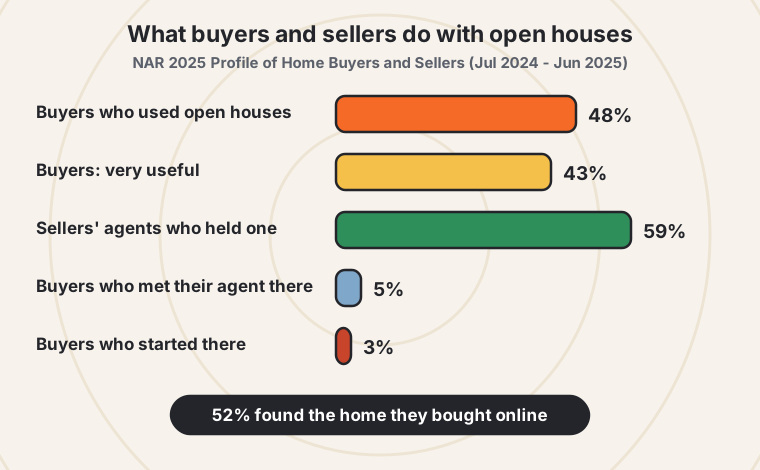
These figures come from the National Association of Realtors’ 2025 Profile of Home Buyers and Sellers (purchases from July 2024 to June 2025). It is national, not Connecticut-specific, and run by the agents’ trade group, so read it as a picture of how buyers search.
| What NAR measured | Result | What it means for you |
|---|---|---|
| Buyers who used open houses as an information source | 48% | About half of buyers walk through at least one |
| Buyers who found open houses very useful | 43% | Those who go value the unhurried look |
| First step was visiting open houses | 3% | Few buyers start there; they start online |
| Found the home they bought on the internet | 52% | Photos, price and description do the finding |
| Found their agent at an open house | 5% | Open houses also help agents meet clients |
| Sellers’ agents who held an open house | 59% | Common, but four in ten sellers skipped it |
Note the 5%: an open house also helps the hosting agent meet buyers who have no agent yet. That is fine, but ask your agent what the open house is for and how visitors will be followed up. Since August 17, 2024, buyers need a written agreement before an agent tours homes with them; NAR’s guidance is that walking into an open house does not require one.
What is different about an open house in Essex?
What is different about an open house in Essex is scale and visibility. Essex had 94 single-family sales in the year to September 2025, fewer than two a week, at a $675,000 median. With so few houses for sale, a sign on Saturday draws neighbors and casual drivers along with buyers, and the real buyer pool is small enough that one well-timed private showing can matter more than a crowd.
Essex is three villages, Essex Village, Centerbrook and Ivoryton, counted together in the state’s sales records. Over two recent sales years (Oct 2022 to Sep 2023 and Oct 2024 to Sep 2025; the file has no Essex records for the year between), 185 single-family homes sold, 40 of them (21.6%) from December to February. Essex has less of a “season” than a steady trickle of buyers.
Three local facts shape the open house itself:
- Older houses, oil heat. In the 2025 parcel data, 79% of Essex single-family homes heat with oil and 53% were built before 1978 (median 1975). Visitors will ask about the tank, the boiler, the roof and lead paint; a host who cannot answer loses credibility. Buyers of a pre-1978 house must get the federal lead disclosure before signing.
- Price point. At $675,000, many buyers are relocating or buying a second home and book private showings from a distance. A Sunday open house reaches local buyers and neighbors more than out-of-town ones.
- Everyone knows the house. An open house invites the curious. That is free word of mouth, and it is why privacy matters more here, not less.
Before you decide, get the basics right. A wrong price will not be fixed by an open house, and neither will deferred repairs. Our pillar on what to fix before selling a house in Connecticut sorts the repairs that pay back from the ones that do not.
How do you protect valuables, prescriptions and privacy at an open house?
You protect valuables, prescriptions and privacy at an open house by removing them from the house or locking them away, requiring every visitor to sign in with a name and phone number the agent can check, having two hosts so no room goes unwatched, keeping audio recording off, and walking every room and window lock after the last visitor leaves.
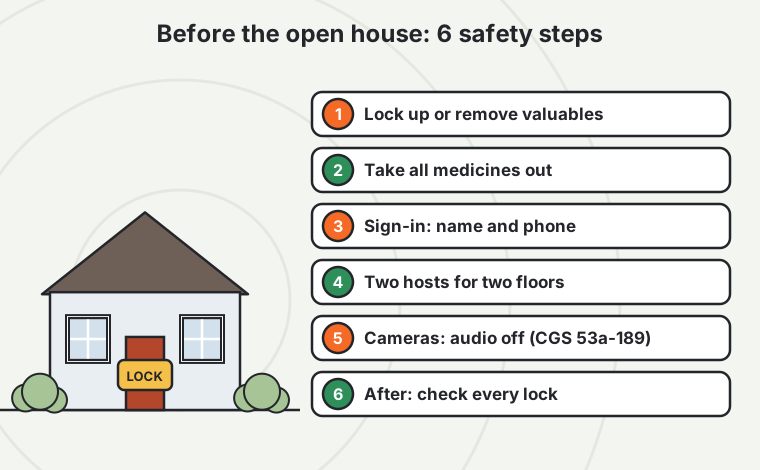
Valuables and personal papers
Take jewelry, cash, small electronics, spare keys, firearms and collectibles out of the house, or lock them in a bolted-down safe. Do the same with mail, bank statements, checkbooks and anything with a Social Security number. Put away family photos and children’s names too.
Prescriptions
Medicine cabinets get opened at open houses. Take every prescription out of the house for the day, not just the cabinet. Do not hide pills in a drawer. If you have old medicines you no longer need, dispose of them properly: Connecticut’s Department of Consumer Protection runs a prescription drug drop-box program at police departments and approved pharmacies, and its map shows the nearest box.
Sign-in sheets
A sign-in sheet only protects you if the agent checks it. Ask for each visitor’s name and phone number (some agents also ask for ID), and have the agent follow up by phone. A visitor who refuses to sign in can be shown the door politely. Keep the sheet out of other visitors’ sight.
Cameras and audio
Video cameras in your own home are common. Audio is different. Connecticut law makes it a crime to record a conversation you are not part of, without the consent of at least one person in it (CGS 53a-187 and 53a-189). If you are not at the open house, a doorbell or indoor camera that records sound may be recording conversations you are not part of. Turn off audio, or ask a Connecticut lawyer before you rely on it. Tell your agent where cameras are.
Insurance
Call your homeowners insurer before the first open house. Ask whether theft or damage during a showing is covered and whether the agent’s brokerage carries its own coverage. If the house is empty, also ask about vacancy limits.
What are the alternatives to an open house in Essex?
The alternatives to an open house in Essex are private showings by appointment to buyers whose agent has screened them, a broker open house for local agents only, a video walk-through and floor plan online for out-of-town buyers, or skipping showings entirely by selling directly to a buyer who sees the house once. Most Essex sellers can combine the first three and lose very little.
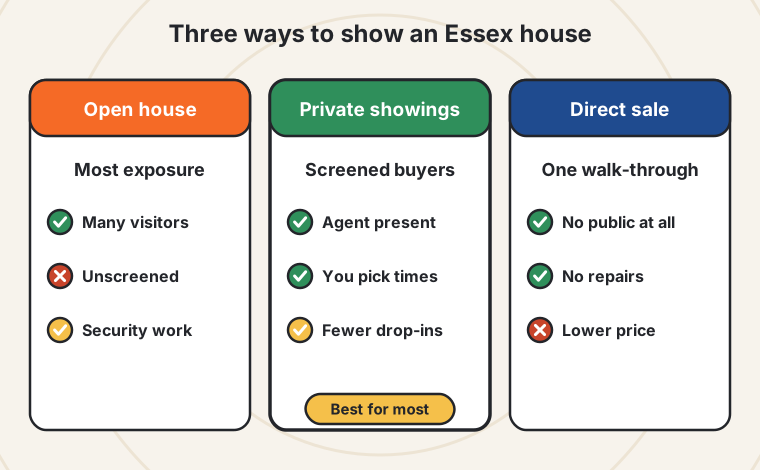
Public open house
Most exposureBest for a house that shows well and a seller who is comfortable with visitors.
- Unscreened visitors, including neighbors
- Two to three hours away from home
- Security work before and after
Private showings only
Screened buyersBest for most Essex sellers.
- Buyer’s agent present and identified
- You pick the time slots
- Slightly fewer casual lookers
Direct sale, no showings
One walk-throughBest when the house is not show-ready or privacy matters most.
- No public at all
- No repairs or staging
- A price below a retail listing
If you list, you can tell your agent “no public open houses” in writing. Ask for a broker open house instead, so local agents who already have qualified buyers see the house early, and ask for a video tour and floor plan in the listing for buyers who live out of state. Our guide to staging and photos covers what makes those online images work.
If any showing at all is the problem, because of a health issue, a hoarding situation, tenants or a house that needs too much work, read how to sell a house without showings in Connecticut, and our page on selling a house that needs repairs.
What does an open house cost an Essex seller?
An open house costs an Essex seller little in cash but real money in time. The direct costs are cleaning, a few hours away and some lost privacy. The real cost is how long the house stays unsold: at Essex’s 19.26 mill rate, property tax alone on a $675,000 house runs about $758 a month, before heat, insurance and any mortgage, and the 1.0% conveyance tax ($6,750) is due either way.
| Line | Essex example at $675,000 | Notes |
|---|---|---|
| State conveyance tax, 0.75% | $5,063 | CGS 12-494, paid by the seller at closing |
| Essex conveyance tax, 0.25% | $1,688 | Standard town rate |
| Property tax per year | About $9,100 | 19.26 mills x 70% of $675,000 (CGS 12-62a) |
| Property tax per month on the market | About $758 | Before heat, insurance, utilities and mortgage |
| Open house prep (cleaning, storage, lock box) | A few hundred dollars (est.) | Your own numbers |
| Missing property condition report | $500 credit to the buyer | CGS 20-327b and 20-327c |
So the question is whether the open house shortens the time to a good offer. For a well-priced, show-ready house, one or two in the first two weekends can help. For a house that needs work, it mostly gives the whole town a look at the problems.
How much would you walk away with?
Slide the numbers to match your house. It works in your browser; nothing is saved or sent.
Estimates for planning. Conveyance tax per CGS 12-494 (state 0.75% up to $800,000, 1.25% to $2.5M, 2.25% above, plus the town rate). Seller attorney about $1,200 to $1,500; flat-fee MLS about $400; listings include three months of taxes, insurance and utilities, a cash sale about two weeks. Your attorney gives you the final numbers.
Should you skip showings and sell directly instead?
You should skip showings and sell directly only when the showings themselves are the obstacle: the house needs repairs a financed buyer’s lender or inspector will flag, you cannot keep it show-ready, someone in the house is ill, or privacy matters more than the last dollar. If your Essex house is in good shape and you can handle a few weekends of showings, listing will usually net you more.
If your Essex house is in good condition, priced right and you are fine with private showings, list it with a good local agent. A cash offer, including ours, will be below what a prepared house can bring on the open market. A direct sale makes sense when the condition, the timing or the people in the house make showings the real problem.
If you do want to compare, a direct sale means one visit by the buyer, no open house, no staging and no repairs. We buy houses ourselves, with our own money, and typically close in about two weeks, or on the date you pick. You can see how that works, and how we arrive at a number, on our Essex page and in our honest explainer on why cash offers are lower. Before you sign anything with any buyer, use the checks in we buy houses scams: red flags.
How do you run a safe open house in Essex, step by step?
You run a safe open house in Essex in five steps: decide its purpose with your agent, prepare the house and remove valuables and medicines, set the visitor rules (sign-in, two hosts, no audio recording), hold it for two to three hours early in the listing, and walk and lock the house afterward while the agent follows up with every visitor.
Agree on the purpose
Who hosts, who it is for, how visitors are followed up; a broker open house and video tour too?
Prepare the house
Clean and fix small visible problems. Put the condition report, oil tank age, roof receipts and any lead disclosure on the counter.
Lock down the house
Remove valuables, medicines, mail and papers. Lock rooms you do not want shown. Turn off camera audio.
Hold it early
The first two weekends after listing, two to three hours, two hosts for two floors.
Walk, lock and follow up
Check every door and window afterward. The agent calls each visitor and reports the feedback.
See the house together.
Pick a time that works.
Choose a time for us to walk through the property with you, or ask for a quick call first. We confirm every request personally.
Tuesday, January 13
No open times in the next few weeks. Please call us.
We will confirm by email. Nothing is booked until we do.
View my requestQuestions about open houses in Essex, CT
Do open houses help sell a house?
Open houses help buyers who already found your listing take an unhurried look, but they seldom find the buyer on their own. In NAR’s 2025 survey, 48% of buyers used open houses, 43% found them very useful, and only 3% started their search at one.
Should I have an open house in a small town like Essex?
You should have an open house in a small town like Essex only if the house is ready and you are comfortable with neighbors and casual visitors walking through. With about 94 single-family sales a year, private showings to screened buyers do most of the work; an open house is a bonus.
Can I refuse to have an open house?
You can refuse to have an open house; it is your house and your listing. Put the instruction in writing to your agent and ask for private showings, a broker open house for local agents and a video tour instead. About four in ten sellers’ agents held no open house, per NAR’s 2025 survey.
What should I hide during an open house?
During an open house you should remove or lock away jewelry, cash, keys, small electronics, firearms, all prescription medicines, mail, bank statements and any paper with an ID number. Put away family photos and children’s names as well.
Is it legal to record visitors at my open house in Connecticut?
Recording video in your own home is generally allowed, but recording conversations you are not part of, without the consent of at least one person in them, is a crime in Connecticut (CGS 53a-187 and 53a-189). Turn off camera audio if you are not present, or ask a Connecticut lawyer first.
Should the seller be home during an open house?
The seller should not be home during an open house. Buyers talk more freely and stay longer when the owner is out, and the agent can answer questions. Leave contact details with the agent in case a question comes up that only you can answer.
Do visitors at an open house need a buyer agreement?
Visitors at an open house do not need a written buyer agreement just to walk through, according to NAR’s guidance after the August 17, 2024 settlement changes. A buyer who wants an agent to tour homes with them must sign a written agreement first.
What is the conveyance tax when I sell in Essex?
The conveyance tax when you sell in Essex is 1.0% of the price up to $800,000: 0.75% to the state and 0.25% to the town (CGS 12-494). On a $675,000 sale that is $6,750, paid by the seller at closing.
Can I sell my Essex house without any showings?
You can sell an Essex house without public showings by selling directly to a buyer who walks through once, as we do. You give up some price compared with a prepared listing in exchange for privacy, no repairs and a closing date you choose.
Related Connecticut guides
Showing your house
Getting ready
For every route, step and cost in one place, see every way to sell a house in Connecticut and our step-by-step guide to how to sell a house in Connecticut.
Plain-English information, not legal, insurance or security advice. Estimates are labelled (est.).
Sources (checked on October 27, 2026)
- Connecticut OPM, Real Estate Sales 2001-2024 GL, data.ct.gov dataset 5mzw-sjtu (Essex, arm’s-length residential sales, no non-use code, $30,000 or more; queried October 27, 2026).
- National Association of Realtors, 2025 Profile of Home Buyers and Sellers (Exhibits 3-1, 3-2, 3-4, 3-6, 4-6, 7-8).
- NAR, the settlement facts (written buyer agreements from August 17, 2024; open houses).
- CGS 53a-187 and 53a-189 (mechanical overhearing; eavesdropping).
- Connecticut Department of Consumer Protection, Prescription Drug Drop Box Program.
- CGS 12-494 (conveyance tax).
- CGS 12-62a (assessment at 70% of value).
- Connecticut OPM, mill rates (Essex fiscal 2027: 19.26).
- CGS 20-327b and 20-327c (residential condition report; $500 credit).
- EPA, lead-based paint real estate disclosure (homes built before 1978).
- 2025 Connecticut Parcel and CAMA Data, data.ct.gov (Essex single-family year built and heating fuel).

Who wrote this
Jerryll Noorden
Jerryll has bought and sold Connecticut houses since 2016 and has sat at more closing tables than he can count, on both sides. Before real estate he was a robotics scientist at NASA, IHMC and IIT. He wrote this guide because the national sites that rank for it skip the Connecticut rules that cost sellers money. When listing or selling it yourself would get you more than a cash offer, he says so.
This guide explains Connecticut rules in plain English. It is not legal or tax advice. Laws change; for your sale, talk to a Connecticut real estate attorney and a tax professional.
