
Key facts at a glance
| Fact | Number | Source |
|---|---|---|
| Connecticut households heating with oil or other petroleum | About 41% (4th highest of any state); natural gas about 37% | U.S. Energy Information Administration, Connecticut profile |
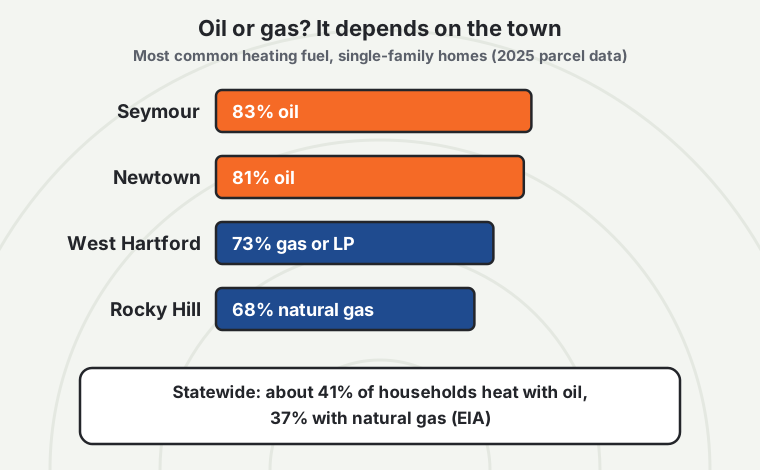
| Single-family homes heated mainly with oil, by town | Seymour 83%, Newtown 81%; West Hartford 73% gas or LP | 2025 Connecticut parcel (CAMA) data |
| Connecticut residents served by a private well | About 23% | CT Department of Public Health and state private-well work group (2020) |
| Flood questions on the seller’s condition report | Six, since July 1, 2025 | Public Act 25-33; CGS 20-327b |
| Pyrrhotite question on the condition report | Required for every seller who must give the report | CGS 20-327b |
| Mill rates, fiscal 2027 (examples) | Shelton 15.51; Wallingford 24.57; Manchester 41.0; West Hartford 46.77 | CT OPM |
| Buyers who rate heating and cooling costs at least somewhat important | 82% (national) | NAR 2025 Profile of Home Buyers and Sellers |
| Top factor in choosing a neighborhood | Quality of the neighborhood, 59% (national) | NAR 2025 Profile of Home Buyers and Sellers |
This page is one chapter of our guide to how to sell a house in Connecticut. It answers one question: what do buyers look for in a house in Connecticut, and what can you do about each item before you list? National survey data tells you what buyers want everywhere; the second half of this page covers what Connecticut buyers ask about that buyers in most states never think of.
What do buyers look for in a house in Connecticut?
Buyers look for a house in Connecticut the way buyers do everywhere, starting with the neighborhood, the price and the condition, and then they ask a set of Connecticut questions: oil or gas heat, septic or sewer, well or town water, flood zone, crumbling-foundation risk, the town’s mill rate and the commute. A seller who answers those questions before the buyer asks takes the doubt out of the offer.
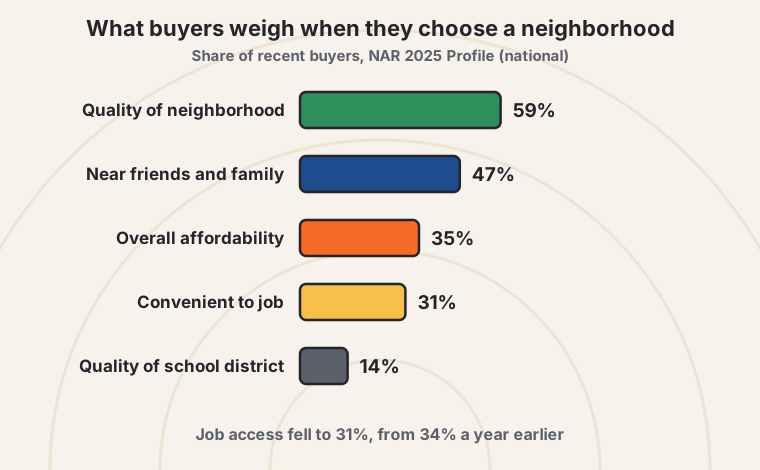
In the National Association of Realtors’ 2025 survey of recent buyers, the quality of the neighborhood (59%), being near friends and family (47%) and overall affordability (35%) led the reasons for choosing where to buy. Heating and cooling costs mattered at least somewhat to 82% of buyers. When buyers compromised, it was most often on price (30%) and condition (24%).
In Connecticut those national priorities turn into specific, local questions:
- “What does it cost to heat?” About 41% of Connecticut households heat with oil, one of the highest shares in the country.
- “Is it on septic and a well?” About 23% of residents drink private well water.
- “Is it in a flood zone?” Since July 2025 the seller’s disclosure report asks six flood questions.
- “What about the foundation?” The same report asks every seller about pyrrhotite.
- “What are the taxes?” Mill rates range from the teens to the 40s and beyond, town to town.
- “How long is the drive?” Commutes along I-95, I-84, I-91 and Metro-North shape demand by town.
You cannot change your town or your well. You can decide how clearly and how early buyers get the answers.
Why is it hard to see your house through a buyer’s eyes?
It is hard to see your house through a buyer’s eyes because you know its history and the buyer only knows its risks. You remember the new furnace and the dry basement every spring; the buyer sees an oil tank, a well and a 1968 foundation and wonders what they are getting into. That gap is normal, and it is closable with paperwork and plain answers.
Many sellers feel a little defensive here. Your house has kept your family warm for twenty winters, and a stranger’s agent is asking whether it floods. Some feel embarrassed about an old tank or a septic system they have never had pumped. Others worry that being honest about anything will scare buyers away, or that they will be blamed later for something they did not know.
Here is the reassuring part. Connecticut buyers expect these questions to have answers, not perfect answers. A house with a 25-year-old oil boiler and a receipt for last fall’s service is easier to buy than a house with a 10-year-old boiler and no records. This page is for you if you want to know which questions are coming and what to have ready. If the honest answers point to big repairs, we will also say when selling as-is makes more sense. (If the emotional side of letting go is the hard part, read the emotions of selling your home.)
What does the national data say buyers want?
The national data says buyers want a good neighborhood they can afford, near the people they care about, in a house they can run without surprises. In NAR’s 2025 profile, quality of the neighborhood led at 59%, convenience to friends and family followed at 47%, and affordability at 35%. Convenience to work fell to 31%, from 34% a year earlier.
A few other numbers from the same survey change how you should present a house:
| What NAR measured | Result | What it means for your listing |
|---|---|---|
| Heating and cooling costs at least somewhat important | 82% (33% very important) | Have last year’s fuel and electric totals ready. |
| Windows, doors and siding at least somewhat important | 77% | Note replacement years in the listing and the records folder. |
| Commuting costs at least somewhat important | 63% | State real drive or train times honestly; do not oversell. |
| Most common compromise | Price 30%, condition 24%, size 20% | Buyers will bend on condition if the price reflects it. |
| Buyers who made no compromise | 30% | Most buyers settle for something; make it clear what they get. |
| Typical buyer age | 59 overall; first-time buyers 40; repeat buyers 62 | Single-floor living, low upkeep and records matter to older buyers. |
| Buyers with children under 18 at home | 24%, a record low | Do not assume schools are the main pitch. |
| Multigenerational purchases | 14% | An in-law space or first-floor bedroom is worth describing. |
Two cautions. First, these are national figures; Connecticut’s buyers include plenty of young families in some towns and retirees in others. Second, a survey tells you what buyers say mattered, not exactly what they paid for. Use it to decide what to explain, not as a promise about price.
How buyers see your house first matters too: 52% found the home they bought on the internet. Photos, facts and floor plans are covered in our guide to marketing your house online in Connecticut; how the rooms look is covered in staging a house to sell.
Do Connecticut buyers care whether a house heats with oil or gas?
Connecticut buyers do care whether a house heats with oil or gas, mostly because of running cost, the oil tank, and what lenders and insurers ask. About 41% of Connecticut households heat with oil and 37% with natural gas (EIA). In towns where oil is normal, such as Newtown at 81%, buyers expect it; in gas towns, an oil house raises more questions.
What buyers actually want to know about the heat:
- Fuel type and system age. Boiler or furnace, year installed, last service date.
- The tank. Above ground or buried, age and location. The condition report asks whether there is an underground storage tank, its age and location, and whether one was ever removed (CGS 20-327b). A buried tank is the item that most often slows a Connecticut sale.
- Annual cost. Last year’s gallons or therms, from your supplier’s statements.
- Oil left in the tank. By local custom the buyer reimburses the seller for oil left at closing; your attorney handles it as an adjustment.
How to address it: get your supplier’s 12-month delivery history, a copy of the last service ticket, and the tank’s age (often on the tank tag). If there is or was a buried tank, our oil tank, septic, well and radon guide covers sweeps, removal and credits; we will not repeat it here. Converting to gas just to sell rarely pays back; documenting what you have nearly always does.
What do buyers worry about with a septic system or a private well?
Buyers worry that a septic system will fail soon after they move in and that a private well will have poor water or low flow. About 23% of Connecticut residents rely on a private well, and the seller’s condition report asks about the water system, any well test, and the type and history of the sewage system (CGS 20-327b). Records and a recent test calm most of that worry.
In rural and shoreline towns, well and septic are normal and buyers’ agents plan for them. The questions are predictable:
- Septic: when was it last pumped, has it ever backed up, how many bedrooms is it designed for, where is the tank and field?
- Well: has the water been tested, what did it show, is there treatment equipment, how is the flow? Lenders often require a potability test before closing.
How to address it: find your pump-out receipts, any septic permit drawings from the town health department, and your last water test. If you have none, a recent pump-out and a basic water test before listing replace a buyer’s guess with a fact. The details, costs and when to test are in our septic and well guide.
How do flood risk and the new disclosure questions affect buyers?
Flood risk affects buyers through insurance cost and lender rules, and Connecticut now makes sellers answer six flood questions on the condition report: the FEMA flood zone, any federal disaster help for flood damage, a current flood policy, an elevation certificate, past flood claims, and any water penetration from seepage or a natural flood (Public Act 25-33, effective July 1, 2025).
The rule exists because buyers were surprised too often. A buyer using a federally backed mortgage on a house in a high-risk flood zone generally must carry flood insurance, and that premium becomes part of the monthly payment the lender approves. On the shoreline, and along rivers such as the Housatonic, Naugatuck, Farmington and Connecticut, flood questions are now routine.
How to address it:
- Look up your address on FEMA’s Flood Map Service Center and print the result, even if you are not in a zone.
- If you carry flood insurance, get the current premium and ask your agent whether the policy can be assigned to a buyer.
- Find your elevation certificate if you have one; it can lower a buyer’s premium.
- Answer the six questions honestly. “Unknown” is a legal answer when it is true; guessing is not.
Leaving the report out does not make the questions go away; it costs you a $500 credit at closing (CGS 20-327c). Our Connecticut property condition disclosure guide walks through the whole form.
How does the crumbling foundation issue shape buyers’ decisions?
The crumbling foundation issue shapes buyers’ decisions in north-central and eastern Connecticut, where concrete containing pyrrhotite was poured in many homes from 1983 onward. Every seller who gives the condition report must answer whether they know of pyrrhotite or foundation repairs (CGS 20-327b), and buyers in affected towns often ask for an engineer’s visual inspection or a core test.
If your house was built before 1983 or is outside the affected area, a buyer may still ask, and the honest answer (“built in 1962; no known issues”) usually settles it. If your house is in a town on the Capitol Region Council of Governments list and was built in 1983 or later, expect the question and expect lenders to care about the answer.
How to address it: know your foundation’s pour year (the building permit or assessor card), and if you have an engineer’s report or core test, have it ready, because once you have one, you must disclose it. If the result is bad, a financed buyer may not be able to close at all. Our crumbling foundation guide covers testing, CFSIC and your selling options.
How do property taxes and mill rates change what buyers will pay?
Property taxes change what buyers will pay because buyers and their lenders budget the whole monthly payment, and in Connecticut the tax line varies widely. The same $400,000 house carries about $4,343 a year in tax in Shelton at 15.51 mills and about $13,096 in West Hartford at 46.77 mills (fiscal 2027, assessed at 70%). A higher tax bill leaves less room for the mortgage.
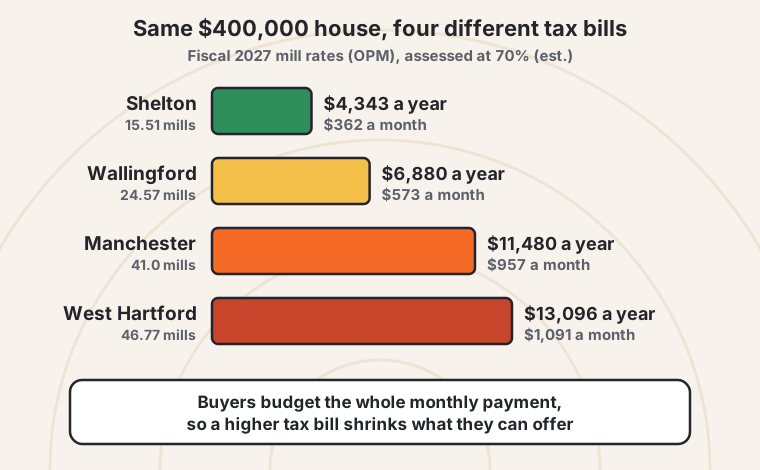
Example (illustrative). A $400,000 house, taxed on 70% of its value (CGS 12-62a), at fiscal 2027 mill rates:
| Town | Mill rate | Tax per year (est.) | Tax per month (est.) |
|---|---|---|---|
| Shelton | 15.51 | $4,343 | $362 |
| Wallingford | 24.57 | $6,880 | $573 |
| Manchester | 41.0 | $11,480 | $957 |
| West Hartford | 46.77 | $13,096 | $1,091 |
The gap between Shelton and West Hartford is about $729 a month. At a 6.5% 30-year mortgage rate (est.), $729 a month would carry roughly $115,000 of loan (est.). Buyers in high-tax towns do not simply pay $115,000 less, because those towns also offer things buyers pay for, but the tax bill is always in their math.
How to address it: put the current assessment and last year’s tax bill in your listing folder, and if your town has revalued recently, say so. If your assessment looks wrong, our guide to assessed value vs market value explains how the 70% rule works. Do not hide taxes; buyers find them in minutes on the assessor’s site.
How much do commute and location matter to Connecticut buyers?
Commute and location still matter to Connecticut buyers, but less than they used to. Nationally, convenience to work was a deciding neighborhood factor for 31% of buyers in NAR’s 2025 survey, while 63% said commuting costs were at least somewhat important. In Connecticut, access to Metro-North, I-95, I-84 and I-91 shapes which buyers look at which towns.
Buyers who work in New York City look at Fairfield and lower New Haven County towns along the train lines. Hartford-area employers draw buyers to towns along I-84 and I-91. Southeastern Connecticut draws Groton and New London workers. Hybrid work has widened the circle, which is one reason “near friends and family” now outranks the job.
How to address it: state facts a buyer can check, such as the distance to the nearest train station or highway ramp, and leave out claims like “easy commute.” If you are near a station, a park, a lake access or a town center, say so in plain words; those are the “quality of neighborhood” details buyers rank first.
How do you address what buyers look for before you list?
You address what buyers look for before you list by collecting short, factual answers to the predictable Connecticut questions in one folder: heat and tank, water and septic, flood, foundation, taxes, and any permits. Most of it costs nothing but an afternoon of phone calls. Buyers who get answers early make firmer offers and ask for fewer credits after inspection.
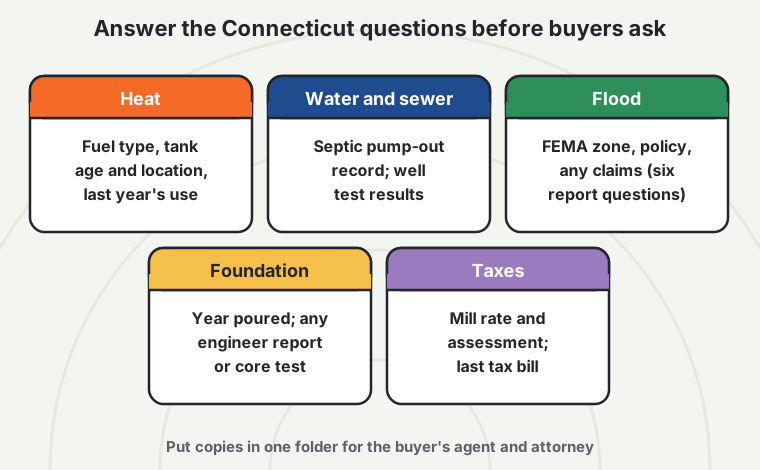
| Buyer concern | What to have ready | Typical cost | Rule or source |
|---|---|---|---|
| Heat and oil tank | Fuel type, system age, last service ticket, 12 months of deliveries, tank age and location | Free (records) | CGS 20-327b (tank questions) |
| Septic | Pump-out receipts, permit drawing from the health department | Free; a pump-out is extra (est. a few hundred dollars) | CGS 20-327b (sewage questions) |
| Private well | Last water test; treatment equipment details | Free if on file; a basic test is extra | CGS 20-327b (water questions) |
| Flood | FEMA map printout, policy premium, elevation certificate, claim history | Free | Public Act 25-33; CGS 20-327b |
| Foundation | Pour year; any engineer report or core test | Free if on file | CGS 20-327b (pyrrhotite question) |
| Taxes | Assessment card, last tax bill, revaluation year | Free | CGS 12-62a; OPM mill rates |
| Running costs and records | Utility totals, receipts, permits | Free | See our records binder guide |
Making the house look and show its best is a separate job; our guides to staging and making your house stand out cover the records binder, pre-listing inspections and showing utility costs in detail.
When should you sell as-is, and when should you not sell to a cash buyer?
You should sell as-is when the honest answers to buyers’ questions point to work you cannot or will not do, such as a leaking buried tank, a failed septic, a crumbling foundation or a flood-damaged basement. You should not sell to a cash buyer when your answers are good or merely ordinary, because a financed buyer will usually pay more for a house with clean, documented answers.
Document and list
Top priceBest when heat, water, septic, flood and foundation answers are ordinary or good.
- An afternoon of paperwork
- Financed buyers, inspection and appraisal
- Usually the highest net
Fix one item, then list
MiddleBest when one known problem, such as an old buried tank, would scare most buyers.
- Spend on the one thing buyers fear
- Keep receipts and reports
- Compare cost with a credit
Sell as-is for cash
FastestBest when several answers are bad or unknown and you cannot fund the work.
- No repairs, tests or showings
- Typically about 2 weeks to close
- Lower price; see why cash offers are lower
We buy Connecticut houses for cash, so take this from the other side of the table: most houses with oil heat, a well, a septic system or a high mill rate sell perfectly well on the open market. Those are features of Connecticut, not defects. Our cash buyer vs realtor comparison shows when the numbers favor listing, which is most of the time. A cash sale earns its place when a financed buyer’s lender, inspector or insurer is likely to say no, as with a confirmed pyrrhotite foundation, a leaking tank or a house that needs everything; see selling a house that needs repairs.
Is a cash sale right for you, or should you list?
Seven quick questions. There is no wrong answer, and we will tell you honestly if listing would leave you more.
- Does the house need repairs you would rather not pay for or manage?
- Do you need to close by a certain date, or within the next month or two?
- Would showings be hard: tenants, belongings, privacy, or you live out of state?
- Is there a complication: an estate or probate, a divorce, foreclosure, liens or back taxes?
- Could you comfortably cover the mortgage, taxes and utilities for three or more months?
- Is getting the highest possible price more important to you than speed and certainty?
- Would a buyer's bank lend on the house as it is (no major roof, foundation, oil tank or code issues)?
How do you prepare for what Connecticut buyers look for, step by step?
To prepare for what Connecticut buyers look for, list the local questions that apply to your house, gather records for each, fill the gaps with simple tests where they are cheap, answer the condition report honestly, and decide whether any one problem is worth fixing before you list. For most houses this takes one to two weeks alongside your other preparation.
List your Connecticut questions (day 1)
Heat and tank, water, sewage, flood zone, foundation age, taxes. Cross off those that do not apply.
Gather the records (days 1 to 5)
Call your oil or gas supplier, find pump-out receipts and water tests, print the FEMA map, pull the assessor card and last tax bill.
Fill cheap gaps (week 2)
A septic pump-out or a basic water test is often cheaper than the doubt it removes. Price anything larger before deciding.
Complete the condition report (week 2)
Answer every question, including the six flood questions and the pyrrhotite question. Use “unknown” only when it is true.
Decide fix, credit or sell as-is (week 2)
If one item would stop most buyers, price fixing it against a credit and against an as-is sale.
Put it in the listing and the folder
Fuel type, water and sewer, taxes and replacement years belong in the listing facts. Reports go in the folder for buyers’ agents and attorneys.

When we look at a house, the first questions are the same ones your buyer’s agent will ask: what heats it, where the water comes from, where it goes, and when the foundation was poured. Sellers who have those four answers on paper make every buyer’s job easier, including ours.
Questions about what buyers look for in a Connecticut house
What do buyers look for most in a house?
What buyers look for most in a house is a good neighborhood they can afford. In NAR’s 2025 survey, quality of the neighborhood (59%), being near friends and family (47%) and affordability (35%) led, and 82% said heating and cooling costs were at least somewhat important.
Do buyers in Connecticut avoid houses with oil heat?
Buyers in Connecticut do not generally avoid houses with oil heat; about 41% of households heat with oil. They do ask about the system’s age, the tank’s age and location, and yearly cost. A buried tank raises the most concern.
Is a house with a septic system harder to sell in Connecticut?
A house with a septic system is not much harder to sell in Connecticut when it has records, because septic is normal in many towns. Pump-out receipts and a clean inspection reassure buyers; an unknown or failing system is what slows a sale.
Do I have to tell buyers my house is in a flood zone in Connecticut?
You do have to tell buyers if your house is in a flood zone in Connecticut. Since July 1, 2025, the condition report asks six flood questions, including the FEMA zone, flood insurance and past claims (Public Act 25-33; CGS 20-327b).
Do buyers ask about pyrrhotite outside eastern Connecticut?
Buyers may ask about pyrrhotite anywhere, because the condition report asks every seller about it (CGS 20-327b). The concern is greatest in north-central and eastern towns on the CRCOG list, for homes built in 1983 or later.
How much do property taxes affect a home’s sale price in Connecticut?
Property taxes affect a home’s sale price in Connecticut through the buyer’s monthly budget. A $400,000 house costs about $4,343 a year in tax in Shelton and $13,096 in West Hartford at fiscal 2027 rates, so buyers in higher-tax towns have less room for the mortgage.
Do school districts still matter to buyers?
School districts still matter to some buyers, but fewer than many sellers assume. In NAR’s 2025 survey, 14% of buyers named school district quality as a factor, and only 24% of buyers had children under 18 at home, a record low.
What features do older buyers look for?
Older buyers, who are a growing share (repeat buyers’ median age was 62 in NAR’s 2025 survey), often look for single-floor living, a first-floor bedroom, low upkeep and clear records. Describe those features plainly in the listing if your house has them.
Should I convert from oil to gas before selling?
You usually should not convert from oil to gas just to sell, because buyers rarely repay the full cost. Document the existing system’s age, service and yearly use instead. Remove or address a buried tank if buyers in your area routinely object to it.
Do I need a well test before selling my house in Connecticut?
You are not generally required to test a private well before selling in Connecticut, but the condition report asks whether it was tested, and buyers’ lenders often require a potability test. A recent test you can show removes one of the biggest buyer worries.
What turns buyers off most when they see a house?
What turns buyers off most is uncertainty about expensive systems: heat, roof, water, septic and foundation. Clutter and dated finishes matter less than an unanswered question about a $20,000 item. Answer the big questions in writing.
Do buyers care about the commute anymore?
Buyers still care about the commute, but less than before. In NAR’s 2025 survey, 31% named convenience to work as a neighborhood factor, down from 34% a year earlier, while 63% said commuting costs were at least somewhat important.
Related Connecticut guides
Connecticut issues
We buy houses across the state, including in Newtown, Seymour and West Hartford. For every route, cost and step in one place, start with how to sell a house in Connecticut.
Plain-English information, not legal, insurance or environmental advice. Estimates are labeled (est.). Talk to a Connecticut real estate attorney about your own sale.
Sources (checked on October 27, 2026)
- NAR, 2025 Profile of Home Buyers and Sellers (Exhibits 2-7, 2-12 and 2-13; buyer ages; survey of July 2024 to June 2025 buyers).
- U.S. Energy Information Administration, Connecticut state profile (household heating fuel shares).
- Connecticut private well records work group report, September 2020 (about 23% of residents on private wells).
- Public Act 25-33, section 3 (six “Flood Risk Awareness” questions, effective July 1, 2025).
- CGS 20-327b and 20-327c (residential condition report; tank, water, sewage and pyrrhotite questions; $500 credit).
- CGS 12-62a, assessment at 70% of value.
- Connecticut OPM, mill rates (fiscal 2027).
- 2025 Connecticut Parcel and CAMA Data (heating fuel by town, single-family homes).
- FEMA Flood Map Service Center.

Who wrote this
Jerryll Noorden
Jerryll has bought and sold Connecticut houses since 2016 and has sat at more closing tables than he can count, on both sides. Before real estate he was a robotics scientist at NASA, IHMC and IIT. He wrote this guide because the national sites that rank for it skip the Connecticut rules that cost sellers money. When listing or selling it yourself would get you more than a cash offer, he says so.
This guide explains Connecticut rules in plain English. It is not legal or tax advice. Laws change; for your sale, talk to a Connecticut real estate attorney and a tax professional.
