
Key facts at a glance
The Connecticut rules and numbers behind this checklist, part of our larger guide to how to sell a house in Connecticut.
| Fact | Number | Source |
|---|---|---|
| Smoke and carbon monoxide affidavit at closing | Required, signed by the seller (no credit option since PA 23-164) | CGS 29-453 |
| Credit if the Property Condition Disclosure Report (which asks about air conditioning) is not delivered | $500 | CGS 20-327b, 20-327c |
| Pool alarm required before a town issues a permit to build or substantially alter a residential pool | At least 50 decibels | CGS 29-265a |
| Residential automatic lawn sprinklers installed since July 1, 2010 that must have a rain sensor | All of them | CGS 29-265b |
| Summer 2026 drought advisory (Stage 2) for Fairfield, Middlesex and New Haven counties | June 10 to August 28, 2026 | Office of the Governor |
| Deer ticks found on lawns within 9 feet of the lawn edge | 82% | CT Agricultural Experiment Station |
| Share of houses heating with oil in Groton, Waterford and Madison | 77%, 75% and 64% | Our town data (assessor records) |
What are the best summer home selling tips in Connecticut?
The best summer home selling tips in Connecticut are the ones July and August buyers and inspectors actually check: a cool, dry house with serviced air conditioning and heat, working smoke and CO alarms (CGS 29-453), a pumped septic, a safe pool with its permit papers, a lawn kept tidy within water rules, and a yard edge cleared for tick season. Most of it costs hundreds, not thousands.
The old version of this page said to run the AC, power wash and plant flowers. Some of that still helps, but a Connecticut summer sale has its own checks: inspectors test central air in July, many houses heat with oil, much of the state is on septic, pools need permits and alarms, dry summers bring drought advisories, and the yard is tick country.
This page is a practical, priced checklist for July and August. It is not about whether to sell in summer (our guide to selling a house in summer in Connecticut covers the trade-offs) or how to price it (see pricing a house in summer). For the bigger fix-or-skip decisions, use what to fix before selling a house in Connecticut.
Why does getting a house ready in July feel overwhelming, and is this page for you?
Getting a house ready in July feels overwhelming because everything competes at once: the heat, the yard, the kids home from school, contractors booked for weeks, and a list of “must-do” tips that never ends. Most sellers in this spot feel exhausted, unsure what actually matters, worried about wasting money and embarrassed about the state of the yard. This page is for them.
Maybe you own a 1960 ranch in Groton with an oil boiler you have not thought about since March. Maybe the lawn in Fairfield County went brown in June and you were not allowed to water much. Maybe you inherited a house in Madison with a pool that has not been opened in three years. Or you simply work full time and have four weekends to get ready.
You may feel overwhelmed by a list with no order to it. You may feel afraid of spending on the wrong thing. You may feel ashamed of a yard gone wild or a basement that smells. And you may feel doubtful that any of it changes the price at all.
Here is the good news. Buyers and inspectors in a Connecticut summer look at a short, predictable list. Fix those things, document them, and leave the rest. Every task below has an estimated price and the reason it matters. And if the list is more than you can or want to do, there is an honest way to skip it, which we cover near the end.
What should you fix or service first for a July or August sale?
For a July or August sale in Connecticut, fix or service first the items that show up in a summer inspection or at the closing table: smoke and CO alarms, air conditioning, the heating system, the septic tank, the pool, gutters and a damp basement. Then do the cheap visual work: lawn, yard edges and a deep clean. The core list costs about $1,300 to $6,550 (est.).

| Task | Cost (est.) | Why it matters in summer | Rule or source |
|---|---|---|---|
| Test or replace smoke and CO alarms | $50 to $400 | You must sign a smoke and CO affidavit at closing | CGS 29-453 |
| Service the central air (or check window units) | $100 to $250 | Inspectors run it in July; the disclosure report asks about AC problems | CGS 20-327b |
| Tune up the heating system, keep the receipt | $150 to $400 | Inspectors still fire the boiler; lenders need working heat | Sibling cost guide |
| Pump the septic if it has been 3+ years | $350 to $700 | Heavy summer water use; buyers order septic inspections | EPA: pump every 3 to 5 years |
| Open, clean and check the pool and its alarm | $250 to $900 | A green pool kills showings; permits and alarms get checked | CGS 29-265a |
| Clean gutters, extend downspouts | $150 to $1,200 | Summer thunderstorms show every overflow and wet corner | Sibling cost guide |
| Run a dehumidifier, check the sump | $250 to $1,000 | Basements smell worst in July and August | Sibling cost guide |
| Lawn, mulch, trim, front door | $200 to $1,500 | First photos and first impression | Sibling cost guide |
| Tick-season yard edge: leaf litter, brush, wood-chip strip | $300 to $1,200 | Buyers walk the yard in peak nymph season | CAES fact sheet |
| Deep clean and declutter | $0 to $900 | Heat makes clutter and smells worse | Sibling cost guide |
You do not need every line. A house on city sewer skips the septic; a house with no pool skips that row. The order matters more than the total: do the closing-table and inspection items first, because they cost money if you skip them, then the visual items, which only help if the basics are done.
- Smoke and CO alarms tested on every level
- AC serviced; filters changed; condensate line draining
- Heating system serviced, receipt in the listing folder
- Oil tank gauge read and tank records found
- Septic pumped or last pumping receipt found
- Pool opened, clean, alarm working, permit papers found
- Gutters cleared, downspouts extended
- Dehumidifier running in the basement for two weeks
- Lawn mowed and edged, beds mulched
- Leaf litter and brush cleared along the yard edge
- Disclosure report filled out honestly
How do you get the air conditioning and oil heat ready for summer buyers?
You get the air conditioning and oil heat ready for summer buyers by having both serviced before you list, keeping the receipts for the buyer, and knowing what is in the oil tank. Summer inspectors run the AC and fire the boiler, and the Connecticut disclosure report asks about air conditioning and heating problems and fuel type (CGS 20-327b). Expect about $250 to $650 for both tune-ups (est.).
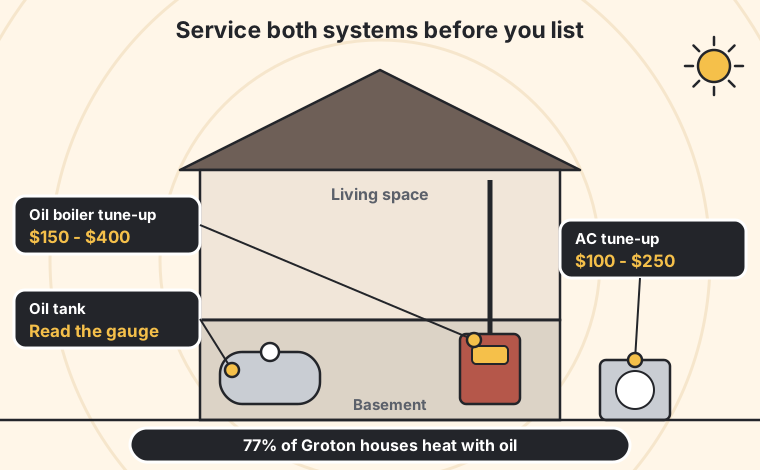
Air conditioning. A buyer arriving from a 90-degree driveway judges the house in the first ten seconds. A central air system that has not been serviced may still run, but an inspector will measure how well it cools and look at the condensate drain. A basic tune-up (cleaning the coils, checking refrigerant and the drain line, a new filter) is about $100 to $250 (est.). If the system is old and weak, do not replace it just to sell. Disclose it honestly and let the buyer price it in.
Oil heat. Connecticut is still an oil-heat state, especially outside the gas-served cities. In our town data, 77% of houses in Groton heat with oil, 75% in Waterford, 64% in Madison and Guilford, and 43% even in Southington. An inspector will fire the boiler in August and look at the burner, the flue and the tank. A tune-up with a dated receipt ($150 to $400) is one of the cheapest ways to take a worry off the buyer’s list.
The oil tank. Read the gauge before you list and find any records about the tank’s age. The disclosure report asks whether there is an underground storage tank, how old it is, and whether one was ever removed. In Connecticut the buyer customarily reimburses the seller at closing for oil left in the tank, so you do not need to run it dry, and you should not let it run empty either. If you suspect an old buried tank, our oil tank, septic, well and radon guide explains the sweep ($200 to $500) and removal ($1,500 to $4,000) costs.

Put every service receipt in one folder on the kitchen counter: AC, boiler, septic, pool. Buyers and their inspectors relax when they can see dates and names. It turns “how old is this and has anyone looked at it?” into a question already answered.
What do Connecticut buyers check on a pool?
Connecticut buyers check that a pool is open, clean and safe, and their attorney or inspector may check that it was built with a permit. State law bars a town from issuing a permit to build or substantially alter a residential pool unless a pool alarm is installed (CGS 29-265a). The State Building Code sets the barrier rules, such as fence height and self-latching gates.
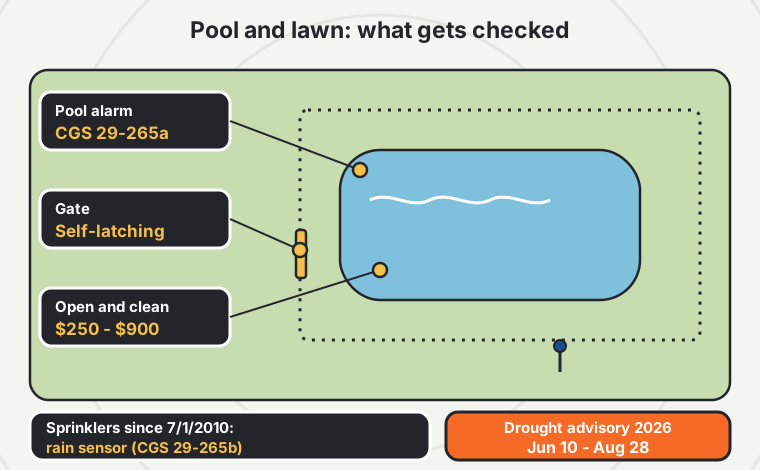
A pool is a selling point in July and a worry for some buyers at any time of year. Here is what to do:
- Open it and keep it clean for the whole listing period. A green pool in listing photos tells buyers the house has been neglected. Opening and chemicals for a season, or a few weekly cleanings, run about $250 to $900 (est.).
- Test the pool alarm. CGS 29-265a defines a pool alarm as a device that sounds at least 50 decibels when a person or object of 15 pounds or more enters the water. If yours is dead, replacing it is a small cost (est. $100 to $300) that removes a safety question.
- Check the barrier. Fences and gates must meet the State Building Code your town enforces. A broken self-closing gate is cheap to fix and a common inspection note.
- Find the permit. Ask your town building department for the pool’s permit and final inspection. An above-ground or in-ground pool built without a permit can delay a closing while the buyer’s attorney sorts it out. Some towns require permits even for storable pools, plus a separate electrical permit for pumps and lights.
- Disclose what you know. Leaks, cracked decks or a heater that does not work go on the disclosure report. Our property condition disclosure guide explains the form.
How do you keep the lawn presentable during a drought or water restrictions?
You keep the lawn presentable during a Connecticut drought or water restrictions by mowing high, edging, mulching beds and watering only within your water utility’s rules, rather than trying to grow new grass in July. Connecticut declared a Stage 2 drought advisory for Fairfield, Middlesex and New Haven counties from June 10 to August 28, 2026, and automatic sprinklers installed since July 1, 2010 must have rain sensors (CGS 29-265b).
The old advice was to seed, fertilize and water hard for a lush lawn. In a Connecticut July that rarely works. New seed struggles in heat, and in a dry summer your water utility or town may ask for limits on lawn watering. The state’s Interagency Drought Workgroup tracks conditions every month and recommends advisories to the governor; Connecticut was also under a statewide Stage 2 advisory in November 2024.
What works instead:
- Mow high and edge cleanly. Taller grass shades its roots and stays greener. Crisp edges along the walk and driveway make even a tired lawn look cared for.
- Mulch the beds. Fresh mulch holds moisture and photographs well. A few cubic yards and a weekend cost a few hundred dollars (est.).
- Water within the rules. Check your water utility’s notices. If you have an irrigation system, make sure the rain sensor works; any residential automatic sprinkler installed since July 1, 2010 must have one (CGS 29-265b).
- Do not hide a brown lawn. Buyers know Connecticut summers. A brown, mowed lawn is fine; an overgrown one is not. Fall is the right time for seeding, and you can say so.
Should you pump the septic before a summer sale?
You should pump the septic before a summer sale if it has been three years or more, because summer water use is heavy and many Connecticut buyers order a septic inspection. The EPA advises inspecting a household septic system about every three years and pumping it typically every three to five years. Pumping a typical tank costs about $350 to $700 (est.).
In summer a septic system works hardest: guests, laundry, showers after the beach. A tank that has not been pumped in years can back up or show surface wetness right when buyers walk the yard.
Pumping before you list does three things. It removes the risk of a backup during showings, it gives the buyer’s inspector a clean tank to look at, and it gives you a dated receipt. If the pumper sees a broken baffle or cover, fix it now ($300 to $2,500); small fixes are cheap reassurance. If the leaching field is failing, that is a $15,000 to $40,000+ job, and most sellers credit or price it in rather than fix it before a sale. Details and costs are in our septic and well guide.
How do you handle yard work in tick and Lyme season?
You handle yard work in tick and Lyme season by focusing on the lawn edge, where the Connecticut Agricultural Experiment Station found 82% of lawn deer ticks within 9 feet of the edge. Clear leaf litter and brush along woods, stone walls and plantings, keep the grass mowed, and lay a dry wood-chip or gravel strip between woods and lawn. Expect about $300 to $1,200 (est.).
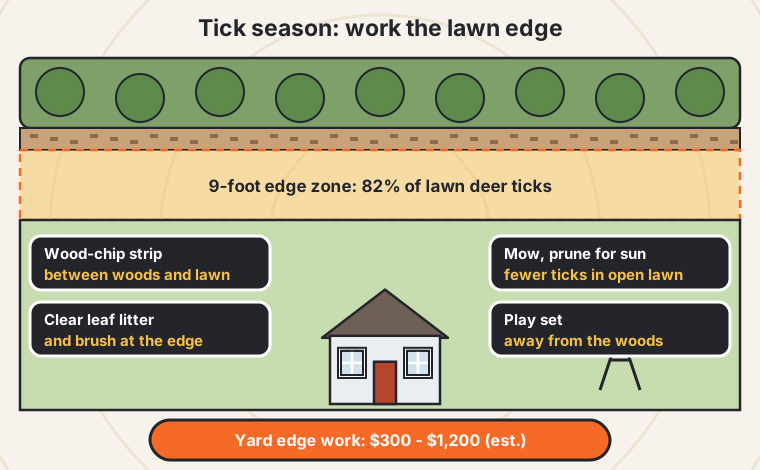
Lyme disease takes its name from Lyme, Connecticut, and buyers here know it. The Experiment Station’s fact sheet on managing ticks on your property explains that most people get Lyme disease from nymphal deer ticks, which are active in late spring and summer: the same weeks buyers are walking your yard.
The fact sheet recommends simple landscape changes, and they double as curb appeal:
- Clear leaf litter and brush along the lawn edges, stone walls and driveway. This is where most ticks sit.
- Keep the grass mowed and prune low branches to let in sun. Ticks need humidity; sunny, open lawn has fewer.
- Lay a dry barrier of wood chips, bark, mulch or gravel between the woods and the lawn. It also makes a neat, defined border in photos.
- Move play sets and seating away from the woodland edge.
- Cut back Japanese barberry and dense groundcover near the house; the fact sheet links barberry thickets with more infected ticks.
How do you run showings in a Connecticut summer?
You run showings in a Connecticut summer by keeping the house cool and dry before every visit, opening blinds for the long evening light, offering evening showing windows, and planning around storms and kids home from school. The goal is a house that feels comfortable the moment the door opens, with nothing that makes a hot, tired buyer want to leave.
- Cool the house ahead. Run the AC for a few hours before showings; close blinds on the sunny side in the afternoon, open them on the shaded side.
- Dry the basement. Keep the dehumidifier running and empty. Musty smell is the number one summer complaint.
- Use the light. Connecticut summer evenings stay light until after 8 p.m. Offer evening windows for buyers who work.
- Stage the outdoor space simply. A clean deck, two chairs and a table are enough.
- Plan for storms. Summer thunderstorms knock out power and show every gutter overflow. Clean gutters before you list, and check the basement after a storm.
Get your cash offer
without anyone coming over.
Want your offer faster, or rather not talk to anyone yet? Send a few phone photos of each room. We price the repairs from them, line by line, and send your cash offer back, so you see a real number before you ever meet us or pick up the phone.
 CabinetsFlooring
 Tub & tile
 Floors
 Roof
We may bring in a partner buyer to close. Your price and terms don't change.
What does summer prep cost for a typical Connecticut house?
Summer prep for a typical Connecticut house costs about $1,300 to $6,550 (est.) for the core list in this guide, and two to four weekends of work. For a 1960 oil-heated house in Groton at the town’s single-family median of $372,500, that is about 0.3% to 1.8% of the price, which is usually worth it when it removes inspection items and keeps the listing on schedule.
Example (illustrative). A single-family house in Groton, built around 1960 (the town’s median year built), heated with oil (77% of Groton houses), on septic, no pool, valued at the town’s single-family median of $372,500. Monthly property tax about $550 at the fiscal 2027 mill rate (town data).
| Task | Low (est.) | High (est.) |
|---|---|---|
| Smoke and CO alarms | $50 | $400 |
| AC service | $100 | $250 |
| Oil boiler tune-up | $150 | $400 |
| Septic pumping | $350 | $700 |
| Gutters and downspouts | $150 | $1,200 |
| Lawn, mulch, trim, front door | $200 | $1,500 |
| Tick-season yard edge | $300 | $1,200 |
| Deep clean and declutter | $0 | $900 |
| Total | $1,300 | $6,550 |
| Share of a $372,500 price | 0.3% | 1.8% |
Compare that with what the prep prevents. A smoke and CO affidavit is required at closing, and alarms that fail hold it up. A failed septic or boiler found by the buyer’s inspector becomes a repair request or a price cut, usually bigger than the cost of servicing it first. And every extra week on the market costs about $550 in Groton property tax alone, before insurance and utilities.
What the prep will not do is turn a dated house into a renovated one. Skip kitchens, baths and new windows; buyers price those in no matter what. Our list of 13 low-cost fixes covers the other cheap items that pay back, and the what to fix guide covers when not to fix.
If you are near the shoreline, our Groton, Waterford and Guilford pages have local sales and tax figures.
When is it smarter to skip the summer prep?
It is smarter to skip the summer prep when the house needs far more than this list, when you cannot be there to manage contractors, or when the date matters more than the last few thousand dollars. In those cases you can sell as-is, disclose what you know and let the buyer price it in. For a sound house you can show, the prep usually pays and listing usually nets more.
Do the core list, then list
About $1,300 to $6,550 (est.)A sound house you can show for six to ten weeks.
- Fewer inspection items, cleaner negotiation
- Best net for most houses
- Commissions and carrying costs apply
List as-is, priced for it
$0 up frontAn occupied house where you cannot do the work in time.
- Disclose honestly
- Expect repair requests or a lower price
- Still needs showings
Sell as-is for cash
No prep, no showingsA vacant, dated or damaged house, an estate, or a fixed date.
- Leave everything, no repairs
- Close in about 2 weeks or on your date
- Lower price than a retail sale after repairs
Our pages on selling a house that needs repairs and selling a house as-is in Connecticut explain what as-is does and does not change, and the comparison of a cash buyer vs. a realtor in Connecticut works through the net on both routes.
If your house only needs the routine items on this list and you can handle showings, do not sell to a cash buyer. A few hundred to a few thousand dollars of service work, plus a sensible price, will almost always net more on the open market. A cash sale makes sense when the work, the time or the distance is the problem. And never pay a buyer a fee or sign over a deed outside a closing with attorneys; see our scam red flags.
Is a cash sale right for you, or should you list?
Seven quick questions. There is no wrong answer, and we will tell you honestly if listing would leave you more.
- Does the house need repairs you would rather not pay for or manage?
- Do you need to close by a certain date, or within the next month or two?
- Would showings be hard: tenants, belongings, privacy, or you live out of state?
- Is there a complication: an estate or probate, a divorce, foreclosure, liens or back taxes?
- Could you comfortably cover the mortgage, taxes and utilities for three or more months?
- Is getting the highest possible price more important to you than speed and certainty?
- Would a buyer's bank lend on the house as it is (no major roof, foundation, oil tank or code issues)?
What is a six-week summer prep plan for a Connecticut house?
A six-week summer prep plan for a Connecticut house books the service calls in week one, does the safety and inspection items in weeks two and three, handles the yard and basement in weeks three and four, cleans and photographs in week five, and lists in week six. If contractors are booked solid in July, start the calls first and do the yard work while you wait.
Week 1: Book the service calls
Call the HVAC and oil service company, the septic pumper and, if you have one, the pool company. Summer calendars fill fast. Order your attorney and find your records: tank, septic, pool permit, past repairs.
Week 2: Safety and closing-table items
Test or replace smoke and CO alarms on every level. Start filling out the disclosure report. Note anything you will fix and anything you will disclose.
Week 3: Systems
AC and boiler serviced, receipts filed. Septic pumped. Pool opened, alarm tested, gate latching. Dehumidifier running in the basement.
Week 4: Yard and edges
Clear leaf litter and brush along the woods and walls, lay a wood-chip strip, mow high, edge and mulch. Clean gutters and extend downspouts.
Week 5: Clean, declutter, photograph
Deep clean, pack a third of what is in closets and on counters, and shoot photos on a bright morning with the lawn freshly mowed.
Week 6: List, or take the shortcut
List with the service folder on the counter. Or, if the list was too much, ask for a written as-is cash offer: a legitimate buyer charges no fee, puts no expiry pressure on you, closes with attorneys in about two weeks, and lets you leave everything.
See the house together.
Pick a time that works.
Choose a time for us to walk through the property with you, or ask for a quick call first. We confirm every request personally.
Tuesday, January 13
No open times in the next few weeks. Please call us.
We will confirm by email. Nothing is booked until we do.
View my requestQuestions Connecticut owners ask about summer selling prep
What should I fix first before selling my house in a Connecticut summer?
Fix first what inspectors and the closing table check: smoke and CO alarms (CGS 29-453), the air conditioning, the heating system, the septic, and any pool safety items. Then do the lawn, yard edges and cleaning. The core list costs about $1,300 to $6,550 for a typical house (est.).
Do inspectors test air conditioning in Connecticut?
Yes, home inspectors in Connecticut usually test central air in summer, when it is warm enough to run it safely. The disclosure report also asks sellers about air conditioning problems and type (CGS 20-327b). A tune-up before listing costs about $100 to $250 (est.).
Should I service my oil boiler before selling in summer?
Yes, service your oil boiler before selling, even in summer. Inspectors fire the boiler in any season, and lenders need working heat. A tune-up with a dated receipt costs about $150 to $400 (est.). In Groton 77% of houses heat with oil, so buyers expect the question.
Does the buyer pay for the oil left in the tank in Connecticut?
In Connecticut the buyer customarily reimburses the seller at closing for heating oil left in the tank. It is a local custom handled by the attorneys, not a statute, so confirm it in your contract.
Do I need a pool permit to sell my house in Connecticut?
You do not need a new permit to sell, but the buyer’s attorney or inspector may ask for the original pool permit and final inspection. A town cannot issue a permit to build or substantially alter a residential pool unless a pool alarm is installed (CGS 29-265a). Find the papers at your building department before you list.
Is it worth reseeding the lawn before a summer sale?
Reseeding in July or August is rarely worth it in Connecticut; new grass struggles in heat and dry spells. Mow high, edge, mulch the beds and water within your utility’s rules. Summer 2026 brought a Stage 2 drought advisory for three counties from June 10 to August 28.
Do lawn sprinklers need a rain sensor in Connecticut?
Yes, any automatic lawn sprinkler system installed on residential property in Connecticut on or after July 1, 2010 must have a rain sensor or switch that overrides the cycle after enough rain (CGS 29-265b). Check that it works before you list.
How often should a septic tank be pumped before selling?
Pump the septic before selling if it has been three years or more. The EPA advises inspecting about every three years and pumping typically every three to five years. In Connecticut, pumping a typical tank costs about $350 to $700 (est.), and the receipt reassures buyers.
How do I make my yard safer from ticks before showings?
Focus on the lawn edge. The Connecticut Agricultural Experiment Station found 82% of lawn deer ticks within 9 feet of the edge. Clear leaf litter and brush there, mow, and lay a dry wood-chip or gravel strip between woods and lawn. Expect about $300 to $1,200 (est.).
Can I sell my house as-is in summer without doing any of this?
Yes, you can sell as-is in summer without doing any prep. You still owe the disclosure report and the smoke and CO affidavit, or the credits. A mortgage buyer will price in what the inspector finds; a cash buyer will take the house as it is, at a lower price than a repaired retail sale.
Do I have to fix a broken pool before selling in Connecticut?
You do not have to fix a broken pool before selling in Connecticut, but you must disclose known problems on the disclosure report. Many sellers price it in or credit the buyer. A dead pool alarm or a broken gate latch is cheap to fix and worth doing.
Related Connecticut guides
- Best time to sell a house in Connecticut: the month-by-month data.
- Selling a house in summer in Connecticut: the honest trade-offs.
- Pricing a house in summer in Connecticut.
- What to fix before selling a house in Connecticut.
- Tips for selling a Connecticut home in winter.
- Disadvantages of selling during the holiday season.
- The worst times to sell your house in Connecticut.
- Cash buyer vs. realtor in Connecticut and where we buy houses in Connecticut.
For the whole process from first decision to closing, start with our guide to how to sell a house in Connecticut.
Plain-English information, not legal, health or engineering advice. Costs are estimates; get quotes from licensed Connecticut contractors.
Sources (checked on October 27, 2026)
- CGS 29-453 (smoke and carbon monoxide detector affidavit; as amended by PA 23-164).
- CGS 20-327b and 20-327c (Property Condition Disclosure Report, $500 credit).
- CGS 29-265a and 29-265b (pool alarms for pool permits; rain sensors on automatic sprinklers).
- Office of the Governor, June 2026: Stage 2 drought advisory for three counties.
- Office of the Governor, August 28, 2026: drought advisories removed.
- Office of the Governor, November 2024: statewide Stage 2 drought advisory.
- Connecticut Interagency Drought Workgroup.
- Connecticut Agricultural Experiment Station, Managing Exposure to Ticks on Your Property (K. C. Stafford III, 2014).
- U.S. EPA SepticSmart: how to care for your septic system.
- Town fuel, year built, medians and monthly tax: our town data from assessor records, Connecticut OPM fiscal 2027 mill rates and Oct 2024 to Sep 2025 sales.
- Cost ranges: our Connecticut cost guides (what to fix, low-cost fixes, oil tank and septic) and our own estimates, labelled (est.).

Who wrote this
Jerryll Noorden
Jerryll has bought and sold Connecticut houses since 2016 and has sat at more closing tables than he can count, on both sides. Before real estate he was a robotics scientist at NASA, IHMC and IIT. He wrote this guide because the national sites that rank for it skip the Connecticut rules that cost sellers money. When listing or selling it yourself would get you more than a cash offer, he says so.
This guide explains Connecticut rules in plain English. It is not legal or tax advice. Laws change; for your sale, talk to a Connecticut real estate attorney and a tax professional.
