
Key facts at a glance
| Fact | Number | Source |
|---|---|---|
| Homes sold in Madison, Oct 2024 to Sep 2025 | 289 | CT OPM real estate sales, data.ct.gov |
| Median sale price (all sales) | $660,000 (single-family: $713,750) | CT OPM real estate sales, data.ct.gov |
| Mill rate, fiscal 2027 | 23.06 (about $10,654 a year, $888 a month or $29.19 a day on $660,000) | CT OPM mill rates; assessment at 70% (CGS 12-62a) |
| Conveyance tax the seller pays | 1.00% up to $800,000 ($6,600 on $660,000); state share rises to 1.25% above $800,000 | CGS 12-494 |
| Homes heated with oil | 64% (gas 20%) | 2025 CT parcel (CAMA) data, data.ct.gov |
| Condo resale certificate fee | $185, as adjusted for inflation, plus copies | CGS 47-270(b) |
| Home-sale gain you can exclude from federal tax | $250,000 single, $500,000 married filing jointly (2 of last 5 years) | IRS Publication 523 |
| Probate court and Superior Court | Probate District No. 34 (Guilford and Madison); New Haven Judicial District | CGS 45a-2; CGS 51-344 |
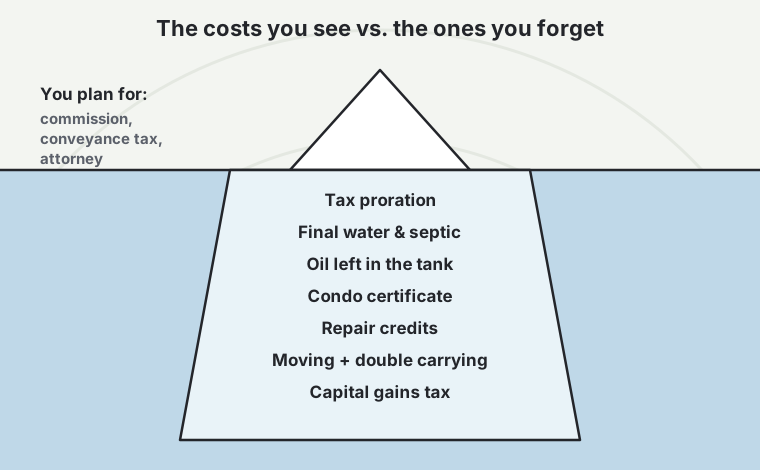
Every seller budgets for the commission, the conveyance tax and the attorney. The money that surprises people is everything else: the tax credit on the settlement statement, the septic pumping the buyer asked for, the condo paperwork, two months of paying for two homes, and a capital gains bill the following spring. This guide lists those hidden costs with Madison numbers. It is one chapter of our guide to how to sell a house in Connecticut; the standard costs are covered in the cost to sell a house in Connecticut.
Why do hidden selling costs feel so unfair?
Hidden selling costs feel unfair because they show up late, after you have planned your next move around a number, and each one sounds small on its own. In Madison, where the median sale is $660,000, small percentages turn into thousands of dollars quickly, and nobody puts them on one page for you.
Maybe you are downsizing from a Colonial you raised a family in, and you have already put a deposit on the next place. Maybe you are handling a parent’s house near the green and want to give your siblings a straight answer. You may feel blindsided by a line you did not expect, distrustful of anyone quoting a net figure, pressured by a move date, overwhelmed by paperwork, and guarded, because it is your equity on the line.
The fix is not to worry less. It is to see every line before the buyer does. This page is for you if you want the full list, with Madison numbers, so the settlement statement holds no surprises.
What are the hidden costs of selling a house in Connecticut?
The hidden costs of selling a house in Connecticut are the property tax proration at closing, final water and sewer or septic charges, oil left in the tank, condo or HOA fees and the resale certificate, moving, carrying two homes at once, repair credits after the buyer’s inspection, and capital gains tax. Together they often add 1% to 3% of the price (est.).
| Hidden cost | Who decides it | Madison example | Rule or source |
|---|---|---|---|
| Property tax proration | Days you owned the house | $29.19 a day on $660,000 | CGS 12-62a, 12-142 |
| Final water, sewer, septic | Your utility; buyer’s requests | Septic pumping or inspection about $600 (est.) | CGS 20-327b (report asks about unpaid charges) |
| Oil left in the tank | Custom and your contract | About $843 back to you on 137 gallons | EIA price, week of Oct 19, 2026 |
| Condo resale certificate | The association | $185 as adjusted, plus copies | CGS 47-270 |
| Repair credits | Buyer’s inspection | Often thousands | Your contract |
| Moving and double carrying | Your timing | $1,358 a month before mortgage | Mill rate; NAIC; (est.) |
| Capital gains tax | Your gain and filing status | Only above the $250,000 / $500,000 exclusion | IRS Pub 523; CT income tax |
How much is the property tax credit at closing in Madison?
The property tax credit at closing in Madison is your share of the year’s tax for the days you owned the house that no paid bill covers. On a $660,000 home at 23.06 mills the tax is about $10,654 a year, or $29.19 a day, so 77 unbilled days come to about $2,248. If you prepaid days past closing, the buyer credits you instead.
Connecticut assesses at 70% of market value (CGS 12-62a): $660,000 × 70% = $462,000. At 23.06 mills, $462,000 × 23.06 ÷ 1,000 = about $10,654 a year. Madison bills real estate tax in two installments, in July and January. Exactly which days a paid installment covers is a local convention that the attorneys follow, so ask yours to show you the tax line on a draft statement early.
This is not a fee. It is your own property tax for your own days. It feels hidden because it is netted out of your proceeds instead of arriving as a bill. The pillar guide’s proration example walks through the full mechanics.
What do final water, septic and oil add up to at a Madison closing?
Final water, septic and oil can move a few hundred to over a thousand dollars at a Madison closing. You pay the final water bill to the closing date, the buyer may ask for septic pumping or an inspection (about $600, est.), and the buyer usually reimburses you for oil in the tank, about $843 for 137 gallons at $6.154 a gallon.
Septic. Madison has no public sewer system for most homes, so nearly every house sells with a septic system, and buyers ask about it. The condition report asks for the name of the service company, the date it was last pumped and any problems (CGS 20-327b). Pull your pumping receipts now. A buyer who sees a recent pumping record is less likely to ask for a credit.
Water. Some Madison homes are on public water and many are on private wells. If you have public water, call the water company about a week before closing for a final reading so your attorney can pay it exactly. Unpaid charges can become liens, and the condition report asks about them.
Oil. 64% of Madison homes heat with oil. By Connecticut custom the buyer pays you for the oil left in the tank at the current price, but only if someone documents it. A half-full 275-gallon tank holds about 137 gallons; at $6.154 a gallon (EIA, Connecticut, week of October 19, 2026) that is about $843. Get a gauge reading or delivery receipt and send it to your attorney. Our guide to oil tanks, septic, wells and radon covers the bigger issues buyers raise about these systems.
What does it cost to sell a condo or a house in an HOA in Madison?
Selling a condo or a house in an HOA in Madison costs the resale certificate the association prepares (CGS 47-270 sets the fee at $185, adjusted for inflation, plus 5 cents a page or $10 for an electronic copy, and up to $10 more to expedite), plus any unpaid common charges and special assessments, which are settled at closing.
The certificate tells the buyer the monthly assessment, unpaid charges, approved capital projects over $1,000, reserves, the budget, pending lawsuits and insurance (CGS 47-270(a)). The association must deliver it within ten business days of your written request and payment. Order it as soon as you have a buyer, because the buyer’s contract stays voidable until a few days after they receive it (CGS 47-270(c)).
The bigger hidden cost is not the fee. It is a special assessment that has been voted but not yet billed, or a capital project in next year’s budget. Read your association’s minutes before you price the unit; a buyer’s attorney will.
How much does moving and carrying two homes cost a Madison seller?
Moving and carrying two homes costs a Madison seller about $1,358 a month in tax, insurance and utilities on the $660,000 median house before any mortgage payment, so two months of overlap is about $2,716. Add the move itself, often several thousand dollars for a full house (est.), and any storage.
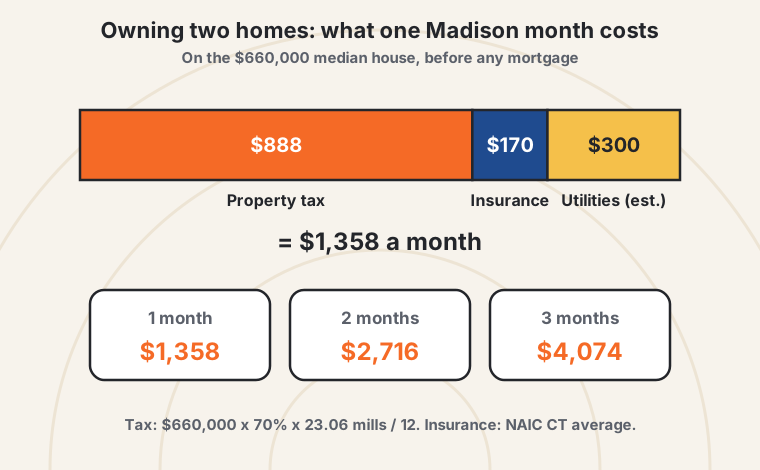
- Property tax: $10,654 ÷ 12 = about $888 a month.
- Insurance: about $170 a month, the Connecticut average for a standard homeowners policy (NAIC). A vacant house may need a different policy; call your insurer before you move out.
- Utilities, lawn, snow: about $300 a month (est.). Keep the heat on in winter; frozen pipes in an empty house are the costliest surprise of all.
Use the carrying-cost worksheet for your own numbers. The way to cut this cost is to line up the closing date with the move, not the other way around.
How big are repair credits after the buyer’s inspection?
Repair credits after the buyer’s inspection are often the largest hidden cost, frequently several thousand dollars, because the buyer’s report arrives after the price is set and the buyer can cancel under the inspection contingency. On Madison’s 1970s Colonials, common items are the oil tank, the septic system, the roof, radon and an aging boiler.
The median Madison home was built in 1973, and 47% of single-family homes are Colonials. That means many original systems are now 50 years old. You can shrink this line in two ways: fix cheap safety items before listing, and price known big items in from the start. Whether a pre-listing inspection is worth it is its own question; our Milford pre-listing inspection guide runs the numbers. Our list of what to fix before selling separates fixes that pay from fixes that do not.
Will you owe capital gains tax when you sell your Madison house?
You will owe capital gains tax on your Madison house only if your gain is larger than the federal exclusion: $250,000 for a single filer or $500,000 for a married couple filing jointly, if you owned and lived in the home for 2 of the last 5 years (IRS Publication 523). Connecticut taxes any taxable gain as income, at rates up to 6.99%.
Long-time Madison owners are the ones who get caught. Here is an illustrative example. A single owner bought in 1998 for $250,000 and sells for $660,000. Selling costs of about $40,000 (est.) reduce the amount realized, and documented improvements raise the basis. Without improvements the gain is $660,000 − $40,000 − $250,000 = $370,000. After the $250,000 exclusion, $120,000 is taxable: federal long-term capital gains rates of 0%, 15% or 20% apply depending on income, and Connecticut taxes it as income. A married couple filing jointly would owe nothing on the same sale.
Keep receipts for improvements (a new roof, an addition, a septic replacement); they raise your basis. Inherited houses work differently, because heirs usually get a stepped-up basis. Our guide to taxes when selling a house in Connecticut covers both, and a tax professional should check your own numbers.
What do hidden costs add up to on a $660,000 Madison sale?
On a $660,000 Madison sale, hidden costs add up to about $17,064 in this illustrative example, about 2.6% of the price: a $7,500 repair credit, $4,000 of moving (est.), $2,716 of double carrying, a $2,248 tax proration credit and $600 for septic work (est.). About $843 of oil comes back to you if you claim it.

| Hidden cost | Amount | Basis |
|---|---|---|
| Repair credit after inspection | $7,500 | Illustrative |
| Moving | $4,000 | (est.) |
| Double carrying, 2 months | $2,716 | $888 tax + $170 insurance + $300 utilities (est.), × 2 |
| Tax proration credit, 77 days | $2,248 | 77 × $29.19 |
| Septic pumping or inspection | $600 | (est.) |
| Hidden total | $17,064 | About 2.6% of $660,000 |
| Oil credited back to you | +$843 | 137 gallons × $6.154 |
Run your own version, including commission and conveyance tax, in the calculator below.
How much would you walk away with?
Slide the numbers to match your house. It works in your browser; nothing is saved or sent.
Estimates for planning. Conveyance tax per CGS 12-494 (state 0.75% up to $800,000, 1.25% to $2.5M, 2.25% above, plus the town rate). Seller attorney about $1,200 to $1,500; flat-fee MLS about $400; listings include three months of taxes, insurance and utilities, a cash sale about two weeks. Your attorney gives you the final numbers.
When should you not sell your Madison house to a cash buyer?
You should not sell your Madison house to a cash buyer when it is in good condition, you can time the move, and the hidden costs on this page are small compared with the gap between a retail price and a cash price. On a $660,000 home, that gap is usually far larger than $17,064.
We buy houses for cash, and we would rather tell you this now: for a well-kept Madison home, listing almost always nets more. A cash offer is below retail because the buyer takes on repairs, carrying costs and resale. See our cash buyer vs. realtor comparison and our tips for selling faster in Madison.
A cash sale makes sense when the hidden costs stack up: a failed septic system, an old buried tank, an estate with nobody local to manage it, or a move you cannot delay. Then removing repair credits, double carrying and months of uncertainty can be worth more than the price difference. Compare both nets in our side-by-side guide, or ask for a number on our Madison page.
How do you find every hidden cost before you sell, step by step?
You find every hidden cost before you sell by asking your attorney for a draft net sheet early, gathering your tax, septic, oil and improvement records, checking condo documents, timing the move to the closing, and asking a tax professional about your gain before you sign.
Ask for a draft net sheet
Your attorney can estimate the tax proration, conveyance tax and payoff before you list. Update it with every offer.
Gather the records buyers ask for
Septic pumping receipts, oil delivery records, radon tests, roof and boiler receipts. They shrink repair requests.
Order condo documents early
If you are in an association, request the resale certificate as soon as you have a buyer, and read the minutes for upcoming assessments.
Plan the overlap
Count the months you may carry two homes, and set the closing date around your move.
Check your gain
Purchase price, improvements and the exclusion. If the gain is near or above $250,000 or $500,000, talk to a tax professional before you sign.
Claim what is yours
Oil reading and a final water reading in the last week, so your attorney settles both exactly.
Frequently asked questions
What are the hidden costs of selling a house in Connecticut?
The hidden costs of selling a house in Connecticut are the property tax proration, final utility and septic charges, condo or HOA fees, moving, carrying two homes, repair credits after inspection, and capital gains tax. They often add 1% to 3% of the price (est.).
How much is the conveyance tax on a $660,000 house in Madison?
The conveyance tax on a $660,000 house in Madison is $6,600: 0.75% to the state and 0.25% to the town (CGS 12-494). Above $800,000, the state rate rises to 1.25% on the portion over $800,000.
Why do I owe property tax at closing in Connecticut?
You owe property tax at closing in Connecticut because the attorneys split the year’s tax by the day. If no paid bill covers some of the days you owned the house, you credit the buyer for those days.
Does Madison, CT have public sewers?
Most of Madison, CT has no public sewer system, so homes use septic systems. Buyers usually ask for pumping records or an inspection, so gather receipts before you list.
How much does a condo resale certificate cost in Connecticut?
A condo resale certificate in Connecticut costs $185, as adjusted for inflation, plus 5 cents a page or $10 for electronic copies, with up to $10 more to expedite (CGS 47-270(b)).
Do I pay capital gains tax when I sell my house in Connecticut?
You pay capital gains tax when you sell your house in Connecticut only on gain above the federal exclusion of $250,000 (single) or $500,000 (married filing jointly), if you meet the 2-of-5-year rule (IRS Pub 523). Connecticut taxes the taxable gain as income.
Who pays for the oil left in the tank?
The buyer usually pays the seller for the oil left in the tank at a Connecticut closing, at the current price. It is a custom, so check your contract and document the level.
Is there still a $250 smoke detector credit in Connecticut?
No. Since PA 23-164, Connecticut sellers must give a signed smoke and carbon monoxide affidavit at closing (CGS 29-453); there is no $250 credit option. The $500 condition-report credit (CGS 20-327c) still applies.
Can a cash sale remove hidden costs?
A cash sale can remove repair credits, double carrying and most showing costs, but not the conveyance tax, your payoff, your share of property tax or capital gains tax. The real cost of a cash sale is a lower price.
Related guides
Costs
Same cluster
For the whole process, see how to sell a house in Connecticut, or ask for a no-obligation number on our Madison page.
Plain-English information, not legal or tax advice. Talk to a Connecticut attorney and a tax professional about your own sale.
Sources (checked on October 27, 2026)
- Connecticut OPM Real Estate Sales (Madison, recorded Oct 2024 to Sep 2025), data.ct.gov.
- OPM mill rates, fiscal 2027, data.ct.gov.
- 2025 Connecticut parcel (CAMA) data for Madison (year built, style, heating fuel), data.ct.gov.
- CGS 12-494 (conveyance tax).
- CGS 47-270 (condo resale certificate).
- CGS 20-327b and 20-327c (condition report).
- CGS 29-453 (smoke and carbon monoxide affidavit).
- CGS 45a-2 (probate districts) and CGS 51-344 (judicial districts).
- IRS Publication 523, Selling Your Home.
- U.S. EIA heating oil and propane update.
- NAIC Homeowners Insurance Report (Connecticut average premium).
See the house together.
Pick a time that works.
Choose a time for us to walk through the property with you, or ask for a quick call first. We confirm every request personally.
Tuesday, January 13
No open times in the next few weeks. Please call us.
We will confirm by email. Nothing is booked until we do.
View my request
Who wrote this
Jerryll Noorden
Jerryll has bought and sold Connecticut houses since 2016 and has sat at more closing tables than he can count, on both sides. Before real estate he was a robotics scientist at NASA, IHMC and IIT. He wrote this guide because the national sites that rank for it skip the Connecticut rules that cost sellers money. When listing or selling it yourself would get you more than a cash offer, he says so.
This guide explains Connecticut rules in plain English. It is not legal or tax advice. Laws change; for your sale, talk to a Connecticut real estate attorney and a tax professional.
