
Key facts at a glance
| Fact | Number | Source |
|---|---|---|
| Homes sold in Cromwell, Oct 2024 to Sep 2025 | 244 | CT OPM real estate sales, data.ct.gov |
| Median sale price (all sales) | $350,000 (single-family: $455,000) | CT OPM real estate sales, data.ct.gov |
| Mill rate, fiscal 2027 | 29.28 (about $7,174 a year, or $19.65 a day, on a $350,000 home) | CT OPM mill rates; assessment at 70% (CGS 12-62a) |
| Conveyance tax the seller pays | 1.00% (0.75% state + 0.25% town), $3,500 on $350,000 | CGS 12-494 |
| Interest on a late tax installment | 18% a year (1.5% a month), from the due date | CGS 12-146 |
| Credit if you skip the condition report | $500 to the buyer | CGS 20-327c |
| Homes heated with oil | 63% (gas 28%) | 2025 CT parcel (CAMA) data, data.ct.gov |
| Probate court and Superior Court | Probate District No. 15 (Cromwell, Durham, Middlefield, Middletown); Middlesex Judicial District | CGS 45a-2; CGS 51-344 |
Most advice on saving money when you sell is really about the commission. This guide is narrower. It covers the closing-cost lines on a Cromwell settlement statement that you can actually shrink, and the ones you cannot. It is one chapter of our guide to how to sell a house in Connecticut. For the full list of seller costs, see the cost to sell a house in Connecticut; for the commission itself, see real estate commission in Connecticut.
Why does it feel like closing costs are out of your hands?
Closing costs feel out of your hands because most sellers first see the full list a few days before closing, on a settlement statement prepared by attorneys, when it seems too late to change anything. In fact several Cromwell lines can be lowered weeks earlier: the attorney fee, the oil credit, late tax interest, the payoff date and title problems.
Maybe you have a number in your head for what the house will bring, and you are afraid of watching it shrink line by line. Maybe a friend told you about a surprise tax credit or a fee nobody explained. You may feel anxious about the unknown, suspicious that someone is padding the bill, embarrassed to ask what a line means, rushed by a closing date that is already set, and a little resigned, as if these costs simply happen to you.
They do not have to. In Cromwell the biggest fixed item is the $3,500 conveyance tax on a $350,000 sale, and nobody can talk that down. But a handful of smaller items, each a few hundred dollars, are decided by what you do in the month before closing. This page is for you if you want to keep those dollars. It lists each one, with Cromwell numbers, and tells you who to call.
Which closing costs can a Cromwell seller actually lower?
The closing costs a Cromwell seller can actually lower are the seller’s attorney fee, the $500 condition-report credit, the heating oil left in the tank, interest on a late tax installment, daily interest on the mortgage payoff, and fees caused by title problems or a late closing. The conveyance tax, the payoff balance and your share of property tax are fixed.
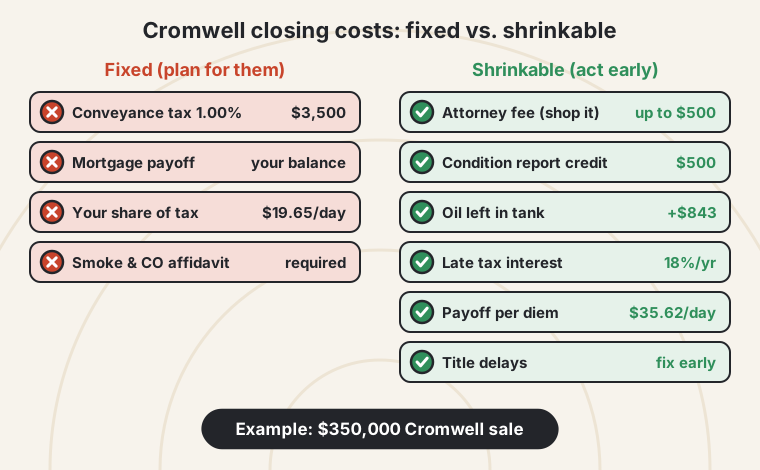
The rest of this guide takes them one at a time, in the order they come up before closing.
How much can you save by comparing real estate attorneys in Cromwell?
You can usually save a few hundred dollars by comparing Cromwell real estate attorneys, because most seller representation in Connecticut is a flat fee that typically runs about $1,000 to $1,500 for a simple sale (est.). Ask two or three attorneys for a written quote and a list of what is extra, such as wire fees, courier charges or a second trip for a power of attorney.
Connecticut does not let you skip the attorney. Only a Connecticut-admitted attorney may conduct a real estate closing (CGS 51-88a). The buyer’s attorney usually runs the closing, and you hire your own attorney to protect your side. Your attorney orders the payoff, prepares the deed and the conveyance tax return (Form OP-236), and checks the settlement statement.
When you compare quotes, compare what is included: the deed, the OP-236 and the payoff request, and what happens to the fee if the closing date moves or a title problem needs extra work.
An estate sale, a short sale or an old unreleased mortgage takes more work and costs more. That is fair. What you want to avoid is learning about the extras at the closing table. Our guide to the Connecticut closing process for sellers explains what your attorney does at each step.
Does the closing date change how much property tax you pay in Cromwell?
The closing date does not change how much property tax you pay in Cromwell, because the attorneys split the year’s tax by the day: you pay for the days you own the house and the buyer pays for the rest. On a $350,000 home at 29.28 mills, that is about $19.65 a day. What timing can change is late interest and when the cash moves.
Here is the math. Connecticut assesses at 70% of market value (CGS 12-62a), so a $350,000 house is assessed at $245,000. At Cromwell’s fiscal 2027 mill rate of 29.28, the annual tax is $245,000 × 29.28 ÷ 1,000 = about $7,174, or $19.65 a day. If on closing day 60 days of your ownership have not been covered by a bill you paid, you credit the buyer about $1,179. If you paid a bill that covers days after closing, the buyer credits you. Either way it is your own tax for your own days.
Each town decides whether its tax is paid in one, two or four installments (CGS 12-142). Cromwell, like most Connecticut towns, bills real estate tax in a July and a January installment; check the dates on your own bill. If an installment falls due shortly before your closing and you leave it unpaid past the grace period, interest runs at 18% a year counted from the due date (CGS 12-146). Towns typically charge 1.5% for each month or part of a month, so a payment made just after the grace period already owes 3%: about $108 on a half-year Cromwell installment of about $3,587. Small, but it is pure waste.
So do not let anyone sell you on “closing before July 1 saves you a tax bill”. It does not. Close when it suits your move, pay every installment on time, and ask your attorney early how the Cromwell bill will be split on the statement.
How do oil and water final readings put money back in your pocket?
Oil and water final readings put money back in your pocket because, by Connecticut custom, the buyer pays you for the heating oil left in the tank, and a final water and sewer reading means you pay only for what you used instead of an estimate or a holdback. With 63% of Cromwell homes heated by oil, the oil credit is often several hundred dollars.
Oil. A common basement tank holds 275 gallons. If it is half full on closing day, that is about 137 gallons. At $6.154 a gallon, the Connecticut residential average for the week of October 19, 2026 (U.S. Energy Information Administration), those 137 gallons are worth about $843. The buyer normally reimburses you at closing, but only if someone asks. Get a gauge reading or a delivery receipt from your oil company a few days before closing and send it to your attorney. Check what your contract says: the oil adjustment is custom, not statute, and the contract controls.
Water and sewer. Water in most of Cromwell comes from the Cromwell Fire District’s water division. Call your water provider (and the sewer billing office, if you are on public sewer) about a week before closing and ask for a final reading on or close to the closing date. Unpaid water and sewer charges can become liens, and the state’s condition report asks whether any are unpaid (CGS 20-327b). Without a final number, the buyer’s attorney may ask to hold back part of your proceeds in escrow until the bill arrives. A final reading lets your attorney settle it to the dollar.
How do title problems and delays cost Cromwell sellers money?
Title problems and delays cost Cromwell sellers money because every extra day adds payoff interest on the mortgage, and clearing an old lien or an unreleased mortgage at the last minute adds attorney time. On a $200,000 balance at 6.5%, one day is about $35.62, so a one-week slip costs about $249 and a month about $1,068.
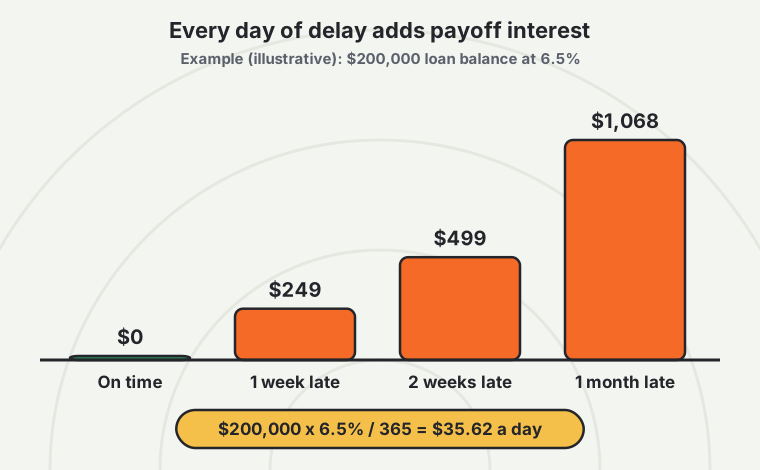
Your payoff letter includes interest up to the payoff date, so a closing that slips simply adds days. The common causes are avoidable:
- An old mortgage that was paid off but never released. If a lender you paid off years ago never recorded a release, your attorney must chase it. Connecticut law requires a release after payoff, and a lender that ignores a proper written request for 60 days can owe damages of $200 a week, up to $5,000 or the actual loss if greater (CGS 49-8). Find out early so you are not waiting on the lender in closing week.
- Liens and judgments. Unpaid sewer use charges, a contractor’s lien or an old judgment must be paid or released before the buyer gets clean title. Our guide to selling a house with a lien in Connecticut covers how that works.
- Estate paperwork. If the house belonged to a parent, the fiduciary needs authority from the probate court. Cromwell is in Probate District No. 15 with Durham, Middlefield and Middletown (CGS 45a-2). Start that paperwork before you sign a contract.
The fix is the same for all four: ask your attorney to run the title search and order the payoff as soon as you have a signed contract, not in the last week.
What do these savings add up to on a $350,000 Cromwell sale?
On a $350,000 Cromwell sale, these habits can add up to about $2,200 in this illustrative example: about $500 from comparing attorneys (est.), $500 from delivering the condition report, $843 of oil reimbursed, $108 of avoided late interest and $249 of payoff interest saved by not slipping a week. The $3,500 conveyance tax and the payoff balance stay the same.
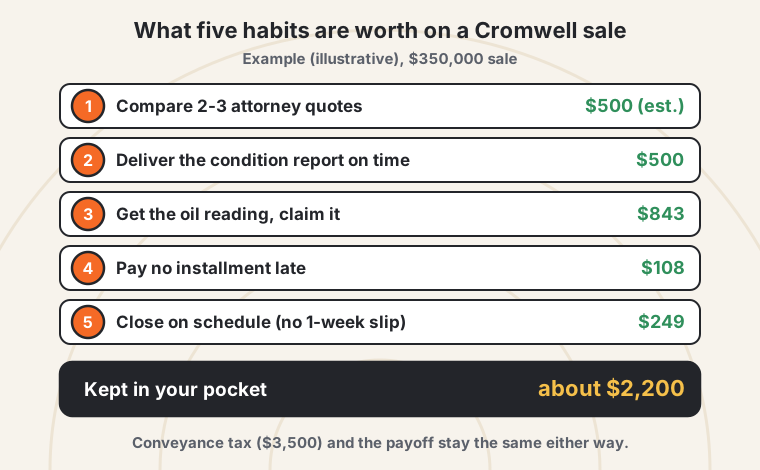
| Line | Careless seller | Prepared seller | Difference |
|---|---|---|---|
| Seller’s attorney | $1,500 (est.) | $1,000 (est.) | $500 |
| Condition-report credit | $500 | $0 | $500 |
| Oil in the tank (137 gallons) | $0 (forgot to ask) | +$843 | $843 |
| Late half-year installment, paid just after the grace period | $108 | $0 | $108 |
| Payoff interest, one-week slip | $249 | $0 | $249 |
| Conveyance tax (1.00%) | $3,500 | $3,500 | $0 |
| Total difference | about $2,200 |
Put your own numbers into the calculator below to see your net.
How much would you walk away with?
Slide the numbers to match your house. It works in your browser; nothing is saved or sent.
Estimates for planning. Conveyance tax per CGS 12-494 (state 0.75% up to $800,000, 1.25% to $2.5M, 2.25% above, plus the town rate). Seller attorney about $1,200 to $1,500; flat-fee MLS about $400; listings include three months of taxes, insurance and utilities, a cash sale about two weeks. Your attorney gives you the final numbers.
Which closing costs can’t a Cromwell seller save on?
The closing costs a Cromwell seller can’t save on are the conveyance tax of 1.00% on sales up to $800,000 (0.75% state plus 0.25% town, CGS 12-494), the full mortgage payoff, your share of the year’s property tax, and any liens on the house. The smoke and carbon monoxide affidavit is also required; since PA 23-164 there is no credit you can pay instead.
A few transfers are exempt from the conveyance tax (CGS 12-498); our guide to the Connecticut conveyance tax lists them. For the affidavit, install working smoke and CO detectors near each bedroom before closing; older advice about a $250 credit you could give instead is out of date.
When should you not sell your Cromwell house to a cash buyer?
You should not sell your Cromwell house to a cash buyer when it is in good shape, you have a few months, and a listing would net more even after commission and the costs on this page. A cash offer is below retail because the buyer takes on repairs and resale risk, so for an updated home the trade rarely pays.
We buy houses for cash, and we will tell you the same thing on the phone. Cromwell had 244 sales in the year to September 2025; a clean, well-priced house usually finds a financed buyer.
A cash sale earns its place when the costs on the other side are bigger: a roof, an oil tank or a septic problem you cannot fund, an estate with nobody nearby to manage showings, or a deadline. Our comparison of a cash buyer vs. a realtor in Connecticut walks through both nets, and why cash offers are lower explains the gap honestly.
How do you keep closing costs low when selling in Cromwell, step by step?
You keep closing costs low when selling in Cromwell by acting in the weeks before closing, not on closing day: hire your attorney early, deliver the condition report, pay tax installments on time, line up the oil and water readings, and fix title problems while there is still time.
Get two or three attorney quotes
Ask for a flat fee in writing and a list of extras. Hire before you sign a contract, so your attorney can review it.
Hand over the condition report before the buyer signs
Fill in the Department of Consumer Protection form honestly. It costs nothing and avoids the $500 credit (CGS 20-327c). Our guide to the Connecticut property condition disclosure walks through it.
Ask for the title search and payoff right after signing
That gives your attorney weeks, not days, to deal with an unreleased mortgage, a lien or estate paperwork.
Check your tax bill dates
If an installment falls due before closing, pay it on time or make sure your attorney pays it from proceeds before the grace period ends.
Order the final readings
Oil gauge reading or receipt, final water reading, and sewer charges if you are on public sewer, about a week out. Send them to your attorney.
Read the settlement statement a day early
Check the tax proration, the oil credit and the payoff. Ask about any line you do not understand. That is what you are paying your attorney for.
If you would rather skip most of this, a direct sale is about two weeks from first call to closing with us, with no repairs and no showings; you still pay the conveyance tax and your own attorney. Our Cromwell page is where to ask for a number.
Frequently asked questions
How can I save on closing costs when selling a house in Cromwell, CT?
You can save on closing costs when selling a house in Cromwell by comparing attorney quotes, giving the buyer the condition report on time to avoid the $500 credit, claiming the oil left in your tank, paying tax installments on time, and closing on schedule so payoff interest does not pile up.
How much is the conveyance tax when selling in Cromwell?
The conveyance tax when selling in Cromwell is 1.00% of the price up to $800,000: 0.75% to the state and 0.25% to the town (CGS 12-494). On a $350,000 sale that is $3,500, paid by the seller.
Does the seller pay property taxes at closing in Connecticut?
The seller pays property taxes at closing in Connecticut only for the days the seller owned the house. The attorneys split the year’s tax by the day, so the seller usually credits the buyer for unbilled days, or the buyer credits the seller for prepaid days.
Is there still a $250 credit for the smoke detector affidavit?
No, there is no longer a $250 credit for the smoke detector affidavit in Connecticut. Since PA 23-164, the seller must give the buyer a signed smoke and carbon monoxide affidavit at closing (CGS 29-453). The $500 condition-report credit (CGS 20-327c) still exists.
Does the buyer pay me for the oil left in my tank?
Yes, the buyer usually pays you for the oil left in your tank at a Connecticut closing. It is a custom, not a law, so check your contract and give your attorney a gauge reading or delivery receipt before closing.
What is a payoff per diem?
A payoff per diem is the daily interest your lender charges until it receives the payoff. On a $200,000 balance at 6.5%, it is about $35.62 a day, so a closing that slips a week costs about $249.
What happens if an old mortgage was never released?
If an old mortgage was never released, your attorney asks the lender for a release before closing. Under CGS 49-8, a lender that ignores a proper written request for 60 days can owe $200 a week in damages, up to $5,000 or the actual loss if greater.
Do cash buyers pay the seller’s closing costs?
Some cash buyers pay part of the seller’s closing costs, but the conveyance tax and your mortgage payoff still come out of your proceeds. Ask any buyer, including us, to put in the contract exactly which costs it pays, and compare the net, not the price.
Related guides
Costs
Same question, other angles
For the whole process from first call to closing, see how to sell a house in Connecticut, or ask for a no-obligation number on our Cromwell page.
Plain-English information, not legal or tax advice. Talk to a Connecticut attorney about your own sale.
Sources (checked on October 27, 2026)
- Connecticut OPM Real Estate Sales (Cromwell, recorded Oct 2024 to Sep 2025), data.ct.gov.
- OPM mill rates, fiscal 2027, data.ct.gov.
- 2025 Connecticut parcel (CAMA) data for Cromwell (heating fuel), data.ct.gov.
- CGS 12-494 and 12-498 (conveyance tax and exemptions).
- CGS 12-142 and 12-146 (tax installments; 18% interest on delinquent taxes).
- CGS 20-327b and 20-327c (condition report; $500 credit).
- CGS 29-453 (smoke and carbon monoxide affidavit).
- CGS 49-8 (release of satisfied mortgage; damages).
- CGS 45a-2 (probate districts) and CGS 51-344 (judicial districts).
- U.S. EIA heating oil and propane update (Connecticut residential heating oil price).
See the house together.
Pick a time that works.
Choose a time for us to walk through the property with you, or ask for a quick call first. We confirm every request personally.
Tuesday, January 13
No open times in the next few weeks. Please call us.
We will confirm by email. Nothing is booked until we do.
View my request
Who wrote this
Jerryll Noorden
Jerryll has bought and sold Connecticut houses since 2016 and has sat at more closing tables than he can count, on both sides. Before real estate he was a robotics scientist at NASA, IHMC and IIT. He wrote this guide because the national sites that rank for it skip the Connecticut rules that cost sellers money. When listing or selling it yourself would get you more than a cash offer, he says so.
This guide explains Connecticut rules in plain English. It is not legal or tax advice. Laws change; for your sale, talk to a Connecticut real estate attorney and a tax professional.
