
Key facts at a glance
| Fact | Number | Source |
|---|---|---|
| Homes sold in Milford, Oct 2024 to Sep 2025 | 780 | CT OPM real estate sales, data.ct.gov |
| Median sale price (all sales) | $450,000 (single-family: $515,000) | CT OPM real estate sales, data.ct.gov |
| Age of the housing | Median year built 1955; 58% built before 1960, 23% before 1940 | 2025 CT parcel (CAMA) data, data.ct.gov |
| Heating fuel | Gas 63%, oil 37% | 2025 CT parcel (CAMA) data, data.ct.gov |
| Is a seller inspection required? | No; the law does not require a seller to inspect or test | CGS 20-327d |
| Credit if you skip the condition report | $500 to the buyer | CGS 20-327c |
| Conveyance tax the seller pays | 1.00% (0.75% state + 0.25% town), $4,500 on $450,000 | CGS 12-494 |
| Probate court and Superior Court | Probate District No. 40 (Milford and Orange); Ansonia-Milford Judicial District | CGS 45a-2; CGS 51-344 |
The buyer’s home inspection is where many Connecticut sales lose money: a list of problems arrives, and the buyer asks for a price cut or a credit. A pre-listing inspection is the seller’s way of seeing that list first. This guide answers one question for Milford owners: does paying for one actually save you money? It is one chapter of our guide to how to sell a house in Connecticut. For the full list of seller costs, see the cost to sell a house in Connecticut.
Why does the buyer’s inspection feel like the riskiest part of selling?
The buyer’s inspection feels like the riskiest part of selling because it arrives after you have agreed on a price, it is written by someone the buyer hired, and it can reopen the deal. In Milford, where 58% of homes were built before 1960, an inspector almost always finds something.
Maybe your house is a 1950s Cape near the water and you have no idea what an inspector would say about the roof, the panel or the basement after a storm. Maybe you already know about a problem and dread the conversation. You may feel exposed, as if a stranger is about to grade your home, defensive about the way you kept it, uncertain what anything costs to fix, worried about a buyer walking away a week before closing, and torn about whether to spend money on a house you are leaving.
Those feelings are normal, and they are the reason this decision deserves real numbers rather than a slogan. This page is for you. It shows what a pre-listing inspection costs, what it can save, when it backfires, and which Milford items matter most.
Does a pre-listing inspection save money in Milford, CT?
A pre-listing inspection saves money in Milford, CT when the house is older or has unknowns, because you can get real repair quotes and fix or price problems before a buyer turns them into a bigger credit. It rarely pays on a recently updated house, and it can hurt if you will not act on what it finds, since anything you learn must be disclosed.
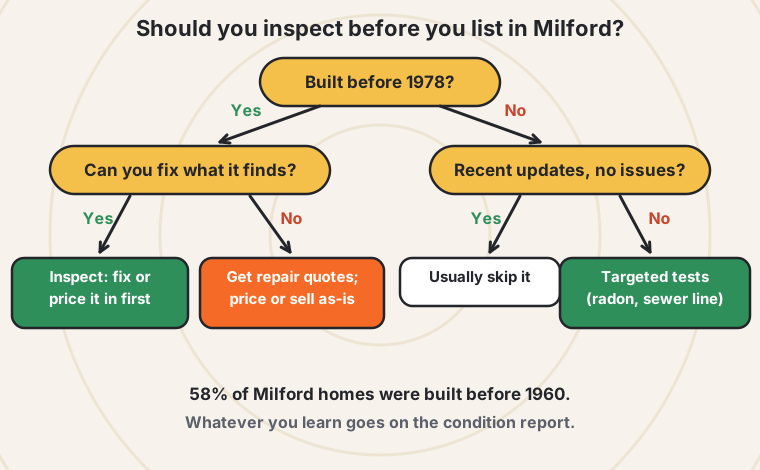
The saving does not come from the inspection itself. It comes from three things the inspection lets you do:
- Replace the buyer’s guess with your quote. A buyer who sees “roof near end of life” in a report tends to ask for a round, generous number. A seller who already has two contractor quotes can answer with a real figure.
- Fix cheap items before they become negotiating points. A missing GFCI outlet, a double-tapped breaker or a loose railing costs little to fix but reads badly in a buyer’s report.
- Price the big items in up front. If the house needs a roof, pricing it in from day one keeps the deal from reopening after the buyer’s inspector says so.
What the inspection cannot do is stop the buyer’s inspection. Buyers almost always order their own, and a second inspector may find something the first one did not. Think of your report as preparation, not a shield.
What does a pre-listing inspection cost in Milford?
A pre-listing inspection in Milford typically costs about $400 to $600 for a general home inspection of a single-family house (est.), plus add-ons you choose: a radon test (about $150, est.), a sewer line camera or septic inspection, or an oil tank check. For a sewered house with a radon test, a package of about $650 is a reasonable planning figure (est.).
| Check | Typical cost (est.) | Worth it in Milford when |
|---|---|---|
| General home inspection | $400 to $600 | The house is older than about 20 years or has not had recent updates |
| Radon test | About $150 | No test in the last few years; the condition report asks whether one was done |
| Sewer line camera | About $250 to $400 | Older clay or cast-iron line, big trees near the line, past backups |
| Septic inspection | About $400 to $700 | The house is one of those not on public sewer |
| Oil tank check | About $300 | Oil heat (37% of Milford homes), or signs of an old buried tank |
Hire a Connecticut-licensed home inspector, and ask for a sample report before you book. A report full of photos and plain-English severity ratings is easier to share with buyers than a 90-page checklist.
What is the renegotiation risk if you skip the inspection?
The renegotiation risk if you skip the inspection is that the buyer’s report becomes the price list: the buyer asks for a credit or a price cut after you are under contract, often rounded up, and threatens to walk under the inspection contingency. In this illustrative Milford example, a $15,000 credit request on work that actually cost $7,000 is an $8,000 swing.
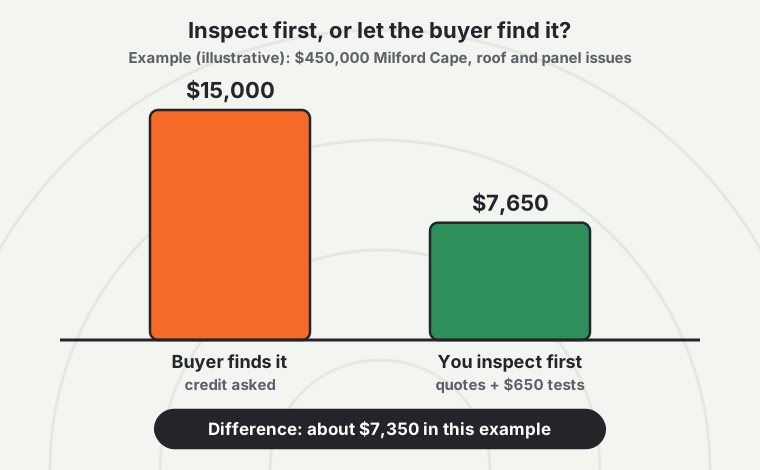
Here is the illustrative example in full. It uses public Milford numbers for the house and labeled assumptions for the repairs.
| Step | Buyer finds it | You inspect first |
|---|---|---|
| House | $450,000 Milford Cape, built 1955 (Milford median price and median year built) | |
| Issues | Roof near end of life; older electrical panel (illustrative) | |
| Inspection and tests | $0 | $650 (est.) |
| What the issues cost | Buyer asks for a $15,000 credit (illustrative) | Two quotes total $7,000 (illustrative); you fix or price it in |
| Cost to you | $15,000 | $7,650 |
| Difference | About $7,350 in your favor | |
Now the honest flip side. If the inspection finds nothing, you spent about $650 for peace of mind and a line in the listing. If it finds something big that you cannot afford to fix, you now have to disclose it, and you were going to take that hit anyway once the buyer’s inspector found it. The inspection pays best in the middle: a house with fixable, quotable problems.
Which Milford items should a pre-listing inspection focus on?
A Milford pre-listing inspection should focus on flood exposure, whether the house is on sewer or septic, oil tanks, the roof and electrical panel on 1950s homes, radon, and water in the basement. These are the items that most often turn into credits on Milford’s older, shoreline housing stock.
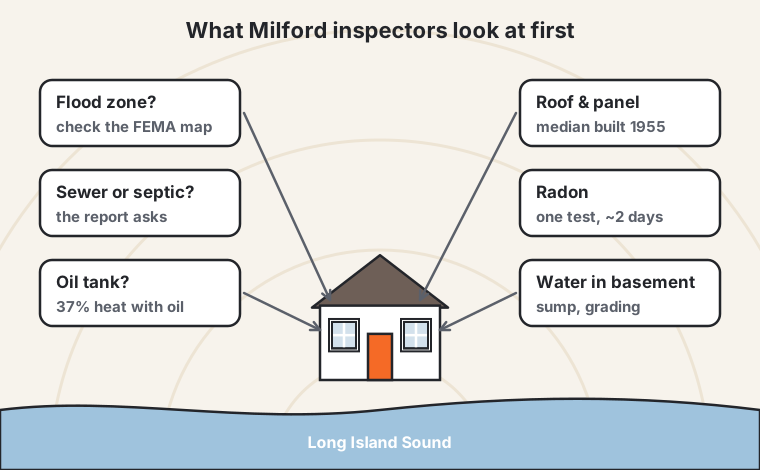
- Flood zone. Milford has a long Long Island Sound shoreline, and parts of the city sit in FEMA flood zones. The state condition report asks whether the property is in a flood hazard area (CGS 20-327b), and a buyer’s lender will require flood insurance in a high-risk zone. Look up your address on the FEMA Flood Map Service Center before you list, and find any elevation certificate you have.
- Sewer or septic. Most of Milford is on public sewer, but the condition report asks which system you have, whether there are separate sewer charges and whether any are unpaid. If you have septic, an inspection is worth more than any other add-on. If you are on sewer, an old lateral line under a big tree is a common surprise.
- Oil tanks. 37% of Milford homes heat with oil. The report asks about underground tanks, their age, and whether one was ever removed. A buried tank that nobody has documented is a classic credit request.
- Roof and electrical panel. A 1955 house may have had two roofs and an updated panel, or neither. Inspectors note older panels and aging roofs in almost every report.
- Radon. The Connecticut Department of Public Health recommends testing. The condition report asks whether a test was done and asks you to attach it.
- Water in the basement. Grading, gutters and a working sump pump. A dry basement in October can be a wet one in April.
For what each of these usually costs to fix and how buyers react, see our guide to oil tanks, septic, wells and radon and what to fix before selling in Connecticut.
Do you have to disclose what a pre-listing inspection finds?
Yes, in practice you have to disclose what a pre-listing inspection finds, because the Connecticut condition report asks about problems you know of, and the inspection makes you know. The law does not require you to inspect (CGS 20-327d), but once you learn about a defect, leaving it off the report exposes you to a claim later.
This is the real cost of a pre-listing inspection, and most articles skip it. You cannot “un-know” a cracked heat exchanger or a failed septic test. Every seller of a one- to four-family home must give the buyer the Residential Property Condition Report before the buyer signs a contract (CGS 20-327b), or credit the buyer $500 at closing (CGS 20-327c). Paying the credit does not excuse you from disclosing defects you know about.
No provision of the condition-report law requires the seller “to secure inspections, tests or other methods of determining the physical conditions of the property” (CGS 20-327d). So the choice is yours. If you inspect, decide in advance that you will fix, price in, or disclose what you find.
That is why the decision chart above asks whether you can act on the results. If the honest answer is no, a full inspection may only add a disclosure without adding a fix. Our guide to the Connecticut property condition disclosure covers the report question by question.
When is a pre-listing inspection not worth it?
A pre-listing inspection is not worth it when the house is recently updated with records to show, when you plan to sell as-is to a cash buyer who will not ask for repairs, or when you already know about a major problem and will price it in regardless. In those cases a targeted test, or none, is cheaper.
- Updated house with paperwork. New roof, new panel, new heating system, with permits and receipts. Hand buyers the receipts; that does more than a report.
- As-is cash sale. A cash buyer prices the house as it stands and does not come back with a repair list. Spending $650 to learn what the buyer will price in anyway is money you do not need to spend.
- Known big problem. If you know the septic has failed or the foundation needs work, get one or two repair quotes instead of a general inspection. Quotes are what you will negotiate with.
- No time or cash to fix. If you need to sell within weeks, the inspection mostly adds a disclosure. Our guide to selling a house as-is in Connecticut covers that path.
When should you not sell your Milford house to a cash buyer?
You should not sell your Milford house to a cash buyer when it is in decent shape, the problems are fixable for a known price, and you have a few months to list. Milford had 780 sales in the year to September 2025, so a well-priced, well-prepared house usually finds a financed buyer, and that nets more than a cash offer.
We buy houses for cash, and we say this plainly: a cash price is below retail, because the buyer pays for the repairs, the carrying costs and the resale risk. If a $650 inspection and $7,000 of quoted work make your house easy to finance, listing is likely the better route. Compare both nets with our cash buyer vs. realtor comparison, and see what listing with an agent costs.
A cash sale makes sense when the inspection list is long and expensive, when flood or septic issues would scare off lenders, or when you simply cannot carry the house through months of showings. In that case you skip the inspection, the repairs and the renegotiation together, and close in about two weeks. Our Milford page is where to ask for a number, and our side-by-side comparison helps you check it.
How do you use a pre-listing inspection to save money, step by step?
You use a pre-listing inspection to save money by deciding first what you will do with the results, booking a licensed inspector plus only the add-ons your house needs, getting quotes on anything significant, then fixing, pricing in or disclosing each item before you list.
Decide what you will do with the results
Fix, price in, or disclose. If you will do none of these, skip the inspection.
Pull your records
Roof and furnace receipts, permits, any radon test, septic pumping records, an elevation certificate. Records answer half the questions an inspector raises.
Book the inspection and only the add-ons you need
Radon if never tested, sewer camera or septic if relevant, oil tank check if you heat with oil.
Get two quotes for anything significant
Quotes turn “needs a roof” into a number you can defend in a negotiation.
Fix the cheap items, price in the big ones
Small safety items first. For big items, either fix with receipts or set the price to reflect them.
Fill in the condition report honestly
Deliver it before the buyer signs, so you avoid the $500 credit (CGS 20-327c), and offer the inspection report to serious buyers.
Frequently asked questions
Is a pre-listing inspection worth it in Milford, CT?
A pre-listing inspection is worth it in Milford, CT for older houses with fixable unknowns, which describes much of Milford’s housing: the median home was built in 1955. It is usually not worth it for a recently updated house or an as-is sale to a cash buyer.
How much does a pre-listing inspection cost in Connecticut?
A pre-listing inspection in Connecticut usually costs about $400 to $600 for a general inspection of a single-family house (est.). Radon, sewer line, septic and oil tank checks are extra.
Do Connecticut sellers have to get an inspection?
No, Connecticut sellers do not have to get an inspection. CGS 20-327d says the condition-report law does not require a seller to secure inspections or tests. Sellers must still deliver the condition report or credit the buyer $500.
Do I have to share my pre-listing inspection report with buyers?
You do not have to hand buyers the report itself, but you must disclose known defects on the Connecticut condition report, and the inspection makes you aware of them. Many sellers share the report to build trust.
Will buyers still do their own inspection?
Yes, buyers almost always do their own inspection, and their inspector may find different things. Your report prepares you; it does not replace the buyer’s inspection contingency.
Do I need to disclose that my Milford house is in a flood zone?
Yes, the Connecticut condition report asks whether the property is in a flood hazard area (CGS 20-327b). Check the FEMA flood map for your address before you list.
Should I test for radon before selling?
Testing for radon before selling is a good idea if you have no recent result, because the condition report asks whether a test was done and the Connecticut Department of Public Health recommends testing. A short-term test takes a few days.
What happens if the buyer’s inspection finds problems?
If the buyer’s inspection finds problems, the buyer may ask for repairs, a credit or a lower price, or cancel under the inspection contingency. Having repair quotes ready lets you answer with real numbers.
Do cash buyers ask for an inspection?
Cash buyers usually do one walkthrough and price the house as it is, without a repair list afterward. That is why a pre-listing inspection adds little if you plan to sell to a cash buyer.
Related guides
Costs
Same cluster
For the whole process, see how to sell a house in Connecticut, or ask for a no-obligation number on our Milford page.
Plain-English information, not legal advice. Talk to a Connecticut attorney about your own sale.
Sources (checked on October 27, 2026)
- Connecticut OPM Real Estate Sales (Milford, recorded Oct 2024 to Sep 2025), data.ct.gov.
- OPM mill rates, fiscal 2027, data.ct.gov.
- 2025 Connecticut parcel (CAMA) data for Milford (year built, heating fuel), data.ct.gov.
- CGS 20-327b, 20-327c and 20-327d (condition report, $500 credit, no duty to inspect).
- CGS 12-494 (conveyance tax).
- CGS 45a-2 (probate districts) and CGS 51-344 (judicial districts).
- FEMA Flood Map Service Center.
- Connecticut Department of Public Health radon program.
See the house together.
Pick a time that works.
Choose a time for us to walk through the property with you, or ask for a quick call first. We confirm every request personally.
Tuesday, January 13
No open times in the next few weeks. Please call us.
We will confirm by email. Nothing is booked until we do.
View my request
Who wrote this
Jerryll Noorden
Jerryll has bought and sold Connecticut houses since 2016 and has sat at more closing tables than he can count, on both sides. Before real estate he was a robotics scientist at NASA, IHMC and IIT. He wrote this guide because the national sites that rank for it skip the Connecticut rules that cost sellers money. When listing or selling it yourself would get you more than a cash offer, he says so.
This guide explains Connecticut rules in plain English. It is not legal or tax advice. Laws change; for your sale, talk to a Connecticut real estate attorney and a tax professional.
