
Key facts at a glance
| Fact | Number | Source |
|---|---|---|
| Homes sold in Stratford, Oct 2024 to Sep 2025 | 699, median $435,000 (single-family $449,000) | CT OPM real estate sales, data.ct.gov |
| Typical Stratford home | Built 1952; 69% built before 1960; heat 62% gas or propane, 37% oil | 2025 CT parcel (CAMA) data, data.ct.gov |
| Property tax on a $449,000 house, fiscal 2027 (37.73 mills) | About $11,860 a year, $990 a month (est.) | OPM mill rates; assessment at 70% |
| New flood questions on the seller’s condition report | 6, in a “Flood Risk Awareness” section, since July 1, 2025 | Public Act 25-33, sec. 3; CGS 20-327b |
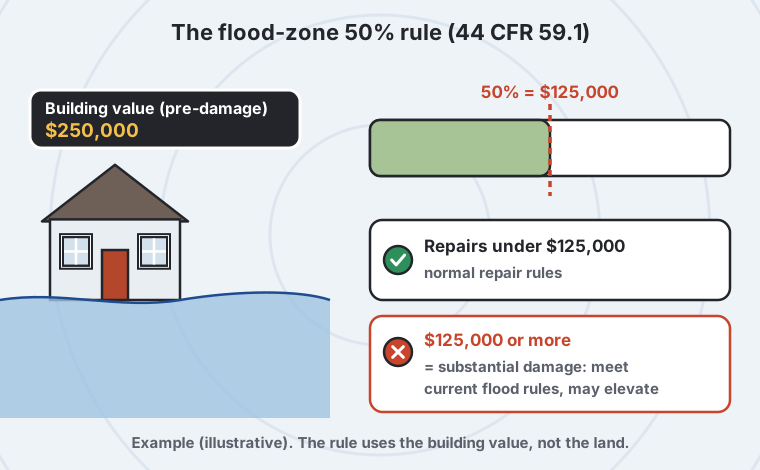
| Flood-zone “substantial damage” line | Repairs of 50% or more of the building’s pre-damage value | 44 CFR 59.1 |
| Residential properties where EPA found Raymark waste used as fill | 46, cleaned up starting in the 1990s | U.S. EPA, Raymark Industries Superfund site |
| Conveyance tax the seller pays | 1.00% (0.75% state + 0.25% town): $4,490 on $449,000 | CGS 12-494 |
| Probate court and Superior Court | Stratford Probate District (No. 47); Bridgeport Judicial District | CGS 45a-2; CGS 51-344 |
Some houses cost their owners money every month and still do not sell. This guide answers one question: which houses are hard to sell in Connecticut, and what can you do about each type? It covers flood zones, crumbling foundations, buried oil tanks, mixed-use buildings, non-conforming lots and deed restrictions, with examples from Stratford’s shoreline and older neighborhoods. It is part of our guide to how to sell a house in Connecticut.
What does it feel like to own a house that is hard to sell?
Owning a house that is hard to sell usually feels like being stuck with a problem you did not create: the flood map changed, the oil tank was buried before you bought, the zoning was written after the house was built. Most owners in this spot are not careless; they simply own the one kind of house that most buyers and lenders avoid.
Maybe your Lordship cottage took water in a storm and the flood insurance bill keeps climbing. Maybe the buyer’s inspector found an old fill pipe in the yard of your 1950s Cape and the buyer vanished. People in this spot often feel trapped, because the house will not sell at the price they need, resentful about a problem they inherited with the deed, ashamed to tell another buyer, confused by rules nobody explains clearly, and worn down by paying taxes on a house that only causes worry.
This page is for you. Every type below has a fix or a workaround, and a few have more than one. Some are worth fixing before you sell; some are not. We buy houses like these, and we will tell you which ones you should not sell to us.
Which houses are hardest to sell in Connecticut?
The houses hardest to sell in Connecticut are those with a problem that blocks a buyer’s mortgage or insurance, or that no one can price: houses in a FEMA flood zone, houses with pyrrhotite (crumbling) foundations, houses with a buried oil tank, mixed-use buildings, houses on non-conforming lots or with non-conforming uses, and houses with deed restrictions or easement disputes.

The pattern is the same for all six. Most buyers need a mortgage, and lenders need the house to be insurable, appraisable and legal as it stands. Break one link and only cash buyers or risk-takers remain, and a smaller pool pays less. With each type, restore the link if you can, or show buyers exactly what it will cost.
Why is a house in a flood zone harder to sell in Stratford?
A house in a flood zone is harder to sell in Stratford because buyers with a federally regulated or insured mortgage must carry flood insurance in a FEMA special flood hazard area, sellers now answer six flood questions on the condition report (Public Act 25-33), and a house damaged by 50% or more of its value must be rebuilt to current flood rules (44 CFR 59.1). Each one adds cost or doubt for buyers.
Stratford has a long shoreline on Long Island Sound and the Housatonic River, and neighborhoods such as Lordship, Short Beach and the areas near the river mouth include mapped flood zones. Check your own address on FEMA’s Flood Map Service Center before you list; the condition report now asks which zone you are in, whether you or past owners received federal flood assistance, whether a flood policy is in force, whether an elevation certificate exists, whether you ever filed a flood claim, and whether the structure has had water from seepage or a natural flood (CGS 20-327b as amended by Public Act 25-33, effective July 1, 2025).
The same Act also requires insurers to tell homeowners plainly that their homeowners policy does not cover flood (from July 1, 2026), and mortgage lenders to give borrowers a written flood notice before closing. Buyers will arrive better informed than ever, so a vague answer costs more than a clear one.
What to do. Order an elevation certificate if you do not have one; it is the single document that most affects a flood premium. Get a written flood insurance quote for a buyer, so they see a real number instead of a rumor. Gather any repair records, and disclose fully. If the house has been substantially damaged, talk to the Stratford building department before you plan repairs; elevating an older cottage can cost more than the house is worth, which is when a direct sale is the honest answer.
Does a crumbling foundation make a house hard to sell, even outside the pyrrhotite belt?
A crumbling foundation makes a house very hard to sell, because concrete with pyrrhotite deteriorates over time and most lenders and insurers will not touch a failing foundation. Stratford is outside the northeastern Connecticut area where pyrrhotite concrete was used, but the condition report asks every Connecticut seller whether they know of pyrrhotite and of any foundation testing or repairs (CGS 20-327b).
For most Stratford owners the foundation question is about ordinary settling, cracks and water, not pyrrhotite, and a structural engineer’s letter usually settles it. If you own a house in the affected towns, our full guide to selling a house with a crumbling foundation covers core testing, the state’s Connecticut Foundation Solutions Indemnity Company program and the disclosure rules in depth, so we will not repeat it here.
Why does a buried oil tank scare Stratford buyers?
A buried oil tank scares Stratford buyers because a leak is invisible until the tank is pulled, the cleanup can cost far more than the tank, and buyers’ insurers and lenders often ask for proof the tank was removed. Connecticut’s environmental agency does not regulate home heating tanks serving four units or fewer, but any contamination from them is regulated, and there is no state money for removal or cleanup.
About 37% of Stratford’s houses still heat with oil, and many of the 62% now on gas were converted from oil. That conversion is where forgotten tanks come from: a fill pipe by the foundation, a vent pipe, or a capped line in the basement. The condition report asks whether there is a buried tank, whether you know of problems with it, and whether one was ever removed, with the removal paperwork attached (CGS 20-327b). Connecticut’s DEEP recommends a soil sample under the tank when it comes out, and says homebuyers usually want proof the tank did not leak. Our guide to oil tanks, septic, wells and radon covers the removal process.
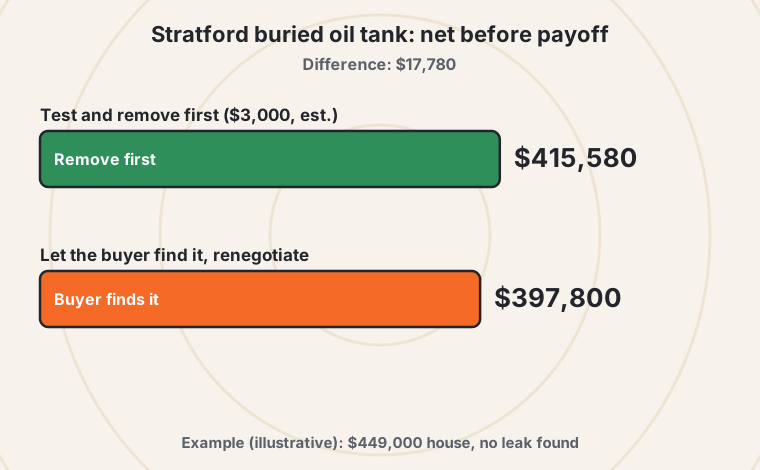
Example (illustrative). A Stratford house worth $449,000 (the single-family median) with an abandoned buried tank. Commission is assumed at 5% (est.), the attorney at $1,500 (est.), and property tax at about $990 a month.
| Line | Test and remove first | List and let the buyer find it |
|---|---|---|
| Price | $449,000 | $429,000 (after a $20,000 renegotiation, illustrative) |
| Tank removal and soil test, no leak (est.) | -$3,000 | $0 |
| Commission (5%, est.) | -$22,450 | -$21,450 |
| Conveyance tax (1.00%) | -$4,490 | -$4,290 |
| Seller’s attorney (est.) | -$1,500 | -$1,500 |
| Property tax while you wait (est.) | -$1,980 (2 months) | -$3,960 (4 months, after a lost buyer) |
| Net before your mortgage payoff | $415,580 | $397,800 |
Stratford also has a past that no other Connecticut town shares: the U.S. EPA reports that waste from the former Raymark Industries plant was used as fill at 46 residential properties across town, which were cleaned up starting in the 1990s. If you know your property was one of them, the condition report asks about prior government actions or orders related to hazardous substances; attach the paperwork you have. A documented cleanup is a known quantity, and known quantities sell.
Why are mixed-use buildings hard to sell?
Mixed-use buildings, such as a storefront with apartments above, are hard to sell because they fall between two lending worlds: many residential loan programs cap how much of the building can be commercial, and commercial loans need larger down payments and look at the business income. Comparable sales are also scarce, so appraisals come in low, and the buyer pool shrinks to investors and owner-operators.
Stratford has mixed-use buildings along its older commercial corridors. If you own one, the most useful things you can bring to a sale are a clean rent roll, current leases, three years of income and expense figures, and confirmation from the town that the current mix of uses is allowed in the zone. A buyer who can see the income and the zoning can finance and price the building; a buyer who cannot will discount for both. If tenants are in place, our guide to selling a rental with tenants in Connecticut covers leases and security deposits at closing.
What makes a non-conforming lot or use hard to sell?
A non-conforming lot or use is hard to sell because the house or use does not meet today’s zoning, so buyers worry they cannot expand, rebuild after a fire, or keep the use. Connecticut law protects existing non-conforming uses: zoning may not prohibit their continuance or end them for non-use alone without regard to the owner’s intent, and demolition by itself is not evidence of abandonment (CGS 8-2). Expanding usually still needs a variance.
Small beach lots, houses that sit too close to a lot line, and two-families in single-family zones are common examples in older shoreline towns. Lenders often ask whether the house could be rebuilt as it is if destroyed. The fix is paper: ask the Stratford zoning office for a letter confirming the legal non-conforming status, find the original permits, and, if there is a violation rather than a protected non-conformity, see our guide to selling a house with code violations. A buyer with that letter in hand prices the house as a house, not as a question mark.
How do deed restrictions and easements make a house harder to sell?
Deed restrictions and easements make a house harder to sell when they limit what a buyer can do with it, or when nobody is sure what they mean. The condition report asks every seller about encroachments, easements or rights-of-way, and land use restrictions beyond zoning (CGS 20-327b). A shared driveway with no written agreement, a neighbor’s fence over the line, or an old restriction on rentals can each stall a buyer’s title review.
A survey and an attorney usually solve these, not a contractor. A boundary survey shows what is really where, and a written easement or boundary agreement recorded on the Stratford land records turns a dispute into a document. Start early; title problems found days before closing cost the most.
When should you NOT sell a hard-to-sell house to a cash buyer?
You should not sell a hard-to-sell house to a cash buyer when the problem can be fixed cheaply and quickly, such as removing a buried tank that did not leak, getting a zoning letter or an elevation certificate, or recording a driveway agreement. Fix those first and sell to the full market; the price difference is usually far larger than the cost.
A direct sale fits when the fix is large or uncertain: a flood-damaged house that would need elevating, a leaking tank with unknown cleanup, a failing foundation, a mixed-use building with no records, or a house you have already lost one buyer on. In those cases, a clean, as-is sale can be worth more than the hope of a higher number later. Our guide to selling as-is in Connecticut explains how disclosure works when you sell without fixing, and our page on selling a house that needs repairs shows how we handle the problem houses ourselves.
Is a cash sale right for you, or should you list?
Seven quick questions. There is no wrong answer, and we will tell you honestly if listing would leave you more.
- Does the house need repairs you would rather not pay for or manage?
- Do you need to close by a certain date, or within the next month or two?
- Would showings be hard: tenants, belongings, privacy, or you live out of state?
- Is there a complication: an estate or probate, a divorce, foreclosure, liens or back taxes?
- Could you comfortably cover the mortgage, taxes and utilities for three or more months?
- Is getting the highest possible price more important to you than speed and certainty?
- Would a buyer's bank lend on the house as it is (no major roof, foundation, oil tank or code issues)?
How do you sell a hard-to-sell house in Stratford, step by step?
You sell a hard-to-sell house in Stratford by naming the exact problem, getting the one document that defines it (an elevation certificate, a tank test, a zoning letter, a survey), pricing the fix, comparing a fix-and-list net with as-is offers, and disclosing fully on the condition report. A direct sale typically closes in about two weeks once title is clear.
Name the problem
Flood zone, foundation, tank, mixed use, zoning or title. If there is more than one, list them all.
Get the defining document
Elevation certificate and flood quote; engineer’s letter; tank test or removal report; zoning letter; boundary survey. One page often changes a buyer’s mind.
Price the fix
Get one or two written quotes. Put the cost next to what buyers are asking you to take off.
Compare the routes
Fix and list, list as-is with full disclosure, or sell direct. Check any cash buyer with our cash buyer checklist and our list of scam red flags.
Disclose and close
Answer the condition report fully, attach the documents, and close with a Connecticut attorney.
How much would you walk away with?
Slide the numbers to match your house. It works in your browser; nothing is saved or sent.
Estimates for planning. Conveyance tax per CGS 12-494 (state 0.75% up to $800,000, 1.25% to $2.5M, 2.25% above, plus the town rate). Seller attorney about $1,200 to $1,500; flat-fee MLS about $400; listings include three months of taxes, insurance and utilities, a cash sale about two weeks. Your attorney gives you the final numbers.
Questions Stratford owners ask about hard-to-sell houses
What houses are hard to sell in Connecticut?
Houses that are hard to sell in Connecticut include those in FEMA flood zones, those with pyrrhotite or failing foundations, buried oil tanks, mixed-use buildings, non-conforming lots or uses, and title problems such as deed restrictions or easement disputes.
Do I have to disclose that my Stratford house is in a flood zone?
Yes, you must disclose that your Stratford house is in a flood zone. Since July 1, 2025, the condition report has a “Flood Risk Awareness” section asking the FEMA zone, flood insurance, past flood claims and federal assistance (CGS 20-327b; Public Act 25-33).
Does a buyer need flood insurance in a flood zone?
A buyer with a federally regulated or insured mortgage on a house in a FEMA special flood hazard area must carry flood insurance. Cash buyers are not required to, though many still buy it.
Do I have to remove a buried oil tank before selling in Connecticut?
No, Connecticut does not require you to remove a residential buried oil tank before selling; DEEP does not regulate home heating tanks serving four units or fewer. You must disclose it, and contamination from a leak is regulated.
Is Stratford in the crumbling foundation area?
No, Stratford is not in the northeastern Connecticut area where pyrrhotite concrete was used. Every seller still answers the pyrrhotite and foundation questions on the condition report (CGS 20-327b).
Can I rebuild a non-conforming house after a fire in Connecticut?
Often yes: Connecticut zoning may not prohibit the continuance of a non-conforming use or structure, and demolition alone is not evidence of intent to abandon it (CGS 8-2). Confirm with the town zoning office, and in a flood zone check the substantial damage rule too.
What is substantial damage in a flood zone?
Substantial damage means repairs costing 50% or more of the building’s market value before the damage (44 CFR 59.1). In a flood zone, the rebuilt house must then meet current floodplain rules, which can mean elevating it.
Why is it hard to get a mortgage on a mixed-use building?
It is hard to get a mortgage on a mixed-use building because many residential programs limit the commercial share, while commercial loans need bigger down payments and income records. Clean leases and income figures help any buyer finance it.
What is the conveyance tax on a Stratford sale?
The conveyance tax on a Stratford sale is 1.00% for most homes, 0.75% to the state and 0.25% to the town, paid by the seller: $4,490 on a $449,000 sale (CGS 12-494).
Which court handles a Stratford estate or foreclosure?
A Stratford estate goes to the Stratford Probate District, district 47 under CGS 45a-2, and foreclosures and other civil cases go to the Bridgeport Judicial District (CGS 51-344).
Related guides
The house
Other problem houses
For the full process, see how to sell a house in Connecticut. For a no-obligation as-is number on a hard-to-sell house, see how we buy houses that need repairs or start on our Stratford page.
Plain-English information, not legal, insurance or environmental advice. Talk to a Connecticut attorney about your own property.
Sources (checked on October 27, 2026)
- Public Act 25-33, sections 1 to 4 (flood notices; “Flood Risk Awareness” questions).
- CGS 20-327b and 20-327c (residential condition report).
- CGS 8-2 (zoning; non-conforming uses).
- 44 CFR 59.1 (substantial damage).
- FEMA Flood Map Service Center.
- CT DEEP: residential home heating oil tanks FAQ.
- U.S. EPA: Raymark Superfund site cleanup milestone and site page.
- Connecticut Foundation Solutions Indemnity Company.
- CGS 12-494 (conveyance tax).
- CGS 45a-2 (probate districts) and CGS 51-344 (judicial districts).
- CT OPM Real Estate Sales, 2025 CT Parcel and CAMA data and OPM mill rates, data.ct.gov.
See the house together.
Pick a time that works.
Choose a time for us to walk through the property with you, or ask for a quick call first. We confirm every request personally.
Tuesday, January 13
No open times in the next few weeks. Please call us.
We will confirm by email. Nothing is booked until we do.
View my request
Who wrote this
Jerryll Noorden
Jerryll has bought and sold Connecticut houses since 2016 and has sat at more closing tables than he can count, on both sides. Before real estate he was a robotics scientist at NASA, IHMC and IIT. He wrote this guide because the national sites that rank for it skip the Connecticut rules that cost sellers money. When listing or selling it yourself would get you more than a cash offer, he says so.
This guide explains Connecticut rules in plain English. It is not legal or tax advice. Laws change; for your sale, talk to a Connecticut real estate attorney and a tax professional.
