
Key facts at a glance
| Fact | Number | Source |
|---|---|---|
| Homes sold in Guilford, Oct 2024 to Sep 2025 | 378, median $593,000 (single-family $606,000) | CT OPM real estate sales, data.ct.gov |
| Typical Guilford home | Built 1975; 26% built before 1960; 64% heat with oil | 2025 CT parcel (CAMA) data, data.ct.gov |
| Guilford septic pump-out rule | At least once every 5 years; warning letter, then a $200 fine and $25 a day | Town of Guilford code (septic pump-out ordinance) |
| Permit needed to repair a septic system | “Approval to construct” from the local director of health before any repair | CT Public Health Code 19-13-B103e |
| Adding a bedroom, garage or pool on a septic lot | Health director must find a code-complying area for a system first | CT Public Health Code 19-13-B100a |
| Septic questions on the seller’s report | System type, service company, date last pumped, any problems | CGS 20-327b |
| Conveyance tax the seller pays | 1.00% (0.75% state + 0.25% town): $5,930 on $593,000 | CGS 12-494 |
| Probate court and Superior Court | Guilford-Madison Probate District (No. 34); New Haven Judicial District | CGS 45a-2; CGS 51-344 |
Sewage in the yard, a backup into the basement, or a pumper who says “your leaching field is done” can stop a Guilford sale cold. This guide answers one question: how do you sell a house with a failed septic in Connecticut, and should you repair it first? It covers the state septic rules, who approves what in Guilford, what repairs cost, and the honest math for repairing versus selling as-is. It is part of our guide to how to sell a house in Connecticut. If you are selling a Guilford house without an agent or wondering about timing, our separate guides on selling by owner in Guilford and the right time to sell in Guilford cover those questions.
What is it like to find out your septic has failed right before a sale?
Finding out your septic has failed right before a sale usually feels like a trap door opening: the house you thought was ready now needs a repair you cannot see, cannot price on your own, and cannot finish without engineers and the health department. Most owners in this spot worry less about the repair itself than about losing the buyer, the timeline and a large slice of their equity.
Maybe the buyer’s inspector ran water for an hour and the ground over the field turned soggy. Maybe you have known for a while that the drains are slow and the grass over the field is greener than anywhere else. People in this position often feel embarrassed, as if a failing system says something about how they kept the house, anxious about a cost nobody will name, stuck between a buyer’s deadline and a designer’s schedule, wary of anyone who offers a quick fix, and tired of a house that keeps asking for money.
Septic systems wear out. Leaching fields have a working life, and a 1975 Guilford house, the town’s typical age, may be on its original field. This page is for you if you want to know your real options, in order, with the Connecticut rules attached.
What Connecticut rules apply to a failed septic system when you sell?
The Connecticut rules that apply to a failed septic system when you sell are the Public Health Code sections 19-13-B103a to B103f, which set the design and permit rules, section 19-13-B100a, which limits additions and conversions on septic lots, the seller’s condition report under CGS 20-327b, and in Guilford the town’s five-year pump-out ordinance. Connecticut has no statewide rule that forces a septic inspection or repair at the point of sale.
| Rule | What it says, in plain English | Why it matters to a seller |
|---|---|---|
| Public Health Code 19-13-B103e | No septic system may be “constructed, altered, repaired or extended” without an approval to construct, and no use starts without a discharge permit, both from the local director of health. | A repair is a permitted job with a design, an inspection and a sign-off, not a weekend fix. |
| Public Health Code 19-13-B103d | Sets minimum requirements; the local director of health may grant an exception for the repair of an existing system that cannot meet them. | On a small or wet shoreline lot, a repair can often be approved even when a full code system will not fit. |
| Public Health Code 19-13-B100a | Without sewers, no addition, conversion, garage or pool unless the health director finds a “code-complying area” for a system on the lot. | Buyers who plan to expand will ask about it; a lot with no code-complying area is worth less to them. |
| CGS 20-327b | The condition report asks the system type, the service company, the date last pumped and frequency, and “are there problems?” | You must disclose a known failure; the $500 credit in 20-327c does not excuse hiding a serious defect. |
| Guilford pump-out ordinance | Every septic tank in town must be pumped at least once every five years, with records kept by the Water Pollution Control Authority. | Buyers and their attorneys can ask for the pump-out history; an overdue tank is an easy red flag. |
The broader question of whether you need a septic inspection to sell at all, and how septic sits next to oil tanks, wells and radon, is covered in our guide to oil tanks, septic, wells and radon. This page goes deeper on the failed system itself.
How do you know if a septic system has actually failed?
You know a septic system has actually failed when sewage or gray water surfaces in the yard, backs up into the house, or the leaching field can no longer absorb water so the tank stays full after pumping. Slow drains, odors and soggy, extra-green grass over the field are warning signs. A licensed installer or engineer can confirm it with a pump-out, a look at the outlet and a check of the field.
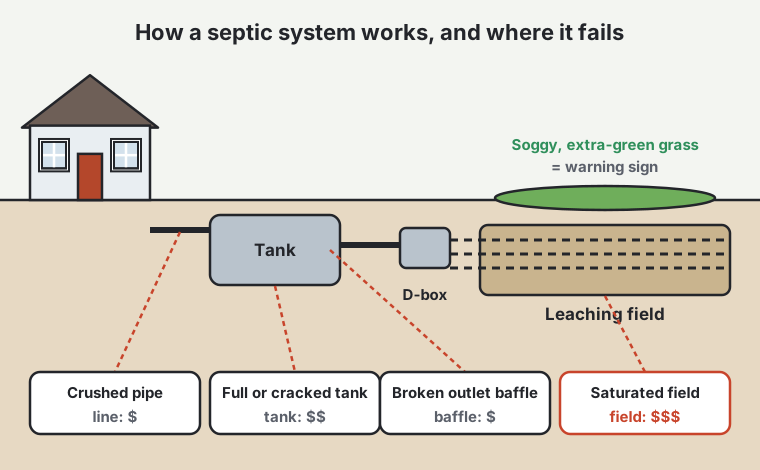
Not every septic problem is a failed system. Owners often hear “failed” when the real problem is a cracked tank lid, a missing outlet baffle, a crushed line to the distribution box, or a tank that has not been pumped in a decade. Those are repairs in the low thousands (est.). A failed leaching field is a different scale of job, because the field itself has to be rebuilt or moved.
Ask the person who inspected it to put the finding in writing: what failed, where, and what they recommend. That one page is what a buyer, an engineer and the Guilford Health Department will all want to see first.
Who approves a septic repair in Guilford, and how long does it take?
A septic repair in Guilford is approved by the town’s health department, acting as the local director of health under the Public Health Code. In most repairs an engineer or licensed designer tests the soil and draws a plan, the health department approves it, a licensed installer builds it, and the department inspects before the system goes back into use. A simple repair can move in weeks; a full field replacement often takes one to three months (est.).
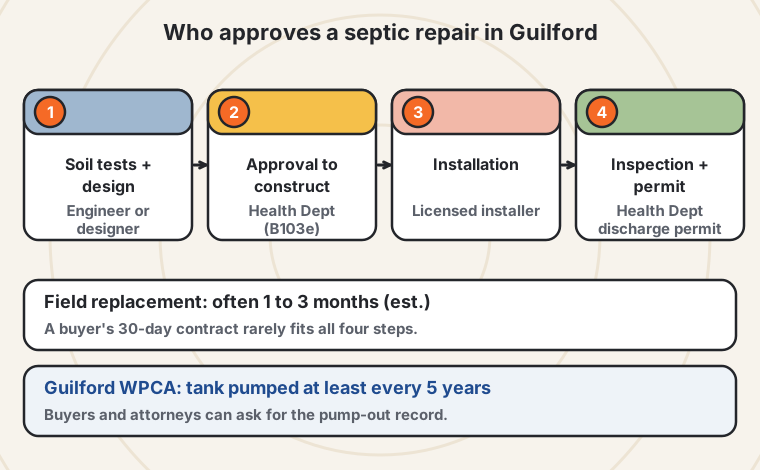
Guilford’s town code also says no system may be built, altered or repaired without a sanitary permit from the town health director, and that the building official will not issue a building permit for work that affects a septic system without the health director’s written approval. Shoreline and ledge conditions are common in town, so soil testing and design can take longer than the dig itself, especially in wet seasons.
Timing is the real problem for a seller under contract. A buyer’s mortgage lender usually wants the system working, not promised, so a failed field found during inspection often means one of three things: the closing is pushed back, money is held in escrow at closing to cover the repair (if the lender allows it), or the buyer walks.
How much does it cost to repair a failed septic in Connecticut?
Repairing a failed septic in Connecticut costs from a few hundred dollars for pumping and a baffle to roughly $15,000 to $35,000 for a conventional leaching field replacement and $30,000 to $60,000 or more for an engineered or raised system on a tight or wet lot. These are planning estimates (est.), not quotes; soil, ledge, groundwater and access drive the real price.
| Job | Typical range (est.) | Notes |
|---|---|---|
| Pump-out and inspection | $400 to $900 | Guilford requires pumping at least every 5 years anyway. |
| Baffle, lid, or line to the distribution box | $500 to $3,000 | Often mistaken for a “failed system”. |
| New septic tank | $4,000 to $10,000 | Needs a health department permit. |
| Soil testing and engineered design | $2,000 to $5,000 | Needed before most field replacements. |
| Conventional leaching field replacement | $15,000 to $35,000 | Includes excavation and fill; ledge adds cost. |
| Engineered, raised or pumped system | $30,000 to $60,000+ | Shoreline lots with high groundwater often need one. |
Two hidden costs matter for sellers. First, a repair on a lot that cannot fit a full code system may need an exception from the health director, which takes design time. Second, if the house has more bedrooms than the system was designed for, the repair is sized to the bedroom count, which can push it toward the top of the range.
Should you repair the septic or sell the Guilford house as-is?
You should usually repair the septic before selling a Guilford house if you can pay for it and wait about three months, because buyers tend to knock off more than the repair costs. In our illustrative example on the town’s $606,000 single-family median, repairing then listing nets about $527,140, listing as-is with a buyer credit about $518,140, and a direct as-is sale about $462,800.
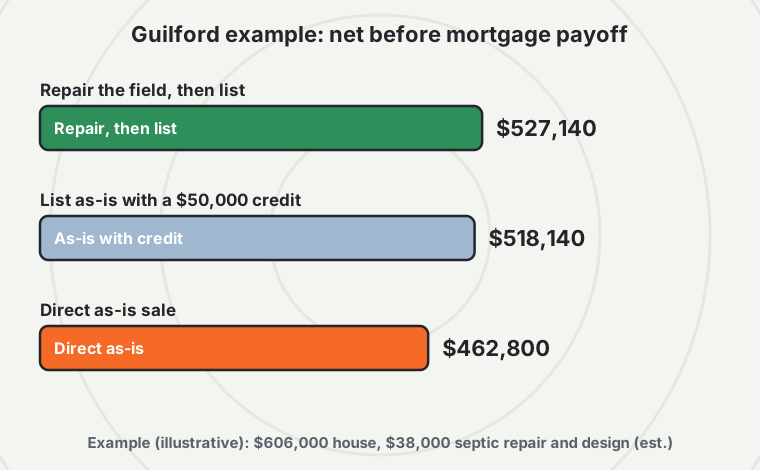
Example (illustrative). A Guilford Cape worth $606,000 with a working system. The leaching field has failed; replacement is $35,000 plus $3,000 for testing and design (est.). Commission is assumed at 5% (est.), the seller’s attorney at $1,500 (est.), and property tax at about $1,000 a month (fiscal 2027 mill rate 28.4).
| Line | Repair, then list | List as-is with credit | Direct as-is sale |
|---|---|---|---|
| Price | $606,000 | $556,000 ($50,000 credit, illustrative) | $470,000 (illustrative) |
| Septic repair and design (est.) | -$38,000 | $0 | $0 |
| Commission (5%, est.) | -$30,300 | -$27,800 | $0 |
| Conveyance tax (1.00%) | -$6,060 | -$5,560 | -$4,700 |
| Seller’s attorney (est.) | -$1,500 | -$1,500 | -$1,500 |
| Property tax while you wait (est.) | -$3,000 (3 months) | -$3,000 (3 months) | -$1,000 (1 month) |
| Net before your mortgage payoff | $527,140 | $518,140 | $462,800 |
The middle column carries a risk the numbers do not show: many buyers’ lenders will not close with a failed system and no repair, so the “credit” route works best with a cash buyer or a lender that allows a repair escrow. And buyers almost never ask for exactly the repair cost; they price in their own uncertainty, which is why the illustrative credit is larger than the $38,000 repair.
Your own numbers will differ. Plug them in here:
How much would you walk away with?
Slide the numbers to match your house. It works in your browser; nothing is saved or sent.
Estimates for planning. Conveyance tax per CGS 12-494 (state 0.75% up to $800,000, 1.25% to $2.5M, 2.25% above, plus the town rate). Seller attorney about $1,200 to $1,500; flat-fee MLS about $400; listings include three months of taxes, insurance and utilities, a cash sale about two weeks. Your attorney gives you the final numbers.
When should you NOT sell a house with a failed septic to a cash buyer?
You should not sell a house with a failed septic to a cash buyer when you can pay for the repair, the lot has room for a code-complying system, and you have two or three months before you need the money. In that case the repair usually costs less than the discount any as-is buyer will take, including us, and you sell to the full Guilford market afterwards.
A direct as-is sale makes sense when the repair cost is unknown or very high (ledge, high groundwater, a lot with no room), when you cannot fund $30,000 or more up front, when the house also needs other major work, when it is an estate and the heirs want one clean decision, or when a buyer has already walked and you do not want to do it again. Our page on selling a house that needs repairs in Connecticut explains how that works, and our as-is selling guide covers the disclosure side.
Is a cash sale right for you, or should you list?
Seven quick questions. There is no wrong answer, and we will tell you honestly if listing would leave you more.
- Does the house need repairs you would rather not pay for or manage?
- Do you need to close by a certain date, or within the next month or two?
- Would showings be hard: tenants, belongings, privacy, or you live out of state?
- Is there a complication: an estate or probate, a divorce, foreclosure, liens or back taxes?
- Could you comfortably cover the mortgage, taxes and utilities for three or more months?
- Is getting the highest possible price more important to you than speed and certainty?
- Would a buyer's bank lend on the house as it is (no major roof, foundation, oil tank or code issues)?
How do you sell a Guilford house with a failed septic, step by step?
You sell a Guilford house with a failed septic by getting the failure confirmed in writing, pulling the pump-out and permit history, getting a repair design and two quotes, comparing the repair route against as-is offers, and then disclosing the problem on the condition report and closing with an attorney. A direct sale typically closes in about two weeks once title is clear; a repair adds one to three months (est.).
Confirm what failed
Have a licensed installer pump and inspect the tank and check the field. Get the finding in writing. A baffle or a line is not a field.
Gather the paper trail
Ask the Guilford Health Department for the system’s permit file and the WPCA for the pump-out record. Buyers’ attorneys will ask for both.
Price the repair
Get a designer’s opinion on whether the lot has a code-complying area or needs an exception, and two installer quotes.
Compare routes
Put the repair-then-list net next to at least two as-is offers, using the table above. Check any buyer with our cash buyer checklist.
Disclose and close
Answer the septic questions on the condition report honestly, attach the inspection, and close. If you sell to us, the system stays exactly as it is and the repair becomes our job.
Questions Guilford owners ask about selling with a failed septic
Can you sell a house with a failed septic system in Connecticut?
Yes, you can sell a house with a failed septic system in Connecticut. No state law forces a repair before a sale, but you must disclose known problems on the condition report (CGS 20-327b), and many buyers’ lenders will want the system working before they lend.
Is a septic inspection required to sell a house in Connecticut?
No, Connecticut has no statewide septic inspection requirement for a sale. Buyers usually order one, and a lender may require it. In Guilford, the town’s ordinance separately requires pumping at least once every five years.
Who approves a septic repair in Guilford?
The Guilford Health Department approves septic repairs, acting as the local director of health under Public Health Code 19-13-B103e. It issues the approval to construct before work starts and the discharge permit after inspection.
How much does a new leaching field cost in Connecticut?
A new leaching field in Connecticut typically costs about $15,000 to $35,000 for a conventional system and $30,000 to $60,000 or more for an engineered or raised system (est.). Get two written quotes; soil and ledge drive the price.
What happens if I do not pump my septic in Guilford?
If you do not pump your septic in Guilford within five years, the town code provides for a warning letter, then a $200 fine and $25 a day if it is still not done 90 days after the letter. Confirm the current terms with the town.
Can a buyer get a mortgage on a house with a failed septic?
A buyer often cannot get a standard mortgage on a house with a failed septic unless it is repaired before closing or the lender allows money to be held in escrow for the repair. Cash buyers do not have that condition.
Should I give the buyer a credit instead of fixing the septic?
A credit instead of fixing the septic can work with a cash buyer or a lender that allows a repair escrow, but buyers usually ask for more than the repair costs. If you can fund the repair, fixing it first usually nets more.
Can I add a bedroom if my lot has septic?
You can add a bedroom on a septic lot in Connecticut only if the health director finds a code-complying area for a system on the lot (Public Health Code 19-13-B100a), and Guilford’s code requires an upgrade when bedrooms increase.
What is the conveyance tax on a Guilford sale?
The conveyance tax on a Guilford sale is 1.00% for most homes, 0.75% to the state and 0.25% to the town, paid by the seller: $5,930 on a $593,000 sale (CGS 12-494).
Related guides
The house
Other problem houses
For the full process, see how to sell a house in Connecticut. For an as-is number on a house with a failed system, see our repairs page.
Plain-English information, not legal or engineering advice. Talk to a Connecticut attorney and a licensed septic professional about your own property.
Sources (checked on October 27, 2026)
- CT DPH: Public Health Code 19-13-B100a, 19-13-B103a to B103f and Technical Standards (January 2023).
- CT DPH: 19-13-B100a building conversions and additions.
- Town of Guilford code: septic pump-out ordinance and sewage disposal permits.
- CGS 20-327b and 20-327c (residential condition report; $500 credit).
- CGS 12-494 (conveyance tax).
- CGS 45a-2 (probate districts) and CGS 51-344 (judicial districts).
- CT OPM Real Estate Sales, 2025 CT Parcel and CAMA data and OPM mill rates, data.ct.gov.
See the house together.
Pick a time that works.
Choose a time for us to walk through the property with you, or ask for a quick call first. We confirm every request personally.
Tuesday, January 13
No open times in the next few weeks. Please call us.
We will confirm by email. Nothing is booked until we do.
View my request
Who wrote this
Jerryll Noorden
Jerryll has bought and sold Connecticut houses since 2016 and has sat at more closing tables than he can count, on both sides. Before real estate he was a robotics scientist at NASA, IHMC and IIT. He wrote this guide because the national sites that rank for it skip the Connecticut rules that cost sellers money. When listing or selling it yourself would get you more than a cash offer, he says so.
This guide explains Connecticut rules in plain English. It is not legal or tax advice. Laws change; for your sale, talk to a Connecticut real estate attorney and a tax professional.
