
Key facts at a glance
| Fact | Number | Source |
|---|---|---|
| Homes sold in Glastonbury (East Glastonbury uses town data), Oct 2024 to Sep 2025 | 477, median $540,000 (single-family $615,000) | CT OPM real estate sales, data.ct.gov |
| Typical Glastonbury home | Built 1975; 28% built before 1960; heat 47% oil, 46% gas | 2025 CT parcel (CAMA) data, data.ct.gov |
| Proof of loss due to your insurer (standard fire policy) | Within 60 days of the loss, unless the insurer extends it in writing | CGS 38a-307 |
| Insurer pays after proof of loss is agreed | 30 days; lawsuit deadline 24 months after the loss | CGS 38a-307 |
| Coverage can be suspended if the house sits empty | Beyond 60 consecutive days vacant or unoccupied | CGS 38a-307 (standard fire policy) |
| Fire, smoke, rot and water damage on the seller’s report | Separate yes/no questions; flood questions added July 1, 2025 | CGS 20-327b; Public Act 25-33, sec. 3 |
| Conveyance tax the seller pays | 1.00% (0.75% state + 0.25% town): $5,400 on $540,000 | CGS 12-494 |
| Probate court and Superior Court | Glastonbury-Hebron Probate District (No. 6); Hartford Judicial District | CGS 45a-2; CGS 51-344 |
A kitchen fire, a pipe that burst while you were away, or water in the basement after a storm turns a house into a project overnight. This guide covers one question for Glastonbury and East Glastonbury owners: after the damage, do you repair with the insurance money or sell, and how do you sell a fire or water damaged house in Connecticut without losing money on the claim? It is part of our guide to how to sell a house in Connecticut, and it uses Glastonbury’s own numbers. East Glastonbury is a village of Glastonbury, so the town’s data, courts and building department apply.
How does it feel to own a damaged house you did not plan to sell?
Owning a damaged house you did not plan to sell usually feels like being pulled in four directions at once: the insurer wants paperwork, the mortgage company wants a say in the check, contractors want deposits, and you still need somewhere to live. Most owners in this spot are not choosing between good options; they are trying to pick the least painful one, quickly.
Maybe the smoke smell is still in the curtains of your Colonial off Main Street, or a frozen pipe brought the family-room ceiling down in February. People in this position often feel shocked that it happened at all, overwhelmed by adjusters and estimates, guilty that they missed a warning sign, suspicious of every contractor and buyer who calls, and exhausted from living out of a hotel or a relative’s spare room.
Fires and water losses happen in well-kept houses. This page is for you if you want a clear, honest way to decide, with the Connecticut rules and Glastonbury numbers laid out, including when you should not sell to us.
What should you do in the first days after a fire or water loss?
In the first days after a fire or water loss you should make the house safe, report the claim to your insurer in writing, protect the property from further damage, photograph everything, and keep every receipt. Connecticut’s standard fire policy requires immediate written notice and a sworn proof of loss within 60 days, unless the insurer extends that in writing (CGS 38a-307). Do not sign a sale contract in the first week.
Protecting the house from more damage is not optional: the standard policy says the insured must “protect the property from further damage”. That means boarding, tarping, shutting off water and drying. The U.S. EPA advises drying water-damaged areas within 24 to 48 hours to prevent mold growth. Keep the receipts; reasonable emergency costs are usually part of the claim.
- Give your insurer written notice and ask for the claim number and the adjuster’s name.
- Photograph and video every room before anything is thrown away.
- Ask whether your policy pays additional living expenses (hotel or rent) and for how long.
- Call your mortgage servicer and ask how it handles insurance checks (its “loss draft” process).
What deadlines does a Connecticut insurance claim put on you?
A Connecticut insurance claim puts several deadlines on you. Under the standard fire policy in CGS 38a-307, you give immediate written notice, file a sworn proof of loss within 60 days unless extended in writing, the insurer pays 30 days after the loss amount is agreed, coverage can be suspended if the house is vacant beyond 60 consecutive days, and any lawsuit must start within 24 months of the loss.
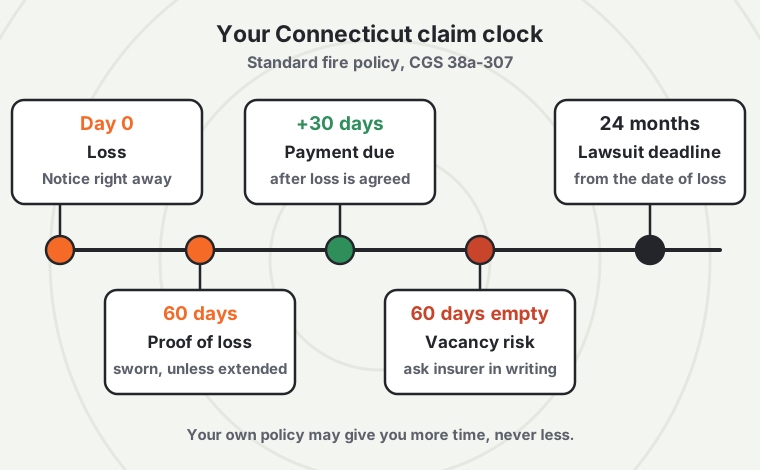
Fire insurance sold in Connecticut must conform to this standard policy (CGS 38a-308), so these clauses appear in some form in yours. Check your endorsements too: many policies pay full replacement cost only after the work is done and “actual cash value” (cost minus depreciation) until then, which matters if you sell before repairing.
The vacancy clause is the one owners miss. If the fire or flood forces you out and the house sits empty for more than 60 days, ask your insurer in writing whether coverage continues, and get the answer in writing. An empty, damaged house that loses coverage is a bigger problem than the original damage. Our vacant house page covers vacancy insurance in more depth.
Why is your mortgage company’s name on the insurance check?
Your mortgage company’s name is on the insurance check because almost every mortgage requires the lender to be named on the policy, so claim checks are made out to you and the servicer together. The Consumer Financial Protection Bureau says this is usual. The servicer then typically holds the money and releases it in stages as repairs are done and inspected, under its own loss-draft rules.
That is why owners feel stuck after a loss: the check exists, but they cannot cash it alone. Ask your servicer for its written loss-draft procedure; most want a signed contractor estimate, lien waivers and inspections before releasing later draws.
Here is the part that changes the sell-or-repair decision: when you sell, your mortgage is paid off at closing. Once the loan is gone, the servicer has no more claim on the insurance money. Whether the servicer must release funds for repairs or may apply them to the loan balance depends on your mortgage documents, so ask your servicer and your attorney what happens to undisbursed funds if you sell. In most sales the result is the same either way: the money that pays down the loan shows up as a smaller payoff at closing, so it still reaches you as equity.
Should you repair with the insurance money or sell the damaged house?
You should repair with the insurance money and then sell (or stay) when the claim covers most of the repair cost, you have somewhere to live for several months, and you can manage contractors and permits. You should consider selling the damaged house as-is when the claim falls well short, the repair would take most of a year, the damage hides unknowns such as mold or wiring, or you simply do not want the project.
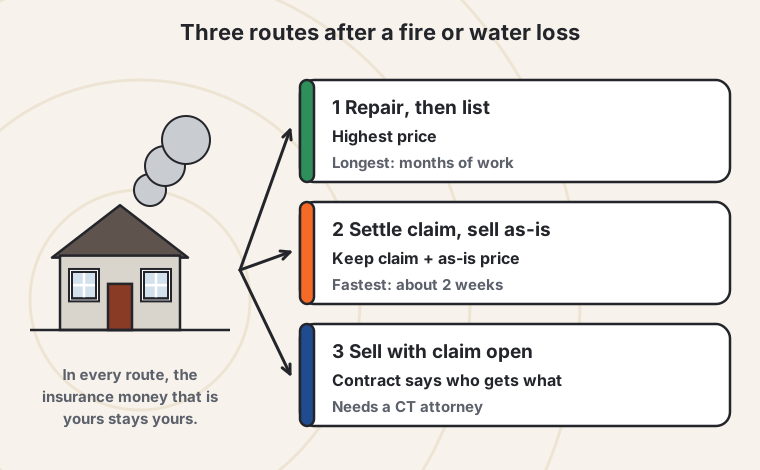
There are really three routes, and the insurance claim is part of each one:
- Repair, then list. Restore the house with the claim, close out the permits, list at full value. Highest price, most time and work.
- Settle the claim, then sell as-is. Agree the claim (often the actual cash value if you will not rebuild), then sell the house damaged. You keep the claim money plus the as-is price.
- Sell with the claim still open. You normally keep your right to the claim, since the loss happened on your watch, but the contract must say who gets which payment, and some policies limit assignment without the insurer’s consent. Use a Connecticut attorney.
Selling as-is is not the same as hiding the damage. Connecticut’s residential condition report asks directly about “Fire and/or Smoke damage”, “Rot or Water damage problems”, basement water seepage and, since July 1, 2025, a set of flood questions, including whether you have ever filed a flood claim (CGS 20-327b, as amended by Public Act 25-33). Our disclosure guide explains the form; the short version is to answer honestly and attach the adjuster’s report.
Do repairs after a fire or flood need permits, and what about mold?
Yes, most repairs after a fire or flood need permits in Connecticut. State law says no building may be altered until a permit is issued by the building official (CGS 29-263), and structural, electrical, plumbing and heating work all fall under it. Mold has no separate Connecticut disclosure statute, but water damage and rot are on the seller’s report, and buyers’ inspectors look for mold first.
In Glastonbury, the town building department issues those permits and inspects the work. Unpermitted repairs come back at sale time, because the condition report tells every buyer to check permits with the building official. If a previous repair was done without a permit, our guide to selling a house with code violations covers how to legalize it or sell around it.
On mold, the EPA’s advice is to fix the water source, dry fast and remove porous materials that stayed wet; large areas are a job for a professional. For a seller, the real problem with mold is uncertainty: a buyer who cannot see behind the walls prices in the worst case.
If the house is in a FEMA special flood hazard area (parts of Glastonbury along the Connecticut River are), a repair costing 50% or more of the building’s pre-damage market value counts as “substantial damage” (44 CFR 59.1), and the rebuilt house must meet current floodplain rules, which can mean elevating it. Ask the building department before you plan the repair.
How much would you net from each route on a Glastonbury house?
On a Glastonbury house worth the town median of $540,000 before a fire, the repair-then-list route nets about $493,920 in our illustrative example, and settling the claim and selling as-is nets about $471,190. Repairing earns more on paper, by about $22,700 here, but only if the claim covers the work, the estimate holds, and you can carry the house for eight months.
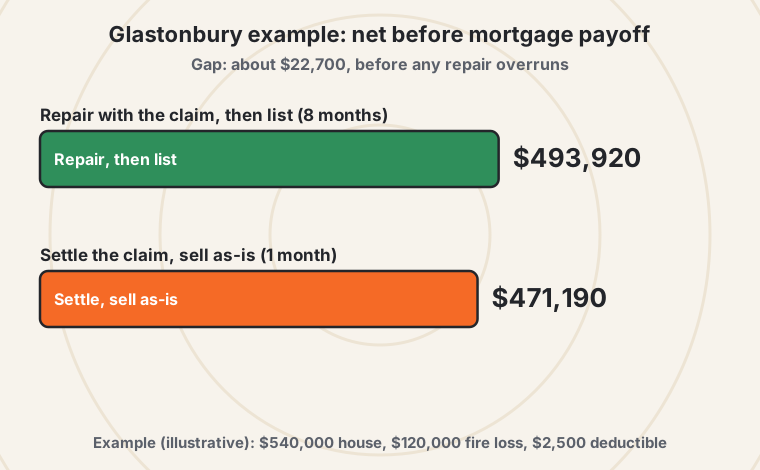
Example (illustrative). A Glastonbury Colonial worth $540,000 before a kitchen fire. The adjuster agrees $120,000 of damage; the deductible is $2,500. Commission is assumed at 5% (est.), the seller’s attorney at $1,500 (est.), and carrying cost is the property tax on the house at the fiscal 2027 mill rate, about $1,210 a month (est.).
| Line | Repair, then list | Settle, sell as-is |
|---|---|---|
| Sale price | $540,000 | $360,000 (illustrative as-is price) |
| Commission (5%, est.) | -$27,000 | $0 (direct sale) |
| Conveyance tax (1.00%, CGS 12-494) | -$5,400 | -$3,600 |
| Seller’s attorney (est.) | -$1,500 | -$1,500 |
| Insurance claim kept (after $2,500 deductible) | $117,500, spent on repairs | +$117,500 |
| Repair cost | -$120,000 (claim plus deductible) | $0 |
| Property tax while you wait | -$9,680 (8 months, est.) | -$1,210 (1 month, est.) |
| Net before your mortgage payoff | $493,920 | $471,190 |
Three things move the gap: fire repairs often run over the first estimate once walls are opened, and the overrun is yours; a replacement-cost policy may pay only actual cash value if you do not rebuild, which shrinks the as-is column; and every buyer prices the damage differently, so get more than one number. Our page on why cash offers are lower shows how investors build theirs.
Run your own version with your claim figures:
How much would you walk away with?
Slide the numbers to match your house. It works in your browser; nothing is saved or sent.
Estimates for planning. Conveyance tax per CGS 12-494 (state 0.75% up to $800,000, 1.25% to $2.5M, 2.25% above, plus the town rate). Seller attorney about $1,200 to $1,500; flat-fee MLS about $400; listings include three months of taxes, insurance and utilities, a cash sale about two weeks. Your attorney gives you the final numbers.
When should you NOT sell a damaged house to a cash buyer?
You should not sell a damaged house to a cash buyer when the damage is mostly cosmetic and the claim covers it, when you have the time and a place to live during repairs, or when you have a good contractor already working through the insurer. In those cases repairing and listing, or simply moving back in, will usually leave you with more money.
Smoke odor, a few rooms of drywall or a wet finished basement are often fully covered and fixed in weeks; selling that house as-is would hand a buyer money that should be yours. Our guide to what to fix before selling in Connecticut helps you sort the repairs that pay back from the ones that do not.
A direct sale makes sense when the structure, wiring or roof framing burned, when water sat long enough for mold to spread inside walls, when the claim was denied or settled low, when the loss happened during an estate or a divorce, or when you cannot face a year of contractors. See our page on selling a house that needs repairs in Connecticut for how an as-is sale works.
How do you sell a fire or water damaged house in Glastonbury, step by step?
You sell a fire or water damaged house in Glastonbury by securing the house and the claim first, getting the adjuster’s estimate in writing, collecting at least two as-is offers and one agent’s opinion, comparing them against the repair route, and closing with a Connecticut attorney who handles the insurance money and the payoff. A direct sale typically closes in about two weeks once title is clear.
Secure the house and the claim
Board, tarp, dry, photograph, file written notice and calendar the 60-day proof of loss.
Get the numbers in writing
The adjuster’s estimate, an independent contractor’s estimate and your mortgage payoff.
Collect as-is offers and an agent’s view
Ask two or three buyers for an as-is price, and one listing agent for the after-repair value. Compare them against the table above. Check any buyer using our cash buyer checklist; nobody should charge you a fee or ask for your deed before closing.
Agree on the insurance money in the contract
If the claim is still open, the contract should say that you keep the claim proceeds (or exactly how they are split). Your attorney coordinates with the servicer on any undisbursed loss-draft funds.
Disclose and close
Complete the condition report honestly, attach the adjuster’s report, sign the smoke and carbon monoxide affidavit at closing (CGS 29-453), and close. With us, closing typically takes about two weeks, and you can leave the damaged contents behind.
If you want a number to compare against your repair estimate, you can send photos of the damage instead of walking anyone through a smoky house:
Get your cash offer
without anyone coming over.
Want your offer faster, or rather not talk to anyone yet? Send a few phone photos of each room. We price the repairs from them, line by line, and send your cash offer back, so you see a real number before you ever meet us or pick up the phone.
 CabinetsFlooring
 Tub & tile
 Floors
 Roof
We may bring in a partner buyer to close. Your price and terms don't change.
Questions Glastonbury owners ask about selling a damaged house
Can I sell a fire damaged house in Connecticut?
Yes, you can sell a fire damaged house in Connecticut, either after repairs or as-is. You must disclose the fire and smoke damage on the residential condition report (CGS 20-327b), or credit the buyer $500 at closing if you do not provide the report, which still does not excuse hiding a known serious defect (CGS 20-327c).
Do I keep the insurance money if I sell the house?
Usually you keep the insurance money if you sell the house, because the loss happened while you owned it. Your mortgage servicer may hold or apply the funds first, and your sale contract should state who receives any claim payments. Confirm with your insurer and a Connecticut attorney.
How long do I have to file a proof of loss in Connecticut?
You have 60 days after the loss to file a sworn proof of loss under Connecticut’s standard fire policy, unless the insurer extends that in writing (CGS 38a-307). Lawsuits on the policy must start within 24 months of the loss.
Do I have to disclose mold when I sell in Connecticut?
Connecticut’s condition report has no question that uses the word mold, but it asks about rot or water damage, basement seepage and water drainage problems, so known water damage with mold falls under those answers. Disclose what you know and attach any remediation report.
Will a buyer get a mortgage on a fire or water damaged house?
A buyer will often struggle to get a standard mortgage on a fire or water damaged house, because the lender’s appraiser must find it safe and habitable. That is why many damaged houses sell to cash buyers or after repairs.
Do fire repairs in Glastonbury need a building permit?
Yes, fire repairs in Glastonbury need a building permit from the town building department for structural, electrical, plumbing and heating work, because Connecticut law bars altering a building until a permit is issued (CGS 29-263).
What is the conveyance tax on a Glastonbury sale?
The conveyance tax on a Glastonbury sale is 1.00% for most homes, 0.75% to the state and 0.25% to the town, paid by the seller: $5,400 on a $540,000 sale (CGS 12-494).
Is East Glastonbury a separate town?
No, East Glastonbury is a village within the town of Glastonbury. Permits come from the Glastonbury building department, estates go to the Glastonbury-Hebron Probate District, and court cases go to the Hartford Judicial District.
Related guides
The house
Other problem houses
Your situation
For the whole process, see how to sell a house in Connecticut and our as-is selling guide. If you would like a no-obligation number for a damaged house, start on our Glastonbury page.
Plain-English information, not legal or insurance advice. Talk to a Connecticut attorney and your insurer about your own claim and sale.
Sources (checked on October 27, 2026)
- CGS 38a-307, 38a-308 and 38a-316e (standard fire policy; matching of adjacent items).
- CGS 20-327b and 20-327c (residential condition report; $500 credit).
- Public Act 25-33, sections 1 to 4 (flood notices and the “Flood Risk Awareness” questions).
- CGS 29-263 (building permits) and CGS 29-453 (smoke and CO affidavit).
- CGS 12-494 (conveyance tax).
- CGS 45a-2 (probate districts) and CGS 51-344 (judicial districts).
- 44 CFR 59.1 (FEMA definition of substantial damage).
- CFPB: Protecting and rebuilding your finances after a disaster.
- EPA: A Brief Guide to Mold, Moisture and Your Home.
- CT OPM Real Estate Sales, 2025 CT Parcel and CAMA data and OPM mill rates, data.ct.gov.
See the house together.
Pick a time that works.
Choose a time for us to walk through the property with you, or ask for a quick call first. We confirm every request personally.
Tuesday, January 13
No open times in the next few weeks. Please call us.
We will confirm by email. Nothing is booked until we do.
View my request
Who wrote this
Jerryll Noorden
Jerryll has bought and sold Connecticut houses since 2016 and has sat at more closing tables than he can count, on both sides. Before real estate he was a robotics scientist at NASA, IHMC and IIT. He wrote this guide because the national sites that rank for it skip the Connecticut rules that cost sellers money. When listing or selling it yourself would get you more than a cash offer, he says so.
This guide explains Connecticut rules in plain English. It is not legal or tax advice. Laws change; for your sale, talk to a Connecticut real estate attorney and a tax professional.
