
Key facts at a glance
| Fact | Number | Source |
|---|---|---|
| State conveyance tax on property used for non-residential purposes | 1.25% (unimproved land: 0.75%) | CGS 12-494(b)(1) |
| Total conveyance tax on a commercial sale in East Hartford | 1.75% (1.25% state + 0.50% town) | CGS 12-494; OLR 2020-R-0020 |
| Tax on selling a controlling interest in an entity that owns CT real estate | 1.11% of the property’s value | CGS 12-638b |
| East Hartford mill rate, fiscal 2027 | 47.24 mills (about 3.31% of market value a year at 70% assessment) | CT OPM mill rates; CGS 12-62a |
| East Hartford commercial and apartment-building sales, Oct 2024 to Sep 2025 | 20 recorded; only 3 without a non-use code | Our query of data.ct.gov 5mzw-sjtu |
| Connecticut Property Transfer Act | Sunset March 1, 2026; release-based cleanup rules in effect | CT DEEP; CGS 22a-134pp to 22a-134xx |
| 1031 exchange deadlines | 45 days to identify, 180 days to close | IRS, like-kind exchanges |
| Income and expense report to the assessor (rental property) | Due June 1 if requested; 10% assessment penalty if not filed | CGS 12-63c |
Selling commercial property in Connecticut works differently from selling a house in five ways that cost real money: a higher conveyance tax, a price set by the rents rather than by neighboring sales, environmental questions that changed in 2026, commercial leases that follow their own rules, and a tax bill you may be able to defer with a 1031 exchange. This guide covers all five for small commercial and mixed-use buildings, with an East Hartford example. It sits beside our guide to how to sell a house in Connecticut and our guide to selling a property as-is.
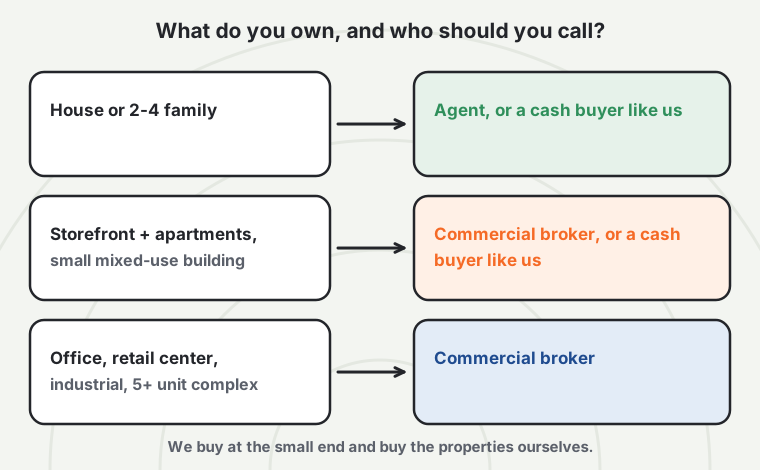
A straight word first. We Buy Houses In Connecticut mainly buys houses, two- to four-families and smaller mixed-use buildings, such as a storefront with apartments above. We do not buy office parks, shopping centers or industrial plants. If that is what you own, a commercial broker is the right call, and this page will still help you ask the right questions.
Why does selling a small commercial building feel harder than selling a house?
Selling a small commercial building feels harder than selling a house because there are fewer buyers, fewer comparable sales and more paperwork: leases, rent rolls, environmental history, tax filings. Most owners of a storefront or a mixed-use building have never sold one before, and the people they would normally ask, house agents and friends who sold homes, do not know the answers either.
Maybe you ran a business out of the ground floor for twenty years and rented the apartments upstairs. Maybe you inherited a parent’s building on a busy East Hartford street, with a barber, a vacant storefront and two tenants upstairs. You may feel out of your depth with the vocabulary, worried about what was in the ground before you owned it, stuck with a vacancy that drags the value down, skeptical of every unsolicited offer, and weary of tax bills that keep climbing. Underneath, you are probably cautiously hopeful that the building is worth more than the offers suggest.
This page is for you if you own a smaller commercial or mixed-use property in Connecticut and want to understand how a sale actually works before you talk to anyone.
What counts as commercial property when you sell in Connecticut?
Commercial property, for a Connecticut sale, is any property used for something other than housing: stores, offices, garages, restaurants, warehouses. The line matters because it changes the conveyance tax rate (CGS 12-494(b)(1)), which disclosure forms apply, and which buyers and lenders you can attract. A one- to four-family house is residential even if you rent it; a building of five or more apartments is residential but financed commercially; a storefront with apartments is mixed-use.
| Property type | State conveyance rate | Condition report (CGS 20-327b) | Typical buyer financing |
|---|---|---|---|
| 1-4 family house | 0.75% up to $800,000 | Required | Residential mortgage, including owner-occupant loans |
| Apartment building, 5+ units | 0.75% (residential property other than a dwelling) | Not required (statute covers 1-4 units) | Commercial loan or cash |
| Mixed-use (store + apartments) | Ask your attorney how it is classified | Depends on the residential part | Commercial loan or cash |
| Store, office, garage, restaurant | 1.25% | Not required | Commercial loan, SBA loan or cash |
| Unimproved land | 0.75% | Not required | Cash or land loan |
Two residential rules drop away on a purely commercial sale: the Connecticut property condition report applies only to one- to four-unit residential property, and the smoke and carbon monoxide affidavit applies to one- and two-family homes and residential condo units (CGS 29-453). Common law and your contract still matter: do not hide known defects, and answer the buyer’s due diligence questions truthfully. In a mixed-use building, the apartments still follow residential landlord-tenant law, including the security deposit rules.
How much conveyance tax do you pay on a commercial sale in Connecticut?
On a commercial sale in Connecticut you pay a state conveyance tax of 1.25% of the price when the property is used for non-residential purposes, except unimproved land, which stays at 0.75% (CGS 12-494(b)(1)). The town adds 0.25%, or 0.50% in towns such as East Hartford, Hartford and New Britain. A commercial sale in East Hartford therefore costs the seller 1.75% of the price.
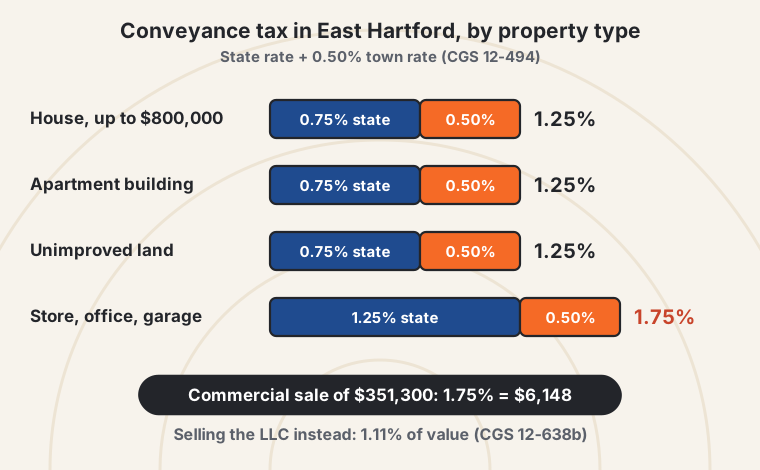
The seller pays the tax when the deed is recorded, using DRS Form OP-236; the town clerk will not record the deed without it. On a $351,300 commercial sale in East Hartford, 1.75% is $6,148. For the residential rates and the full town list, see our Connecticut conveyance tax guide.
Two traps catch commercial owners:
- Selling the company instead of the building. If your building sits in an LLC and you sell the LLC (a controlling interest) rather than deeding the property, Connecticut taxes that too, at 1.11% of the property’s value (CGS 12-638b). Transfers within six months of each other are presumed to be one series.
- Mixed-use classification. The statute taxes property “used for any purpose other than residential use” at the higher rate. We could not find a DRS rule on how to split a storefront-with-apartments building, so ask your attorney how the return will be filed before you calculate your net.
How do buyers value a small commercial or mixed-use building?
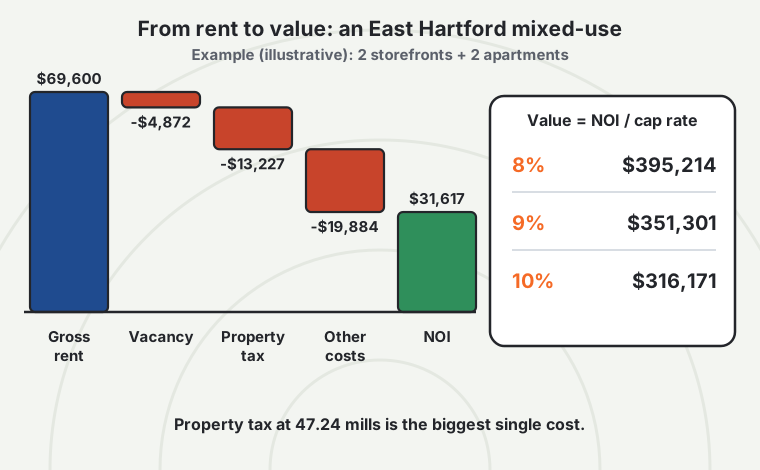
Buyers value a small commercial or mixed-use building by its income. They take the rent the building can reliably collect, subtract vacancy and operating costs to get net operating income (NOI), and divide by a capitalization rate that reflects risk. A building with $31,617 of NOI is worth about $351,300 to a buyer who wants a 9% return. Neighboring sales matter less, because there are so few.
Comparable sales are thin. In East Hartford, 20 commercial and apartment-building sales were recorded from October 2024 to September 2025, ranging from $325,000 to $15,000,000. Seventeen carried a non-use code, mostly “inter corporation” transfers, which assessors flag as not reliable market sales. Only three were plain market sales: $390,000, $398,500 and $605,000. Three sales cannot price your building; its rent roll can.
What moves the number:
- Vacancy. An empty storefront earns nothing and costs a fit-out to fill. Buyers price that in.
- Lease quality. A long lease with a stable tenant is worth more than a month-to-month tenant at the same rent.
- Property tax. At East Hartford’s 47.24 mills on a 70% assessment, the tax equals about 3.31% of market value every year. That is often the biggest single expense, and it comes straight out of NOI.
- Deferred work. A roof, a boiler, a parking lot or an oil tank becomes a dollar-for-dollar deduction from the price.
- Records. Assessors may require owners of rental property to file an income and expense report by June 1; failing to file adds 10% to the assessment (CGS 12-63c). Buyers often ask for those filings, and they should match your rent roll.
This is the same logic investors use on two- to four-families. Our multi-family guide goes deeper into cap rates and gross rent multipliers, and our explainer on why cash offers are lower shows how investors build an offer.
What would an East Hartford mixed-use sale net, listed or sold for cash?
In our illustrative East Hartford example, a storefront-and-apartments building with $31,617 of NOI could sell for about $351,300 listed with a broker at a 9% cap rate, netting about $324,075 after a 6% commission (est.) and 1.75% conveyance tax. A cash investor at a 10% cap rate, less $40,000 of work, might offer about $276,000, netting about $271,170. Listing nets more if you can wait.
Example (illustrative). Two storefronts at $1,500 a month and two apartments at $1,400 a month. Every rent and expense below is an assumption for the example, not East Hartford market data; the mill rate is real.
| Line | Amount | Note |
|---|---|---|
| Gross rent | $69,600 | $5,800 a month x 12 |
| Vacancy and credit loss (7%) | -$4,872 | Assumption |
| Property tax | -$13,227 | $280,000 assessment (est.) x 47.24 mills |
| Insurance, repairs, common utilities, reserves | -$16,000 | $6,000 + $5,000 + $3,000 + $2,000 (est.) |
| Management (6% of collected rent) | -$3,884 | Assumption |
| Net operating income | $31,617 | |
| Value at 8% / 9% / 10% cap rate | $395,214 / $351,301 / $316,171 | NOI divided by cap rate |
| List with a commercial broker | Sell to a cash investor | |
|---|---|---|
| Price | $351,300 (9% cap) | $276,000 (10% cap, less $40,000 of work, est.) |
| Commission | -$21,078 (6%, est.; negotiable) | $0 |
| Conveyance tax at 1.75% | -$6,148 | -$4,830 |
| Net before attorney and payoff | about $324,075 | about $271,170 |
| Time | Often 6 to 12 months (est.), plus buyer financing | About 2 weeks is typical for us |
The gap here is about $52,900. It shrinks when the building has a big vacancy, a failing roof, an environmental question or a seller who cannot carry it through a long listing, which are the situations where investors earn their discount. Run your own net with the calculator; use the commercial conveyance rate.
How much would you walk away with?
Slide the numbers to match your house. It works in your browser; nothing is saved or sent.
Estimates for planning. Conveyance tax per CGS 12-494 (state 0.75% up to $800,000, 1.25% to $2.5M, 2.25% above, plus the town rate). Seller attorney about $1,200 to $1,500; flat-fee MLS about $400; listings include three months of taxes, insurance and utilities, a cash sale about two weeks. Your attorney gives you the final numbers.
What environmental rules apply when you sell commercial property in Connecticut now that the Transfer Act is gone?
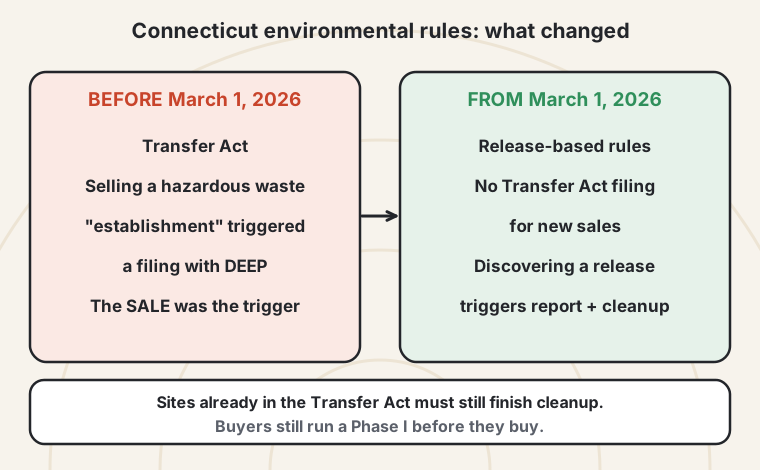
Connecticut’s Property Transfer Act, which required filings with DEEP when certain businesses that handled hazardous waste changed hands, sunset on March 1, 2026. It was replaced by release-based cleanup regulations under CGS 22a-134pp to 22a-134xx: the duty to report and clean up is now triggered by discovering a release, not by selling. Properties already in the Transfer Act still have to finish their cleanup.
What that means for a seller:
- No Transfer Act forms for new sales. DEEP says no Transfer Act filings are required for transactions on or after March 1, 2026.
- Old Transfer Act sites continue. If your property entered the Transfer Act before then, the cleanup obligations stay with it. Have the file ready; buyers will ask.
- Discovery now drives reporting. Under the new program, a newly discovered release can trigger a duty to report and clean up. DEEP notes that reviewing historical records showing a past release is not, by itself, discovering a release. The details and deadlines are in the regulations; ask an environmental attorney or licensed environmental professional before you commission testing.
- Buyers still run a Phase I. Commercial buyers and their lenders usually order a Phase I environmental site assessment under the federal “all appropriate inquiries” rule, which protects the buyer’s defenses under federal Superfund law. Expect questions about past uses: a dry cleaner, auto repair, a gas station, a machine shop, old fuel tanks.
Environmental uncertainty is one of the biggest reasons a commercial sale stalls or a price drops. If you know about a tank, a spill or a past use, say so early and get advice; surprises late in a deal cost more than honest answers early. For residential oil tanks, see our oil tank, septic and radon guide.
What happens to commercial leases, deposits and estoppels when you sell?
When you sell, commercial leases stay in force and pass to the buyer, just like residential ones. The difference is that commercial deposits, estoppels and tenant rights are set mostly by the lease itself, not by statute: Connecticut’s security deposit law, CGS 47a-21, covers residential tenants. Buyers and their lenders will want signed tenant estoppel certificates and, often, subordination agreements.
Before you sign a contract, read every lease for these clauses:
- Right of first refusal or option to buy. A tenant with one must be offered the deal first, or can block it.
- Estoppel and subordination duties. Most commercial leases require the tenant to sign an estoppel within a set number of days; check the deadline.
- Security deposits and guaranties. Who holds them, in what account, and how they transfer under the lease.
- Expense pass-throughs. Tax, insurance or common-area charges the tenant reimburses; your attorneys will reconcile them at closing.
- Renewal options and rent steps. Buyers value future rent, so a tenant’s option at a below-market rent lowers the price.
- Use restrictions. Exclusive-use clauses can limit what the buyer can lease the vacant space for.
For the apartments in a mixed-use building, residential law applies: deliver each deposit plus interest to the buyer (CGS 47a-21(h)(3)) and make sure tenants get the new-landlord notice (CGS 47a-6). Our guide to tenant estoppels and lease transfer at closing walks through that hand-off with numbers, and our landlord guide covers selling a rental with tenants in Connecticut more broadly.
Can you defer the tax on a commercial sale with a 1031 exchange?
Yes, you can usually defer the federal tax on a commercial sale with a 1031 exchange, if you reinvest in other real property held for business or investment. You must identify replacement property within 45 days of selling and close within 180 days, and a qualified intermediary must hold the money in between (IRS). If you take the cash, the gain is taxed, including depreciation recapture.
The details that matter for a small Connecticut owner:
- Real property only. Since 2018, only real property qualifies for like-kind treatment; equipment and fixtures sold with the building do not.
- Start before closing. The intermediary has to be in place before the sale closes. If the sale money reaches your account, the exchange fails.
- Depreciation recapture. Without an exchange, the part of your gain from depreciation you took is taxed federally at up to 25% (unrecaptured section 1250 gain), the rest at capital gains rates.
- Connecticut. Connecticut taxes capital gains as ordinary income, at a top rate of 6.99%. Because the state return starts from federal income, a gain deferred federally is generally deferred for Connecticut as well; confirm with your tax adviser.
A 1031 exchange can work with any buyer, including a cash buyer, as long as the contract includes a cooperation clause and the timing fits your search for a replacement. Our guide to taxes when selling property in Connecticut covers the state side.
Who buys small commercial property in East Hartford, and where do we fit?
Small commercial property in East Hartford is bought by local owner-users (a business that wants its own building), small landlords and investors, regional investors with commercial loans, and cash buyers who take buildings with problems. We fit the small end: houses, two- to four-families and smaller mixed-use buildings. For larger or purely commercial properties, a commercial broker reaches the right buyers.
East Hartford’s commercial streets, such as Main Street, Burnside Avenue and Silver Lane, are lined with the kind of small buildings that change hands between local owners: a corner store with two apartments, a garage, a small office. Those are the buildings an owner-user or a local investor will look at, and the ones where a cash buyer can be useful if the building has a vacancy, deferred repairs or an owner who needs to be done.
Whoever you talk to, check them. Ask for proof of funds, a written offer with the price and closing costs spelled out, and a clear answer on whether they are buying the property themselves. Our guide to wholesalers, realtors and cash buyers explains the difference, and our red-flags guide lists what to watch for. We buy the properties we make offers on ourselves.
When should you not sell your commercial property to a cash buyer?
You should not sell your commercial property to a cash buyer when the building is well leased, in good repair and free of environmental questions, and you can wait through a broker’s marketing and a buyer’s financing. That kind of building sells on its income to many buyers, and a cash investor’s price, which must cover risk and profit, will usually be lower, as our example shows.
A cash sale fits when:
- A storefront has been vacant for months and you cannot fund a fit-out.
- The roof, heating, parking lot or a fuel tank needs work you cannot or will not do.
- The leases are messy: tenants behind, no written lease, or a tenant you need gone.
- You inherited the building, live elsewhere, or the partners want out on a fixed date.
If your building is a smaller mixed-use property in that situation, see how we buy rental property with tenants in place, or how we handle properties that need repairs.
How do you sell a small commercial property in Connecticut, step by step?
To sell a small commercial property in Connecticut, build a rent roll and a 12-month income statement, gather leases and environmental history, estimate value from the net income, decide between a broker and a direct buyer, have a Connecticut attorney draft the contract (with a 1031 clause if needed), collect estoppels, and close with the conveyance tax at the commercial rate.
Build the numbers
Rent roll, last 12 months of income and expenses, tax bills and any income and expense reports filed with the assessor.
Gather the paper
Every lease and amendment, deposit records, service contracts, permits and certificates of occupancy, and anything you know about tanks, spills or past uses.
Estimate value from income
Net operating income divided by a range of cap rates; then subtract the cost of any obvious repairs.
Choose the route
A commercial broker for a clean, leased building; a direct cash buyer for a building with problems or a deadline. Get the 1031 intermediary lined up before you sign if you plan an exchange.
Sign and clear due diligence
Answer the buyer’s questions, provide estoppels, and let the buyer complete its Phase I and inspections.
Close
Pay the conveyance tax (1.75% in East Hartford for commercial), transfer deposits, prorate rents and taxes, hand over keys and records.
Want a number on a smaller mixed-use building? Ask on our East Hartford page and tell us what is on each floor.
Questions owners ask about selling commercial property in Connecticut
What is the conveyance tax on commercial property in Connecticut?
The conveyance tax on commercial property in Connecticut is 1.25% to the state for property used for non-residential purposes (CGS 12-494(b)(1)), plus the town rate of 0.25% or 0.50%. Unimproved land is taxed at 0.75% to the state. In East Hartford, a commercial sale costs 1.75% in total.
Does the Connecticut Transfer Act still apply when I sell?
No, the Connecticut Transfer Act does not apply to sales on or after March 1, 2026, when it sunset. DEEP’s release-based cleanup regulations took its place, so reporting is triggered by discovering a release, not by a sale. Sites already in the Transfer Act must still finish their cleanup.
Do I have to give a property condition report when selling commercial property?
You do not have to give the Connecticut property condition report when selling purely commercial property; the statute covers residential property of one to four units (CGS 20-327b). You still must not misrepresent known defects, and buyers will ask detailed due diligence questions.
How are commercial buildings valued in Connecticut?
Commercial buildings in Connecticut are valued mainly by income: net operating income divided by a capitalization rate. Assessors use the same method for rental property (CGS 12-63b), which is why they may ask for an income and expense report by June 1.
What is a cap rate?
A cap rate is the yearly net operating income divided by the price. A building with $31,617 of NOI that sells for $351,300 trades at a 9% cap rate. Higher risk means a higher cap rate and a lower price.
Is there a tax if I sell the LLC that owns my building instead of the building?
Yes, there is a tax if you sell a controlling interest in an LLC that owns Connecticut real estate: 1.11% of the property’s value under the controlling interest transfer tax (CGS 12-638b). Talk to your attorney before choosing that structure.
Can I do a 1031 exchange if I sell to a cash buyer?
Yes, you can do a 1031 exchange if you sell to a cash buyer, as long as a qualified intermediary is in place before closing and the contract lets you exchange. You then have 45 days to identify and 180 days to buy the replacement property (IRS).
What happens to my commercial tenants’ leases when I sell?
Your commercial tenants’ leases stay in force when you sell, and the buyer becomes the landlord. Deposits, estoppels and any right of first refusal follow the lease terms, so read each lease before you sign a contract.
Do commercial tenants have to sign estoppel certificates?
Commercial tenants usually have to sign estoppel certificates because most commercial leases require it within a set number of days. Without that clause, a tenant can refuse, and the buyer may accept a seller’s certificate instead.
Do you buy commercial property in East Hartford?
We buy smaller mixed-use properties in East Hartford and across Connecticut, such as a storefront with apartments above, as well as houses and two- to four-families. We do not buy large office, retail or industrial properties; a commercial broker is the better call for those.
How long does it take to sell commercial property in Connecticut?
Selling commercial property in Connecticut through a broker often takes six months to a year (est.), because buyers are fewer and commercial loans take longer. A direct cash sale of a smaller building can close in about two weeks once title and leases are in order.
How much tax will I pay on the gain from selling a commercial building?
The tax on the gain from selling a commercial building depends on your basis and depreciation. Federally, depreciation you took is taxed at up to 25% and the rest at capital gains rates; Connecticut taxes the gain as income at up to 6.99%. A 1031 exchange can defer both.
Related guides
Selling as-is
Tenants and buildings
For the whole process, see how to sell a house in Connecticut. If your building has apartments and you would rather sell it with the tenants in place, see how we buy rentals with tenants.
Plain-English information, not legal, tax or environmental advice. Talk to a Connecticut attorney, a tax adviser and, where needed, a licensed environmental professional about your own property.
Sources (checked on October 27, 2026)
- CGS 12-494 (conveyance tax, including the non-residential rate and the unimproved land exception).
- OLR Report 2020-R-0020 (towns with a 0.50% local rate).
- CGS 12-638b (controlling interest transfer tax).
- CGS 12-63b and 12-63c (income approach and income and expense reports).
- CT DEEP, Release-Based Cleanup Regulations (effective March 1, 2026; Transfer Act sunset).
- CGS chapter 445b, 22a-134pp to 22a-134xx (release-based remediation).
- EPA, All Appropriate Inquiries.
- CGS 20-327b (condition report scope) and CGS 29-453 (smoke and CO affidavit).
- CGS 47a-21 (residential security deposits) and CGS 47a-6.
- IRS, Like-Kind Exchanges: Real Estate Tax Tips.
- IRS Topic 409, Capital gains and losses (unrecaptured section 1250 gain).
- Connecticut OPM Real Estate Sales (East Hartford, Oct 2024 to Sep 2025), data.ct.gov.
- OPM mill rates, fiscal 2027, data.ct.gov.
See the house together.
Pick a time that works.
Choose a time for us to walk through the property with you, or ask for a quick call first. We confirm every request personally.
Tuesday, January 13
No open times in the next few weeks. Please call us.
We will confirm by email. Nothing is booked until we do.
View my request
Who wrote this
Jerryll Noorden
Jerryll has bought and sold Connecticut houses since 2016 and has sat at more closing tables than he can count, on both sides. Before real estate he was a robotics scientist at NASA, IHMC and IIT. He wrote this guide because the national sites that rank for it skip the Connecticut rules that cost sellers money. When listing or selling it yourself would get you more than a cash offer, he says so.
This guide explains Connecticut rules in plain English. It is not legal or tax advice. Laws change; for your sale, talk to a Connecticut real estate attorney and a tax professional.
