
Key facts at a glance
| Fact | Number | Source |
|---|---|---|
| Single-family homes sold in Chester, Oct 2024 to Sep 2025 | 49; median $525,000 | CT OPM real estate sales, data.ct.gov (our calculation) |
| Chester mill rate, fiscal 2027 | 27.78 (about $10,209 a year, $851 a month, on a $525,000 house, est.) | CT OPM mill rates, data.ct.gov |
| Probate court for Chester | Saybrook Probate Court, District 33 (Old Saybrook) | CGS 45a-2 |
| Named executor applies to probate the will | Within 30 days of the death | CGS 45a-283 |
| Spouse’s share with no will, if all children are also the spouse’s | First $100,000 plus half of the rest | CGS 45a-437 |
| Lender calling the loan because a relative inherited (1-4 units) | Not allowed | 12 U.S.C. 1701j-3(d) |
| Servicer’s duty when a possible heir writes in | List the documents it needs to confirm you | 12 CFR 1024.36(i) |
| Conveyance tax a Chester seller pays | 1.00% ($5,250 on $525,000) | CGS 12-494 |
Someone you love has died and left a house. This guide covers the first 30 days: who owns the house now, how to keep it safe and insured, what to do about the utilities and the mortgage, and what to leave alone. We use Chester, a small Middlesex County town on the Connecticut River, as the worked example. It is part of our guide to how to sell a house in Connecticut; the whole inherited-house picture (probate, taxes, family decisions) is in our inherited house guide for Connecticut.
General education only, not legal advice. A Connecticut probate attorney can tell you how these rules apply to your family.
What happens when you inherit a house in Connecticut?
When you inherit a house in Connecticut, ownership passes by the deed, the will or the intestacy law, but you usually cannot sell or move in right away. If the person owned it alone, a Probate Court fiduciary takes control first, and the named executor must apply within 30 days (CGS 45a-283). In the meantime someone has to secure, insure and heat the house and keep the mortgage current.
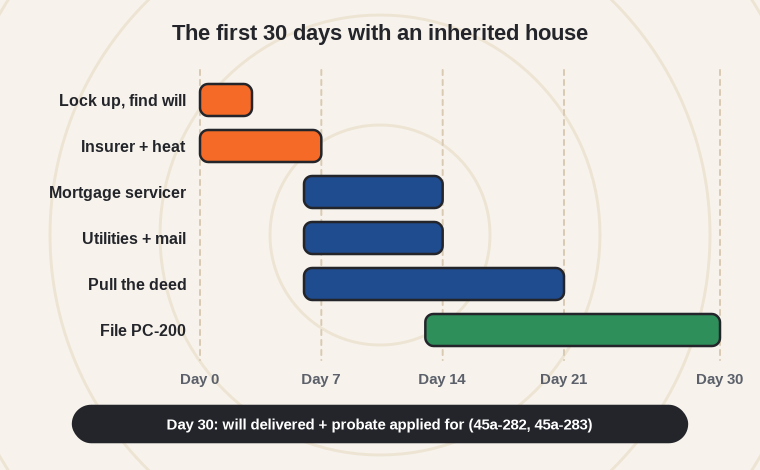
In practice the first month has four jobs: work out who owns the house now, protect it, keep the insurance alive, and stop the mortgage from falling behind. Nothing has to be sold, cleared out or decided in these 30 days. A few things should not be done at all; we list them below.
Why do the first weeks after a death feel so disorienting?
The first weeks after a death feel disorienting because grief arrives together with a pile of practical tasks, and the house is the biggest of them. You are making calls about oil deliveries while you are still writing an obituary. Feeling lost is normal; the house needs only a few simple things from you this month.
Maybe it is your mother’s cape off Route 154, the one with the garden she kept for forty years. Maybe you live in Boston or North Carolina and the house in Chester is suddenly yours to worry about. People in your place often feel stunned, guilty for thinking about money, anxious about doing something wrong, pulled between siblings, and quietly exhausted.
This page is for you. You do not need to decide whether to keep or sell anything this month. You need to keep the house safe, keep it insured, and get the paperwork started. If, later, you want the house handled without repairs or a cleanout, our page on how we buy inherited houses in Connecticut explains it. That can wait.
Who legally owns the house the day after the death?
Who legally owns an inherited Connecticut house the day after the death depends on how the deed was written. A surviving joint owner with survivorship owns it at once (CGS 47-14a). A house in a trust belongs to the trustee. A house owned alone passes under the will or, without one, the intestacy law (CGS 45a-437 to 45a-439), but a Probate Court fiduciary controls it until the estate is settled.
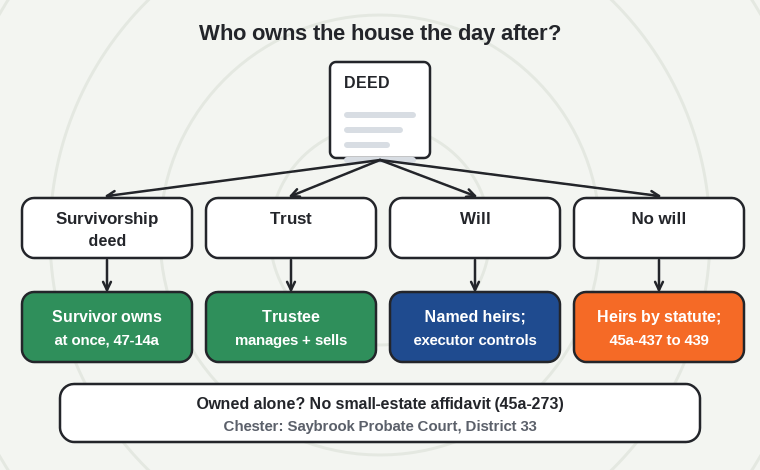
Start with the deed. You can get a copy from the Chester town clerk or from the closing papers in the house. Then find your path:
- Survivorship deed. If the deed runs to two people “and unto the survivor of them”, the survivor owns the whole house the moment the other dies (CGS 47-14a). No probate is needed to transfer the house. The estate still files a Connecticut estate tax return, usually Form CT-706 NT, so the estate tax lien can be released before a sale (CGS 12-398).
- Trust. If the house was deeded to a living trust, the successor trustee manages and can sell it under the trust’s terms.
- Will. If the person owned the house alone and left a will, the house goes to whoever the will names. But the executor controls it during probate, pays its bills from the estate and decides, with the court, whether it is sold.
- No will. The Probate Court appoints an administrator, and the house passes to the heirs the statute names. The next section shows how that works.
If the person owned the house alone, the small-estate affidavit cannot be used (CGS 45a-273). That surprises many families with a modest estate, but the test is ownership of real estate, not value. For Chester, the court is the Saybrook Probate Court (District 33 under CGS 45a-2), which also serves Clinton, Deep River, Essex, Haddam, Killingworth, Lyme, Old Saybrook and Westbrook.
How does Connecticut divide a house when there is no will?
When there is no will, Connecticut divides the estate, house included, by statute. A surviving spouse takes everything if there are no children or parents; the first $100,000 plus half the rest if all the children are also the spouse’s; or half if any child is not the spouse’s (CGS 45a-437). Children share the rest equally (CGS 45a-438); with no spouse or children, parents and then siblings inherit (CGS 45a-439).
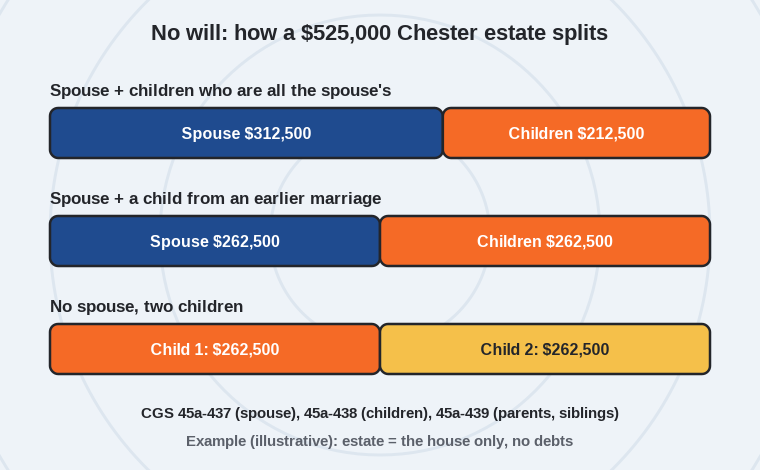
Example (illustrative). Say the only asset is a Chester house worth $525,000, the town’s single-family median for October 2024 to September 2025, with no debts:
| Family left behind | Spouse gets | Others get | Rule |
|---|---|---|---|
| Spouse, no children, no parents | $525,000 | $0 | CGS 45a-437(a)(1) |
| Spouse and a parent, no children | $100,000 + 3/4 of $425,000 = $418,750 | Parent(s): $106,250 | CGS 45a-437(a)(2), 45a-439 |
| Spouse and children who are all the spouse’s | $100,000 + 1/2 of $425,000 = $312,500 | Children share $212,500 | CGS 45a-437(a)(3), 45a-438 |
| Spouse and a child from an earlier relationship | 1/2 = $262,500 | Children share $262,500 | CGS 45a-437(a)(4), 45a-438 |
| No spouse, two children | None | $262,500 each | CGS 45a-438 |
| No spouse, children or parents; two siblings | None | $262,500 each | CGS 45a-439(a)(2) |
The shares are shares of value, not rooms. A spouse with $312,500 and two children with $212,500 between them own a house together, or the administrator sells it and divides the money. If the heirs cannot agree on which, see what happens when heirs disagree. An heir who does not want a share can disclaim it within 9 months of the death, recorded with the town clerk (CGS 45a-579).
How do you secure an inherited house in the first week?
You secure an inherited house in the first week by changing or rekeying the locks, listing who has keys, photographing every room, removing papers and small valuables to a safe place with a written list, and making the house look lived in. Do not give away or sell belongings yet; the fiduciary must inventory the estate (CGS 45a-341).
- Rekey the locks and keep a list of everyone with a key
- Photograph each room and the outside, with the date
- Take the will, deeds, bank and insurance papers to a safe place; write down what you took
- Lock up jewelry, cash, guns and medicine; Connecticut has strict rules for transferring firearms
- Put lights on timers; arrange snow and lawn care
- Ask a neighbor to call you if anything looks wrong
- Visit, or have someone visit, at least once a week and write down each visit
Leave the furniture and the forty years of things where they are for now. Sorting comes later, and our cleanout guide for inherited houses covers what to keep, what the law says and what it costs. If you might sell to a buyer who takes the house with its contents, you may never need a cleanout at all.
How do you keep an inherited house insured when nobody lives there?
You keep an inherited house insured by calling the homeowner’s insurer the week of the death, reporting the death and naming the person handling the estate, and asking exactly what the policy covers once the house is vacant. Many homeowners policies limit coverage after a house has been vacant for a set period, often 60 days; if yours does, ask for a vacancy endorsement or a vacant-dwelling policy.
The policy is in the dead person’s name, and the insurer needs to know. Ask four questions, and write down the answers with the name of the person you spoke to:
- Who is covered now: the estate, the executor, the heirs?
- Does the policy limit coverage for vandalism, theft, glass or frozen pipes after a period of vacancy, and how long is it?
- Do I need to keep the heat at a minimum temperature or have the water system drained?
- When is the next premium due, and where do I send it?
Keep paying the premium from the estate account. A lapsed policy is the most expensive mistake an estate can make: a frozen pipe or a fire in an uninsured house can wipe out the inheritance, and the buyer’s lender will need the house insurable at closing. Liability matters too; if someone slips on an unshoveled walk, the estate is the owner.
What happens to the utilities, heating oil and mail?
The utilities, heating oil and mail at an inherited house keep running only if someone pays and manages them. Keep the power and heat on, schedule oil deliveries or set up automatic delivery, and move the accounts into the estate’s name once a fiduciary is appointed. If the house will sit empty and unheated, have a plumber winterize it.
Connecticut winters break more inherited houses than any buyer does. A Chester house heated by oil can run its tank dry in a cold snap, and nobody is there to hear the furnace stop. Practical points:
- Electric and gas. Call the utility, report the death, and ask to keep service on while the estate is settled. They will usually want a death certificate and, later, the probate certificate.
- Oil or propane. Check the tank gauge and set up deliveries. Leftover oil is reimbursed by the buyer at a Connecticut closing by custom, so it is not wasted.
- Water. On a private well, keep the pump powered. If the house will not be heated, shut the main valve and have the lines drained.
- Mail. Forward it to the person handling the estate. Bills, bank statements and the tax bill arrive there, and they help find assets and debts.
- Phone, cable, subscriptions. Cancel what is not needed for safety; keep an internet line only if alarms or cameras use it.
What happens to the mortgage when the owner dies?
When the owner of a Connecticut house dies, the mortgage does not disappear, but the lender cannot call the loan due just because the house passed to a relative, a spouse or a child, or to a surviving joint owner (12 U.S.C. 1701j-3(d), for homes with fewer than five units). Federal servicing rules also let an heir be confirmed as a “successor in interest” and get loan information.
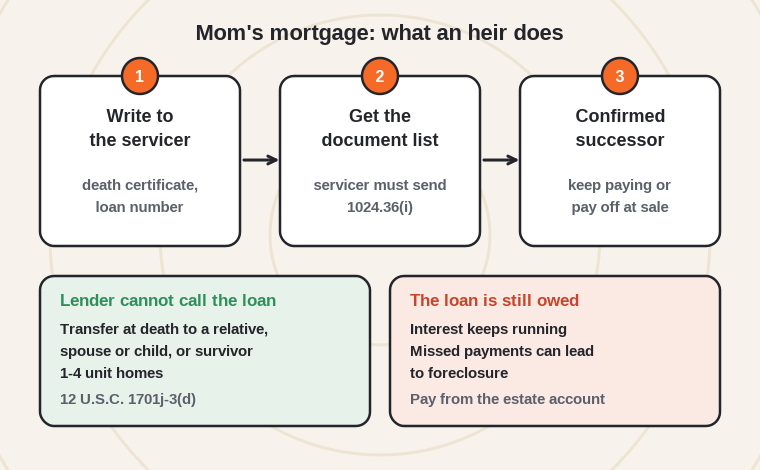
Two federal rules protect heirs:
- The due-on-sale protection (Garn-St Germain). Most mortgages say the loan is due if the house is transferred. Federal law bars the lender from using that clause on a transfer at death to a relative, to a spouse or children, or to a surviving joint tenant, for homes with fewer than five units (12 U.S.C. 1701j-3(d)). The loan stays in place on its old terms.
- Successor-in-interest rules (CFPB). Under Regulation X, a person who received an ownership interest in one of those ways is a “successor in interest” (12 CFR 1024.31). When you write to the servicer, it must send a written list of the documents it needs to confirm you, with a phone number (12 CFR 1024.36(i)). Once confirmed, you are treated as a borrower for the servicing rules: you get statements, loss-mitigation options and answers about the loan.
What to do this month: send the servicer a short letter with the loan number, the death certificate and your contact details, asking to be confirmed as a successor in interest. Keep paying from the estate account if you can. Being confirmed does not make you personally liable for the loan unless you assume it. If payments are already behind, read our guide for homeowners behind on mortgage payments in Connecticut. A reverse mortgage works differently: it becomes due when the last borrower dies, and the time limits are short; the inherited house guide covers it.
The federal protections apply to the lender’s right to call the loan. They do not pay the loan. Interest keeps running, and a loan that falls far enough behind can still be foreclosed, which in Connecticut ends in strict foreclosure on a Law Day set by the court. Keeping the payments current is what keeps every option open.
What does an inherited house in Chester cost each month while you decide?
An inherited house in Chester at the town’s $525,000 median costs about $851 a month in property tax alone at the fiscal 2027 mill rate of 27.78 (70% assessment), plus insurance, heat, power and upkeep. With those added, a typical month runs roughly $1,500 (est.), and more in a cold January.
| Monthly cost | Amount | How we got it |
|---|---|---|
| Property tax | $851 | $525,000 x 70% x 27.78 mills = $10,209 a year, divided by 12 |
| Insurance, including any vacancy coverage | $175 (est.) | Estimate; vacant-dwelling coverage often costs more |
| Heat and electric, averaged over a year | $350 (est.) | Estimate for an oil-heated house kept at a safe temperature |
| Lawn, snow, checks and small repairs | $100 (est.) | Estimate |
| Total | about $1,476 (est.) | Before any mortgage payment |
Six months of that is about $8,856 (est.); a year is about $17,712 (est.). That is not a reason to rush. It is a reason to make the decision on purpose rather than by drift. Our carrying-cost worksheet lets you plug in your own numbers.
What should you not do in the first 30 days?
In the first 30 days you should not sell, give away or throw out belongings, let a relative move in or take things, sign a listing agreement or purchase contract without legal authority, stop paying the insurance, or ignore the mortgage. Each of these is hard to undo and can cause trouble with the court, the other heirs or the lender.
- Do not clear out the house yet. The fiduciary must list the estate’s property at fair market value (CGS 45a-341), and heirs notice what disappears.
- Do not move in or rent it out informally. It complicates insurance, the other heirs’ rights and, later, the tax treatment of a loss on sale.
- Do not sign a contract to sell. Until a fiduciary is appointed, nobody has authority to sell a house the person owned alone. Listening to offers is fine; signing is not.
- Do not pay big debts from your own pocket. Creditors are paid from the estate in the order the law sets. Ask the attorney first.
- Do not miss the 30-day dates. The will must be delivered (CGS 45a-282) and the executor must apply (CGS 45a-283) within 30 days.
What is the 30-day plan, step by step?
The 30-day plan for an inherited Connecticut house is: secure the house and find the will, call the insurer, keep the heat and power on, write to the mortgage servicer, pull the deed to learn who owns it, and file the probate petition with the right court within 30 days. Selling, keeping or renting is a decision for after that.
Days 1 to 3: lock up and find the papers
Rekey, photograph, take the will and important papers to a safe place, order several death certificates.
Days 1 to 7: insurance and heat
Call the insurer, ask about vacancy limits, keep the premium paid. Check the oil tank, keep the heat on or winterize.
Days 7 to 14: mortgage and utilities
Write to the servicer asking to be confirmed as successor in interest; keep payments current. Move utility accounts toward the estate; forward the mail.
Days 7 to 21: find out who owns it
Get the deed from the town clerk. Survivorship, trust, will or no will decides who acts next.
By day 30: open probate
File the will and petition (form PC-200) with the Probate Court for the town where the person lived; for Chester, the Saybrook Probate Court. The probate timeline guide shows what comes next, and our 10-step checklist to sell an inherited house picks up from here.
What are your options after the first month, and when should you not sell to a cash buyer?
After the first month, your options for an inherited house are to keep it, rent it, let one heir buy the others out, list it, or sell it directly for cash. You should not sell to a cash buyer when the house is in good shape, the family can carry it for a few months, or an heir wants to buy it at a fair price; those routes usually leave more for the family.
A Chester house in good condition at the town’s median price will usually net the most on the open market, because buyers in the lower Connecticut River Valley pay for move-in-ready homes. A direct sale makes more sense when the house needs work, is full of belongings, the heirs live far away, or the family wants one written number and a closing date it controls. Whatever the route, the sale itself happens later, once a fiduciary has authority; can you sell a house in probate in Connecticut explains how, and the taxes on the sale are in taxes on selling an inherited house.
If you want to know what a direct sale would look like, we buy houses in Chester and every town around it, including Essex, Haddam and Killingworth; see every town we buy in. We buy the house ourselves, wait for the Probate Court, never charge a fee, and you can leave everything inside. Start on our inherited house page or call Jerryll at (203) 529-4712. If listing would net your family more, we will tell you.
See the house together.
Pick a time that works.
Choose a time for us to walk through the property with you, or ask for a quick call first. We confirm every request personally.
Tuesday, January 13
No open times in the next few weeks. Please call us.
We will confirm by email. Nothing is booked until we do.
View my requestQuestions families ask in the first month after inheriting a house
Do I own my parent’s house as soon as they die?
You own your parent’s house as soon as they die only if you were a joint owner with survivorship on the deed (CGS 47-14a). Otherwise the house passes under the will or the intestacy law, and a Probate Court fiduciary controls it until the estate is settled.
Can I move into an inherited house before probate is done?
You should not move into an inherited house before probate is done without the fiduciary’s and the other heirs’ agreement. The estate controls it until distribution, and living there rent-free can create insurance, family and tax problems.
Does the house have to go through probate in Connecticut?
The house has to go through probate in Connecticut if the person owned it alone. The small-estate affidavit is not available when the decedent solely owned Connecticut real property (CGS 45a-273). A survivorship deed or a trust avoids probate for the house.
Which probate court handles a Chester estate?
The Saybrook Probate Court, District 33, in Old Saybrook handles a Chester estate. The district also covers Clinton, Deep River, Essex, Haddam, Killingworth, Lyme, Old Saybrook and Westbrook (CGS 45a-2).
Can the bank call the mortgage due when the owner dies?
No, the bank cannot call the mortgage due just because the house passed at death to a relative, a spouse or child, or a surviving joint owner, for homes of one to four units (12 U.S.C. 1701j-3(d)). The loan still has to be paid.
What is a successor in interest?
A successor in interest is a person who received an ownership interest in a mortgaged home through a protected transfer, such as an inheritance from a relative (12 CFR 1024.31). Once the servicer confirms you, you are treated as a borrower under the servicing rules.
Am I personally responsible for my parent’s mortgage?
You are not personally responsible for your parent’s mortgage just because you inherit the house, unless you sign or assume the loan. The debt stays secured by the house, so if nobody pays, the lender can foreclose.
Do I need to tell the homeowner’s insurance company about the death?
Yes, you need to tell the homeowner’s insurance company about the death right away. Coverage on a vacant house is often limited after a set period, and the policy should show who is now responsible for the house.
Who pays the property tax on an inherited house?
The estate pays the property tax on an inherited house from the estate account while probate is open. In Chester, a $525,000 house costs about $10,209 a year at the fiscal 2027 mill rate (est.).
How is a house divided if there is no will in Connecticut?
If there is no will in Connecticut, a surviving spouse takes all, or $100,000 plus a fraction, or half, depending on children and parents (CGS 45a-437); children share the rest equally (CGS 45a-438); with no spouse or children, parents and then siblings inherit (CGS 45a-439).
Can I refuse to inherit a house in Connecticut?
Yes, you can refuse to inherit a house in Connecticut by disclaiming your share in writing within 9 months of the death and recording the disclaimer with the town clerk (CGS 45a-579).
If the heirs end up in court over the house, which court is it?
If heirs of a Chester house end up in a partition lawsuit, it goes to the Superior Court for the Judicial District of Middlesex, in Middletown. Estate matters themselves stay in the Saybrook Probate Court.
Related guides
Nearby towns
When you are ready to think about selling, start with how to sell a house in Connecticut.
General education, not legal advice. Probate, title and mortgage questions depend on your documents; talk to a Connecticut probate attorney.
Sources (checked on October 27, 2026)
- CGS chapter 802b, Decedents’ Estates: § 45a-273 (small estates), § 45a-282 and § 45a-283 (30 days), § 45a-341 (inventory), § 45a-437 to § 45a-439 (intestate succession).
- CGS chapter 801: § 45a-2 (probate districts; District 33).
- CGS chapter 821: § 47-14a (joint tenancy with survivorship).
- CGS chapter 802g: § 45a-579 (disclaimers).
- CGS chapter 217: § 12-398 (estate tax lien).
- 12 U.S.C. 1701j-3(d) (Garn-St Germain due-on-sale exceptions).
- CFPB, Regulation X § 1024.31 (successor in interest) and § 1024.36(i) (requests from potential successors).
- Connecticut Judicial Branch, Middlesex Judicial District (towns served).
- Town of Chester, Probate Court page (Saybrook Probate Court).
- CT OPM Real Estate Sales (Chester, Oct 2024 to Sep 2025) and OPM mill rates, fiscal 2027, data.ct.gov.

Who wrote this
Jerryll Noorden
Jerryll has bought and sold Connecticut houses since 2016 and has sat at more closing tables than he can count, on both sides. Before real estate he was a robotics scientist at NASA, IHMC and IIT. He wrote this guide because the national sites that rank for it skip the Connecticut rules that cost sellers money. When listing or selling it yourself would get you more than a cash offer, he says so.
This guide explains Connecticut rules in plain English. It is not legal or tax advice. Laws change; for your sale, talk to a Connecticut real estate attorney and a tax professional.
