
Key facts at a glance
This guide is part of how to sell a house in Connecticut. It is a clause-by-clause checklist for the purchase contract a cash buyer hands you, using a Berlin house as the worked example. Kensington and East Berlin are part of the Town of Berlin and use the same numbers.
| Fact | Number | Source |
|---|---|---|
| Berlin residential sales, Oct 2024 to Sep 2025 | 255 (median $410,000; single-family $415,000) | CT OPM Real Estate Sales, data.ct.gov |
| Median year built, Berlin single-family houses | 1968 | 2025 CT Parcel and CAMA data |
| Berlin mill rate, fiscal 2027 | 31.15 mills (about $750 a month on $415,000) | CT OPM mill rates |
| Conveyance tax on a Berlin sale up to $800,000 | 1.00% (0.75% state + 0.25% Berlin) | CGS 12-494 |
| Credit if the seller skips the condition report | $500 to the buyer at closing | CGS 20-327b, 20-327c |
| Smoke and CO affidavit | Signed by the seller at closing; no credit option | CGS 29-453 (as amended by PA 23-164) |
| Wholesale contracts | 3 business days to cancel; closing within 90 days | CGS 20-329ccc |
| Berlin’s probate court and Superior Court district | Berlin Probate Court (PD-08), One Liberty Square, New Britain; Judicial District of New Britain | ctprobate.gov; CGS 51-344 |
Why does signing a cash buyer’s contract feel so risky?
Signing a cash buyer’s contract feels risky because it is usually the buyer’s own form, written by the buyer’s side, full of terms you have never seen, and handed to you right after a friendly walk-through. You know the price. You do not know what the other three pages say, and you are being asked to sign today.
Maybe the buyer was at your kitchen table in Kensington an hour ago and the contract is still on the counter. Most sellers at this point feel pressured by the friendliness as much as by any deadline, out of their depth with the legal words, afraid of being locked in, embarrassed to ask what a clause means, and relieved that someone wants the house, which makes them want to sign before the relief goes away.
I am Jerryll Noorden. I have bought houses in Connecticut since 2016, about ten a year, and I write contracts like the one on your counter. If you have a cash offer contract on a Berlin house, or anywhere in Connecticut, and want to know what to check before you sign, this page is for you.
What should you check in a cash offer contract in Connecticut?
In a cash offer contract in Connecticut you should check twelve things: who the buyer is and whether it can assign, the price and proof of funds, the deposit and who holds it, the inspection period, the as-is wording, the closing date, possession and belongings, tax and oil prorations, who pays which costs, the default remedies, how liens get paid, and your right to attorney review.
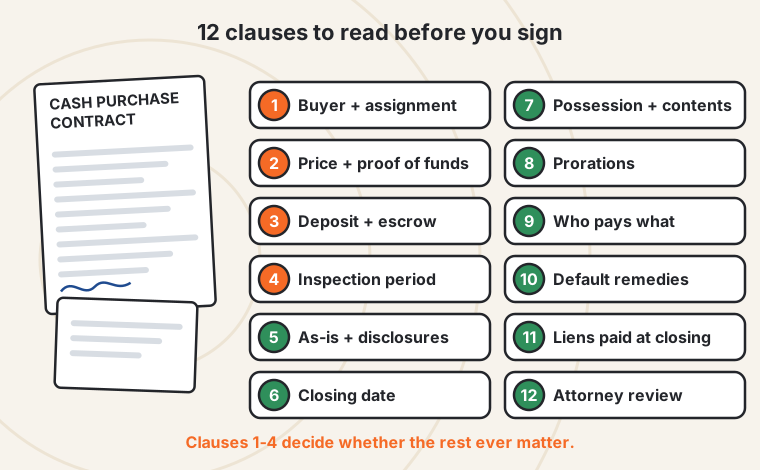
- The buyer is a named company you can look up, and you know whether it can assign the contract
- The price is fixed, with no financing or “partner approval” condition, and proof of funds is attached
- The deposit is 1% or more and sits in an attorney’s escrow account
- The inspection or due-diligence period is short, with a hard end date
- “As-is” is written in, and the required disclosures are handled
- The closing date is a date you chose
- Possession, move-out and any belongings left behind are spelled out
- Taxes, oil and utility prorations follow Connecticut custom
- Each closing cost has a named payer
- If the buyer defaults, you keep the deposit at least
- Your mortgage and any liens are paid from the proceeds at closing
- You have time to have your own Connecticut attorney read it
Our guide to checking a cash home buyer covers the company, and cash home buyers in Connecticut covers what they pay; this page covers the contract, clause by clause.
Who is the buyer on the contract, and can they assign it?
The buyer on the contract should be a named company or person you can look up on the state business registry, and the contract should say plainly whether it may be assigned. The words “and/or assigns” after the buyer’s name mean someone else may close. In Connecticut, a person who assigns without taking title must be registered with DCP and give you three business days to cancel.
Check the exact legal name, then look it up: the Secretary of the State’s business search for status, and the town land records for deeds the company has received. Our Hartford buyer-check guide shows how, step by step.
If the contract is assignable, Connecticut’s wholesaler law, in force since July 1, 2026, gives you four protections: the wholesaler must be registered with the Department of Consumer Protection (CGS 20-329bbb), must give you DCP’s disclosure report before you sign (CGS 20-329eee), must let you cancel within three business days for any reason, and may not set a closing more than 90 days out without your written extension (CGS 20-329ccc). Our pillar page on we buy houses scams and red flags explains why assignment is where most trouble starts.
How big should the deposit be, and who should hold it?
The deposit should be big enough that the buyer loses something real by walking away, about 1% of the price or more, and it should be held in a Connecticut attorney’s escrow account, not by the buyer. On a $330,000 Berlin example, that is $3,300. A $500 deposit is less than two weeks of Berlin carrying costs.
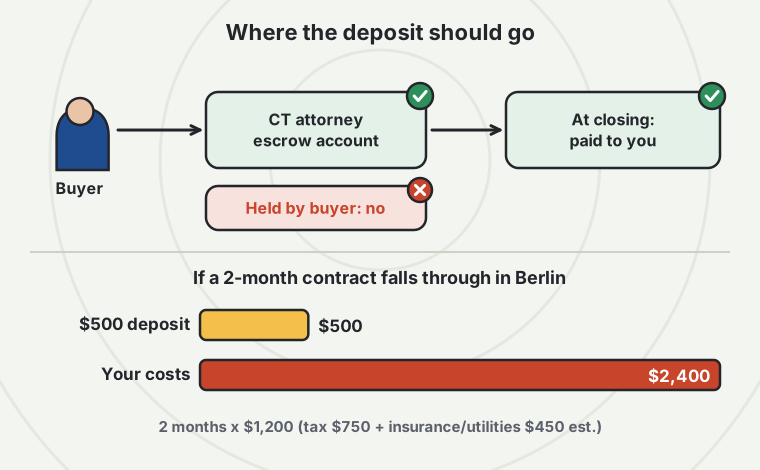
Most cash contracts make the deposit the seller’s only remedy if the buyer fails to close, so it is, in practice, your insurance. In Berlin, a house costs about $750 a month in property tax at 31.15 mills, plus about $450 a month for insurance and utilities (est.), so about $1,200 a month. A contract that ties up the house for two months and then fails has cost you $2,400 before you start over.
Also check when it is due (“within 3 business days of signing” is normal). A deposit “held by buyer” is not protection.
How long should the inspection or due-diligence period be?
The inspection or due-diligence period should be short, usually 7 to 14 days, with a fixed end date, because during it the buyer can usually cancel for any reason and get the deposit back. A buyer who has already walked through the house needs little or none. A 30-day or open-ended period “at buyer’s sole discretion” is a free option on your house.
Check the length and end date, the exit (“for any reason” versus “for a material defect not disclosed”), and whether the buyer may “renegotiate” afterward, which usually means a price cut. If the buyer saw the roof and furnace on day one, ask that the price be fixed for anything visible.
For an estate, note one Berlin detail: the Berlin Probate Court (PD-08) also serves New Britain and sits at One Liberty Square in New Britain. If the executor needs the court’s permission to sell (CGS 45a-164), the closing date must allow for the notice and hearing. See selling an inherited house.
What does an as-is clause cover in Connecticut, and what does it not?
An as-is clause in Connecticut means the buyer takes the house in its current condition and you will not make repairs or give repair credits. It does not cancel your disclosure duties: you still give the property condition report or a $500 credit (CGS 20-327b, 20-327c), the federal lead paint disclosure for pre-1978 houses, and the signed smoke and carbon monoxide affidavit at closing (CGS 29-453).
Three Connecticut points a cash buyer’s form may skip:
- Condition report or $500. The seller gives the written residential condition report before the buyer signs. If you do not, the contract must credit the buyer $500 at closing (CGS 20-327c). Many cash buyers take the $500 credit. Either is legal; the contract should say which.
- Lead paint. Berlin’s median single-family house was built in 1968, so most Berlin sales need the federal lead disclosure. The buyer gets a chance to test, usually 10 days, which it may waive in writing.
- Smoke and CO affidavit. For a one- or two-family house or a condo unit, the seller signs an affidavit at closing that the house has working smoke and carbon monoxide detection (CGS 29-453). Since Public Act 23-164 there is no credit option in place of the affidavit, so test the detectors before closing. Sales by an executor, administrator, trustee or conservator are among the listed exemptions (CGS 29-453(f)).
“As-is” also does not protect you if you hide a defect you know about. Disclose it, and let the price reflect it. Our guide on the Connecticut property condition disclosure covers the form, and selling a house that needs repairs covers the as-is route.
What should the contract say about the closing date, possession and belongings?
The contract should give a specific closing date you chose, say whether that date is firm, say when you hand over the keys, and say what may stay in the house. Cash sales often close in about two weeks, but you can ask for a later date, a few days of occupancy after closing, or permission to leave furniture and belongings behind.
- Closing date. “On or before” a date is fine if it is your date. Watch for automatic extensions at the buyer’s option.
- Possession. Usually at closing. If you need a few days after, write it in, with any per-day charge and how it is secured.
- Belongings. “Seller may leave any personal property, which buyer accepts” saves you a cleanout. Without it, the default is broom clean.
Who pays which costs in a Berlin cash sale?
In a Berlin cash sale the seller normally pays the 1% conveyance tax (0.75% state plus 0.25% Berlin), the seller’s own attorney and the payoff of any mortgage or liens; the buyer normally pays its own attorney and title costs. Property taxes, which Connecticut towns collect in arrears, and heating oil left in the tank are prorated between you at closing.
Here is an example (illustrative) closing statement for a dated Berlin ranch sold to a cash buyer for $330,000:
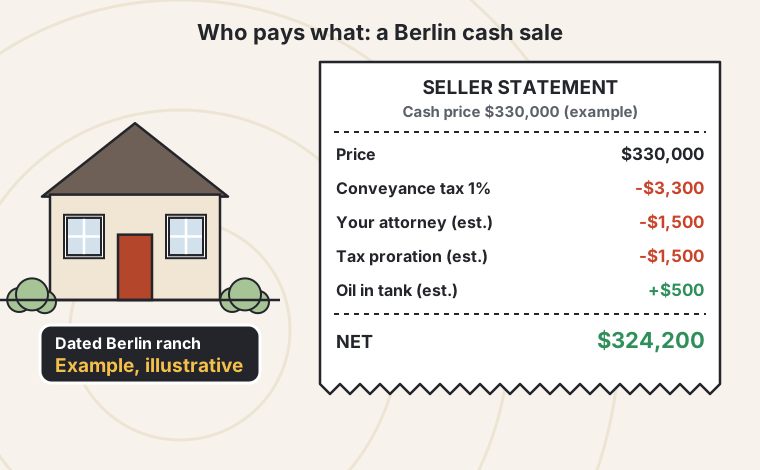
| Line | Amount | Who pays and why |
|---|---|---|
| Price | $330,000 | Example cash price on a dated house (illustrative) |
| Conveyance tax, 1% | -$3,300 | Seller (CGS 12-494) |
| Seller’s attorney | -$1,500 | Seller (est.) |
| Property tax proration | -$1,500 | Seller credits buyer for taxes owed but not yet billed (est.) |
| Heating oil in tank | +$500 | Buyer reimburses seller, by custom (est.) |
| Net before mortgage payoff | $324,200 |
Read the costs clause for anything that moves the buyer’s costs onto you: “seller to pay buyer’s closing costs”, “transaction fee”, “administrative fee”. A cash buyer should not charge you a fee to buy your house. For the full list of selling costs, see the cost to sell a house in Connecticut.
How much would you walk away with?
Slide the numbers to match your house. It works in your browser; nothing is saved or sent.
Estimates for planning. Conveyance tax per CGS 12-494 (state 0.75% up to $800,000, 1.25% to $2.5M, 2.25% above, plus the town rate). Seller attorney about $1,200 to $1,500; flat-fee MLS about $400; listings include three months of taxes, insurance and utilities, a cash sale about two weeks. Your attorney gives you the final numbers.
What happens if the buyer or the seller backs out?
What happens if the buyer or the seller backs out depends on the default clause. Many cash contracts say that if the buyer fails to close after the inspection period, the seller keeps the deposit as its only remedy, while if the seller fails to close, the buyer may sue to force the sale (specific performance). Read both halves: they are often lopsided.
What to look for:
- Buyer default. You keep the deposit. That is why the deposit size matters.
- Seller default. The buyer can usually get its deposit back, and may be able to ask a court to order the sale. In Berlin, that case would be filed in the Superior Court for the Judicial District of New Britain (CGS 51-344).
- Balance. A buyer who can walk for $500 while you can be sued to sell is not a balanced deal.
- No recorded “memorandum”. A wholesale contract may not be recorded against your title in Connecticut, and any such filing has no legal effect (CGS 20-329fff).
If you already signed and want out, read can you back out of a wholesale real estate contract and call an attorney.
Do you need your own attorney to review a cash contract in Connecticut?
You do not strictly need your own attorney to sign a cash contract in Connecticut, but you should have one, because a Connecticut attorney must conduct the closing anyway (CGS 51-88a) and the buyer’s attorney represents the buyer. Your attorney reads the contract, orders the mortgage payoff, prepares the deed and conveyance tax return, and protects your side. Expect about $1,000 to $1,500 (est.).
Ask for the contract by email and say you will sign after your attorney reads it. A good buyer will say yes.

Before you sign any cash contract, mine included, find three numbers in it: the deposit, the number of inspection days and the closing date. Then find two words: “assigns” and “sole discretion”. If the deposit is small, the days are many and both words are there, you are not selling your house yet. You are giving someone the option to buy it.
When should you NOT sign a cash buyer’s contract on your Berlin house?
You should not sign a cash buyer’s contract on your Berlin house when the house is updated and an agent could sell it to a financed buyer within a few months, when the contract fails several checks on this page and the buyer will not fix them, or when you are signing to stop a feeling of pressure rather than to solve a real problem. Unsigned is always reversible.
Berlin is a steady market, with 255 residential sales in a year at a $410,000 median. A move-in-ready Berlin colonial or updated ranch will usually net more listed. Our investor vs. agent guide for Berlin sorts which Berlin houses fit which route, and the low-hassle Berlin sale guide maps each hassle to the route that removes it. If you are comparing several cash contracts, our guide to comparing cash offers lines them up side by side.
How do you review a cash offer contract step by step before you sign?
You review a cash offer contract step by step by getting it by email, checking the buyer and any assignment clause first, then the deposit, inspection period and closing date, then the as-is, cost and default wording, and finally sending it to your own Connecticut attorney with your questions. Sign only when every item on the checklist above has a clear answer.
Get the contract in writing, not at the table
Ask for a PDF by email. Say you will reply after your attorney reads it.
Check who is buying
Look up the legal name. Find “and/or assigns”. If it is assignable, ask for the DCP registration and disclosure report.
Check the three numbers
Deposit (1% or more, attorney escrow), inspection days (short, fixed end date), closing date (yours).
Check the words
As-is, disclosures, belongings, who pays what, default remedies. Strike “sole discretion” and “partner approval” if you can.
Send it to your attorney
With a list of questions. Then sign, or ask the buyer for changes in writing.
Prepare for closing
Fill in the condition report or agree the $500 credit, test the smoke and CO detectors for the affidavit, and gather your payoff details. A typical cash closing takes about two weeks. To see our contract next to the others, start on our Berlin page.
Questions about cash offer contracts in Connecticut
What should be in a cash offer contract in Connecticut?
A cash offer contract in Connecticut should name the buyer and say whether it may assign, state a fixed price with proof of funds, set a deposit held in attorney escrow, give a short inspection period, address as-is condition and disclosures, set the closing date and possession, assign each cost, and state the default remedies.
How much earnest money should a cash buyer put down?
A cash buyer should put down earnest money of about 1% of the price or more, held in a Connecticut attorney’s escrow account. On a $330,000 Berlin sale that is $3,300. A $500 deposit gives the buyer an almost free way out.
Does an as-is sale in Connecticut mean no disclosures?
No, an as-is sale in Connecticut does not mean no disclosures. You still give the property condition report or a $500 credit (CGS 20-327b, 20-327c), the federal lead paint disclosure for pre-1978 homes, and a signed smoke and carbon monoxide affidavit at closing (CGS 29-453).
Can I still pay $250 instead of the smoke detector affidavit?
No, you can no longer pay $250 instead of the smoke and carbon monoxide affidavit in Connecticut. Under CGS 29-453, as amended by Public Act 23-164, the seller of a one- or two-family house or condo unit signs the affidavit at closing.
What does “and/or assigns” mean in my contract?
“And/or assigns” in your contract means the buyer may transfer it to someone else, who would close instead. In Connecticut, anyone who assigns a contract without taking title must register with DCP as a wholesaler, and you may cancel a wholesale contract within three business days (CGS 20-329bbb, 20-329ccc).
Can a cash buyer back out after signing?
A cash buyer can usually back out during the inspection or due-diligence period and get its deposit back. After that period, if it fails to close, most contracts let the seller keep the deposit. That is why a short inspection period and a meaningful deposit matter.
Do I need an attorney for a cash sale in Connecticut?
A Connecticut attorney must conduct every real estate closing (CGS 51-88a), and you should hire your own rather than rely on the buyer’s. Your attorney reads the contract, handles the payoff, deed and conveyance tax return, and protects your side.
Which probate court handles a Berlin estate sale?
The Berlin Probate Court (PD-08), at One Liberty Square in New Britain, handles estates for Berlin and New Britain. If the executor needs court permission to sell the house (CGS 45a-164), the contract’s closing date should allow time for the notice and hearing.
Related guides
Cash buyers
Berlin and nearby
For the whole process from first call to closing, see how to sell a house in Connecticut.
Plain-English information, not legal advice. Contracts differ; have a Connecticut attorney read yours. The Berlin example uses public data and labelled estimates.
Sources (checked on October 27, 2026)
- Connecticut OPM, Real Estate Sales (data.ct.gov dataset 5mzw-sjtu): Berlin residential sales, October 2024 to September 2025.
- 2025 Connecticut Parcel and CAMA Data (data.ct.gov): Berlin median year built.
- Connecticut OPM mill rates (Berlin, fiscal 2027: 31.15).
- CGS § 12-494 (conveyance tax).
- CGS §§ 20-327b, 20-327c (condition report; $500 credit).
- CGS § 29-453 (smoke and carbon monoxide affidavit at closing), as amended by Public Act 23-164.
- CGS §§ 20-329aaa to 20-329hhh (real estate wholesalers, effective July 1, 2026).
- CGS § 51-88a (closings conducted by Connecticut attorneys).
- CGS § 51-344 (judicial districts).
- CGS § 45a-164 (probate court authority to sell real property).
- Directory of Connecticut Probate Courts (ctprobate.gov): Berlin Probate Court (PD-08) serves Berlin and New Britain.
- EPA and HUD lead-based paint disclosure rule (homes built before 1978).

Who wrote this
Jerryll Noorden
Jerryll has bought and sold Connecticut houses since 2016 and has sat at more closing tables than he can count, on both sides. Before real estate he was a robotics scientist at NASA, IHMC and IIT. He wrote this guide because the national sites that rank for it skip the Connecticut rules that cost sellers money. When listing or selling it yourself would get you more than a cash offer, he says so.
This guide explains Connecticut rules in plain English. It is not legal or tax advice. Laws change; for your sale, talk to a Connecticut real estate attorney and a tax professional.
