
Key facts at a glance
| Fact | Number | Source |
|---|---|---|
| Home sales in Branford, Oct 2023 to Sep 2024 | 411, median $363,000 | CT OPM real estate sales, data.ct.gov |
| Median single-family sale, same period | $547,000 | CT OPM real estate sales, data.ct.gov |
| One- to three-family homes built before 1978 | 72% of 7,371 (median year built 1959) | 2025 CT parcel (CAMA) data, data.ct.gov |
| Single-family parcels the assessor classes as waterfront | 400 (median year built 1934) | 2025 CT parcel (CAMA) data |
| Heating fuel, one- to three-family homes | 60% gas, 35% oil | 2025 CT parcel (CAMA) data |
| Mill rate, fiscal 2027 | 22.16 (about $8,485 a year on a $547,000 house, est.) | CT OPM mill rates, data.ct.gov |
| Conveyance tax the seller pays (up to $800,000) | 1.00% (0.75% state + 0.25% town) | CGS 12-494 |
| New flood questions on the condition report | 6, in effect since July 1, 2025 | Public Act 25-33; CGS 20-327b |
Branford sells like two towns. Inland, it is mostly 1950s to 1970s colonials, ranches and capes on town sewer. Along the shore, from Short Beach to Stony Creek, the houses are older, closer to the water and asked harder questions. This guide, part of our guide to how to sell a house in Connecticut, covers the repairs and paperwork that are specific to a Branford sale: sewer or septic, salt-air wear, decks, flood vents and the new flood questions on the state disclosure report.
Why does selling a house near the Branford shore feel riskier?
Selling a house near the Branford shore feels riskier because buyers now ask about flood history, flood insurance and elevation in writing, and many sellers are unsure what they are expected to fix or prove. Most of it is disclosure and paperwork, not construction. Knowing which is which takes most of the fear out of it.
Maybe the house went through Irene and Sandy and you still remember the water line in the garage. Maybe it is the cottage your family has owned for decades, and the deck has gone soft in a few places. Sellers here often feel anxious about the flood questions, defensive about a house they love, unsure whether a past insurance claim will scare buyers off, tempted to renovate their way out of it, and tired of salt, rust and upkeep.
This page is for you. It separates the items a buyer can walk over from the ones you simply have to describe honestly.
What should you fix before selling a house in Branford, CT?
Before selling a house in Branford, CT, fix the safety and soundness items a buyer’s inspector will find on a shoreline house: soft or loose deck boards and railings, rusted fasteners, rotted trim, missing or blocked flood vents, and dead smoke and CO alarms. Have your sewer or septic paperwork and any flood records ready. Skip big remodels, especially in a flood zone.

The statewide fix, credit or skip calls (alarms, leaks, heat, radon, oil tanks, roofs, remodels) are in our guide to what to fix before selling a house in Connecticut, and the cheap cosmetic wins are in our 13 low-cost fixes. This page adds only what is different about Branford.
Does it matter whether your Branford house is on sewer or septic?
It matters whether your Branford house is on sewer or septic, because the condition report asks which you have, and a septic system brings its own inspection and possible repairs. The town says its sewer system serves almost 85% of Branford’s residences, so most sellers only need their sewer bills; the rest should have pumping and service records ready.
The Connecticut condition report asks the type of sewage disposal (public, septic, cesspool or other). For public sewer it asks about separate sewer charges and any unpaid amounts. For a private system it asks the name of the service company, the date last pumped and how often, and whether there are problems (CGS 20-327b). It also asks whether you have reason to believe the town may impose an assessment for sewer installation or improvements.
- On sewer: have your last sewer use bill and confirm nothing is unpaid
- On septic: pump it if it is due, keep the receipt, and ask the health district for the system’s file
- Not sure: check your tax and utility bills, or ask the town before you fill in the report
- A failing leaching field is a credit or price item, not a pre-listing project
Septic inspections, costs and what fails are covered in our oil tank, septic, well and radon guide.
What do the new flood questions on the Connecticut disclosure report mean for Branford sellers?
The new flood questions on the Connecticut disclosure report mean that Branford sellers now state in writing whether the property is in a FEMA floodplain and which zone, whether flood aid was received, whether flood insurance is in effect, whether an elevation certificate exists, whether a flood claim was filed, and whether water has come in from seepage or a flood. Public Act 25-33 added them from July 1, 2025.
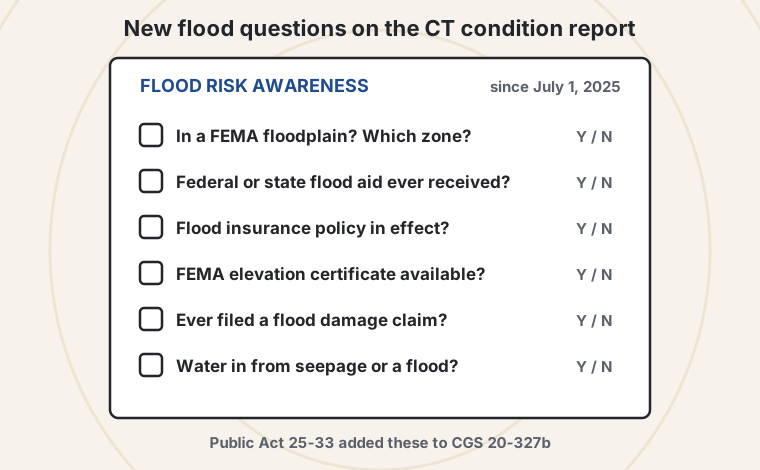
The new section is titled “Flood Risk Awareness.” The same law added a notice to the report explaining that federal law requires flood insurance on properties with a federally regulated or insured mortgage in a Special Flood Hazard Area, and that a flood-insurance requirement tied to past federal disaster aid stays with the property for future owners. That last point is why the question about past aid matters: it can affect your buyer.
What to do before you list:
- Look up your zone on FEMA’s Flood Map Service Center.
- Find your elevation certificate, if one exists. Your insurance agent or the town may have a copy.
- Pull your flood insurance declarations page and any claim records.
- Write down what you know about water in the house and when. Answers extend only to your actual knowledge (CGS 20-327e).
None of this requires a repair. It requires honest, organized answers. A buyer who sees an elevation certificate and an insurance quote up front negotiates on facts; one who discovers the zone from the lender negotiates on fear. Our Connecticut property condition disclosure guide covers the rest of the form.
Do flood vents, decks and salt-air wear need fixing before you list in Branford?
Flood vents, decks and salt-air wear usually need small fixes before you list in Branford. Clear and repair blocked or missing flood openings, replace soft deck boards, rusted fasteners and loose railings, and fix rotted trim and failing hardware. These cost far less than the credit a buyer’s inspector will ask for, and they are what shoreline inspections write up first.
Flood vents. In a FEMA flood zone, an enclosed area below the lowest floor (a crawlspace, or a garage under the house) built to the flood rules needs openings that let water in and out: at least two, with at least one square inch of net open area per square foot of enclosed space, the bottom of each no more than one foot above grade (44 CFR 60.3(c)(5)). Vents that were boarded over, stuffed with insulation or blocked by a deck skirt are a common inspection finding and usually a cheap fix. If vents are missing entirely, do not guess: ask the building department what was approved for your house.
Decks and stairs. Salt air corrodes fasteners and connectors faster than inland. An inspector will push on boards, shake railings and look at the ledger and the hardware under the deck. Replace soft boards and rusted screws, tighten or replace railings, and fix stairs. A deck that needs to be rebuilt is a credit item, with a contractor’s written quote.
Salt-air wear. About one in five Branford homes is sided in wood shingles, according to the parcel data. Rotted trim, peeling paint, sticking windows and corroded door hardware all signal deferred upkeep. Replace the rot, prime and paint, and lubricate or replace hardware. On waterfront houses, which the assessor classes at 400 single-family parcels with a median year built of 1934, pre-1978 paint rules also apply: use a lead-safe certified contractor.
Work on structures, fill or docks waterward of the coastal jurisdiction line needs a certificate or permit from the Department of Energy and Environmental Protection (CGS 22a-361). Do not start seawall or dock work just to sell. Disclose its condition and any permits you have.
Can a big pre-sale renovation trigger flood-zone rules in Branford?
A big pre-sale renovation can trigger flood-zone rules in Branford. Under the federal flood program, an improvement in a flood zone whose cost equals or exceeds 50% of the structure’s market value is a “substantial improvement” (44 CFR 59.1), and the house must then be brought into compliance with the flood rules, which can mean elevating it. That turns a kitchen into a much bigger project.
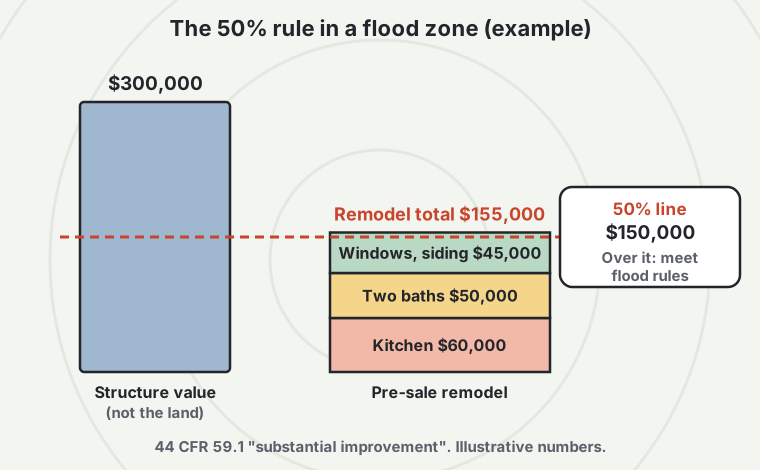
Example (illustrative): a Branford house in a flood zone sells for $650,000, but the land is a large part of that and the structure alone is valued at $300,000. Half of that is $150,000. A seller who plans a $60,000 kitchen, $50,000 for two bathrooms and $45,000 for windows and siding reaches $155,000, which crosses the line. Ask the Branford building department how it values the structure and whether it counts improvements over several years before you sign a contract.
That is one more reason the statewide advice applies doubly on the shore: skip remodels before a sale. Fix what is broken, document what is there and let the buyer plan the renovation they want.
What does the math look like on a $547,000 Branford house?
On a $547,000 Branford house with typical shoreline wear, making about $7,600 of small fixes and listing nets about $501,459 in this illustrative example. Listing as-is and giving a $20,000 inspection credit nets about $489,059, and an illustrative $440,000 direct sale nets about $433,496. For a sound Branford house, fixing the small items and listing clearly wins.
| Line | Small fixes, then list | List as-is, credit later | Direct sale (illustrative) |
|---|---|---|---|
| Sale price | $547,000 | $547,000 | $440,000 |
| Fixes: deck $2,500, trim and paint $4,000, alarms $300, heating service $300, gutters and dehumidifier $500 (est.) | -$7,600 | $0 | $0 |
| Inspection credit to the buyer (est.) | $0 | -$20,000 | $0 |
| Commission, 5% (est.) | -$27,350 | -$27,350 | $0 |
| Conveyance tax, 1.00% (CGS 12-494) | -$5,470 | -$5,470 | -$4,400 |
| Seller’s attorney (est.) | -$1,500 | -$1,500 | -$1,500 |
| Carrying: taxes about $707 a month plus insurance and utilities about $500 (est.) | -$3,621 (3 months) | -$3,621 (3 months) | -$604 (2 weeks) |
| Net before mortgage payoff | $501,459 | $489,059 | $433,496 |
Notice what drives the gap: the credit. Buyers’ inspectors tend to price a shoreline punch list high, and $7,600 of small fixes can save a much larger credit. Run your own numbers:
How much would you walk away with?
Slide the numbers to match your house. It works in your browser; nothing is saved or sent.
Estimates for planning. Conveyance tax per CGS 12-494 (state 0.75% up to $800,000, 1.25% to $2.5M, 2.25% above, plus the town rate). Seller attorney about $1,200 to $1,500; flat-fee MLS about $400; listings include three months of taxes, insurance and utilities, a cash sale about two weeks. Your attorney gives you the final numbers.
When should you not sell a Branford house to a cash buyer?
You should not sell a Branford house to a cash buyer when it is sound, the fixes are small and you can wait two or three months; listing will usually net tens of thousands more. A direct sale fits when the house has flood damage you cannot repair, needs elevation or a new septic field, or when an estate, a move or a deadline leaves no time for showings.
Fix the small items and list
Most moneyBest for most Branford houses in decent shape.
- Deck, trim, vents, alarms
- Flood and sewer paperwork ready
- No remodel
List as-is
MiddleBest when you cannot manage contractors but the house is sound.
- Expect an inspection credit
- Disclose fully
- Same timeline as listing
Sell direct, as-is
FastestBest for flood damage, failed septic, elevation needs or a hard deadline.
- No repairs, no showings
- Typically closes in about two weeks
- You pick the date
If your house is in the hard category, our page on selling a house that needs repairs in Connecticut explains the as-is route, and our guide to selling a house as-is in Connecticut covers what as-is does and does not change. Neighbouring Guilford sellers face many of the same questions; see selling a house that needs work in Guilford.
How do you get a Branford house ready to list, step by step?
To get a Branford house ready to list, confirm sewer or septic, gather your flood records, walk the outside like a shoreline inspector, make the small fixes, get written quotes for anything big and compare the nets before spending more. Most sellers can finish this in three to five weeks.
Confirm sewer or septic
Check your bills or the town. On septic, pump if due and get the health district file.
Gather flood records
FEMA zone, elevation certificate, insurance declarations, claim history and any aid received. These answer the six new report questions.
Walk the outside
Deck boards, railings, stairs, fasteners, trim, windows, door hardware, flood vents and anything mounted below the flood line.
Make the small fixes
Use registered contractors, pull permits where needed and keep every receipt for the buyer.
Price the big items, then decide
Get written quotes for a deck rebuild, septic field or seawall work, plus an as-is number. If a direct sale wins, closing typically takes about two weeks.
Is a cash sale right for you, or should you list?
Seven quick questions. There is no wrong answer, and we will tell you honestly if listing would leave you more.
- Does the house need repairs you would rather not pay for or manage?
- Do you need to close by a certain date, or within the next month or two?
- Would showings be hard: tenants, belongings, privacy, or you live out of state?
- Is there a complication: an estate or probate, a divorce, foreclosure, liens or back taxes?
- Could you comfortably cover the mortgage, taxes and utilities for three or more months?
- Is getting the highest possible price more important to you than speed and certainty?
- Would a buyer's bank lend on the house as it is (no major roof, foundation, oil tank or code issues)?
Questions about fixing a house before selling in Branford
Do I have to disclose that my Branford house is in a flood zone?
Yes, you have to disclose that your Branford house is in a flood zone. Since July 1, 2025, the Connecticut condition report asks whether the property is in a FEMA floodplain and which zone, plus questions on flood insurance, elevation certificates, claims and aid (Public Act 25-33).
Do I need an elevation certificate to sell a house in Branford?
You do not need an elevation certificate to sell a house in Branford, but the condition report asks whether one is available. If the house is in a high-risk zone, the buyer’s insurer will likely want one, so having it ready helps the sale.
Should I fix flood damage before selling?
You should fix small, finished flood repairs and document them, but large unrepaired flood damage is usually better priced in or sold as-is. Disclose past water entry either way; the report asks about seepage and flood events.
Is most of Branford on public sewer?
Most of Branford is on public sewer; the town says its system serves almost 85% of residences. Check your own bills or ask the town, because the condition report asks for your system type.
Should I replace an old deck before selling a shoreline house?
You usually should not replace an old deck before selling a shoreline house. Replace soft boards, rusted fasteners and loose railings so it is safe. If it needs a full rebuild, get a written quote and offer a credit.
What are flood vents and does my house need them?
Flood vents are openings that let floodwater flow through an enclosed area below the lowest floor. In a FEMA flood zone, such enclosures need at least two openings totaling one square inch per square foot of enclosed area (44 CFR 60.3(c)(5)). Ask the building department what applies to your house.
Can renovating before selling force me to raise my house?
Renovating before selling can force you to bring the house up to flood rules if it is in a flood zone and the work costs 50% or more of the structure’s market value (44 CFR 59.1). Check with the Branford building department before signing a large contract.
How much does it cost to sell a $547,000 house in Branford?
Selling a $547,000 house in Branford costs $5,470 in conveyance tax (1.00%), plus attorney fees, any commission and carrying costs. Taxes at the fiscal 2027 mill rate of 22.16 are about $707 a month on that house (est.).
Does a past flood insurance claim stop a sale?
A past flood insurance claim does not stop a sale, but you must disclose it on the condition report. Documenting the repairs that followed, with receipts and permits, is the best way to keep it from becoming a price fight.
Related guides
Repairs
Other towns, other questions
For every step from pricing to closing, see our guide on how to sell a house in Connecticut. If you want an as-is number to set against your repair list, start on our Branford page or call Jerryll at (203) 529-4712.
Plain-English information, not legal advice. Talk to a Connecticut attorney about your own sale.
Sources (checked on October 27, 2026)
- Connecticut OPM Real Estate Sales (Branford, Oct 2023 to Sep 2024), data.ct.gov.
- 2025 Connecticut Parcel and CAMA Data (Branford year built, fuel, siding, waterfront use code), data.ct.gov.
- OPM mill rates, fiscal 2027, data.ct.gov.
- Public Act 25-33 (Flood Risk Awareness questions and flood insurance notice on the condition report).
- CGS 20-327b to 20-327e (property condition report, $500 credit, actual knowledge).
- 44 CFR 60.3(c)(5) (flood openings) and 44 CFR 59.1 (substantial improvement).
- FEMA Flood Map Service Center.
- CGS 22a-361 (DEEP permits for coastal structures).
- CGS 12-494 (conveyance tax).
- Town of Branford, Water Pollution Control Facility page (sewer service share), branford-ct.gov.
See the house together.
Pick a time that works.
Choose a time for us to walk through the property with you, or ask for a quick call first. We confirm every request personally.
Tuesday, January 13
No open times in the next few weeks. Please call us.
We will confirm by email. Nothing is booked until we do.
View my request
Who wrote this
Jerryll Noorden
Jerryll has bought and sold Connecticut houses since 2016 and has sat at more closing tables than he can count, on both sides. Before real estate he was a robotics scientist at NASA, IHMC and IIT. He wrote this guide because the national sites that rank for it skip the Connecticut rules that cost sellers money. When listing or selling it yourself would get you more than a cash offer, he says so.
This guide explains Connecticut rules in plain English. It is not legal or tax advice. Laws change; for your sale, talk to a Connecticut real estate attorney and a tax professional.
