
Key facts at a glance
| Fact | Number | Source |
|---|---|---|
| Home sales in Farmington, Oct 2024 to Sep 2025 | 408, median $436,000 | CT OPM real estate sales, data.ct.gov |
| Single-family sale prices, same period (252 recorded sales) | Median $520,000; 25% under $397,500; 75% under $850,000 | CT OPM real estate sales, data.ct.gov |
| Houses (excluding condos) built before 1978 | 53% (median year built 1975) | 2025 CT parcel (CAMA) data, data.ct.gov |
| Most common style and heating fuel | Colonial (40%); oil heat (63%) | 2025 CT parcel (CAMA) data |
| Cost recovered at sale: complete kitchen renovation / bathroom renovation | 60% / 50% (national) | NAR 2025 Remodeling Impact Report |
| Mill rate, fiscal 2027 | 27.36 (about $830 a month on a $520,000 house, est.) | CT OPM mill rates, data.ct.gov |
| Conveyance tax the seller pays | 1.00% up to $800,000; state rate 1.25% on the portion above | CGS 12-494 |
Farmington is a town where it is easy to spend $60,000 on a house and get $36,000 back. Prices are high enough that a remodel feels proportionate, and the housing stock (half of it built before 1978, much of it 1970s and 1980s colonials) looks dated next to new listings. This guide, part of our guide to how to sell a house in Connecticut, answers one question: which renovations do not pay before you sell in Farmington, and what do buyers there actually pay for?
Why is it so tempting to renovate before selling in Farmington?
It is tempting to renovate before selling in Farmington because the house next door sold for more after a new kitchen, the listing photos online all look new, and a renovation feels like a way to control the price. But a remodel paid for by the seller rarely comes back dollar for dollar, and it adds months and risk to the sale.
Maybe your colonial still has the 1986 kitchen, the brass fixtures and the almond bathroom tile. Maybe an agent friend said “buyers here expect updated.” Sellers in this spot often feel self-conscious about the dated rooms, pressured by the neighbours’ sale prices, hopeful that a remodel will add a big number, worried about leaving money on the table, and exhausted at the idea of living through a renovation just to move out.
This page is for you. It shows, with Farmington’s own numbers and published cost-recovery data, where the money comes back and where it does not.
Which renovations do not pay before selling a house in Farmington, CT?
The renovations that do not pay before selling a house in Farmington, CT are the big ones: complete kitchen remodels, bathroom renovations, additions and new primary suites, basement finishing and pools. National data from the 2025 NAR Remodeling Impact Report puts a complete kitchen renovation at 60% of cost recovered at sale and a bathroom renovation at 50%. Paint, repairs and doors do better.
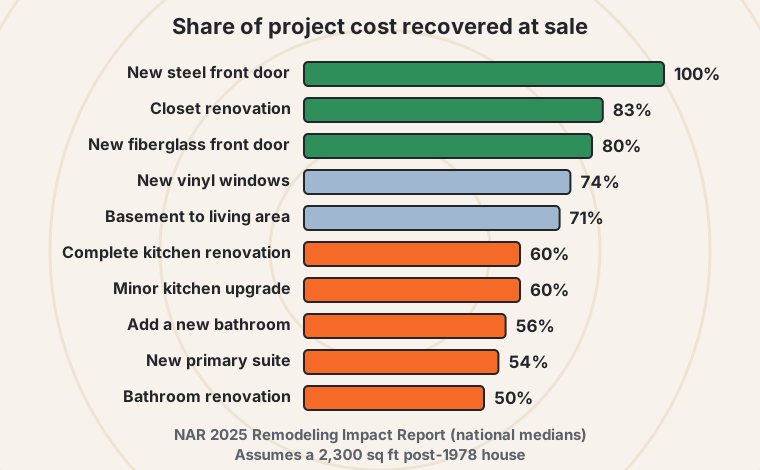
NAR’s figures come from REALTORS’ estimates of the value each project adds, set against remodelers’ median costs, for a typical 2,300-square-foot house built after 1978. They are national, not Farmington quotes, but the pattern holds in most markets: projects buyers would want to choose themselves come back at half to two-thirds of cost. The same survey asked REALTORS what they recommend sellers do before listing; the top answer was painting the entire home (50%), followed by painting one room (41%) and a new roof (37%). A kitchen upgrade was recommended by 30% and a bathroom renovation by 24%.
The statewide fix, credit or skip call for every common repair is in our guide to what to fix before selling a house in Connecticut. This page is about the opposite mistake: spending too much.
Why do Farmington price points make over-improving easy?
Farmington price points make over-improving easy because the town spans a wide range, from $397,500 at the 25th percentile of single-family sales to $850,000 at the 75th, and a renovation cannot move a house out of its street’s range. Buyers and appraisers compare your house with similar houses nearby, so a remodel above the neighbourhood’s level is paid for but not paid back.

In the year to September 2025, Farmington recorded 252 single-family sales at a median of $520,000. A quarter sold under $397,500, three quarters under $850,000 and 51 sold for $1 million or more. That spread is the trap. A $450,000 colonial on a street of $450,000 colonials does not become an $850,000 house because it gets an $850,000-house kitchen. The buyer’s appraiser will look for comparable sales nearby, and if none supports the higher price, a financed buyer cannot pay it without more cash down.
Two more Farmington details matter. First, the town’s median house (excluding condos) was built in 1975 and has about 2,100 square feet of living space, so buyers in each bracket are comparing a lot of similar 1970s and 1980s colonials and ranches; condition and price decide which one sells. Second, above $800,000 the state conveyance tax rises from 0.75% to 1.25% on the portion over $800,000 (CGS 12-494), so pushing the price over that line costs a little more of each added dollar. Our guide to what it costs to sell in Farmington has the full cost math.
What does a $60,000 kitchen remodel really return before selling in Farmington?
A $60,000 kitchen remodel before selling in Farmington returns about $36,000 of added value if it performs at NAR’s 2025 national rate of 60% for a complete kitchen renovation. After three more months of property tax and the commission and conveyance tax on the added price, the seller ends up about $28,650 behind in this illustrative example.
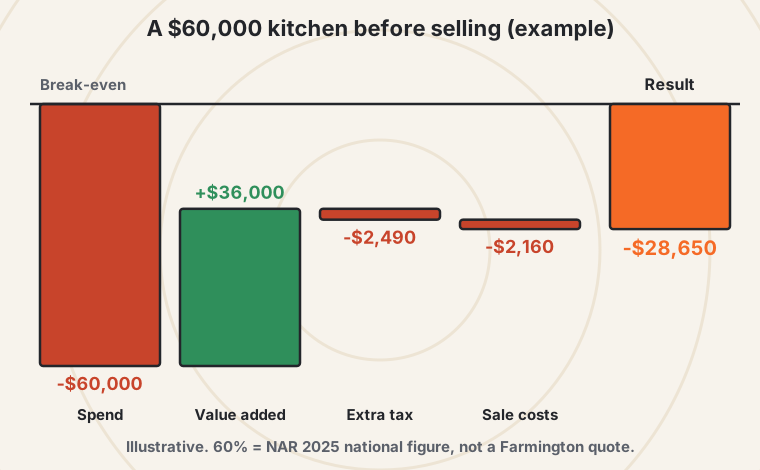
| Line | Amount | How it is figured |
|---|---|---|
| Kitchen remodel (est.) | -$60,000 | Illustrative mid-range scope for a 1980s colonial |
| Value added at sale | +$36,000 | 60% of cost (NAR 2025, complete kitchen renovation, national) |
| Three more months of property tax | -$2,490 | $830 a month on a $520,000 house at 27.36 mills |
| Commission and conveyance on the added $36,000 | -$2,160 | 5% commission (est.) plus 1.00% conveyance tax |
| Net effect of the remodel | -$28,650 | Before insurance, utilities and financing costs during the work |
The case for a remodel is speed, not profit: an updated house may sell faster or draw more offers. Industry data points the same way. The publisher of the long-running Cost vs. Value report put a minor kitchen remodel at $28,458 nationally in 2025, with a resale value of $32,141, or 112.9% recouped; NAR’s survey, which measures differently, put a minor kitchen upgrade at 60%. Either way, the smaller job beats the full rebuild. If the kitchen truly hurts the sale, refresh it; do not rebuild it.
Are pools, additions and finished basements worth it before selling in Farmington?
Pools, additions and finished basements are rarely worth it before selling in Farmington. NAR’s 2025 data puts a new primary suite at 54% of cost recovered, adding a bathroom at 56% and a basement conversion at 71%, and a pool narrows your buyer pool as often as it widens it. Each also needs permits, inspections and time you will spend carrying the house.
- Pools. Some buyers want one; many see maintenance, insurance and fencing. A new in-ground pool also takes months to permit and build. If you already have a pool, maintain it, keep the permits and the barrier compliant, and show it clean. Do not add one to sell.
- Additions and primary suites. Recovered at about half of cost nationally, and in Farmington an addition can push a house past what its street supports. If the house lacks a bedroom that buyers in its bracket expect, let the price reflect it.
- Finished basements. Better than most at 71%, but only if done with permits; an unpermitted basement bedroom becomes a disclosure and a negotiation.
- High-end finishes. Designer tile, custom built-ins and premium appliances suit your taste, not the next owner’s. NAR’s survey does not even include top-of-the-line projects; it assumes typical-quality materials.
- Room conversions. Keep bedrooms as bedrooms. A fourth bedroom turned into a gym or office counts as three when buyers search.
What do Farmington buyers actually pay for?
Farmington buyers actually pay for condition and certainty: a sound roof, a heating system with service records, dry basements, working windows and doors, fresh neutral paint and a clean inspection report. In a town where 63% of houses heat with oil and the median house dates from 1975, buyers’ inspectors focus on the age of the boiler, the tank and the roof.
That makes the best-returning pre-sale spending in Farmington boring and cheap:
- Paint the interior a neutral color, the top REALTOR recommendation in NAR’s survey
- Service the boiler or furnace and keep the receipt; disclose its age
- Have the oil tank inspected, and remove an old buried one
- Fix leaks, stains, sticking doors and windows, and dead alarms
- Replace a worn front or garage door; in the 2025 Cost vs. Value data, a garage door replacement (about $4,672 nationally) recouped 267.7% and a steel entry door (about $2,435) 216.4%
- Clean, declutter and fix the small items on our 13 low-cost fixes list

Before you call a kitchen designer, call a roofer and a heating tech. Buyers forgive an old kitchen they can plan around. They do not forgive a roof or a boiler they have to replace the first winter, and that is where inspection credits come from.
When should you not sell a Farmington house to a cash buyer?
You should not sell a Farmington house to a cash buyer when it is in sound shape and only dated; paint, small repairs and a good listing will usually net more. A direct sale fits when the house needs work you cannot or will not fund, such as a roof, heating system and full update together, or when time, an estate or a move rules out months of showings.
Refresh and list
Most moneyBest for a sound but dated Farmington house.
- Paint, repairs, doors, service records
- No remodel
- Price against the street, not the town
Remodel, then list
Rarely winsOnly when the kitchen or bath is broken, not just dated.
- 50% to 60% recovered (NAR, national)
- Months of carrying
- Contractor and permit risk
Sell direct, as-is
FastestBest when big systems and the update are all due at once.
- No repairs, no showings
- Typically closes in about two weeks
- You pick the date
If your house is in the “everything at once” category, our page on selling a house that needs repairs in Connecticut explains the as-is route, and why cash offers are lower shows how a buyer builds the number. We will tell you if listing nets more.
How do you decide what to spend before selling in Farmington, step by step?
To decide what to spend before selling in Farmington, find your street’s comparable sales, list what a buyer’s inspector will flag, price the boring fixes first, test any remodel against the cost-recovery numbers, and compare the result with an as-is number. Most sellers can make the call in a week or two, before any contractor starts.
Find your street’s comparables
Look at recent sales of similar houses nearby. That range, not the town median, is your ceiling.
List the inspection items
Roof age, boiler or furnace age and service, oil tank, water in the basement, windows, doors and alarms.
Price the boring fixes
Get written quotes. These usually come back in full by avoiding a credit.
Test any remodel
Multiply its cost by 50% to 60% (NAR, national) and subtract the months of carrying. If the result is negative, skip it.
Compare with an as-is number
If the repair list is long, get a written as-is offer and compare nets. A direct sale typically closes in about two weeks.
How much would you walk away with?
Slide the numbers to match your house. It works in your browser; nothing is saved or sent.
Estimates for planning. Conveyance tax per CGS 12-494 (state 0.75% up to $800,000, 1.25% to $2.5M, 2.25% above, plus the town rate). Seller attorney about $1,200 to $1,500; flat-fee MLS about $400; listings include three months of taxes, insurance and utilities, a cash sale about two weeks. Your attorney gives you the final numbers.
Questions about renovations before selling in Farmington
Should I remodel my kitchen before selling in Farmington?
You usually should not remodel your kitchen before selling in Farmington. A complete kitchen renovation recovers about 60% of its cost at sale according to NAR’s 2025 national data. Refresh it with paint, hardware, lighting and repairs instead.
Is a bathroom renovation worth it before selling?
A bathroom renovation is usually not worth it before selling; NAR’s 2025 report puts it at 50% of cost recovered nationally. Regrout, recaulk, fix leaks and replace worn fixtures instead.
Does a pool add value to a Farmington house?
A pool can appeal to some Farmington buyers, but adding one before selling rarely pays because of the cost, the months to build it and the buyers who see upkeep and liability. If you already have one, maintain it and keep its permits handy.
What upgrades have the best return before selling?
The upgrades with the best return before selling are small exterior and safety items: in the 2025 Cost vs. Value data, a garage door replacement recouped 267.7% and a steel entry door 216.4% nationally. Interior paint is the top pre-sale recommendation from REALTORS in NAR’s survey.
How do I know if I am over-improving my Farmington house?
You are over-improving your Farmington house if the work would price it above recent sales of similar houses on your street. Farmington single-family sales ranged from $397,500 at the 25th percentile to $850,000 at the 75th in the year to September 2025, so the street matters more than the town.
Should I finish the basement before selling?
You usually should not finish the basement before selling. NAR’s 2025 data puts a basement conversion at 71% recovered nationally, and only permitted work counts. A dry, clean, well-lit unfinished basement sells fine.
Should I replace an old oil boiler before selling in Farmington?
You usually should not replace a working oil boiler before selling in Farmington. Service it, keep the receipt and disclose its age; 63% of Farmington houses heat with oil, so buyers expect the question. Replace it only if it has failed.
What does it cost to sell a $520,000 house in Farmington?
Selling a $520,000 house in Farmington costs $5,200 in conveyance tax (1.00%), plus attorney fees, any commission and carrying costs. Property tax at the fiscal 2027 mill rate of 27.36 runs about $830 a month on that house (est.).
Can I sell a dated Farmington house as-is?
Yes, you can sell a dated Farmington house as-is. You still give the condition report (or a $500 credit under CGS 20-327c), the lead disclosure for pre-1978 homes and the smoke and CO affidavit at closing. A dated but sound house usually does best listed after a refresh.
Related guides
Repairs
Other towns, other questions
For every step from pricing to closing, see our guide on how to sell a house in Connecticut. If you want an as-is number before deciding what to spend, start on our Farmington page or call Jerryll at (203) 529-4712.
Plain-English information, not legal advice. Talk to a Connecticut attorney about your own sale.
Sources (checked on October 27, 2026)
- Connecticut OPM Real Estate Sales (Farmington, recorded Oct 2024 to Sep 2025), data.ct.gov.
- 2025 Connecticut Parcel and CAMA Data (Farmington year built, style, fuel, living area), data.ct.gov.
- OPM mill rates, fiscal 2027, data.ct.gov.
- NAR 2025 Remodeling Impact Report (cost recovered, REALTOR recommendations, survey assumptions).
- Zonda, 2025 Cost vs. Value report release (national averages, September 18, 2025).
- CGS 12-494 (conveyance tax).
- CGS 20-327b and 20-327c (property condition report, $500 credit).
See the house together.
Pick a time that works.
Choose a time for us to walk through the property with you, or ask for a quick call first. We confirm every request personally.
Tuesday, January 13
No open times in the next few weeks. Please call us.
We will confirm by email. Nothing is booked until we do.
View my request
Who wrote this
Jerryll Noorden
Jerryll has bought and sold Connecticut houses since 2016 and has sat at more closing tables than he can count, on both sides. Before real estate he was a robotics scientist at NASA, IHMC and IIT. He wrote this guide because the national sites that rank for it skip the Connecticut rules that cost sellers money. When listing or selling it yourself would get you more than a cash offer, he says so.
This guide explains Connecticut rules in plain English. It is not legal or tax advice. Laws change; for your sale, talk to a Connecticut real estate attorney and a tax professional.
