
Key facts at a glance
| Fact | Number | Source |
|---|---|---|
| Putnam one- to three-family homes built before 1978 (the federal lead paint cutoff) | 74% of 2,471 homes | 2025 CT parcel (CAMA) data, data.ct.gov |
| Built before 1940 | 40% (median year built 1955) | 2025 CT parcel (CAMA) data |
| Heated with oil / with steam | 67% oil; 12% steam systems | 2025 CT parcel (CAMA) data |
| Median single-family sale, Oct 2022 to Sep 2023 (last full year in the state data) | $295,000 (73 sales; 140 homes in all) | CT OPM real estate sales, data.ct.gov |
| Mill rate, fiscal 2027 | 18.5 (about $3,820 a year on a $295,000 house, est.) | CT OPM mill rates, data.ct.gov |
| Conveyance tax the seller pays | 1.00% (0.75% state + 0.25% town) | CGS 12-494 |
| Credit if you do not deliver the condition report | $500 | CGS 20-327c |
Putnam’s houses are old: three in four predate 1978, and two in five predate 1940. That is where the real pre-sale questions come from: peeling paint, knob-and-tube circuits, damp fieldstone cellars, buried oil tanks and steam boilers. This guide is part of our larger guide to how to sell a house in Connecticut. It answers one narrow question: on an older Putnam house, which items do you fix, which do you disclose, and which do you credit?
Why does selling an old Putnam house feel so hard?
Selling an old Putnam house feels hard because the list of things that could go wrong is long and mostly hidden: wiring behind plaster, a tank under the lawn, paint layers from the 1930s. Most sellers do not need to fix everything. They need to know which few items a buyer’s lender, insurer or inspector will actually stop the sale over.
Maybe it is the mill-era two-family your parents bought in the 1960s, or a 1920s colonial you have never opened a wall in. People in this spot usually feel overwhelmed by the size of the possible list, embarrassed about what an inspector will write, worried about spending money they will not get back, suspicious of anyone who says “just sell it as-is,” and stuck, because every choice seems to cost something.
That is normal. An old house is not a bad house; it is a house with a known set of questions. This page is for you: it sorts them into three piles so you can decide with numbers, not dread.
What should you fix before selling an old house in Putnam, CT?
Before selling an old house in Putnam, CT, fix the items that block a buyer’s loan or insurance and are cheap: peeling paint on a pre-1978 house, missing handrails, exposed wiring, no working heat, and an old buried oil tank. Disclose what you know about the foundation, asbestos and lead. Credit the big, certain items such as knob-and-tube rewiring or an aging boiler.

Our Connecticut guide to what to fix before selling gives the statewide fix, credit or skip call for every common repair, with cost ranges. We will not repeat that table here. This page applies it to the kind of house Putnam has most of: older, oil-heated, often with original wiring and a stone cellar. If you only need cosmetic ideas, the 13 low-cost fixes list covers paint, lighting and curb appeal.
How old are Putnam houses, and why does that matter to a buyer?
Putnam houses are among the older ones in Connecticut: the median one- to three-family home was built in 1955, 74% were built before 1978 and 40% before 1940, according to 2025 state parcel data. Age matters because buyers’ lenders, insurers and inspectors all have rules that bite harder on older houses, especially around paint, wiring, heat and fuel tanks.
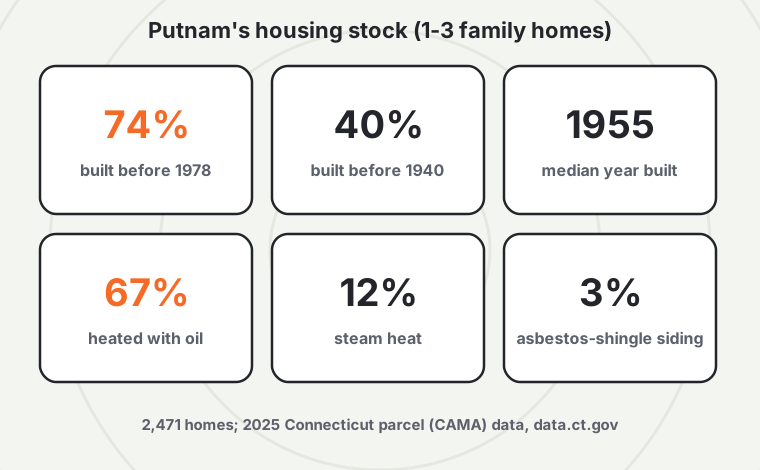
The parcel records show ranches, older two-storey homes, multi-families and capes; half use hot-water heat, 12% steam, and about 3% still carry asbestos-cement shingle siding. Those systems drive the decisions below. Tanks, septic and radon are covered in our oil tank, septic, well and radon guide.
Which items do FHA and VA appraisers flag on an older Putnam house?
FHA and VA appraisers flag items on an older Putnam house that affect safety, soundness or security: chipping or peeling paint on a home built before 1978, missing handrails, exposed or damaged wiring, heat that does not work, a roof near the end of its life, and signs of a leaking tank or water damage. The loan is then conditioned on repair, usually before closing.
This matters in Putnam because its prices suit low-down-payment buyers, and FHA loans are built for them. Under federal rules, the FHA appraiser must inspect a pre-1978 house for defective paint, and the defective areas must be treated before the loan is insured (24 CFR 200.810). VA has similar minimum property requirements. Conventional loans are less strict about cosmetic items but still care about safety and structure. For the value side, see how appraisals affect a Connecticut sale.
| Item on an older Putnam house | FHA / VA appraiser | Buyer’s insurer | Usual call |
|---|---|---|---|
| Chipping or peeling paint, pre-1978 | Must be treated (24 CFR 200.810) | Rarely | Fix, lead-safe ($500 to $5,000, est.) |
| Missing stair or porch handrail, loose steps | Safety repair | Sometimes | Fix ($150 to $1,000, est.) |
| Exposed wiring, open boxes, missing covers | Safety repair | Yes | Fix with a licensed electrician |
| Knob-and-tube circuits still live | Noted if damaged or overloaded | Often a problem | Credit or price in ($8,000 to $20,000+ rewire, est.) |
| Old buried oil tank | Flagged if leaking | Often a problem | Usually remove ($1,500 to $4,000, est.) |
| Steam or hot-water boiler that works but is old | Only if heat fails | Sometimes | Service it, keep the receipt, disclose its age |
| Damp fieldstone cellar, no movement | Only if structural | No | Fix gutters and grading; disclose |
| Bowing or failing stone wall | Structural repair | Possibly | Engineer’s letter, then credit or price in |
If your house has peeling paint and you do not want to fix it, ask for the buyer’s loan type before you accept an offer. An FHA or VA buyer brings the paint rule with them; a conventional or cash buyer usually does not.
What do you have to disclose when selling an old house in Putnam?
When selling an old house in Putnam you must disclose, on the state Residential Property Condition Report, what you actually know about the house, including whether the foundation is concrete, any underground storage tank, asbestos, lead paint and lead plumbing. For a home built before 1978 you also give the federal lead paint disclosure. Disclosure is required; repairs are not.
The report’s questions read as if written for Putnam’s housing: concrete foundation or not, underground tanks and removal papers, asbestos, lead paint and lead plumbing (CGS 20-327b). Your answers extend only to your actual knowledge (CGS 20-327e), and the law does not make you run tests to find out (CGS 20-327d).
- Fieldstone or brick foundation: answer “no” to concrete and describe it; note any water and when
- Oil tank: give its age and location; attach removal papers if it is gone
- Steam pipes or an old boiler with white wrap: if you know it is asbestos, say so; if you do not know, say unknown
- Lead paint: for a pre-1978 house, hand over the federal disclosure and any reports you have
- Smoke and CO alarms: you sign the detector affidavit at closing (CGS 29-453), so test or replace them now
If you do not deliver the report, the contract must give the buyer a $500 credit at closing (CGS 20-327c), but the credit does not excuse you from disclosing a known defect that seriously affects value or safety. Our full Connecticut property condition disclosure guide walks through the form question by question.
When is a credit better than a repair on an old Putnam house?
A credit is better than a repair on an old Putnam house when the job is big, the scope is uncertain until walls or soil are opened, and the buyer would rather pick the contractor: knob-and-tube rewiring, a boiler replacement, or stone foundation work. A repair is better when the buyer’s lender requires it before closing, because a credit cannot replace a lender-required repair.
Knob-and-tube is the classic case. Rewiring a plaster house means opening walls, and the price depends on what the electrician finds. A written electrician’s estimate turns the item into a number the buyer can negotiate around. The same logic applies to a steam boiler that still works: service it, keep the receipt, disclose its age and let the price reflect it.
One limit: if an FHA appraiser conditions the loan on paint or handrail work, that work usually has to be done before closing no matter what credit you offer. The statewide guide covers lender caps on seller credits.

On older houses, the money is usually lost on the wrong project, not on too little work. Spend your first dollars on the things a lender or insurer can say no to. Then get two written quotes for everything else, so you are negotiating with numbers instead of guesses.
What does the math look like on a $295,000 Putnam house?
On a $295,000 Putnam house that needs the typical old-house items, fixing the lender flags and listing nets about $258,927 in this illustrative example, against about $225,841 for an illustrative $230,000 direct as-is sale. Listing wins by about $33,000 when the fixes stay small and the buyer’s inspection holds no larger surprise.

Example (illustrative): a 1920s Putnam house worth the town’s single-family median of $295,000, with peeling paint, a missing handrail, open junction boxes, dead alarms, an unserviced boiler, clogged gutters over a damp fieldstone wall and some live knob-and-tube.
| Line | Fix the flags, then list | Sell as-is, direct (illustrative) |
|---|---|---|
| Sale price | $295,000 | $230,000 |
| Fixes: lead-safe paint $4,000, handrail $500, electrical covers $500, alarms $300, boiler service $400, gutters and grading $300 (est.) | -$6,000 | $0 |
| Commission, 5% (est.) | -$14,750 | $0 |
| Conveyance tax, 1.00% (CGS 12-494) | -$2,950 | -$2,300 |
| Seller’s attorney (est.) | -$1,500 | -$1,500 |
| Carrying costs: taxes about $318 a month plus insurance and utilities about $400 (est.) | -$2,873 (4 months) | -$359 (2 weeks) |
| Credit for knob-and-tube circuits (est.) | -$8,000 | $0 |
| Net before mortgage payoff | $258,927 | $225,841 |
The gap closes fast if the list grows: a leaking tank, a stone wall that must be rebuilt or a full rewire can each add five figures and months. Run your own numbers here:
How much would you walk away with?
Slide the numbers to match your house. It works in your browser; nothing is saved or sent.
Estimates for planning. Conveyance tax per CGS 12-494 (state 0.75% up to $800,000, 1.25% to $2.5M, 2.25% above, plus the town rate). Seller attorney about $1,200 to $1,500; flat-fee MLS about $400; listings include three months of taxes, insurance and utilities, a cash sale about two weeks. Your attorney gives you the final numbers.
When should you not sell an old Putnam house to a cash buyer?
You should not sell an old Putnam house to a cash buyer when the needed work is small and known, you have a few months, and you can fund a few thousand dollars of fixes. In that case fixing the lender flags and listing will usually net more. A cash sale fits when the list is long or uncertain, the house is empty and costing money, or time is short.
Fix the flags and list
Most moneyBest when the work is a few thousand dollars and you have time.
- Paint, handrails, covers, alarms, service
- Remove an old buried tank
- Credit the big items in writing
List as-is
MiddleBest when the house is sound but dated and buyers can use conventional loans.
- Price reflects the repairs
- FHA and VA buyers may not qualify
- Inspection renegotiation still likely
Sell direct, as-is
FastestBest when repairs are large or unknown, or time and cash are short.
- No repairs, no showings
- Leave what you do not want
- Typically closes in about two weeks
If the honest answer is “list it,” we will say so. If the house needs more than you want to take on, our page on selling a house that needs repairs in Connecticut explains the as-is route, and our guide to why cash offers are lower shows how a buyer gets from your price to theirs. For the decision test on listing at all, see five signs a traditional sale is not right for a Putnam house.
How do you get an old Putnam house ready to sell, step by step?
To get an old Putnam house ready to sell, walk it with a lender’s eye, price the flagged items, fix the cheap ones, gather the paperwork the condition report asks for, get written quotes for the big items, and compare your listing net with an as-is number before you spend serious money. Most sellers can do this in four to six weeks.
Walk the house like an FHA appraiser
Look for peeling paint inside and out, missing handrails, open electrical boxes, dead alarms, water stains and any fuel smell. Write it all down.
Find the hidden items
Ask an electrician whether any knob-and-tube is still live, have the boiler serviced, and find out whether there is or ever was a buried oil tank.
Fix the cheap lender flags
Use a lead-safe certified painter for pre-1978 paint, add handrails and covers, replace alarms, clean gutters and regrade soil against the stone wall.
Gather the paperwork
Tank removal letters, boiler service receipts, any lead or asbestos reports, and permits. These answer the condition report and calm the buyer’s inspector.
Get written quotes and an as-is number
Two quotes for each big item, plus a written as-is offer. Then compare nets and decide. If you choose a direct sale, closing typically takes about two weeks, on a date you pick.
Get your cash offer
without anyone coming over.
Want your offer faster, or rather not talk to anyone yet? Send a few phone photos of each room. We price the repairs from them, line by line, and send your cash offer back, so you see a real number before you ever meet us or pick up the phone.
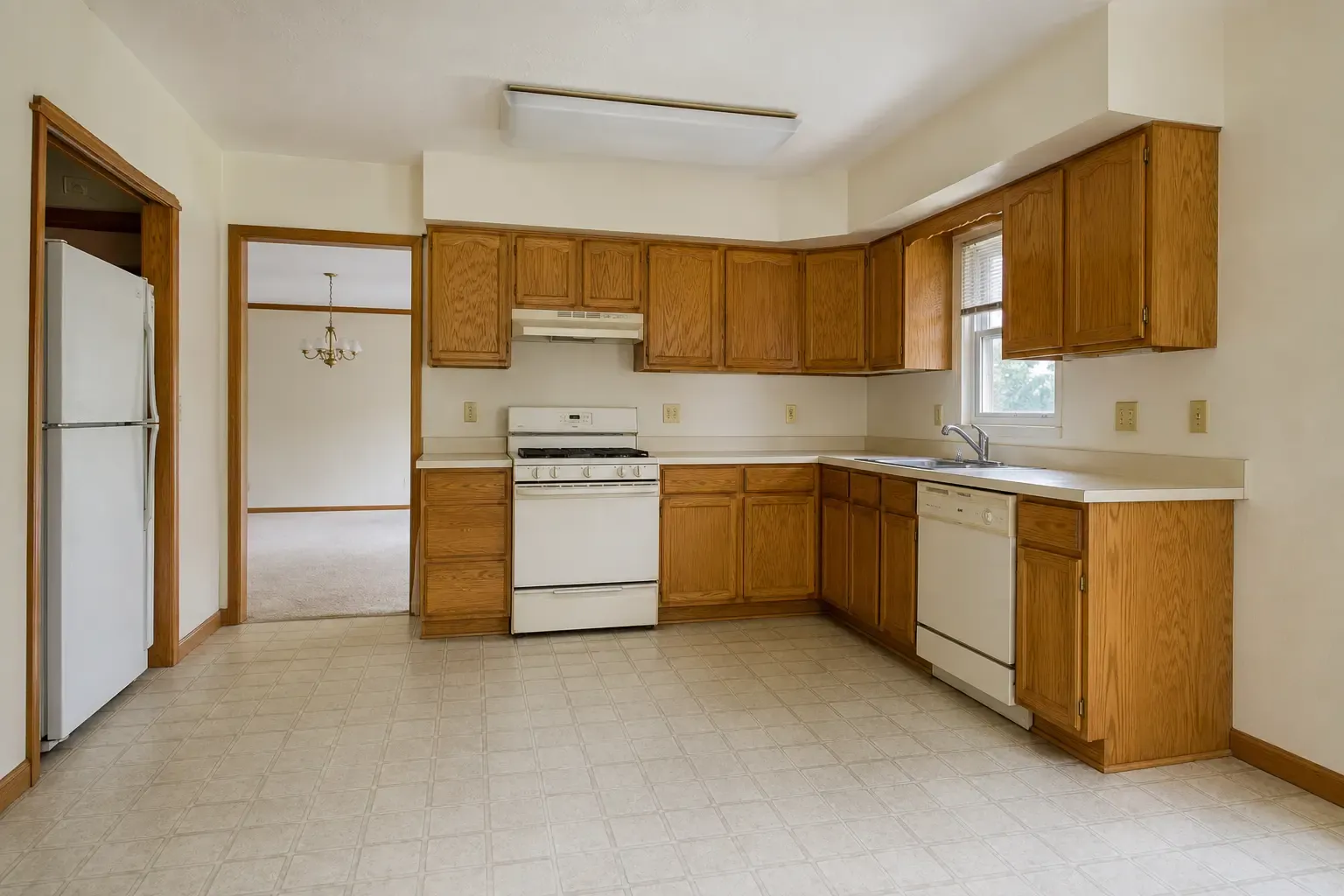 CabinetsFlooring
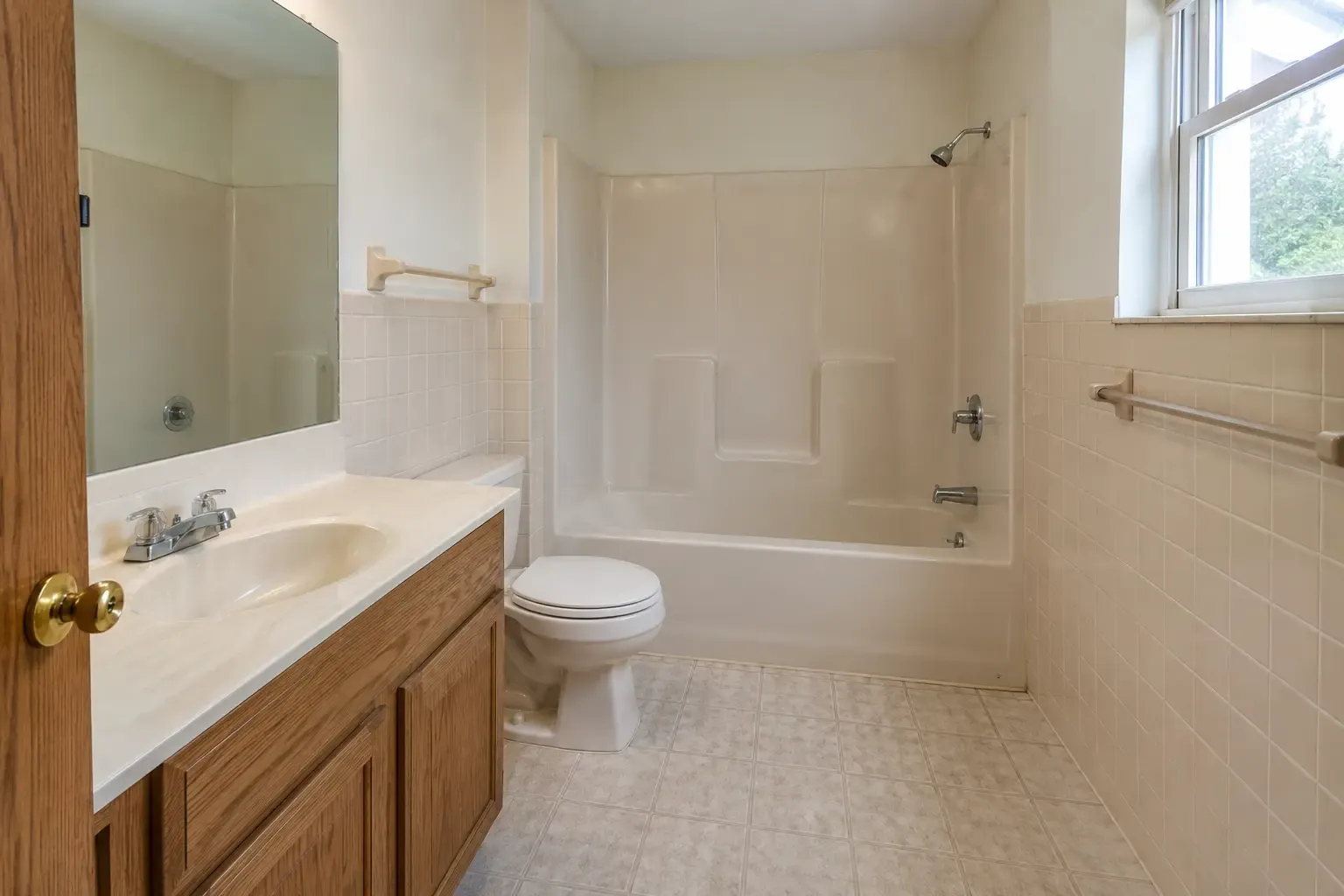 Tub & tile
 Floors
 Roof
We may bring in a partner buyer to close. Your price and terms don't change.
Questions about fixing an old house before selling in Putnam
Do I have to remove knob-and-tube wiring before selling in Connecticut?
No, you do not have to remove knob-and-tube wiring before selling in Connecticut; no state law requires it. You must disclose electrical problems you know about on the condition report. In practice, a buyer’s insurer may be the one that objects, so many sellers get an electrician’s estimate and offer a credit.
Will an FHA buyer’s appraiser require me to fix peeling paint?
Yes, an FHA buyer’s appraiser will usually require peeling or chipping paint to be treated on a house built before 1978 (24 CFR 200.810). In Putnam, 74% of one- to three-family homes predate 1978. Use a lead-safe certified contractor for the work.
Is a fieldstone foundation a problem when selling a house in Putnam?
A fieldstone foundation is not a problem by itself when selling a house in Putnam; many older homes have one. Disclose it on the condition report, which asks whether the foundation is concrete. Dampness is common and usually handled with gutters and grading; bowing or movement needs a structural engineer.
Should I remove a buried oil tank before selling?
You should usually remove an old buried oil tank before selling, because buyers’ lenders and insurers often object to one. Removal with a soil test typically runs $1,500 to $4,000 when nothing leaked (est.). Keep the contractor’s letter; the condition report asks for it.
Do I have to tell buyers about asbestos on steam pipes?
You have to tell buyers about asbestos on steam pipes if you know it is there, because the Connecticut condition report asks whether asbestos-containing materials are present. If you do not know, you can answer unknown; Connecticut does not require you to test (CGS 20-327d).
Should I replace an old steam boiler before selling?
You usually should not replace an old steam boiler that still works before selling. Have it serviced, keep the receipt and disclose its age. If it has failed, repair or replace it, because most lenders will not close on a house without working heat.
What is the lead paint disclosure for a Putnam house built before 1978?
The lead paint disclosure for a Putnam house built before 1978 is a federal form: you disclose known lead paint and hand over any reports, give the buyer the EPA pamphlet, and the buyer usually gets 10 days to test. It applies to sales of most pre-1978 homes.
Can I sell an old Putnam house without fixing anything?
Yes, you can sell an old Putnam house without fixing anything. You still owe the condition report (or a $500 credit), the lead disclosure for pre-1978 homes and the smoke and CO affidavit at closing. Expect a lower price, and expect FHA and VA buyers to have trouble.
Related guides
Repairs
Other towns, other questions
For every step from pricing to the closing table, see our guide on how to sell a house in Connecticut. If you would like a no-obligation as-is number to set against your repair list, start on our Putnam page or call Jerryll at (203) 529-4712.
Plain-English information, not legal advice. Talk to a Connecticut attorney about your own sale.
Sources (checked on October 27, 2026)
- 2025 Connecticut Parcel and CAMA Data (Putnam year built, heating fuel, heat type, siding), data.ct.gov.
- Connecticut OPM Real Estate Sales (Putnam, recorded Oct 2022 to Sep 2023), data.ct.gov.
- OPM mill rates, fiscal 2027, data.ct.gov.
- 24 CFR 200.810 (defective paint on pre-1978 FHA properties) and HUD Handbook 4000.1.
- EPA and HUD lead-based paint disclosure rule and EPA lead-safe renovation (RRP) program.
- CGS 20-327b to 20-327e (property condition report, $500 credit, actual knowledge).
- CGS 29-453 (smoke and carbon monoxide affidavit at closing).
- CGS 12-494 (conveyance tax).
See the house together.
Pick a time that works.
Choose a time for us to walk through the property with you, or ask for a quick call first. We confirm every request personally.
Tuesday, January 13
No open times in the next few weeks. Please call us.
We will confirm by email. Nothing is booked until we do.
View my request
Who wrote this
Jerryll Noorden
Jerryll has bought and sold Connecticut houses since 2016 and has sat at more closing tables than he can count, on both sides. Before real estate he was a robotics scientist at NASA, IHMC and IIT. He wrote this guide because the national sites that rank for it skip the Connecticut rules that cost sellers money. When listing or selling it yourself would get you more than a cash offer, he says so.
This guide explains Connecticut rules in plain English. It is not legal or tax advice. Laws change; for your sale, talk to a Connecticut real estate attorney and a tax professional.
