
Key facts at a glance
This guide is the agent-interview part of our guide to how to sell a house in Connecticut. If you have not yet decided between listing, selling by owner or a direct sale, start with every route to sell a house in Connecticut, then come back here with your shortlist of agents.
| Fact | Number | Source |
|---|---|---|
| Licensed real estate professionals in Connecticut | Nearly 26,000 | CT Department of Consumer Protection (DCP), Real Estate Complaints page |
| Fine the state can impose per violation on a licensee | Up to $5,000 | CGS 20-320(a) |
| Most the Real Estate Guaranty Fund pays on one transaction | $25,000 | CGS 20-324a; DCP |
| Agency disclosure deadline | No later than the first personal meeting | CGS 20-325d(b) |
| Commission rate set by law | None: “not fixed by law” notice required | CGS 20-325b |
| Sellers nationally who used an agent | 91% (5% sold by owner) | NAR 2025 Profile of Home Buyers and Sellers |
| Penalty for selling real estate without a license | Up to $1,000 per violation and/or 6 months | CGS 20-325 |
What questions should you ask a realtor before listing in Connecticut?
The questions to ask a realtor before listing in Connecticut cover five things: their recent track record in your town, how they will price your house, how they will market and show it, what the contract and fees say, and how they communicate and negotiate. Before any of that, look the agent up on the state’s eLicense system. Below are 25 questions with what a good answer sounds like.

Most “questions to ask a realtor” lists online are national and stop at the question. A question is only useful if you know what a good answer sounds like and what a weak one sounds like. That is what this page adds, along with the Connecticut parts other lists skip: the license lookup, the state’s complaint and guaranty fund process, and the things Connecticut law says must be in writing.
One honest note before we start. We are a Connecticut cash home buyer, not a brokerage. We work alongside agents all the time and we do not earn anything from the agent you pick. If listing is the right route for your house, this page is meant to help you pick a good agent. If you want to see how listing compares with a direct sale, our cash buyer vs. realtor comparison runs the numbers.
Why does choosing a real estate agent feel so risky?
Choosing a real estate agent feels risky because you are handing your largest asset to someone you met an hour ago, for a contract that can last months, and every agent sounds confident in the interview. Most sellers only do this a few times in their life, so they have no way to tell polished from good. A fixed set of questions fixes that.
If you feel a little out of your depth, you are not alone. Maybe you are the executor of a parent’s estate and have never sold a house. Maybe the last time you sold was fifteen years ago and everything has changed, including how buyer agents get paid. Maybe a friend recommended an agent and you feel awkward interviewing anyone else.
Sellers we talk to describe a few feelings again and again: unsure (“I don’t know what to ask”), wary (“they all say they’ll get top dollar”), guilty about turning down a friend or relative, pressured by an agent who wants the contract signed tonight, and worried about being locked in to a long listing with the wrong person.
All of those are reasonable. Connecticut has nearly 26,000 licensed real estate professionals, and the state itself says most have no complaints. The goal is not to find a perfect person. It is to find out, in one sitting, how this agent will price, market and negotiate for your house, and to get the important promises in writing. This page is for you if you want a script you can print and take to the kitchen table.
How do you check a Connecticut agent’s license and complaint history?
To check a Connecticut agent’s license and complaint history, search the agent’s name on the state’s eLicense lookup (elicense.ct.gov), confirm the license type is active and see which broker they are affiliated with, then check DCP’s license verification for any disciplinary record. If something goes wrong later, you can file a written complaint with the Department of Consumer Protection.

Here is the check, step by step:
- Search the name. Go to the CT eLicense license lookup and search by the agent’s last name. Choose the real estate license types if the site asks.
- Confirm status and type. You want an active license. A salesperson works under a supervising broker; a broker can run a firm. Either can list your house, but your listing contract is with the brokerage.
- Note the brokerage. The firm on the license should match the firm on the business card and the listing agreement.
- Look for discipline. DCP suggests checking its license verification page for any record of disciplinary action from earlier dealings.
Why it matters: only licensed people can be paid to sell your house. Someone who is not licensed cannot sue to collect a commission (CGS 20-325a(a)), and selling real estate without a license is punishable by a fine of up to $1,000 per violation, up to six months in jail, or both (CGS 20-325).
The Department of Consumer Protection can investigate a licensee and suspend or revoke a license, or fine up to $5,000 per violation, for things like material misrepresentation, a false promise meant to persuade you, acting for both sides without everyone’s knowledge, failing to account for money, mixing client money with their own, or dishonest dealing (CGS 20-320(a)). DCP asks that you first raise the problem with the agent or the brokerage. If that fails, your complaint must be in writing, state the facts, say what loss you claim, and include your documents. If you lost money through a licensee’s fraud, misrepresentation or embezzlement, the Real Estate Guaranty Fund can pay up to $25,000 per transaction after you win a court judgment you cannot collect (CGS 20-324a and 20-324e).
What are the 25 questions, and what does a good answer sound like?
The 25 questions to ask a Connecticut listing agent fall into five groups of five: track record, pricing, marketing and showings, contract and money, and communication and negotiation. For each question below you will see what a good answer sounds like and what should worry you. Good answers are specific, local and written down; weak answers are general, flattering and verbal only.
Print this section. Ask every agent the same questions in the same order, and write a score from 1 to 3 next to each answer while it is fresh.
Group 1: track record and local knowledge
| # | Question | A good answer sounds like | Worry if you hear |
|---|---|---|---|
| 1 | How many listings have you closed in this town in the last 12 months? | A number, and the addresses or a printout from the MLS | “Lots”, or only their brokerage’s numbers |
| 2 | Which of those were in my price range and house style? | Two or three comparable sales they handled, with list and sale price | Only luxury or only condos when you own a colonial |
| 3 | Is this your full-time job, and who covers for you when you are away? | Full-time, with a named backup agent or team member | Vague; “I always answer my phone” |
| 4 | Can I call two sellers you represented this year? | Yes, with names and numbers, without hesitation | Only online reviews, which are easy to curate |
| 5 | What is special about selling in this town right now? | Specifics: school calendar, commuter routes, oil heat, septic, flood zones, how buyers search | “It’s a great market”, with nothing local |
Group 2: pricing
| # | Question | A good answer sounds like | Worry if you hear |
|---|---|---|---|
| 6 | What price would you list at, and why? | A written comparative market analysis (CMA) with recent closed sales, not just active listings | A number with no comps, or the highest number of any agent you interview |
| 7 | Which three sales did you rely on most? | Closed sales near you, recent, similar size and condition, with adjustments explained | Sales from another town or two years ago |
| 8 | What do you expect the appraisal to say? | Awareness that a financed buyer’s lender will appraise, and a plan if it comes in low | “Appraisals aren’t a problem” |
| 9 | If we get no offers in the first weeks, what happens? | A planned review date and what will change: price, photos, access | “We’ll just wait it out” |
| 10 | What would you fix, and what would you leave? | A short list ranked by payback, with honest “don’t bother” items | A long list of upgrades, or a contractor they push |
A warning about pricing: the agent who quotes the highest price is not necessarily the best agent. Some agents “buy” listings with a high number and then ask for price cuts later. Our guide to how important the asking price is explains why the first weeks on the market matter most, and how appraisals affect the price covers what happens when a lender disagrees.
Group 3: marketing and showings
| # | Question | A good answer sounds like | Worry if you hear |
|---|---|---|---|
| 11 | What exactly will you do in the first two weeks? | A dated plan: photos, floor plan, MLS entry, signs, agent outreach, first open house | “Put it on the MLS and the internet” |
| 12 | Who pays for photos, staging, video and ads? | A written list of what the fee includes and what it does not | Extra charges that come up after signing |
| 13 | How will showings work, and will you attend them? | Clear rules on notice, lockbox, pets, tenants and feedback | No plan for occupied or tenant-filled houses |
| 14 | Will you market the house before it is on the MLS? | An explanation of any “coming soon” or office-exclusive plan and how it affects your exposure | Pressure to sell off-market to their own buyer |
| 15 | How do you handle disclosures and the condition report? | They give you the DCP Residential Property Condition Report early and tell you to answer it yourself, honestly | Offers to fill in your disclosure answers for you |
The condition report is yours to complete. If you do not deliver it before the buyer signs, you credit the buyer $500 at closing (CGS 20-327c). Our Connecticut property condition disclosure guide walks through it.
Group 4: the contract and the money
| # | Question | A good answer sounds like | Worry if you hear |
|---|---|---|---|
| 16 | What is your fee, and does it include the buyer’s agent? | An exact rate or dollar amount, with the buyer-agent part shown separately | “Standard commission”; there is no standard in Connecticut (CGS 20-325b) |
| 17 | How long is the listing, and can I end it early? | A term you choose, a fixed end date, and a written early-release clause | An automatic renewal; licensees may not combine a fixed end date with automatic continuation (CGS 20-320(a)(6)) |
| 18 | How long is the protection period after the listing ends, and which buyers does it cover? | A short period, limited to buyers they actually introduced, named in writing | Any buyer, for many months |
| 19 | Will you or your firm ever represent the buyer too? | A clear policy on dual agency and designated agents, with the statutory consent form if it happens | Dodging the question |
| 20 | What will I net after your fee and my costs? | A written net sheet with the conveyance tax, attorney, payoff and carrying costs | Only the sale price |
We keep the fee math in one place: our guide to real estate commission in Connecticut covers typical rates, the August 2024 buyer-agent changes and how to negotiate. The listing contract itself, clause by clause, is explained in our listing agreement guide.
Group 5: communication and negotiation
| # | Question | A good answer sounds like | Worry if you hear |
|---|---|---|---|
| 21 | How often will I hear from you, and how? | A set rhythm (for example a weekly report) by the channel you prefer | “Whenever there’s news” |
| 22 | How do you compare offers that are not just price? | They talk about financing, deposit, contingencies, appraisal gaps and closing dates | “Highest price wins” |
| 23 | Tell me about a deal that nearly fell apart. What did you do? | A specific story about an inspection, appraisal or financing problem and the fix | No story, or blaming everyone else |
| 24 | Who handles the attorney, inspector and lender after we accept an offer? | They track deadlines with both attorneys; Connecticut closings are run by attorneys | “The attorneys handle everything” |
| 25 | If you were me, would you list this house, or sell it another way? | An honest answer, even if it costs them the listing | Listing is always the answer |
Question 25 tells you the most. An agent who will say “this house will struggle with a financed buyer” or “you could sell this to your tenant without me” is an agent who will also tell you the truth about price. For comparing offers once they come in, see how to compare offers on a house in Connecticut.
Which red flags should end the interview?
The red flags that should end an interview with a Connecticut agent are a license you cannot find or that is not active, pressure to sign the same day, a price far above every other agent with no comps, an automatic renewal or a long protection period for any buyer, offers to fill in your disclosure answers, and refusing to put promises in writing. One of these is enough to walk away.

- The license search finds the agent, the license is active, and the brokerage matches
- No pressure to sign at the first meeting; you can take the contract to your attorney
- The suggested price is backed by closed sales, in writing
- The listing has a fixed end date and no automatic renewal
- The protection period is short and limited to named buyers the agent introduced
- You fill in the condition report yourself
- The fee is a clear rate or amount and the “not fixed by law” notice is in the contract
- You received the agency disclosure in writing at or before the first meeting (CGS 20-325d)
- Every promise you care about (photos, open houses, weekly reports) is in the agreement or an addendum
What should a Connecticut agent put in writing before you sign?
Before you sign, a Connecticut agent should give you in writing the agency disclosure (required by the first personal meeting), a comparative market analysis, a net sheet, and a listing agreement that names the broker and owners, states the date and terms, includes the lien-rights statement and the “not fixed by law” commission notice, and has a fixed end date. You get a copy of anything you sign, right away.
The legal minimum for a listing contract comes from CGS 20-325a(b): it must be in writing, name the broker and the owners, show the date, state its conditions, be signed by the broker and by the owner, and include the sentence that the broker “may be entitled to certain lien rights”. CGS 20-325b adds the commission notice. A licensee must also deliver a copy of any instrument you sign immediately (CGS 20-320(a)(7)).
What the law does not require, but you should ask for anyway, is the marketing plan and the price-review date. Those are the promises that decide whether a listing works. We go through every clause, with Simsbury numbers, in our listing agreement guide. For what a good agent actually does week by week once you sign, read our Cheshire listing agent guide.
How many agents should you interview, and how do you compare them?
Interview at least two and ideally three agents in Connecticut, ask each the same 25 questions, score each answer from 1 to 3, and compare totals alongside each agent’s written price and net sheet. The highest price quote should not decide it on its own. Pick the agent with the strongest evidence, then negotiate the contract terms before you sign.
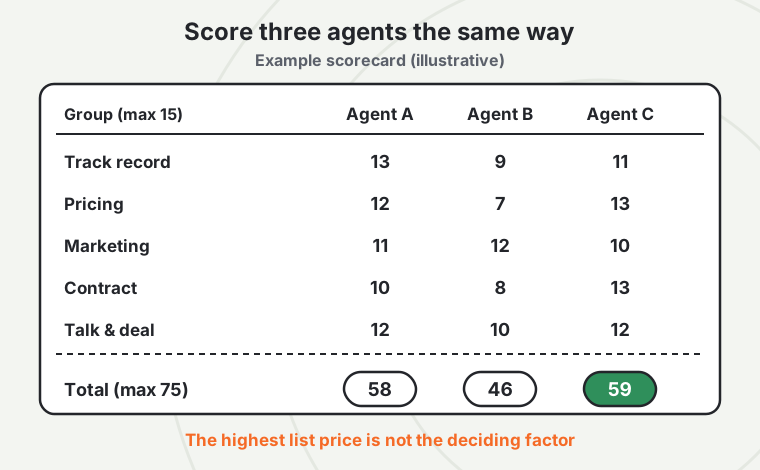
Three is enough to see a pattern. If one price is far above the other two, ask for the closed sales behind it. A simple way to score:
- 3 points: specific, local, backed by a document or a name you can call.
- 2 points: reasonable but general; they promised to send the proof.
- 1 point: vague, flattering, or a red flag from the list above.
A friend or relative can still win; they just have to win on the same 25 questions as everyone else.
Your situation also changes which group matters most. For a Hartford two- to four-family, group 3 (showings with tenants) and the agent’s record with FHA and investor buyers carry the most weight; our Hartford multi-family agent guide adds the questions to ask there. In a small rural town with few sales a year, the pricing group decides most; see our Bethany guide on whether an agent is worth it.
Is a cash sale right for you, or should you list?
Seven quick questions. There is no wrong answer, and we will tell you honestly if listing would leave you more.
- Does the house need repairs you would rather not pay for or manage?
- Do you need to close by a certain date, or within the next month or two?
- Would showings be hard: tenants, belongings, privacy, or you live out of state?
- Is there a complication: an estate or probate, a divorce, foreclosure, liens or back taxes?
- Could you comfortably cover the mortgage, taxes and utilities for three or more months?
- Is getting the highest possible price more important to you than speed and certainty?
- Would a buyer's bank lend on the house as it is (no major roof, foundation, oil tank or code issues)?
When is an agent the wrong answer, and when should you not sell to a cash buyer?
An agent is the wrong answer when a normal mortgage buyer cannot buy the house as it stands, when you cannot handle months of showings, or when you already have a buyer. You should not sell to a cash buyer when your house is in good shape, you have time, and a well-chosen agent can sell it at full market price; in that case listing usually nets more.
| Route | Best when | What you give up |
|---|---|---|
| List with a full-service agent | House is in good condition, you have a few months, buyers can get mortgages for it | Commission, prep costs, showings, months of carrying costs |
| Sell by owner (FSBO), maybe with a flat-fee MLS | You have a buyer lined up, or a simple house and time to manage it | Your time; you still usually pay a buyer’s agent and your attorney |
| Direct sale to a cash buyer | Repairs you cannot fund, tenants, an estate, a deadline, or a house a lender will not finance | Price: cash offers are below full retail value |
We will say it plainly because it is our business: if your house is ready to show and you have time, a good agent will usually get you more than we can. Cash offers are built to leave room for repairs, holding costs and risk; our page on why cash offers are lower explains the math honestly. Selling by owner is covered in how to sell a house without a realtor in Connecticut.
A direct sale earns its place when listing would mean repairs you cannot pay for, months of showings you cannot face, or tenants who will not cooperate. Then you skip the commission, the prep and the showings, and close on your date, typically in about two weeks. If that is you, our cash buyer vs. realtor guide shows where the break-even sits, and you can ask us for a written number to compare against your agents’ net sheets.

The best agents I work with all do one thing in common: they tell sellers the truth about price and condition in the first meeting, even when it is not what the seller hoped to hear. If an agent only says nice things about your house, ask them question 25 again. And always read the end date and the protection clause before you sign anything.
How do you go from interviews to a signed listing in Connecticut?
To go from interviews to a signed listing in Connecticut, check each agent’s license on eLicense, interview two or three with the same 25 questions, collect each agent’s written price analysis and net sheet, score them, negotiate the term, fee and protection period, have your attorney read the agreement, and sign only when every promise you care about is written in.
Shortlist three agents
Use recent sales in your neighborhood, referrals from people who sold, and agents whose listings you have seen sell. Look each one up on eLicense before you call.
Send the same request to all three
Ask for a CMA, a marketing plan and a net sheet before or at the meeting, so you compare documents, not personalities.
Run the interview
Ask the 25 questions in order and score each answer 1 to 3. Do not share your bottom price or your deadline yet.
Compare and choose
Add the scores, read the CMAs side by side and look at the nets, not just the prices. Call two of the winner’s past sellers.
Negotiate the contract
Agree the fee, the buyer-agent policy, a fixed end date, an early-release clause and a short protection period limited to named buyers.
Have your attorney review, then sign
Connecticut closings are run by attorneys (CGS 51-88a), so you will hire one anyway. Ask them to read the listing agreement before you sign, and keep the copy the agent must give you.
See the house together.
Pick a time that works.
Choose a time for us to walk through the property with you, or ask for a quick call first. We confirm every request personally.
Tuesday, January 13
No open times in the next few weeks. Please call us.
We will confirm by email. Nothing is booked until we do.
View my requestQuestions Connecticut sellers ask about choosing an agent
What should I ask a realtor before listing my house in Connecticut?
Before listing in Connecticut, ask a realtor about their closed sales in your town in the last year, how they reached their price (with a written CMA), what they will do in the first two weeks, what the fee includes, how long the listing lasts and how you can end it, the protection period, dual agency, and what you will net. Check their license on eLicense first.
How do I look up a real estate agent’s license in Connecticut?
You look up a Connecticut real estate agent’s license on the state’s eLicense lookup at elicense.ct.gov. Search by name, confirm the license is active, note whether it is a salesperson or broker license, and check the affiliated brokerage. DCP also suggests its license verification page for any record of disciplinary action.
How do I file a complaint against a real estate agent in Connecticut?
To file a complaint against a real estate agent in Connecticut, first raise it with the agent or their brokerage. If that fails, file with the Department of Consumer Protection. The complaint must be in writing, state the facts, say what loss you claim, if any, and include supporting documents. DCP can fine a licensee up to $5,000 per violation or suspend or revoke a license (CGS 20-320).
What is the Connecticut Real Estate Guaranty Fund?
The Connecticut Real Estate Guaranty Fund repays people who lost money through a licensee’s fraud, misrepresentation, embezzlement or similar acts on a Connecticut transaction, after a court judgment that cannot be collected. The maximum is $25,000 per transaction, however many people were harmed (CGS 20-324a). It does not cover ordinary disagreements about service.
Is the commission rate set by law in Connecticut?
No, the commission rate is not set by law in Connecticut. Every agreement that fixes broker pay must say, in prominent type, that the amount or rate is not fixed by law and may be negotiable (CGS 20-325b). Our commission guide covers typical ranges and how to negotiate.
Can a Connecticut listing agreement renew automatically?
A Connecticut listing agreement with a fixed end date cannot also renew automatically. Entering into an exclusive listing with a fixed termination date that also continues automatically past that date is a ground for discipline (CGS 20-320(a)(6)). Any extension should be a new written agreement you sign.
What is dual agency, and should I agree to it?
Dual agency means one brokerage represents both you and the buyer. In Connecticut it requires your informed written consent on a statutory form (CGS 20-325g). You can decline. If you agree, the firm cannot share your confidential information with the buyer, and you may want to negotiate the fee.
What disclosures should an agent give me at the first meeting?
By the first personal meeting, a Connecticut agent must explain in writing the types of agency relationships available and tell you not to share confidential information until you sign a written representation agreement. For residential sales they must also give you fair housing information (CGS 20-325d(b)).
Do I need an attorney if I use a real estate agent in Connecticut?
Yes, you still need an attorney if you use an agent in Connecticut. Closings are handled by attorneys, and agents do not give legal advice. Ask your attorney to read the listing agreement before you sign, since it is a binding contract that can create a broker lien (CGS 20-325a).
Can I sell without an agent in Connecticut?
Yes, you can sell without an agent in Connecticut. Nationally about 5% of sellers sold by owner in the NAR 2025 profile. You still need an attorney, the condition report and the conveyance tax return, and you may still pay a buyer’s agent. Our by-owner guide covers the steps.
Related Connecticut guides
Working with agents
Costs and routes
For the full picture, go back to how to sell a house in Connecticut. We buy houses across the state, including in Hartford, Cheshire, Simsbury and Bethany.
Plain-English information, not legal advice. Have a Connecticut attorney review any listing agreement before you sign.
Sources (checked on October 27, 2026)
- CGS Chapter 392: § 20-320 (discipline, $5,000 fines, no automatic renewal of fixed-term listings, copies of instruments), § 20-324a and 20-324e (Real Estate Guaranty Fund, $25,000), § 20-325 (unlicensed practice), § 20-325a (written contract, contents, broker lien), § 20-325b (commission notice), § 20-325d (agency disclosure), § 20-325g (dual agency consent), § 20-327b and 20-327c (condition report, $500 credit).
- CT DCP: Real Estate Complaints and Guaranty Fund (nearly 26,000 licensees; how to complain; $25,000 maximum).
- CT eLicense license lookup.
- CT DCP: Look up and verify a license.
- CGS § 51-88a (attorneys and closings).
- NAR 2025 Profile of Home Buyers and Sellers (91% used an agent; 5% sold by owner).
- NAR consumer guide: questions to ask a seller’s agent.

Who wrote this
Jerryll Noorden
Jerryll has bought and sold Connecticut houses since 2016 and has sat at more closing tables than he can count, on both sides. Before real estate he was a robotics scientist at NASA, IHMC and IIT. He wrote this guide because the national sites that rank for it skip the Connecticut rules that cost sellers money. When listing or selling it yourself would get you more than a cash offer, he says so.
This guide explains Connecticut rules in plain English. It is not legal or tax advice. Laws change; for your sale, talk to a Connecticut real estate attorney and a tax professional.
