
Key facts at a glance
This guide is part of our guide to how to sell a house in Connecticut. It explains the listing agreement a Simsbury or West Simsbury seller signs, one clause at a time. West Simsbury is a village of the Town of Simsbury, so the numbers below are Simsbury’s.
| Fact | Number | Source |
|---|---|---|
| Simsbury residential sales, Oct 2024 to Sep 2025 | 371 | data.ct.gov Real Estate Sales (5mzw-sjtu) |
| Median single-family sale price, same period | $510,000 | data.ct.gov (5mzw-sjtu) |
| Single-family deeds recorded in January 2025 vs June 2025 | 8 vs 33 | data.ct.gov (5mzw-sjtu), our count |
| Each 1% of commission on the median house | $5,100 | Arithmetic on the $510,000 median |
| Conveyance tax on a $510,000 sale (state 0.75% + town 0.25%) | $5,100 | CGS 12-494 |
| Mill rate, fiscal 2027 | 33.67 | CT OPM |
| Fixed-term listing that also renews automatically | Not allowed; ground for discipline | CGS 20-320(a)(6) |
What is a listing agreement in Simsbury, CT?
A listing agreement in Simsbury, CT is the written contract that hires a real estate brokerage to sell your house. Connecticut law requires it to be in writing, name the broker and the owners, show the date and its conditions, include a lien-rights statement and a “not fixed by law” commission notice, and be signed by the owner (CGS 20-325a and 20-325b). Everything else, from the term to the fee, is negotiable.
Most sellers sign the brokerage’s standard form at the kitchen table. That form decides how long you are tied to the agent, when the fee is earned, and whether you can owe a fee after the listing ends. This page goes through it clause by clause, with Simsbury numbers, so you can negotiate before you sign.
We are a Connecticut cash home buyer, not a brokerage. We see listing agreements when sellers come to us after a listing did not work, and the same few clauses cause most of the trouble. If you are still choosing an agent, use our 25 questions to ask a realtor before listing first.
Why does signing a listing agreement feel so uncomfortable?
Signing a listing agreement feels uncomfortable because it is a binding contract, written by the agent’s side, presented at the end of a friendly meeting, often with a suggestion to sign tonight. Most sellers do not know which clauses are standard and which can be changed, so they sign and hope. Reading it clause by clause, with your attorney, removes that uncertainty.
You may like the agent and still feel uneasy. Sellers describe feeling rushed (“they want an answer tonight”), awkward about questioning a friendly person’s paperwork, afraid of being stuck for six months with the wrong person, suspicious of the fine print about fees after the listing ends, and embarrassed to admit they do not understand it.
In Simsbury the stakes are real: on the $510,000 median single-family house, each 1% of commission is $5,100. This page is for you if a listing agreement is sitting on your table right now.
What does each clause of a Connecticut listing agreement mean?
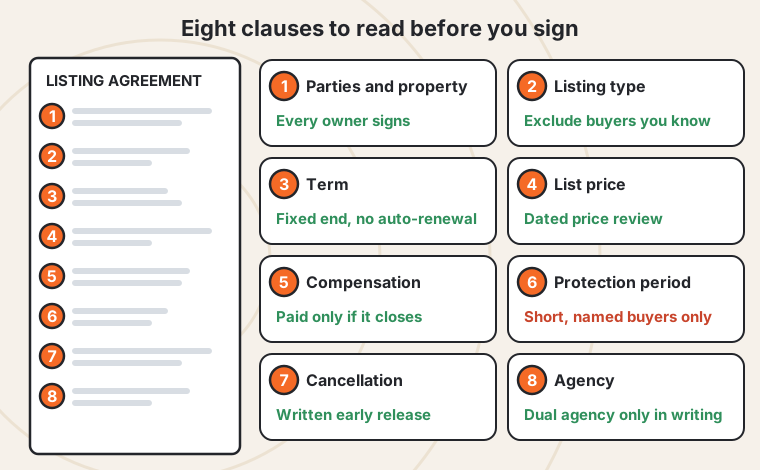
Each clause of a Connecticut listing agreement does one job: the parties and property clause says who is bound, the type says when a fee is owed, the term sets the start and end dates, the price clause sets the list price, the compensation clause sets the fee and when it is earned, the protection clause covers sales after the end date, and the cancellation, agency and marketing clauses set how you can leave and what the agent must do.
1. Parties, property and who must sign
The agreement must name the broker (with address) and the owners, and show the date (CGS 20-325a(b)(2)-(3)). For a house of one to four units, the owner must sign, or an agent authorized in a document executed like a deed (CGS 20-325a(b)(7)). In practice: every person on your deed signs. If you are an executor, a trustee or acting under a power of attorney, your attorney should confirm your authority first. A listing signed by only one of two owners is a problem waiting to happen.
2. The type of listing
Most residential agreements are an exclusive right to sell: the broker earns the fee if the house sells during the term, no matter who finds the buyer, including you. An exclusive agency listing lets you sell to a buyer you find yourself without owing the fee. If a neighbor or relative may buy, say so now and ask for that person to be excluded by name.
3. The term: start date and end date
You choose the length; the law does not set one. What the law does say: a licensee may not use an exclusive listing with a fixed end date that also continues automatically after it (CGS 20-320(a)(6)). Any extension should be a new paper you sign.
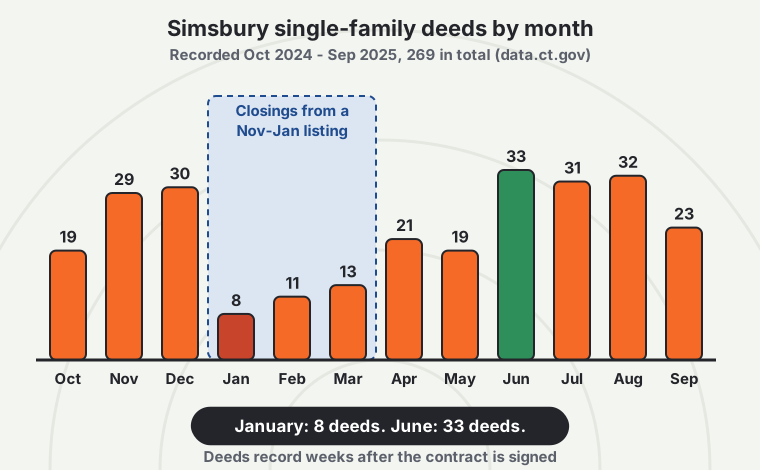
Simsbury’s calendar matters here. In the last year only 8 Simsbury single-family deeds were recorded in January 2025 and 11 in February, against 33 in June and 32 in August. Deeds record weeks after the contract is signed, so the sales from a 90-day listing that runs from November to January mostly record in January to March: Simsbury’s three slowest months, with 8, 11 and 13 single-family deeds. If you list in late fall, either accept a term that reaches into spring, or agree a short first term with a clear option to extend.
4. List price and price changes
The list price is written in, and any change should be a signed amendment. Ask for the date of the first price review to be written into the agreement or the marketing plan.
5. Compensation: how much, and when it is earned
The agreement must carry the notice that the amount or rate “is not fixed by law” and “may be negotiable”, in at least 10-point bold or otherwise prominent type (CGS 20-325b). Read three things in this clause:
- The amount. A rate or a flat dollar figure. In Simsbury, each 1% on a $510,000 sale is $5,100.
- The buyer’s agent. Since August 17, 2024, how much, if anything, you offer a buyer’s agent is a separate, negotiated term. Write your policy down.
- When it is earned. Some forms say the fee is earned when a “ready, willing and able” buyer is found, even if the sale never closes. Ask for the fee to be payable only if and when the sale closes and title passes.
Rates, the 2024 rules and negotiating tactics are covered in our real estate commission guide, so we will not repeat them here.
6. The protection (extender) period
This clause says you still owe the fee if, within a set time after the listing ends, you sell to a buyer who learned of the house during the listing. It protects the agent from a seller who waits out the term to skip the fee. That is fair; a long tail covering any buyer is not. Negotiate it to a short period, limited to buyers the agent actually introduced and named to you in writing at the end of the term, and ending if you list with another broker.
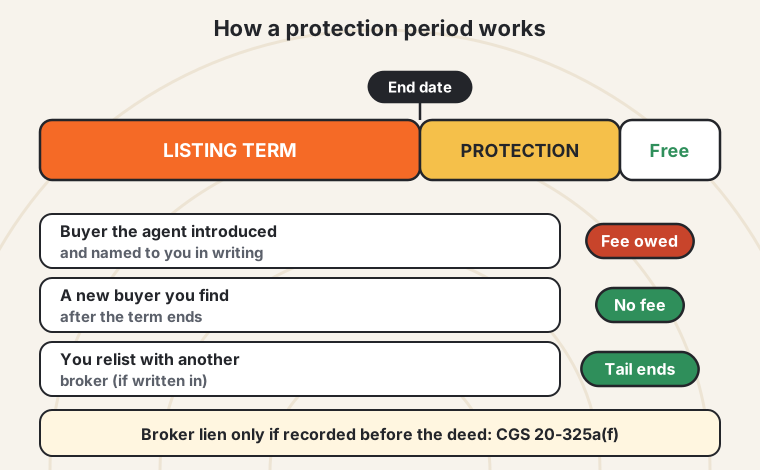
Why it matters in Connecticut: a broker with a written contract has a lien on the property for the agreed fee (CGS 20-325a(e)). It attaches only when the broker is entitled to the fee with no contingencies other than closing, and only if the broker records the claim with the Simsbury town clerk before the deed to the buyer is recorded (CGS 20-325a(f)). A recorded claim can hold up your closing until it is resolved. Every Connecticut listing must warn you about this in capital letters (CGS 20-325a(b)(6)).
7. Cancellation and withdrawal
Ask two questions. Can I end the listing early if I am unhappy, and on what notice? And what do I owe if I take the house off the market without selling? Some forms allow a “withdrawal” that is not a “release”, so the agreement and its protection period stay alive. Ask for a written early-release clause: for example, either side may end the listing on written notice after a set number of days, with or without a stated fee.
8. Agency, dual agency and confidentiality
By your first personal meeting, the agent must have explained in writing the types of agency available and told you not to share confidential information until you have a written agreement (CGS 20-325d(b)). If the same brokerage might also represent a buyer, the agreement should say how: dual agency needs your informed written consent on the statutory form (CGS 20-325g), and the firm may instead appoint designated agents, one for you and one for the buyer (CGS 20-325i). You can decline dual agency, and if you accept it you may want to negotiate the fee.
9. Marketing, access and the smaller clauses
- Marketing: MLS entry date, photos, floor plan, open houses, signs. Attach the plan you were promised.
- Access: lockbox, showing notice, pets, and rules if anyone else lives there.
- Your duties: answering the DCP Residential Property Condition Report truthfully (CGS 20-327b), and the federal lead paint disclosure for homes built before 1978; the median Simsbury single-family home was built in 1969.
- Deposits: if the broker holds a buyer’s deposit, it goes into an escrow account within three banking days of the agreement being signed by everyone (CGS 20-324k).
- Your copy: a licensee must give you a copy of any instrument you sign immediately (CGS 20-320(a)(7)).
What should a Simsbury seller change before signing?
Before signing, a Simsbury seller should check that every owner signs, the end date suits the season, there is no automatic renewal, the fee is a clear amount payable only at closing, the buyer-agent policy is written, the protection period is short and limited to named buyers, there is an early-release clause, and dual agency is either declined or agreed on the statutory form. Then have your attorney read it.
- Every owner on the deed signs, or the signer’s authority is confirmed by your attorney
- Exclusions are written in for any buyer you already know
- A fixed end date that suits Simsbury’s season, with no automatic renewal
- A dated price review written into the plan
- A clear fee, payable only if the sale closes
- Your buyer-agent policy written down
- Protection period short, limited to named buyers, and ending if you relist elsewhere
- Early-release clause and what you owe if you withdraw
- Dual agency declined or agreed on the statutory consent form
- Marketing plan attached; you keep a signed copy
What happens after you sign is in our guide to what a listing agent does week by week.
How much would you walk away with?
Slide the numbers to match your house. It works in your browser; nothing is saved or sent.
Estimates for planning. Conveyance tax per CGS 12-494 (state 0.75% up to $800,000, 1.25% to $2.5M, 2.25% above, plus the town rate). Seller attorney about $1,200 to $1,500; flat-fee MLS about $400; listings include three months of taxes, insurance and utilities, a cash sale about two weeks. Your attorney gives you the final numbers.
When should a Simsbury seller not sign a listing agreement at all?
A Simsbury seller should not sign a listing agreement when the house cannot pass a mortgage buyer’s inspection and appraisal without repairs they cannot fund, when they need a firm closing date, or when they already have a buyer. In those cases selling by owner or a direct sale can make more sense. If the house is in good shape and time is not an issue, listing usually nets the most.
Plainly: you should not sell to a cash buyer like us if your Simsbury house is updated, you have a few months, and a good agent can sell it at full market price. Even after commission, listing will usually leave you with more. Cash offers are lower because the buyer covers repairs, carrying costs and risk; see why cash offers are lower.
If you already have a buyer, such as a neighbor or a tenant, you may not need a listing at all; see selling without a realtor in Connecticut. And if the house needs work a lender will flag, or you cannot face months of showings, a direct sale skips the agreement, the commission and the showings, with a closing on your date, typically in about two weeks. Our cash buyer vs. realtor guide shows how to compare the two nets, our guide to every route to sell a house in Connecticut lays out the rest, and you can ask for a written number on our Simsbury page.

When a seller calls me in the middle of a listing that is not working, the first thing I ask for is the agreement, and the first things I read are the end date and the protection clause. Most of the stress I see comes from those two lines. Read them before you sign, not after.
How do you negotiate and sign a listing agreement in Simsbury?
To negotiate and sign a listing agreement in Simsbury, ask for the blank form before the listing meeting, mark up the term, fee, protection period, cancellation and dual agency clauses, agree changes with the agent in writing, have your Connecticut attorney review the final version, and sign only after every owner is ready. Keep your copy and the attached marketing plan.
Get the form early
Ask each agent you interview to send their blank listing agreement in advance, so you read it without anyone waiting.
Mark the eight clauses
Use the clause list above. Write your changes in the margin: dates, fee, protection period, release terms.
Negotiate in writing
Ask the agent to put agreed changes into the form or an addendum, signed by the broker or the broker’s authorized agent.
Attorney review
You will need a Connecticut attorney for the closing anyway (CGS 51-88a); ask them to read the agreement before you sign.
Sign with every owner
All owners sign. Keep the copy the agent must give you immediately.
Track the dates
Put the price review date, end date and protection period end in your calendar.
See the house together.
Pick a time that works.
Choose a time for us to walk through the property with you, or ask for a quick call first. We confirm every request personally.
Tuesday, January 13
No open times in the next few weeks. Please call us.
We will confirm by email. Nothing is booked until we do.
View my requestQuestions Simsbury sellers ask about listing agreements
What has to be in a listing agreement in Connecticut?
A Connecticut listing agreement has to be in writing, name the broker and address and the owners, show the date and its conditions, be signed by the broker and the owner, include the statement that the broker may be entitled to lien rights under CGS 20-325a, and carry the notice that the commission is not fixed by law (CGS 20-325b).
How long is a typical listing agreement in Simsbury?
There is no legal standard length for a listing agreement in Simsbury or anywhere in Connecticut; you and the brokerage agree the term. Pick it with the season in mind: Simsbury recorded only 8 single-family deeds in January 2025 against 33 in June. The agreement cannot renew itself automatically past a fixed end date (CGS 20-320(a)(6)).
Can I cancel a listing agreement in Connecticut?
You can cancel a Connecticut listing agreement on the terms it allows: at the end date, by mutual written release, or under an early cancellation clause. Check what you owe if you withdraw the house and whether the protection period survives. Talk to your attorney before signing with anyone else.
What is a protection period in a listing agreement?
A protection period is a set time after the listing ends during which you still owe the fee if you sell to a buyer who learned of the house during the listing. Negotiate it to a short period, limited to buyers the agent introduced and named to you in writing, and ending if you list with another broker.
Can a real estate broker put a lien on my house in Connecticut?
Yes, a Connecticut broker with a written contract can have a lien for the agreed fee (CGS 20-325a(e)). It only attaches once the broker is entitled to the fee with no contingency other than closing, and only if the claim is recorded with the town clerk before the property is conveyed (CGS 20-325a(f)).
Who has to sign the listing agreement if two people own the house?
If two people own the house, both should sign the listing agreement. For homes of up to four units, Connecticut requires the owner’s signature, or an agent’s signature under a document executed like a deed (CGS 20-325a(b)(7)). Executors, trustees and agents under a power of attorney should confirm their authority with an attorney first.
Do I owe a commission if the buyer backs out?
Whether you owe a commission if the buyer backs out depends on the compensation clause. Some forms say the fee is earned when a ready, willing and able buyer is found. Ask for the fee to be payable only if the sale actually closes and title passes, and have your attorney check the wording.
Is West Simsbury a separate town?
No, West Simsbury is not a separate town; it is a village in the Town of Simsbury. Sales data, the mill rate and the town conveyance tax are Simsbury’s, and land records are kept by the Simsbury town clerk.
Related Connecticut guides
Working with agents
Start with the big picture in how to sell a house in Connecticut.
Plain-English information, not legal advice. Brokerage forms differ; have your Connecticut attorney review your listing agreement before you sign.
Sources (checked on October 27, 2026)
- CGS Chapter 392: § 20-320(a)(6)-(7) (no automatic renewal; copies of instruments), § 20-324k (escrow), § 20-325a (written contract, contents, signatures, broker lien), § 20-325b (commission notice), § 20-325d (agency disclosure), § 20-325g (dual agency consent), § 20-325i (designated agents), § 20-327b (condition report).
- data.ct.gov Real Estate Sales dataset (5mzw-sjtu): Simsbury deeds recorded October 2024 to September 2025.
- CT OPM mill rates on data.ct.gov (Simsbury, fiscal 2027).
- CGS § 12-494 (conveyance tax).
- CGS § 51-88a (attorneys and closings).
- NAR settlement FAQs (practice changes effective August 17, 2024).

Who wrote this
Jerryll Noorden
Jerryll has bought and sold Connecticut houses since 2016 and has sat at more closing tables than he can count, on both sides. Before real estate he was a robotics scientist at NASA, IHMC and IIT. He wrote this guide because the national sites that rank for it skip the Connecticut rules that cost sellers money. When listing or selling it yourself would get you more than a cash offer, he says so.
This guide explains Connecticut rules in plain English. It is not legal or tax advice. Laws change; for your sale, talk to a Connecticut real estate attorney and a tax professional.
