
Key facts at a glance
The Guilford and Connecticut numbers behind this guide. This page is one chapter of our guide to how to sell a house in Connecticut.
| Fact | Number | Source |
|---|---|---|
| Guilford single-family median sale price | $606,000 | Town sales data, Oct. 2024 to Sep. 2025 (public sales records) |
| Conveyance tax on the median sale (0.75% state + 0.25% Guilford) | $6,060 | CGS 12-494 |
| Property tax on the median house, fiscal 2027 (28.4 mills) | About $12,050 a year, $1,000 a month | OPM mill rates; CGS 12-62a |
| New flood questions on the seller’s disclosure report | 6, in a “Flood Risk Awareness” section, since July 1, 2025 | Public Act 25-33, sec. 3; CGS 20-327b |
| Coastal boundary, where coastal site plan review applies | 100-year coastal flood zone or 1,000 feet from mean high water or tidal wetlands, whichever is farther inland | CGS 22a-94, 22a-105 |
| Guilford septic pump-out rule | At least once every 5 years, with a town permit | Town of Guilford code (septic pump-out ordinance) |
| Guilford single-family sales recorded June to August | 80 of 242 (33%) | OPM sales data on data.ct.gov, our count |
How do you sell a house by owner in Guilford, CT?
To sell a house by owner in Guilford, CT, you follow the same Connecticut steps as anywhere (attorney, disclosures, MLS listing, showings, contract, closing), plus four shoreline jobs: answer the six new flood questions on the disclosure report honestly, gather your septic pump-out and permit records, check whether past work near the water needed coastal approvals, and time your listing for the summer buyers who close most Guilford sales.
The general how-to is already written: our guide to selling a house without a realtor in Connecticut walks through all ten steps, from hiring an attorney to closing day. This page does not repeat it. It covers what is different when the house is in Guilford, a shoreline town where flood maps, septic systems, coastal rules and a summer market shape the sale.
Why this matters more when you sell by owner: with an agent, someone else usually spots these issues and tells you what buyers will ask. Selling by owner, you are that someone. A buyer’s agent will raise the flood zone, the septic and the permits; you want the answers in a folder before they ask.
Why does selling a shoreline house yourself feel risky?
Selling a shoreline house yourself feels risky because the questions buyers ask about water, flood insurance, septic systems and permits sound technical and legal, and a wrong answer could cost you the sale or invite a dispute later. Owners feel proud of the house, protective of its value, nervous about the flood questions and unsure what they must disclose. Knowing the rules ahead of time takes most of that fear away.
Maybe you have owned a cape a few streets from the water for twenty years and lived through the big storms. Maybe you inherited a cottage your parents bought when shoreline houses were cheap. Either way, you are proud of it and protective of what it is worth.
And you may feel nervous about the new flood section of the disclosure form, afraid that admitting a wet basement or a past flood claim will scare buyers away, and unsure whether the deck or the bulkhead your father built ever had a permit. Some owners feel tempted to say “unknown” to everything. Others are simply determined to do it right and keep the commission.
This page is for you. Disclosing a flood zone does not kill a Guilford sale; the shoreline market is full of buyers who expect flood questions. What hurts a sale is a surprise. Below is how to answer each shoreline question before a buyer’s agent asks it.
What flood questions does a Connecticut seller have to answer in 2025 and 2026?
Since July 1, 2025, a Connecticut seller has had to answer six flood questions on the Residential Property Condition Report, added by Public Act 25-33: whether the property is in a FEMA floodplain and which zone, whether past federal or state flood assistance was received, whether a flood insurance policy is in force, whether an elevation certificate exists, whether a flood claim was ever filed, and whether any structure has had water penetration or flood damage.
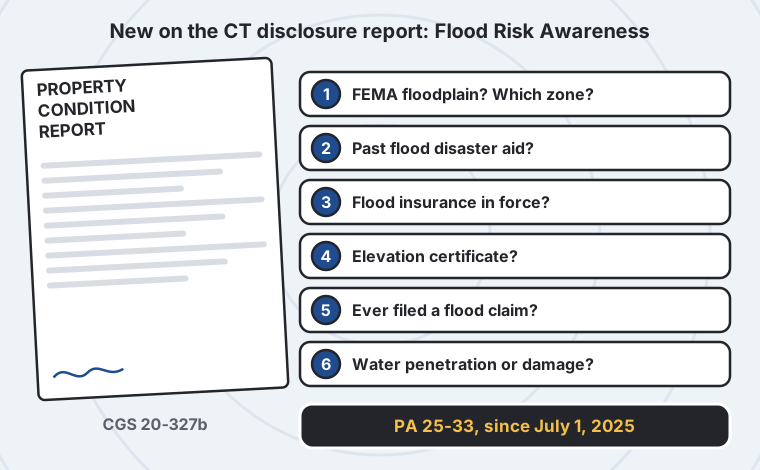
We checked the act itself. Section 3 of Public Act 25-33 amended CGS 20-327b to add a “Flood Risk Awareness” subsection to the report, effective July 1, 2025. Section 4 added a notice to the form explaining that federal law requires flood insurance on homes in a Special Flood Hazard Area financed with a federally regulated or insured mortgage, that the requirement can follow the property to future owners if past owners took federal disaster aid, and that FEMA maps are not a reliable guide to a property’s full flood risk.
| Question on the report | Where to find your answer |
|---|---|
| Is the property in a FEMA designated floodplain? Which zone? | FEMA’s Flood Map Service Center (enter your address), or your flood insurance declarations page |
| Did you, or any previous owner you know of, receive federal or state flood disaster assistance? | Your own records; aid often carries a requirement to keep flood insurance |
| Is a flood insurance policy in force? | Your insurer or mortgage escrow statement |
| Is a FEMA elevation certificate available? | Your closing file, insurer, or the town building department |
| Have you ever filed a flood damage claim? | Your insurer’s claim history |
| Has any structure had water penetration or damage from seepage or a natural flood? | What you know: a wet basement counts |
The rest of the report is unchanged in principle: you deliver it before the buyer signs the contract, or you credit the buyer $500 at closing (CGS 20-327c). Our guide to the Connecticut property condition disclosure covers every other section and what “to the best of your knowledge” means.
A buyer whose lender sees a high-risk flood zone will be required to buy flood insurance. If your house has a current elevation certificate and a flood policy, give both to buyers up front: the buyer’s insurance quote is often the deciding number, and you want it to come early, not after the inspection.
What septic records do Guilford buyers ask for?
Guilford buyers ask for the septic system’s location, size and age, the last pump-out date, any repair or replacement permits, and the result of any inspection. Guilford’s town code requires septic tanks to be pumped at least once every five years, with a town permit for each pumping and a record kept by the town’s Water Pollution Control Authority, so much of that history may already exist at Town Hall.
If your Guilford house is on a septic system, gather three things before you list:
- Your last pump-out receipt or permit copy (the hauler is required to give you one)
- The septic permit and as-built drawing from the town health department, if the system was installed or repaired with a permit
- Any inspection report, yours or a past buyer’s
Septic systems in Connecticut are regulated under the Public Health Code (section 19-13-B103) and its technical standards, and in Guilford no system may be built, altered or repaired without a sanitary permit from the town health director. A buyer’s inspector may want the tank pumped and inspected; budget about $500 to $1,000 (est.) for an inspection with pumping. If you know of a problem, it goes on the disclosure report. Our guide to oil tanks, septic, wells and radon prices the common repairs.
Do coastal rules affect selling a house in Guilford?
Coastal rules affect selling a house in Guilford mainly through permits, not the sale itself. A sale needs no coastal approval. But within the coastal boundary, defined as the 100-year coastal flood zone or 1,000 feet from mean high water or tidal wetlands, many zoning applications require coastal site plan review (CGS 22a-94, 22a-105). Buyers who plan to expand, elevate or rebuild will ask what was permitted.
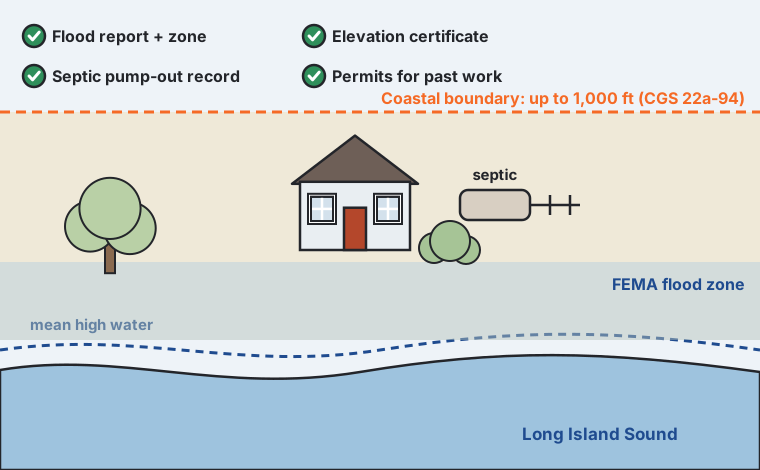
Here is how the coastal rules show up in a by-owner sale:
- Past work. A buyer’s attorney or inspector may ask whether additions, decks, seawalls or docks were permitted. Collect the zoning and building permits you have. If something was built without one, tell your attorney before you list; it is a disclosure and negotiation question, not a reason to hide the house.
- Work below the high tide line. Shoreline flood and erosion control structures such as seawalls are subject to additional state standards (CGS 22a-109, referring to 22a-359 to 22a-363), handled through the state’s Department of Energy and Environmental Protection.
- The buyer’s plans. If a buyer wants to raise the house out of the flood zone or add a second floor, their architect will deal with coastal site plan review. You do not need to solve it, but knowing your zone and having your elevation certificate makes their homework faster and keeps the deal moving.
When do Guilford houses sell, and who are the buyers?
Guilford houses sell most in summer: in the state’s sales records, 80 of the 242 single-family sales recorded from October 2024 to September 2025 (33%) were recorded in June, July and August, with July the busiest month at 33 and February the quietest at 9. Because closings follow contracts by a month or two, a by-owner seller who wants summer buyers should be ready to list in spring.

Shoreline towns draw a mix of buyers: local families moving up, people relocating along the shoreline commuting corridor, retirees, and some buyers looking for a second home near the water. Buyers looking from farther away often shop online first and visit on weekends. For a by-owner seller, three things follow:
- Be on the MLS. Out-of-town buyers search through their agents and the big portals; a yard sign alone will not reach them. A flat-fee MLS listing does.
- Show the setting. Daylight photos of the yard, the water view or the walk to the beach, and the flood and septic facts in the listing, answer the first questions before the call.
- Be available on weekends. If you cannot show the house on Saturdays in June, a by-owner sale in Guilford will be harder.
More on timing is in our guide to the right time to sell a Guilford house.
What does selling by owner save on a Guilford house?
Selling by owner saves about $14,000 on the $606,000 Guilford median in our example (est.): the listing agent’s share at an example 2.5%, $15,150, minus about $1,200 of your own costs for an MLS listing, photos, a sign and a pre-listing inspection. The $6,060 conveyance tax, your attorney and any pay to the buyer’s agent stay the same either way.
Each month on the market costs about $1,000 of property tax on the median house at Guilford’s 28.4 mills, plus insurance (and flood insurance, if you carry it) and utilities. If a by-owner listing misses the summer and runs into the fall, those months come off your saving. The saving is also only about 2.3% of the price, so a by-owner sale that ends about $14,000 lower than an agent’s sale saves nothing. Whether that trade suits you is the subject of our FSBO pros and cons scorecard; our cash buyer vs. realtor comparison works the net for each route.
If your Guilford house is in good shape and you can list for the spring and summer market, list it, yourself or with an agent. You will very likely net more than a cash offer, including ours. A direct sale fits a house with flood damage, a failing septic, open permit problems, or an owner who needs a fixed date or cannot run summer showings. If listing nets more, we will tell you.
How do you prepare a Guilford shoreline house for a by-owner sale?
To prepare a Guilford shoreline house for a by-owner sale, hire your attorney, look up your FEMA flood zone, gather your flood insurance and elevation certificate, pull your septic records, collect permits for past work, complete the disclosure report including the flood section, and plan to list in spring. Then follow the standard Connecticut by-owner steps.
Hire a Connecticut real estate attorney
Before you take offers. Ask about any permit or flood issues you already know about.
Build the flood file
FEMA zone from the Flood Map Service Center, flood policy declarations, elevation certificate if one exists, and any claim history.
Build the septic file
Last pump-out permit copy, septic permit and drawing from the health department, and any inspection report.
Collect permits
Building and zoning permits for additions, decks, docks or seawalls. Note anything built without one and tell your attorney.
Complete the disclosure report
All sections, including the six flood questions. Deliver it before the buyer signs.
List for the season
Aim to be on the MLS in spring, with daylight photos and the flood and septic facts in the listing.
If after all this you would rather not run summer showings, you can ask for a written number on our Guilford page. No obligation and no expiry pressure.
Questions about selling by owner in Guilford, CT
Can I sell my house by owner in Guilford, CT?
Yes, you can sell your house by owner in Guilford, CT. No law requires an agent. You still need a Connecticut attorney for the closing (CGS 51-88a), the Property Condition Disclosure Report with its new flood section, and the smoke and carbon monoxide affidavit.
Do I have to disclose that my Guilford house is in a flood zone?
Yes, you have to disclose whether your Guilford house is in a FEMA floodplain, and which zone, on the property condition report. Public Act 25-33 added that question and five others about flood aid, insurance, elevation certificates, claims and water damage, effective July 1, 2025.
What happens if I do not give the buyer the disclosure report?
If you do not give the buyer the disclosure report before they sign, you credit the buyer $500 at closing (CGS 20-327c). The credit does not protect you if you knew about a defect, such as past flooding, and hid it.
Will a flood zone stop buyers from getting a mortgage?
A flood zone does not stop buyers from getting a mortgage, but in a Special Flood Hazard Area a federally regulated or insured loan requires flood insurance. The cost of that policy can change what a buyer will pay, so an elevation certificate and your current premium help.
How often must a septic tank be pumped in Guilford?
A septic tank in Guilford must be pumped at least once every five years under the town code, with a town permit for each pumping and a record kept by the Water Pollution Control Authority. Check with the town for the current rule and your property’s records.
Do I need coastal approval to sell a house near the water in Guilford?
No, you do not need coastal approval to sell a house near the water in Guilford. Coastal site plan review applies to certain zoning applications inside the coastal boundary (CGS 22a-105), so it matters for past or future building work, not for the sale.
What is the best time to sell a house by owner in Guilford?
The best time to sell a house by owner in Guilford is usually spring, so you are under contract before the summer peak. In state sales records, 33% of Guilford single-family sales from October 2024 to September 2025 were recorded in June, July and August.
What is the conveyance tax on a Guilford house?
The conveyance tax on a Guilford house is 1% of the price under $800,000: 0.75% to the state plus 0.25% to Guilford (CGS 12-494). On the $606,000 median that is $6,060, paid by the seller at closing.
Can I sell a flood-damaged Guilford house as-is?
Yes, you can sell a flood-damaged Guilford house as-is, either listed at a price that reflects the damage or to a direct buyer. You must still disclose the damage you know about on the report. Financed buyers may struggle with active damage; cash buyers usually do not.
Related Connecticut guides
- How to sell a house without a realtor in Connecticut (the 10 steps)
- FSBO pros and cons in Connecticut
- FSBO costs: the Orange budget worksheet
- Selling by owner in rural Easton
- The Connecticut property condition disclosure
- Cash buyer vs. realtor in Connecticut: which nets more
- How to sell a house in Connecticut: every route
For the big picture, see how to sell a house in Connecticut. We buy houses in Guilford and along the shoreline in Madison and Branford.
Plain-English information, not legal advice. Check flood zones, permits and septic rules for your own property with the town and your attorney. Amounts marked (est.) are estimates.
Sources (checked on October 27, 2026)
- Public Act 25-33, sections 3 and 4 (flood questions and flood insurance notice on the property condition report, effective July 1, 2025).
- CGS §§ 20-327b and 20-327c (property condition report; $500 credit).
- Department of Consumer Protection, Residential Property Condition Report.
- CGS §§ 22a-94, 22a-105 and 22a-109 (coastal area, coastal boundary, coastal site plan review).
- FEMA Flood Map Service Center.
- Connecticut Department of Public Health, subsurface sewage (septic) program (Public Health Code 19-13-B103).
- Town of Guilford code, septic pump-out ordinance (eCode360).
- CGS § 12-494 (conveyance tax) and OPM mill rates (fiscal 2027).
- Connecticut OPM real estate sales data (Guilford single-family sales recorded Oct. 2024 to Sep. 2025, queried Oct. 27, 2026).
- Town median, sales count, year built and heating fuel: our town data compiled from public sales records and town parcel data.

Who wrote this
Jerryll Noorden
Jerryll has bought and sold Connecticut houses since 2016 and has sat at more closing tables than he can count, on both sides. Before real estate he was a robotics scientist at NASA, IHMC and IIT. He wrote this guide because the national sites that rank for it skip the Connecticut rules that cost sellers money. When listing or selling it yourself would get you more than a cash offer, he says so.
This guide explains Connecticut rules in plain English. It is not legal or tax advice. Laws change; for your sale, talk to a Connecticut real estate attorney and a tax professional.
