
Key facts at a glance
This page is part of our guide to how to sell a house in Connecticut. It answers one question: can you sell without spending money upfront, and what still comes out at closing? Sandy Hook is a village of Newtown, so the numbers below are Newtown’s.
| Fact | Number | Source |
|---|---|---|
| Newtown residential sales, Oct 2024 to Sep 2025 | 385; median $610,000 (single-family $625,000) | CT OPM Real Estate Sales, data.ct.gov |
| Newtown mill rate, fiscal 2027 | 29.26 mills: about $1,067 a month on $625,000 | CT OPM mill rates; CGS 12-62a |
| Newtown property tax due dates | July and January installments | Town of Newtown Tax Collector |
| Conveyance tax when you sell in Newtown | 1% (0.75% state + 0.25% town): $6,250 on $625,000, paid at closing | CGS 12-494 |
| Credit if you skip the condition report | $500, credited to the buyer at closing | CGS 20-327b, 20-327c |
| Smoke and CO detector affidavit | Required, signed by the seller at closing; no credit option | CGS 29-453 (as amended by PA 23-164) |
| Most a buyer’s lender lets a seller pay toward closing costs | 3%, 6% or 9% of the price, by down payment (owner-occupied) | Fannie Mae Selling Guide B3-4.1-02 |
Why does selling feel impossible when you have no cash to spare?
Selling feels impossible when you have no cash to spare because every piece of advice seems to start with spending: fix the roof, paint, stage, hire someone. Owners in this spot often feel embarrassed, stuck, worried they will be judged for the house’s condition, and afraid of signing up for costs they cannot pay. Most of those costs, it turns out, are optional or paid at closing.
Maybe the house in Sandy Hook or Botsford needs a roof and new carpet, and your savings went to a medical bill or a divorce. Maybe it was your parents’ colonial and the estate account is nearly empty. Every “to do” list adds up to money you do not have.
I am Jerryll Noorden. I have bought houses across Connecticut since 2016, about ten a year, for cash. I will show you every way to sell without spending money upfront, including the ones that do not involve me, and exactly what still has to be paid at closing, so there are no surprises.
If you own a house in Newtown and cannot or will not put more money into it before you sell, this page is for you.
Can you sell a house in Connecticut without spending money upfront?
Yes, you can sell a house in Connecticut without spending money upfront, because nearly every selling cost is taken out of the sale price at closing: the commission, the 1% conveyance tax (CGS 12-494), your attorney’s fee and the mortgage payoff. The money you may still spend before closing is the monthly cost of owning the house until then, plus small items such as smoke detectors.
The costs that require cash before closing are mostly choices: repairs, painting, staging, a pre-listing inspection, a flat-fee MLS service. You can skip all of them. But “no money upfront” is not “no cost”: every route that saves cash now costs something at the closing table, usually a lower price. The rest of this page shows how much, with Newtown numbers. For a full list of every seller cost in the state, see our guide to closing costs in Connecticut.
Which selling costs come out at closing and which come out of your pocket first?
The selling costs that come out at closing in Connecticut are the commission, the conveyance tax, your attorney’s fee, the mortgage payoff, the property tax credit to the buyer and any credits you agreed to. The costs that come out of your pocket first are repairs, cleaning, staging, any flat-fee listing service, and the mortgage, tax, insurance and utility bills you keep paying until the closing day.
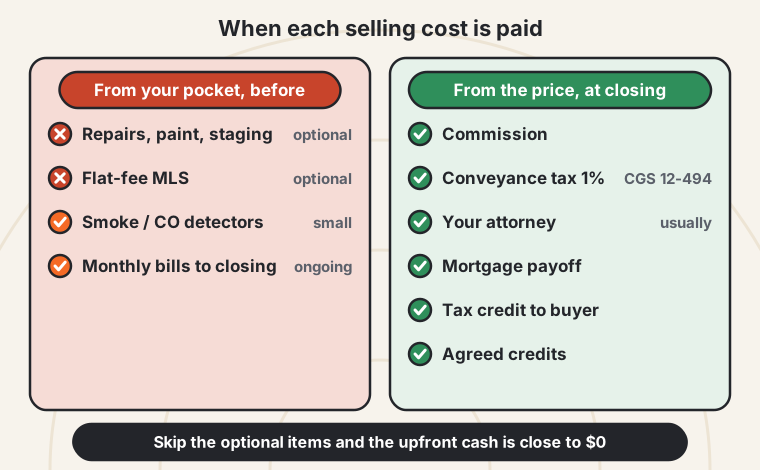
| Cost | When it is paid | Cash upfront? |
|---|---|---|
| Listing and buyer’s agent commission | At closing, from the price (set in your listing agreement) | No |
| Conveyance tax, 1% in Newtown (CGS 12-494) | At closing, before the deed is recorded | No |
| Your attorney’s fee (about $1,000 to $1,500, est.) | Usually at closing; ask when you hire them | Usually no |
| Mortgage and any home equity line payoff | At closing, from the price | No, if the price covers it |
| Property tax credit to the buyer | At closing, as a credit | No |
| Condition report ($0 form) or $500 credit (CGS 20-327c) | Report before the buyer signs; credit at closing | No |
| Smoke and CO detectors for the affidavit (CGS 29-453) | Before closing, if detectors are missing | Small (est. $25 to $50 per detector) |
| Repairs, paint, cleaning, staging | Before listing | Yes, but optional |
| Flat-fee MLS listing service | Often when you sign up | Yes, if you choose it |
| Mortgage, tax, insurance, utilities until closing | Every month you own the house | Yes, ongoing |
Two items work in your favor at closing. If you heat with oil, as about 81% of Newtown single-family houses do (assessor data), the buyer customarily reimburses you for the oil left in the tank. And if you prepaid a tax installment that covers days after the closing, the credit runs the other way. Newtown bills real estate tax in July and January installments, so your attorney prorates whichever has been paid.
What are the four ways to sell a house with no money upfront?
The four ways to sell a house with no money upfront are: list it as-is with an agent and pay the commission from the price; list it and offer a credit at closing instead of doing repairs; sell it as-is to a cash buyer who pays all their own costs; or sell by any route while insisting that every fee is paid from the proceeds at closing. Each saves cash now and costs something in price.
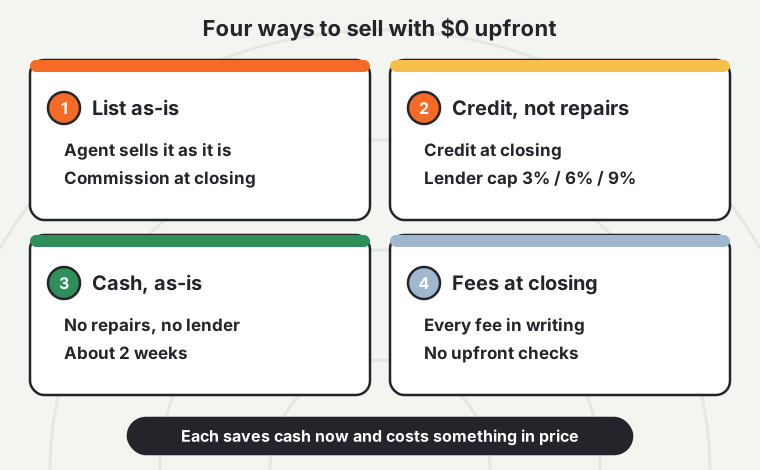
List as-is with an agent
You list the house in its current condition and price it for that condition. The commission comes out of the price at closing. Buyers with mortgages can still buy, unless the house has a problem their lender will not accept, such as a failing roof, no working heat or a safety issue. Our guide to selling a house as-is in Connecticut covers the disclosures and the pricing.
Give a credit instead of doing repairs
When the buyer’s inspection finds problems, you offer a price reduction or a credit at closing instead of paying a contractor now. The buyer’s lender usually allows a seller credit toward the buyer’s closing costs up to 3%, 6% or 9% of the price for an owner-occupied home, depending on the down payment (Fannie Mae B3-4.1-02), and many lenders will not accept a credit labelled for repairs, so it is usually written as a closing-cost credit or a lower price. Your attorney and the agents word it.
Sell as-is to a cash buyer
A direct buyer pays their own closing costs, needs no lender, takes the house with the repairs and the belongings, and usually closes in about two weeks. There is no commission. The trade is a lower price; see why cash offers are lower.
Insist that every fee is paid at closing
Whatever route you take, ask every professional in writing: when are you paid? A legitimate agent, attorney or buyer is paid from the closing. Anyone who wants an upfront fee to “market” your house or “guarantee” an offer is a red flag; see we buy houses scams and red flags.
There is also a fifth structure for a house that needs work: a fix-and-list partnership, where a buyer pays for repairs and the house is sold on the open market, with the upside shared. Our page on the ways we buy houses explains how it works and when it makes sense.
What does each no-upfront route net on a Newtown house?
On a Newtown colonial worth $625,000 in good condition but needing about $30,000 of work, our example nets about $550,182 if you repair first (needing $30,000 upfront), $548,799 listing as-is, $560,299 listing with a $12,000 credit, and $492,991 selling as-is for cash in about two weeks. The three no-upfront routes need $0 before closing.
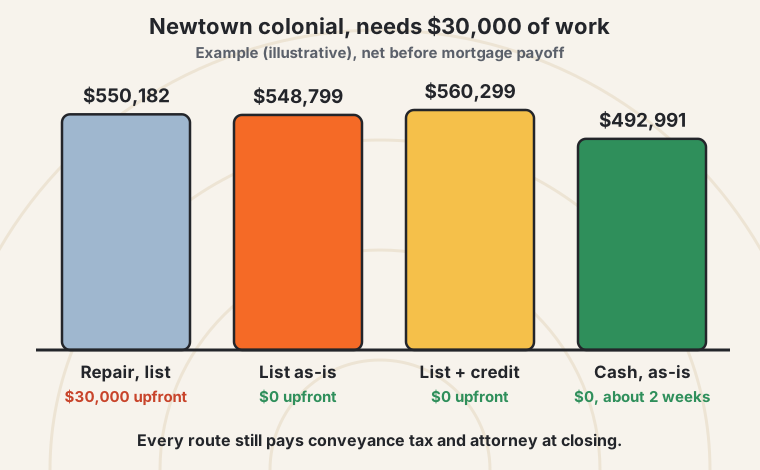
Example (illustrative). A 1970s Newtown colonial that would sell for the town’s $625,000 single-family median in good condition, but needs a roof, paint and flooring, about $30,000 of work (est.). Holding it costs about $1,517 a month: $1,067 of property tax at 29.26 mills plus $450 of insurance and utilities (est.), before any mortgage. The as-is price, the credit and the cash offer are examples, not quotes.
| Line | Repair, then list | List as-is | List with a credit | Cash, as-is |
|---|---|---|---|---|
| Price | $625,000 | $590,000 (est.) | $615,000 (est.) | $500,000 (example offer) |
| Credit to buyer at closing | $0 | $0 | -$12,000 | $0 |
| Commission, 5% total (est.) | -$31,250 | -$29,500 | -$30,750 | $0 |
| Conveyance tax, 1% | -$6,250 | -$5,900 | -$6,150 | -$5,000 |
| Your attorney (est.) | -$1,250 | -$1,250 | -$1,250 | -$1,250 |
| Repairs | -$30,000 | $0 | $0 | $0 |
| Holding at $1,517 a month | -$6,068 (4 months) | -$4,551 (3 months) | -$4,551 (3 months) | -$759 (half a month) |
| Net before mortgage payoff | $550,182 | $548,799 | $560,299 | $492,991 |
| Cash needed before closing | $30,000 + monthly bills | $0 + monthly bills | $0 + monthly bills | $0 + half a month of bills |
What the example teaches:
- Repairing first is not automatically the winner. Here it nets less than the credit route and about the same as listing as-is, while tying up $30,000 and an extra month. Our list of low-cost fixes before you sell shows which small jobs are worth it.
- The credit route has risks. The buyer’s appraisal must support the price, and a buyer can still ask for more after the inspection. The 3% cap on a buyer with a small down payment would be $18,450 here, so a $12,000 credit fits.
- The cash route costs about $56,000 to $67,000 of price in this example. It is worth that only if the monthly bills, the work, the showings or the uncertainty are worth more to you.
- The monthly bills are the real upfront cost. Three or four months at $1,517, plus your mortgage payment, have to come from somewhere. Our carrying-cost worksheet helps you add up your own.
Put your own numbers in, including your mortgage payoff:
How much would you walk away with?
Slide the numbers to match your house. It works in your browser; nothing is saved or sent.
Estimates for planning. Conveyance tax per CGS 12-494 (state 0.75% up to $800,000, 1.25% to $2.5M, 2.25% above, plus the town rate). Seller attorney about $1,200 to $1,500; flat-fee MLS about $400; listings include three months of taxes, insurance and utilities, a cash sale about two weeks. Your attorney gives you the final numbers.
What still has to be paid at closing when you sell in Newtown?
What still has to be paid at closing when you sell in Newtown is everything owed against the house and the sale: your mortgage and any home equity line, the 1% conveyance tax, your attorney, the commission if you listed, the property tax credit to the buyer, any agreed credits, and any liens or judgments. If the price does not cover all of it, you have to bring the difference.
The closing in Connecticut is run by attorneys (CGS 51-88a). Before the closing, your attorney orders the mortgage payoff letter, checks the town records for liens, and prepares a settlement statement showing every line. Read that statement before the closing day; it is the final answer to “what will I walk away with”. Our guide to the documents you need to sell lists what to gather.
Things Newtown sellers sometimes forget:
- The July and January tax installments. If you sell in June before the July bill is paid, the buyer gets a credit for your share instead. Either way you pay for the days you owned the house.
- The Borough of Newtown. The Borough is a separate taxing district with its own bill. If your house is inside it, there is a second tax line to prorate.
- Liens and old judgments. A contractor’s lien, an unpaid sewer use charge or a judgment against you can attach to the house and must be paid or released at closing.
- The smoke and CO affidavit. Since PA 23-164 there is no credit option: you sign the affidavit at closing (CGS 29-453). If detectors are missing, buy and install them before the closing day.
If you owe more than the house will sell for, a no-upfront sale is not possible without the lender’s agreement. That is a short sale, where the lender accepts less than the payoff. Our page on how a short sale works explains the steps.
When should you NOT sell your Newtown house to a cash buyer?
You should not sell your Newtown house to a cash buyer when an as-is listing or a credit at closing would also keep your upfront cost at zero, you can carry the monthly bills for about three months, and the house can pass a buyer’s lender. In our example that choice is worth about $56,000 to $67,000. Also walk away from any buyer who asks you for a fee.
More than half of Newtown’s single-family houses are colonials, with a median year built of 1974 (assessor data): the kind financed buyers look for. If yours needs cosmetic work, an as-is listing or a credit will usually net more than a cash offer. That is what I tell Newtown owners who call with a house like that.
A direct sale makes sense when no lender will finance the house as it is, when the monthly bills cannot be carried for three more months, when the house is full of belongings, or when you need a fixed date. See selling a house that needs repairs in Connecticut for how that works.

Ask every person you talk to the same question: “What do I pay you, and when?” The answer should always be “nothing until closing, and here it is in writing”. If anyone needs a check from you to get started, stop and call your attorney.
How do you sell your house with no money upfront, step by step?
To sell your house with no money upfront, get your mortgage payoff, estimate the price as-is, decide whether a lender could finance the house, choose an as-is listing, a credit or a cash sale, get every fee in writing as paid at closing, and read the settlement statement before you sign. Most of this takes a week; a cash closing typically takes about two weeks.
Know your payoff
Call your lender or check your statement for the payoff, plus any home equity line. Price minus payoff minus about 7% for selling costs (est.) is a rough net.
Price it as it is, not as it could be
Use recent Newtown sales of similar houses in similar condition. A dated colonial and a renovated one are different markets.
Check what a lender would flag
Roof, heat, water, electrical and safety items can stop a mortgage. If the house has one, a cash buyer or a repair credit the lender accepts are your realistic routes.
Choose the route and get fees in writing
Listing agreement, attorney engagement letter or purchase contract: each should say that payment happens at closing. Fill in the free condition report and check your smoke and CO detectors.
Read the settlement statement
Your attorney sends it before the closing. Every line should match what you agreed. If you want a direct offer to compare, our Newtown page is where to ask; our offers do not expire while you decide.
Questions about selling with no money upfront
Can I sell my house in Connecticut without paying anything upfront?
Yes, you can sell your house in Connecticut without paying anything upfront in most cases. The commission, conveyance tax, attorney and mortgage payoff come out of the price at closing. You still pay the monthly bills until closing, and small items such as missing smoke detectors.
Do I have to pay the real estate agent before the house sells?
You do not have to pay a real estate agent before the house sells under a normal listing agreement; the commission is paid from the sale price at closing. Some flat-fee or limited-service listings charge upfront, so read the agreement.
When is the conveyance tax paid when I sell in Newtown?
The conveyance tax is paid at closing when you sell in Newtown, from the sale price, before the deed is recorded. It is 1% on most homes: 0.75% state plus 0.25% town (CGS 12-494), or $6,250 on $625,000.
Can I give the buyer a credit instead of making repairs?
Yes, you can give the buyer a credit instead of making repairs, usually as a closing-cost credit or a lower price. The buyer’s lender caps seller-paid costs, for example at 3%, 6% or 9% of the price for an owner-occupied home (Fannie Mae), and some lenders will not accept a credit labelled for repairs.
What if I owe more on my mortgage than the house is worth?
If you owe more on your mortgage than the house is worth, you cannot sell without bringing money to closing unless the lender agrees to a short sale and accepts less than the payoff. Talk to your lender and a Connecticut attorney first.
Do I need to fix anything before selling my house in Newtown?
You do not need to fix anything before selling your house in Newtown if you sell as-is. You must still give the property condition report or a $500 credit (CGS 20-327b, 20-327c) and sign the smoke and CO detector affidavit at closing (CGS 29-453).
Is there still a $250 credit option for smoke detectors in Connecticut?
No, there is no longer a $250 credit option for smoke detectors in Connecticut. Since Public Act 23-164, the seller must sign the smoke and carbon monoxide detector affidavit at closing (CGS 29-453).
Is Sandy Hook part of Newtown for taxes and records?
Yes, Sandy Hook is a village of Newtown, so Sandy Hook houses pay Newtown’s mill rate, 29.26 for fiscal 2027, and their sales are recorded in Newtown’s land records. A house inside the Borough of Newtown also gets a Borough tax bill.
Related guides
Costs of selling
For the whole process from first step to closing, see how to sell a house in Connecticut.
Plain-English information, not legal or tax advice. The Newtown example uses public data and labelled estimates; your house and your numbers will differ.
Sources (checked on October 27, 2026)
- Connecticut OPM, Real Estate Sales (data.ct.gov dataset 5mzw-sjtu): Newtown residential sales recorded October 2024 to September 2025.
- Connecticut OPM mill rates (Newtown, fiscal 2027: 29.26).
- Town of Newtown, Tax Collector (July and January installments; Borough of Newtown billed separately).
- CGS § 12-494 (conveyance tax).
- CGS § 12-62a (assessment at 70% of market value).
- CGS §§ 20-327b, 20-327c (property condition report; $500 credit).
- CGS § 29-453 (smoke and carbon monoxide detector affidavit).
- CGS § 51-88a (closings conducted by Connecticut attorneys).
- Fannie Mae Selling Guide B3-4.1-02, interested party contributions.

Who wrote this
Jerryll Noorden
Jerryll has bought and sold Connecticut houses since 2016 and has sat at more closing tables than he can count, on both sides. Before real estate he was a robotics scientist at NASA, IHMC and IIT. He wrote this guide because the national sites that rank for it skip the Connecticut rules that cost sellers money. When listing or selling it yourself would get you more than a cash offer, he says so.
This guide explains Connecticut rules in plain English. It is not legal or tax advice. Laws change; for your sale, talk to a Connecticut real estate attorney and a tax professional.
