
Key facts at a glance
| Fact | Number | Source |
|---|---|---|
| Old Saybrook single-family sales, Oct 2024 to Sep 2025 | 142 arm’s-length sales, median $698,000 | data.ct.gov, OPM real estate sales (5mzw-sjtu), our count |
| Single-family closings from November to March | 100 of 263 (38.0%), median $553,500, vs $670,000 May to September | data.ct.gov, two sales years (Oct 2022 to Sep 2023, Oct 2024 to Sep 2025) |
| Single-family homes whose tax bill goes outside Old Saybrook | 23.1% (1,135 of 4,916); 6.8% outside Connecticut | 2025 Connecticut parcel (CAMA) data, our count |
| Old Saybrook single-family homes heated with oil / built before 1978 | 59% / 71% (median year built 1961) | 2025 parcel data |
| Flood questions on the seller’s disclosure report | Six, since July 1, 2025 | Public Act 25-33; CGS 20-327b |
| Septic pump-out and inspection in Old Saybrook | At least once every five years | Town Ordinance #75, on-site sewage disposal systems |
| Conveyance tax on an Old Saybrook sale | 1.0%: 0.75% state + 0.25% town (up to $800,000) | CGS 12-494 |
This guide is part of our walk-through of how to sell a house in Connecticut. It is for the owner of a shoreline house in Old Saybrook, often a summer place or a parent’s cottage, who wants to show it or hold an open house between October and April, including around the holidays. It covers how busy the off-season really is, how to show a house that has been winterized, the flood-zone questions off-season buyers ask, and what it costs to keep the house ready until it sells.
Can you show and sell a shoreline house in Old Saybrook in the off-season?
You can show and sell a shoreline house in Old Saybrook in the off-season. Over two recent sales years, 100 of 263 single-family closings (38.0%) happened from November to March. But an off-season showing needs a heated house, water that can be turned on for the inspection, and ready answers on flood zone, insurance and septic, because winter buyers are serious and they ask more.
The holidays are part of this. A buyer who walks through the week after Thanksgiving is rarely browsing. The decorations matter much less than the basics: a warm house, working plumbing, a clear path to the door and a folder of answers.
Why does selling a shoreline house in the off-season feel so hard?
Selling a shoreline house in the off-season feels hard because the house is at its least appealing and you are often not there. The beach is gray, the porch furniture is stored, the water may be shut off, and every storm brings a call about the roof or a flooded street. If the house was a family summer place, showing it in December can also feel like closing a chapter.
Many Old Saybrook owners live somewhere else: almost one in four single-family tax bills is mailed outside the town. Perhaps you drive down from the Hartford area on weekends, or you inherited your parents’ cottage near the beach and live out of state. Owners in this spot often feel torn about letting go of a family place, anxious about frozen pipes and storms, uncertain whether anyone buys in winter, worried that flood-zone questions will scare buyers off, and tired of managing a house from a distance.
That is a lot to carry. This page is for you if you want Old Saybrook’s real off-season numbers, a plain checklist for showing a winterized house, and honest options, including when to wait for spring.
How busy is Old Saybrook’s off-season housing market?
Old Saybrook’s off-season housing market is quieter but far from closed. From November to March, 100 single-family homes sold over two sales years, 38.0% of the total, at a $553,500 median, against 121 sales (46.0%) at $670,000 from May to September. October alone had 29 closings. Old Saybrook is less seasonal than many inland suburbs, where summer dominates.
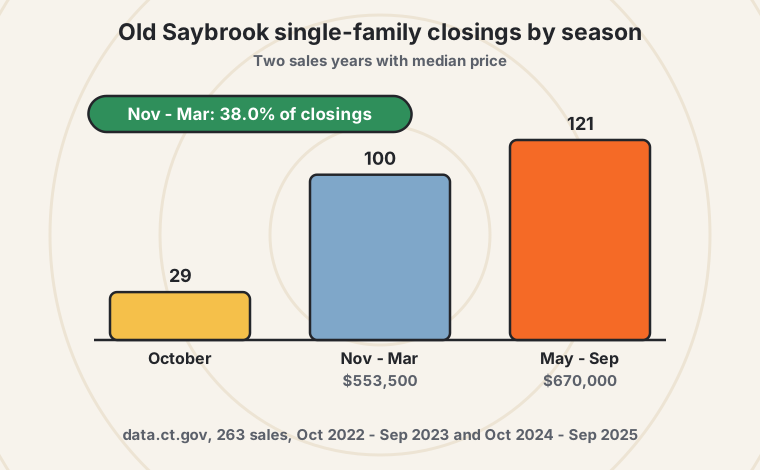
| Old Saybrook, single-family | Closings | Share | Median price |
|---|---|---|---|
| November to March | 100 | 38.0% | $553,500 |
| December to February | 55 | 20.9% | $586,000 |
| May to September | 121 | 46.0% | $670,000 |
| June to August | 74 | 28.1% | $717,500 |
| All months | 263 | 100% | $630,000 |
A note on the price gap. Part of it is which houses sell when: big waterfront houses tend to close in summer, smaller year-round houses close all year. The same house does not lose $116,500 by selling in winter. Still, the summer premium for a beach-season house is real, and a house that shines in July may be worth holding until then.
Statewide, more houses come up for sale every fall than a year earlier: Connecticut had 5,934 active listings in September 2026 against 5,323 in September 2025 (Realtor.com data via FRED). In winter, many sellers pull their listings. Those who stay face fewer rivals.
How do you show a seasonal house that has been winterized?
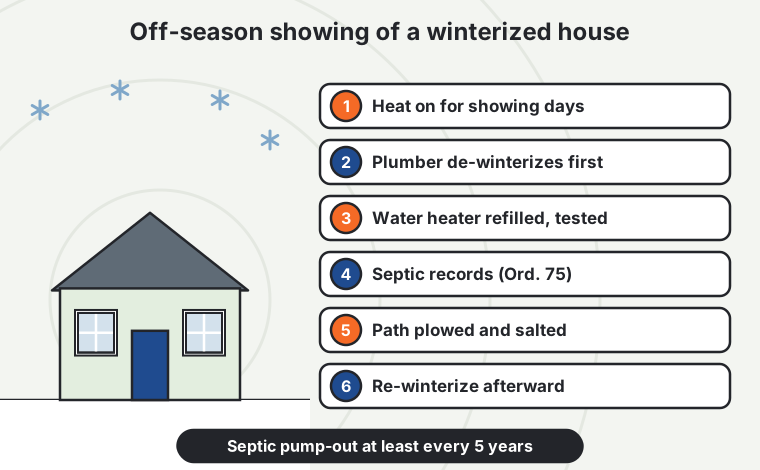
You show a seasonal house that has been winterized by keeping enough heat on to make it comfortable for showings, or by planning a de-winterization before the buyer’s inspection. A buyer’s inspector must run the water, test the heat, the water heater and the septic, so a fully drained house with the water off cannot be fully inspected. Agree in writing who de-winterizes and re-winterizes, and when.
Old Saybrook’s houses are old and many were built for summer. In the 2025 parcel data, the median single-family home was built in 1961, 71% predate 1978, and 59% heat with oil, 16% with electricity. “Cottage” is the fifth most common style in town. Some cottages were never meant for January. That shapes your choice:
| Your house | Best off-season approach | What to tell buyers |
|---|---|---|
| Year-round, insulated, central heat | Keep the heat on (follow your insurer’s minimum), show as normal | Fuel bills for last winter; service records |
| Seasonal with heat, drained for winter | Turn on heat for showing days; de-winterize for the inspection, then re-winterize | Who drained it and when; any freeze damage repaired |
| Summer-only cottage, no real heat | Show by appointment on milder days; disclose seasonal use clearly | It is a seasonal house; what year-round use would need |
| Empty house with oil heat | Automatic oil delivery, temperature alarm, regular checks | Tank age and location; oil left in the tank is credited at closing |
Septic matters too. Old Saybrook manages its wastewater through on-site systems, and the town’s Ordinance #75 requires septic systems to be pumped out and inspected at least once every five years. Buyers and their lenders will ask for the last pump-out report. Frozen ground can delay new septic work, so have the paperwork ready rather than relying on a winter dig. Our oil tank and septic guide covers both.
What flood-zone questions will off-season buyers ask?
Off-season buyers will ask whether the house is in a FEMA flood zone, whether it has flooded, what flood insurance costs and whether your policy can be transferred, whether there is an elevation certificate, and whether past repairs crossed the 50% substantial-improvement line. Since July 1, 2025, Connecticut’s disclosure report asks six flood questions, so have the answers before the first showing.
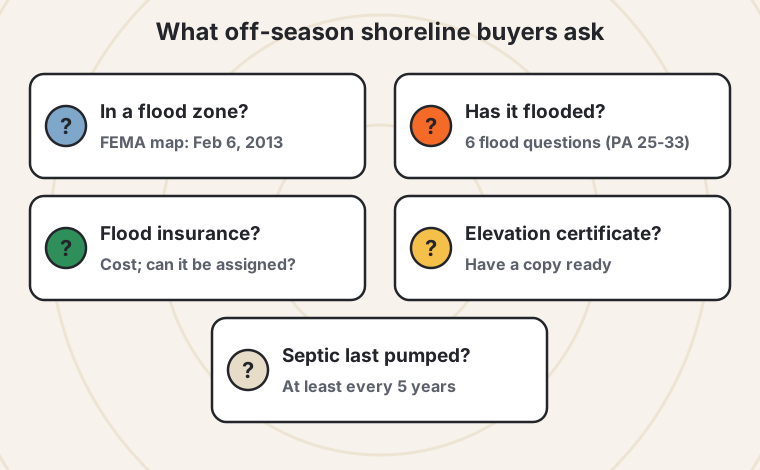
Winter showings make flood questions sharper, not softer. A December nor’easter can put water on Old Saybrook’s low streets while a buyer is in town. Here is what to have in the folder:
- Flood zone. Old Saybrook’s effective FEMA flood map dates from February 6, 2013. Look up your address on FEMA’s Flood Map Service Center and print the result.
- Disclosure report. Answer the six flood questions on the residential condition report honestly (Public Act 25-33). Not delivering the report costs a $500 credit to the buyer (CGS 20-327c).
- Insurance. Your current flood policy’s premium, and whether it can be assigned to the buyer. A buyer with a federally backed mortgage in a high-risk zone must carry flood insurance.
- Elevation certificate, if you have one, and any records of flood damage and repairs.
Our guide to selling a flood zone house in Old Saybrook goes through each item in depth: the map, the policy transfer and the 50% rule. This page only covers what to have ready for a winter showing.
How do you show an Old Saybrook house around the holidays?
You show an Old Saybrook house around the holidays by keeping it warm, bright and simple: modest decorations that do not hide rooms or windows, a plowed and salted path, all lights on before buyers arrive, and showing windows that avoid Thanksgiving, Christmas and New Year’s Day. Holiday buyers tend to be relocating, retiring or buying before year-end, so have the paperwork ready.
The old advice to stage a themed holiday open house is mostly about mood. What actually helps a December showing on the shoreline:
- Warmth and light. Raise the heat a few hours ahead. Days are short: schedule showings before 4 p.m. or light every room.
- Restraint. A wreath and a few lights are fine. A tree that hides the fireplace or a crowded table is not. Buyers need to see the floor and the windows.
- Water views without water. If the view is the selling point, include summer photos in the listing; a gray day undersells a beach house.
- Calendar. Attorneys’ offices and town halls slow down at the end of December. If you need to close before December 31 for tax reasons, plan the date early; our holiday selling guide covers the December-or-January decision.
- Open house or not. A public open house in December draws few people. A scheduled showing to a buyer who has already seen the photos works better. If you still want an open house, our guide to whether an open house is worth it lists the security steps.
For room-by-room winter staging, see how to stage a house for a winter sale in Connecticut.
What does it cost to keep an Old Saybrook house ready through the winter?
Keeping an Old Saybrook house ready through the winter costs about $642 a month in property tax on a $698,000 house at the 15.77 mill rate, plus heat, insurance, utilities, plowing and checks. With Connecticut heating oil at $6.154 a gallon (EIA, week of October 19, 2026), each 100 gallons is about $615. The 1.0% conveyance tax, $6,980 at that price, is due whenever you sell.
| Line | Old Saybrook example at $698,000 | Notes |
|---|---|---|
| State conveyance tax, 0.75% | $5,235 | CGS 12-494 |
| Old Saybrook conveyance tax, 0.25% | $1,745 | Standard town rate |
| Property tax per year | About $7,705 | 15.77 mills x 70% of $698,000 (CGS 12-62a) |
| Property tax per month | About $642 | Before heat, insurance, utilities and mortgage |
| Heating oil per 100 gallons | About $615 | EIA, Connecticut residential, week of Oct 19, 2026 |
| De-winterize and re-winterize for an inspection | A plumber’s visit or two (est.) | Get a quote in the fall |
| Missing condition report | $500 credit to the buyer | CGS 20-327b and 20-327c |
The real decision is simple: will a summer listing bring enough extra to pay for the winter? For a house that shows best with the beach behind it, and an owner who can carry it, often yes. For an empty, drained house that costs money every month and worries you every storm, often no. Our page on selling a vacant house covers selling from a distance.
How much would you walk away with?
Slide the numbers to match your house. It works in your browser; nothing is saved or sent.
Estimates for planning. Conveyance tax per CGS 12-494 (state 0.75% up to $800,000, 1.25% to $2.5M, 2.25% above, plus the town rate). Seller attorney about $1,200 to $1,500; flat-fee MLS about $400; listings include three months of taxes, insurance and utilities, a cash sale about two weeks. Your attorney gives you the final numbers.
Should you list now, wait for summer or sell the shoreline house as it is?
You should list now if the house is year-round and ready, wait for summer if it is a beach-season house that shows far better in July and you can carry it, and consider selling it as it is if the house is drained and empty, needs repairs, sits in a flood zone that worries financed buyers, or is being managed from out of state.
List this winter
38% of closingsBest for a year-round, heated, ready house.
- Serious buyers, fewer rivals
- Heat and access for showings
- Inspection needs the water on
Wait for summer
Beach-season buyersBest for a seasonal house you can carry.
- House shows at its best
- Months of tax, insurance, upkeep
- More competing listings
Sell as it is
One walk-throughBest for a drained, empty or worn house.
- No de-winterizing for showings
- No repairs, no staging
- Below a retail price
If your Old Saybrook house is in good shape and shows best in summer, and you can carry it until May, list it then with a local agent. Beach-season buyers will usually pay more than any cash buyer, including us. A direct sale fits when the winter, the distance, the condition or the flood questions are the real obstacle.
If that is your case, we buy shoreline houses as they are, drained or not, often after one walk-through, and typically close in about two weeks or on the date you pick. See our Old Saybrook page, and our page on selling a house that needs repairs if storm or age damage is part of the picture. Before you fix anything to sell, read what to fix before selling a house in Connecticut.
How do you get an Old Saybrook house ready for off-season showings, step by step?
You get an Old Saybrook house ready for off-season showings in five steps: decide whether the house stays heated or drained, line up a plumber for de-winterizing before inspections, assemble the flood and septic folder, set up snow, oil and check-in services, and choose list-now, wait-for-summer or direct sale with real numbers.
Heated or drained?
Ask your insurer what it requires for a seasonal or vacant house. Decide whether to keep heat on or drain the system.
Book the plumber now
Agree on de-winterizing and re-winterizing for the buyer’s inspection, and put who pays in the contract.
Build the folder
Flood zone printout, the disclosure report with the flood answers, flood policy, elevation certificate, septic pump-out reports, oil tank age.
Arrange winter services
Plowing and salting, automatic oil delivery, a temperature alarm and someone to check inside after storms.
Run the numbers and choose
A winter listing, a summer listing after months of carrying costs, or a direct sale. A cash buyer like us typically closes in about two weeks.
See the house together.
Pick a time that works.
Choose a time for us to walk through the property with you, or ask for a quick call first. We confirm every request personally.
Tuesday, January 13
No open times in the next few weeks. Please call us.
We will confirm by email. Nothing is booked until we do.
View my requestQuestions about selling a shoreline house in the off-season
Do houses sell in Old Saybrook in the winter?
Houses do sell in Old Saybrook in the winter. Over two recent sales years, 100 of 263 single-family closings (38.0%) happened from November to March, at a $553,500 median, and 55 (20.9%) from December to February (data.ct.gov).
Can a home inspection be done on a winterized house?
A home inspection on a winterized house cannot fully test the plumbing, water heater or fixtures while the water is off. Plan to de-winterize before the inspection and re-winterize afterward, and agree in the contract who pays for it.
Who pays to de-winterize a house for the buyer’s inspection?
Who pays to de-winterize a house for the buyer’s inspection is negotiated; Connecticut law does not set it. Sellers often pay so the inspection can happen, and buyers sometimes pay for a re-inspection. Put the arrangement in writing.
Do I have to disclose that my Old Saybrook house is in a flood zone?
You do have to answer the flood questions on Connecticut’s residential condition report; since July 1, 2025 the report asks six of them (Public Act 25-33). If you do not deliver the report, you credit the buyer $500 at closing (CGS 20-327c).
How often must septic systems be pumped in Old Saybrook?
Septic systems in Old Saybrook must be pumped out and inspected at least once every five years under the town’s Ordinance #75 on on-site sewage disposal systems. Keep the latest report for buyers.
Should I decorate for the holidays when selling?
You can decorate for the holidays when selling, but keep it modest: a wreath and a few lights. Do not let a tree or decorations hide rooms, windows or the fireplace, and keep walkways clear and salted.
Should I wait until summer to sell my Old Saybrook beach house?
You should wait until summer to sell an Old Saybrook beach house if it shows far better in July and you can carry the costs until then. If it is empty, drained and costing about $642 a month in tax alone at the median price, the summer premium may not cover the wait.
What is the conveyance tax in Old Saybrook?
The conveyance tax in Old Saybrook is 1.0% of the price up to $800,000: 0.75% to the state and 0.25% to the town (CGS 12-494). On a $698,000 sale that is $6,980, paid by the seller at closing.
Can I sell a seasonal cottage that is not winterized for year-round use?
You can sell a seasonal cottage that is not built for year-round use; disclose its seasonal use clearly and expect some buyers to price in heat and insulation. Many cash and second-home buyers are used to seasonal houses; see selling a house that needs repairs if it also needs work.
Related Connecticut guides
Showing your house
Season and shoreline
Old Saybrook and nearby
For every route, step and cost in one place, see every way to sell a house in Connecticut and our step-by-step guide to how to sell a house in Connecticut.
Plain-English information, not legal, insurance or plumbing advice. Estimates are labelled (est.).
Sources (checked on October 27, 2026)
- Connecticut OPM, Real Estate Sales 2001-2024 GL, data.ct.gov dataset 5mzw-sjtu (Old Saybrook, arm’s-length single-family sales; queried October 27, 2026).
- 2025 Connecticut Parcel and CAMA Data, data.ct.gov (Old Saybrook single-family year built, style, heating fuel, mailing city and state).
- Public Act 25-33 (flood questions on the disclosure report).
- CGS 20-327b and 20-327c (residential condition report; $500 credit).
- FEMA, NFIP Community Status Book (Old Saybrook effective map date) and FEMA Flood Map Service Center.
- Town of Old Saybrook, Ordinance #75: Management of On-Site Sewage Disposal Systems.
- CGS 12-494 (conveyance tax).
- CGS 12-62a (assessment at 70% of value).
- Connecticut OPM, mill rates (Old Saybrook fiscal 2027: 15.77).
- EIA, Weekly Connecticut No. 2 heating oil residential price (week of October 19, 2026).
- Realtor.com, Housing Inventory: Active Listing Count in Connecticut, via FRED.

Who wrote this
Jerryll Noorden
Jerryll has bought and sold Connecticut houses since 2016 and has sat at more closing tables than he can count, on both sides. Before real estate he was a robotics scientist at NASA, IHMC and IIT. He wrote this guide because the national sites that rank for it skip the Connecticut rules that cost sellers money. When listing or selling it yourself would get you more than a cash offer, he says so.
This guide explains Connecticut rules in plain English. It is not legal or tax advice. Laws change; for your sale, talk to a Connecticut real estate attorney and a tax professional.
