
Key facts at a glance
This page is one chapter of our guide on how to sell a house in Connecticut. It shows how a cash offer for a New Haven 2-4 family is built, and how to check yours.
| Fact | Number | Source |
|---|---|---|
| New Haven market home sales, Oct 2024 to Sep 2025 | 875, of which 355 (41%) were 2-4 families | data.ct.gov sales file |
| Median two-family sale, same year | $375,000 (183 sales) | data.ct.gov sales file |
| Median three-family sale, same year | $454,500 (151 sales) | data.ct.gov sales file |
| Median four-family sale, same year | $640,000 (21 sales) | data.ct.gov sales file |
| Mill rate, fiscal 2027 | 39.962 | OPM via data.ct.gov |
| Conveyance tax a New Haven seller pays | 1.25% (0.75% state + 0.50% city) | CGS 12-494 |
| Credit if you skip the condition report | $500 to the buyer | CGS 20-327c |
Why does a cash offer on your New Haven multi-family feel so hard to judge?
A cash offer on your New Haven multi-family feels hard to judge because it arrives as one number, with no visible math, on a building that is your income and your tenants’ home. Most owners here feel tired, suspicious of lowballs, protective of tenants and unsure of the value. This page is for New Haven owners of two- to four-families who want to see how the number is built.
Maybe it is a three-family in Fair Haven with an empty unit and a sagging porch. Maybe you inherited your parents’ two-family and never wanted to be a landlord. Or the rents no longer cover the tax bill, the oil and the repairs.
I am Jerryll Noorden, a Connecticut home buyer since 2016, about ten houses a year. Every number below is from a public source or labeled as an estimate.
How is a cash offer for a multi-family in New Haven, CT built?
A cash offer for a multi-family in New Haven, CT is built backwards from the building’s after-repair value (ARV): the price it would bring renovated and fully rented. The buyer subtracts the repairs, the costs of buying and holding it, the costs of reselling or refinancing, and a margin for profit and risk. What is left is the most that buyer can pay you.
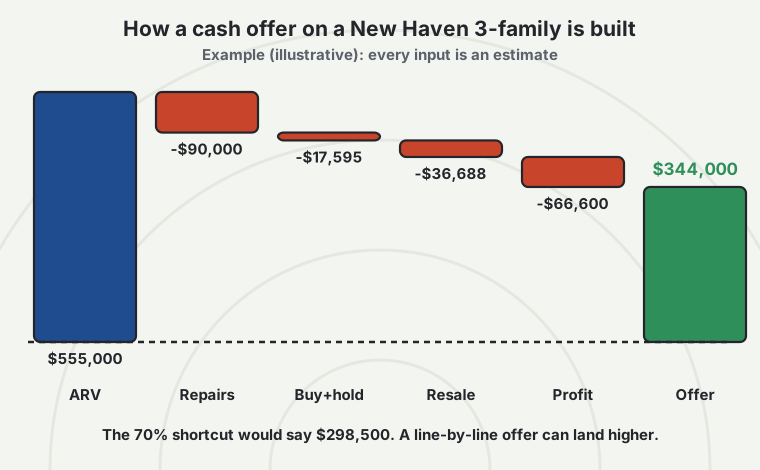
One example, built from public numbers and labeled estimates (not a deal we did):
| Line | Example (illustrative) | How it is figured |
|---|---|---|
| After-repair value (ARV) | $555,000 | Upper quartile of New Haven three-family sales, Oct 2024 to Sep 2025 (est. for a fully renovated building) |
| Repairs | -$90,000 | Roof, porches, lead-safe paint work, two kitchens, heat (est.) |
| Property tax while held, 6 months | -$5,595 | $280,000 assessment x 39.962 mills, half a year |
| Insurance, utilities, loan interest, buying costs | -$12,000 | Six months (est.) |
| Resale commission | -$27,750 | 5% of $555,000 (est.) |
| Resale conveyance tax | -$6,937.50 | 1.25% of $555,000 (CGS 12-494) |
| Resale attorney and other costs | -$2,000 | (est.) |
| Profit and risk margin | -$66,600 | 12% of ARV (est.) |
| Cash offer | about $344,000 | $555,000 minus all lines ($344,117.50) |
The offer is about 62% of the ARV, yet higher than the “70% rule” shortcut gives (70% of $555,000 minus $90,000 is $298,500). A line-by-line offer is often fairer than a rule of thumb. Our guide on why cash offers are so low explains the 70% rule and where it comes from; here we only need the lines.
The biggest swings come from the ARV (which comps the buyer picked) and the repair estimate. Question those two lines in any offer.
What do two-, three- and four-family houses actually sell for in New Haven?
Two-, three- and four-family houses in New Haven actually sold for medians of $375,000, $454,500 and $640,000 in the year to September 2025, across 355 market sales. That was 41% of all New Haven home sales, so a buyer pricing your building has plenty of real comparables, and you can check them yourself in the state’s sales file.
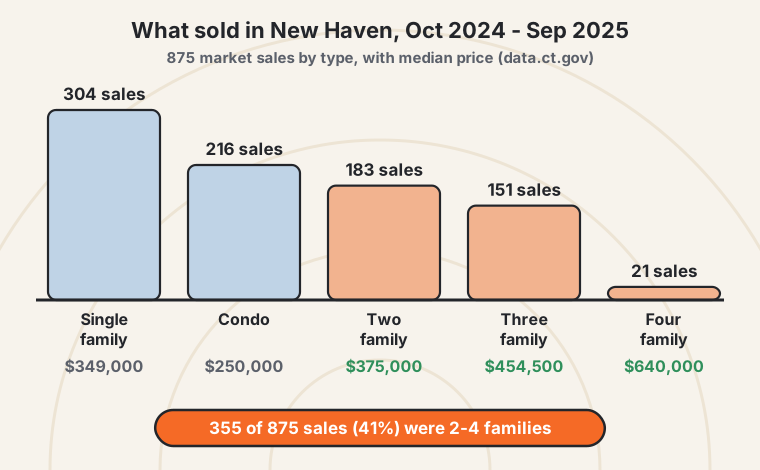
| Type | Oct 2022-Sep 2023 | Oct 2023-Sep 2024 | Oct 2024-Sep 2025 |
|---|---|---|---|
| Single-family | 305 sales, $290,000 | 293, $300,000 | 304, $349,000 |
| Condo | 198, $213,750 | 197, $230,000 | 216, $250,000 |
| Two-family | 170, $292,000 | 198, $310,000 | 183, $375,000 |
| Three-family | 96, $361,750 | 153, $405,000 | 151, $454,500 |
| Four-family | 10, $592,500 | 24, $498,750 | 21, $640,000 |
The spread matters more than the median. The middle half of New Haven three-families sold between $393,000 and $555,000, and two-families between $313,000 and $465,000. Tired buildings sell near the bottom, renovated ones near the top; a cash buyer’s repair and risk lines live in that gap.
Prices rose fast. The two-family median went from $292,000 to $375,000 in two years, so a 2023 comp understates today’s value. Ask which sales, and which dates, a buyer used.
Four-families are thin. With 10 to 24 sales a year, price a four-family from its rents and the closest few sales, not the median.
How do rents and vacancy change a cash offer on a New Haven multi-family?
Rents and vacancy change a cash offer on a New Haven multi-family because many buyers keep the building as a rental, so they also price it from its income. An empty unit, a tenant who stopped paying or rents well below market lowers the income a buyer can count on today, and the offer drops to cover the months and the cost of fixing it.
Investors check a multi-family two ways: the resale lens above and an income lens (net operating income divided by a cap rate). The income method is worked through in our guide to selling a multi-family in Connecticut. Here is what moves the income line:
| What the buyer sees | What it does to the offer | What you can do |
|---|---|---|
| A vacant unit | Lost rent until it is fixed and leased, plus turnover repairs | Show the unit’s condition honestly; a rent-ready unit costs the buyer less |
| A tenant not paying | Months of lost rent plus a possible eviction case in the New Haven Housing Session | Give the ledger and any notices; buyers price uncertainty hardest |
| Rents well below market | Lower income today; raising rent takes notice, time and may draw a complaint | Share lease end dates; long-term tenants who pay on time are worth something |
| Full building, paying, leases on file | Income the buyer can count on from day one | Hand over a rent roll, leases and deposit records early |
Check your rents against current New Haven listings and HUD’s Fair Market Rents for the area. New Haven also has a Fair Rent Commission that hears tenant complaints about increases, so buyers rarely assume a big rent jump.
If the tenants are your main worry, see selling a rental with tenants and the landlord guide.
Which repairs and New Haven rules does a cash buyer price into a multi-family offer?
A cash buyer prices into a New Haven multi-family offer the repairs needed to rent or resell it, plus the cost of meeting the rules that apply to older city rentals: lead paint where young children live, the city’s residential rental license, a unit count that matches city records, and the smoke and carbon monoxide rules. New Haven’s housing is old, so buyers expect several of these.
The city’s housing is old: the median single-family was built in 1930 and 55% predate 1940 (2025 parcel data), and most multi-families are the same era.
- Lead paint. For a pre-1978 building you must disclose known lead paint and give the EPA pamphlet. Connecticut requires an owner to remediate toxic lead levels where children under six live (CGS 19a-111c). Buyers budget lead-safe work into every turnover.
- Rental license. New Haven’s Livable City Initiative says non-owner-occupied two- and three-families and buildings of four or more units need a rental license and a passed inspection.
- Unit count. An apartment the city has no record of may have to be legalized or removed; buyers often value it at zero.
- Smoke and CO. For a one- or two-family, CGS 29-453 requires your signed smoke and carbon monoxide affidavit at closing; there is no longer a credit option. Three- and four-families fall under the fire code, and buyers check detectors either way.
Most sellers must also give the Residential Property Condition Disclosure Report or credit $500 at closing (CGS 20-327b, 20-327c); see our disclosure guide.
Why is a cash offer on a New Haven multi-family so far below its resale price?
A cash offer on a New Haven multi-family is far below its resale price because the gap has to pay for everything between buying it and reselling it: repairs, months of tax and insurance, two sets of closing costs, an agent and the risk that something costs more. You can see the gap in the state’s own records when buildings sell twice.
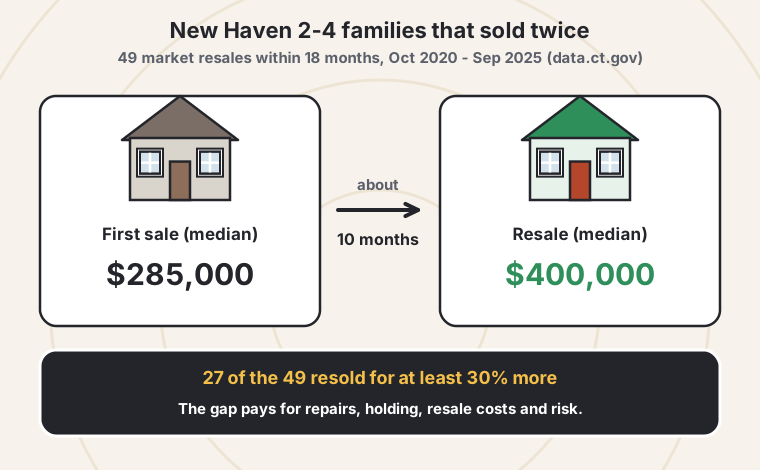
Between October 2020 and September 2025, 49 New Haven two- to four-families sold twice as market sales within 18 months. The median first price was $285,000 and the median resale $400,000, about ten months later. 27 of the 49 resold for at least 30% more.
That does not mean the first sellers were robbed; many of these buildings were likely renovated in between. It shows the honest trade-off of a cash sale: you give up the renovated price in exchange for not doing, funding or waiting for the work. Our guide to cash home buyers in Connecticut covers who they are statewide.
What will you net from a cash sale of a New Haven multi-family compared with listing it?
What you net from a cash sale of a New Haven multi-family is the offer minus the 1.25% conveyance tax, your attorney and your mortgage payoff, with tenants’ deposits handed to the buyer. Listing the same building as-is can net more if it sells at a good price without repair demands, but it takes longer and costs a commission.
The same illustrative three-family, side by side (the listed price is an as-is estimate):
| Line | Cash sale (illustrative) | Listed as-is (illustrative) |
|---|---|---|
| Sale price | $344,000 | $400,000 (est.) |
| Agent commission | $0 | -$20,000 (5%, est.) |
| Conveyance tax, 1.25% | -$4,300 | -$5,000 |
| Your attorney | -$1,500 (est.) | -$1,500 (est.) |
| Extra property tax, 3 more months | $0 | -$2,797 |
| Net before mortgage payoff | $338,200 | $370,703 |
Here listing nets about $32,500 more, if it goes smoothly: the real price of speed and certainty. On either route, every tenant’s security deposit, with interest, transfers to the buyer at closing (CGS 47a-21), and property tax is adjusted between you and the buyer. Our cash buyer vs. realtor comparison walks through the two routes in full, and the calculator below lets you run your own numbers:
How much would you walk away with?
Slide the numbers to match your house. It works in your browser; nothing is saved or sent.
Estimates for planning. Conveyance tax per CGS 12-494 (state 0.75% up to $800,000, 1.25% to $2.5M, 2.25% above, plus the town rate). Seller attorney about $1,200 to $1,500; flat-fee MLS about $400; listings include three months of taxes, insurance and utilities, a cash sale about two weeks. Your attorney gives you the final numbers.
For how Hamden and New Haven tax bills are split at closing, see our sibling guide on property taxes when selling a house in Hamden; the Connecticut method is the same in New Haven, though the city sets its own bill due dates. The Connecticut conveyance tax guide lists every town’s rate.
How do you get the highest cash offer for your New Haven multi-family?
You get the highest cash offer for your New Haven multi-family by giving buyers the facts that shrink their risk line: a rent roll, leases, deposit records, a year of income and expenses, the license and lead records, and access to every unit. Then get two or three written offers and ask each buyer to show the ARV and repair numbers behind theirs.
Gather the rental package
Rent roll, leases, deposit list with interest, ledgers for anyone behind, a year of bills, and license or lead paperwork.
Pull your own comps
Search data.ct.gov dataset 5mzw-sjtu for New Haven sales of your type in the last 12 months.
Ask for the lines, not just a total
Ask which sales set the ARV and what is on the repair list. A buyer who will not explain the number is a buyer to question.
Check the buyer
Ask for proof of funds, a Connecticut attorney for closing, and no fees to you. Our page on we buy houses scams and red flags lists what to watch for, including contracts that let a buyer assign your deal to someone else.
Pick a closing date that works for your tenants and you
A cash close typically takes about two weeks from first call; it can be later if you need time. Our New Haven page explains how we make an offer, with no deadline on it.
To compare offers side by side, see how to run the numbers on offers for a New Haven house.
See the house together.
Pick a time that works.
Choose a time for us to walk through the property with you, or ask for a quick call first. We confirm every request personally.
Tuesday, January 13
No open times in the next few weeks. Please call us.
We will confirm by email. Nothing is booked until we do.
View my requestWhen should you NOT take a cash offer on your New Haven multi-family?
You should not take a cash offer on your New Haven multi-family when the building is in good shape, fully rented to paying tenants with leases on file, and you have two or three months to sell. That building can be bought by an owner-occupant with an FHA or conventional loan, and listing it will usually net more than any cash buyer can pay.
I buy multi-families for cash, and a clean, licensed, fully rented three-family does not need me; it needs a good listing agent. The cash buyer vs. realtor guide shows where that line usually falls.
A cash sale makes sense when a unit is vacant and needs work, a tenant has stopped paying, license or lead work is undone, there is an unrecorded unit, or you need a fixed date. Timelines matter too: our sibling guide on how long it takes to sell a house in Wallingford compares listing, selling by owner and cash on real dates.
Is a cash sale right for you, or should you list?
Seven quick questions. There is no wrong answer, and we will tell you honestly if listing would leave you more.
- Does the house need repairs you would rather not pay for or manage?
- Do you need to close by a certain date, or within the next month or two?
- Would showings be hard: tenants, belongings, privacy, or you live out of state?
- Is there a complication: an estate or probate, a divorce, foreclosure, liens or back taxes?
- Could you comfortably cover the mortgage, taxes and utilities for three or more months?
- Is getting the highest possible price more important to you than speed and certainty?
- Would a buyer's bank lend on the house as it is (no major roof, foundation, oil tank or code issues)?
Questions New Haven owners ask about cash offers on a multi-family
How do investors calculate a cash offer on a multi-family in New Haven?
Investors calculate a cash offer on a multi-family in New Haven by starting from the after-repair value, then subtracting repairs, buying and holding costs, resale or refinance costs and a profit and risk margin. Many also check the price against the building’s rental income.
What percentage of value do cash buyers pay for a New Haven multi-family?
Cash buyers do not pay a fixed percentage of value for a New Haven multi-family; the share depends on repairs, rents and vacancy. In our illustrative three-family the offer was about 62% of a $555,000 after-repair value, slightly more than the 70% rule would give once repairs are subtracted. Ask for the lines behind any offer.
What is the median price of a three-family house in New Haven, CT?
The median price of a three-family house in New Haven was $454,500 for market sales recorded October 2024 to September 2025 (151 sales, data.ct.gov). Two-families had a $375,000 median and four-families $640,000.
Can I sell my New Haven multi-family for cash with tenants living there?
Yes, you can sell your New Haven multi-family for cash with tenants living there. Leases stay in force, every security deposit with interest transfers to the buyer (CGS 47a-21), and the buyer needs reasonable access to see the units.
Does a vacant unit lower a cash offer on a New Haven multi-family?
A vacant unit usually lowers a cash offer on a New Haven multi-family by the lost rent until it is fixed and leased plus the turnover repairs. A clean, rent-ready empty unit costs a buyer much less than one that needs lead-safe work and a new kitchen.
Do I need a New Haven rental license to sell my multi-family?
You do not need a New Haven rental license to sell your multi-family, but a buyer who will rent it will need one, so a missing license or failed inspection shows up as repairs in the offer. Check your status with the Livable City Initiative.
How much is the conveyance tax when selling a New Haven multi-family?
The conveyance tax when selling a New Haven multi-family is 1.25% of the price up to $800,000: 0.75% to the state and 0.50% to the city (CGS 12-494). On a $454,500 sale that is $5,681.25, paid by the seller at closing.
Do I have to fix lead paint before selling my New Haven multi-family?
You do not have to fix lead paint before selling your New Haven multi-family, but you must disclose known lead paint in a pre-1978 building and give the EPA pamphlet. An owner must remediate toxic lead levels where children under six live (CGS 19a-111c), so buyers price that work in.
Related guides
- Cash home buyers in Connecticut: what they pay
- Cash buyer vs. realtor in Connecticut
- Sell a multi-family house in Connecticut (2-4 unit guide)
- Why are cash offers so low? The 70% rule
- Property taxes when selling a house in Hamden
- Selling a flood zone house in Old Saybrook
- We buy houses in New Haven, CT
For every route, cost and step in one place, start with our guide on how to sell a house in Connecticut.
Sources (checked on October 27, 2026)
- CT Office of Policy and Management, Real Estate Sales (data.ct.gov dataset 5mzw-sjtu)
- 2025 Connecticut Parcel and CAMA Data (data.ct.gov)
- Mill Rates for FY 2014-2027, OPM (data.ct.gov)
- CGS 12-494, real estate conveyance tax
- CGS 12-62a, assessment at 70% of value
- CGS 20-327b and 20-327c, property condition disclosure
- CGS 29-453, smoke and carbon monoxide affidavit
- CGS 47a-21, security deposits on transfer
- CGS 19a-111c, lead abatement in dwellings
- EPA, lead-based paint real estate disclosure
- City of New Haven, Livable City Initiative residential rental licensing
- HUD USER, Fair Market Rents
This guide is general information, not legal or tax advice. For your own sale, talk to a Connecticut real estate attorney.

Who wrote this
Jerryll Noorden
Jerryll has bought and sold Connecticut houses since 2016 and has sat at more closing tables than he can count, on both sides. Before real estate he was a robotics scientist at NASA, IHMC and IIT. He wrote this guide because the national sites that rank for it skip the Connecticut rules that cost sellers money. When listing or selling it yourself would get you more than a cash offer, he says so.
This guide explains Connecticut rules in plain English. It is not legal or tax advice. Laws change; for your sale, talk to a Connecticut real estate attorney and a tax professional.
