
Key facts at a glance
| Fact | Number | Source |
|---|---|---|
| Homes sold in Waterford, Oct 2024 to Sep 2025 | 296; single-family median $395,000 | CT OPM real estate sales, data.ct.gov |
| Median year built, Waterford single-family homes | 1959 | CT parcel (CAMA) data, via our town data file |
| Waterford mill rate, fiscal 2027 | 24.54 (about $6,785 a year on a $395,000 house, est.) | CT OPM mill rates, data.ct.gov |
| Conveyance tax a Waterford seller pays | 1.00% ($3,950 on $395,000) | CGS 12-494 |
| Federal home-sale exclusion | $250,000; $500,000 married filing jointly | IRS Publication 523 |
| Military suspension of the 5-year test | Up to 10 years of qualified extended duty | IRS Publication 523 |
| Connecticut tax on a taxable gain | Ordinary income, 2% to 6.99%; starts from federal AGI | CGS 12-700, 12-701 |
You sold, or you are about to sell, a house in Waterford, and you want to know how much of the profit you actually keep. This guide answers that one question with Waterford numbers. It is part of our guide to how to sell a house in Connecticut. The full list of taxes on a Connecticut sale lives in our guide to taxes when selling a house in Connecticut; here we focus on the profit: which part is taxable, which part is not, and the special rules that matter in a town next door to the Navy and Electric Boat.
General education only, not tax or financial advice. Bring your own numbers to a CPA or enrolled agent before you sell.
Is the profit from selling my Waterford house taxable?
The profit from selling your Waterford house is usually not taxable if it was your main home. If you owned it and lived in it for 2 of the 5 years before the sale, up to $250,000 of gain ($500,000 married filing jointly) is excluded federally, and Connecticut follows that result. Profit can be taxable when you lived there less than 2 years, rented it out, or your gain is above the limit.
Maybe you bought a ranch near Route 85 when the kids were small and it is now worth far more than you paid. Maybe orders came through and you have three months to leave New London County. Maybe a job at Millstone or across the river changed, and the house you bought last year has to go. People in your spot often feel uncertain about what they will owe, rushed by a moving date, wary of advice from people who want something, frustrated that the rules seem written for accountants, and relieved but cautious when they hear most sellers owe nothing.
This page is for you. We start with the simple rule, then the partial exclusion for early moves, then the military rules, and then three worked Waterford examples you can copy with your own numbers.
What counts as “profit” on a Waterford home sale for taxes?
For taxes, the “profit” on a Waterford home sale is your gain: the sale price minus selling expenses (commission, the 1.00% conveyance tax, your attorney) minus your adjusted basis (what you paid, plus certain purchase costs and improvements). It is not the check you receive at closing; paying off your mortgage does not reduce your gain.
Your mortgage payoff does not change your gain; it depends only on what the house cost you and what you sold it for, after costs. The details of which costs count, and how to rebuild your basis if you lost receipts, are in our guide to tax deductions when selling a house in Connecticut.
In Waterford, the conveyance tax is 1.00% of the price (0.75% state plus 0.25% town, CGS 12-494). On a $395,000 sale, that is $3,950, and it is a selling expense that lowers your gain.
How do you qualify for the full $250,000 or $500,000 exclusion?
You qualify for the full $250,000 or $500,000 exclusion by meeting three tests: you owned the house at least 2 years of the 5 years before the sale, you lived in it as your main home at least 2 of those 5 years, and you did not exclude gain on another home in the 2 years before. Married couples get $500,000 if they file jointly and both meet the use test (IRS Publication 523).
The 24 months do not have to be in a row. A widowed seller can still use the $500,000 limit if the house is sold within 2 years of the spouse’s death, the seller has not remarried, and the tests were met before the death (IRS Publication 523).
Connecticut does not have its own version. Its income tax starts from your federal adjusted gross income (CGS 12-701), so gain the IRS excludes is not taxed by Connecticut either. Gain that is taxable federally is taxed by Connecticut as ordinary income, at 2% to 6.99% (CGS 12-700).
What if you sell your Waterford house before living there 2 years?
If you sell your Waterford house before living there 2 years, you may still exclude part of the gain if the main reason was a change in work location, health, or an unforeseeable event. The partial limit is the $250,000 (or $500,000) exclusion times the months you qualified, divided by 24. Because the limit is usually far above a short-term gain, many early sellers still owe nothing (IRS Publication 523).
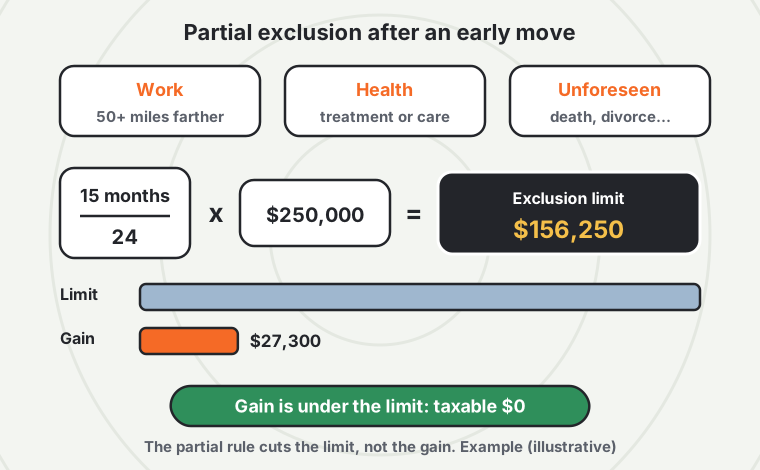
IRS Publication 523 recognizes three kinds of reasons:
- Work. You (or your spouse, a co-owner, or someone who lived with you) started a new job, or were transferred, to a location at least 50 miles farther from the home than the old work location. A permanent change of station for a service member usually fits.
- Health. You moved to get treatment for a disease, illness or injury, or to care for a family member, or a doctor recommended the move for health reasons.
- Unforeseeable events. Publication 523 lists events such as a death, a divorce or legal separation, multiple births from the same pregnancy, becoming eligible for unemployment, a change in employment that left you unable to pay housing costs and basic living expenses, and the home being destroyed, condemned or damaged by a disaster.
Count the months you owned it, the months you lived there, and the months since you last used the exclusion. Use the shortest. Divide by 24, and multiply by $250,000 (or by $250,000 per spouse for a married couple, with special rules). That is your limit, not your exclusion: you exclude the smaller of your gain and the limit.
If the move is a job transfer or orders, our guide for sellers who are relocating from Connecticut covers the timing side, and our relocation page explains how a sale works when you are already gone. A divorce sale has its own tax points, covered in selling a house during a divorce in Connecticut.
Do military families in Waterford get special home-sale tax rules?
Military families in Waterford can get one important special rule: a service member on qualified official extended duty can suspend the 5-year look-back for up to 10 years. That lets a family who lived in a Waterford house, then left on orders and rented it out, still use the exclusion years later. Gain equal to depreciation after May 6, 1997, is still taxable (IRS Publication 523).

Waterford sits next to the region’s biggest military and defense employers: the Naval Submarine Base and Electric Boat are across the Thames in Groton. Under the normal rule, a house you have not lived in for more than 3 years fails the 2-of-5 test; the military rule changes that.
- Who qualifies. Members of the uniformed services and Foreign Service, and certain intelligence community and Peace Corps employees, on qualified official extended duty. You or your spouse can be the one on duty.
- What counts as qualified extended duty. Orders for a period of more than 90 days, or for an indefinite period, at a duty station at least 50 miles from the home, or while living in government quarters under orders.
- How long. The suspension can’t last more than 10 years in total.
- What stays taxable. If you rented the house, the depreciation you took (or could have taken) after May 6, 1997, is not excludable. Federally it is taxed at up to 25%; Connecticut taxes it as ordinary income.
The time on qualified duty is also not counted as “nonqualified use,” which otherwise can shrink the exclusion for houses that were rented before they became a main home. A preparer who works with military families is worth the fee. If you are selling a Waterford rental with a tenant still in it, our guide to selling a rental with tenants in Connecticut covers the leases, deposits and showings.
How much tax would you owe on three Waterford home sales?
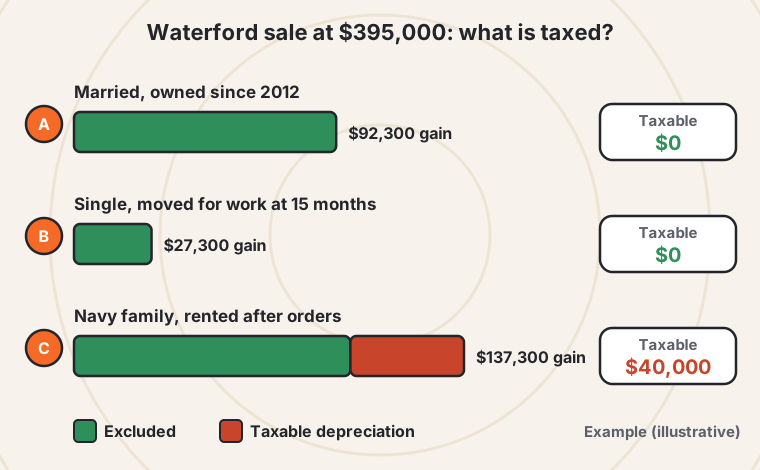
On three typical Waterford home sales at the $395,000 single-family median, a long-time married owner owes no income tax, a single owner who moved for work after 15 months owes none under the partial exclusion, and a Navy family that rented the house out owes tax only on $40,000 of depreciation. Every input except the town numbers is an illustrative assumption.
Example (illustrative). All three sell for $395,000 with an agent. Selling expenses: commission 5% (est.) $19,750, conveyance tax 1.00% $3,950, seller’s attorney (est.) $1,500, for $25,200 in all. Amount realized: $369,800.
| Line | A: married, owned since 2012 | B: single, moved for work after 15 months | C: Navy family, lived 2014 to 2019, then rented |
|---|---|---|---|
| Amount realized | $369,800 | $369,800 | $369,800 |
| Purchase price (est.) | $240,000 | $340,000 (Jan 2025) | $250,000 |
| Purchase costs added (est.) | + $2,500 | + $2,500 | + $2,500 |
| Improvements (est.) | + $35,000 | $0 | + $20,000 |
| Depreciation taken as a rental (est.) | $0 | $0 | − $40,000 |
| Adjusted basis | $277,500 | $342,500 | $232,500 |
| Gain | $92,300 | $27,300 | $137,300 |
| Exclusion limit | $500,000 | $156,250 (15/24 of $250,000) | $500,000 (with the military suspension) |
| Taxable gain | $0 | $0 | $40,000 (the depreciation) |
| Tax (est.) | $0 | $0 | Federal up to $10,000 (25%); Connecticut up to $2,796 (6.99%) |
What would have happened without the special rules? In example B, the whole $27,300 would be taxable: about $4,095 at a 15% federal rate plus up to $1,908 in Connecticut (est.). In example C, without the military suspension, the whole $137,300 would be taxable: up to $10,000 on the depreciation plus about $14,595 at 15% on the rest federally, and up to $9,597 in Connecticut (est.). Your real rates depend on your income for the year.
Put your own numbers into the same table. If any of your profit is taxable, ask your preparer whether to make an estimated payment for the year of sale. No income tax is withheld at a Connecticut closing for a resident seller, and Connecticut expects estimated payments when you will owe $1,000 or more (Form CT-1040ES). What to do with the rest of the money, in what order, is covered in our guide to what to do with house sale proceeds in Connecticut.
Does selling your Waterford house for cash change the tax on the profit?
Selling your Waterford house for cash does not change how the profit is taxed. The same exclusion, partial exclusion and military rules apply. A cash price is usually lower, so the gain is smaller, but you also skip the commission. The right route is the one that leaves you more after all costs, and for many Waterford houses in good shape that is a listing.
We buy houses for cash, so we will be direct. If your Waterford house is in good condition and you have time, list it; the market will usually pay more than we can. A direct sale fits when you have orders and a short window, the house needs work (half of Waterford’s single-family homes were built before 1960), it is a rental with tenants, or you are managing it from another state. Our cash buyer vs. realtor comparison shows the math side by side.
List it
Usually the higher priceBest for a house in good shape with a few months to sell.
- Commission and repairs come out of the price
- Buyer financing, appraisal, inspection
Sell direct
About 2 weeksFits orders, repairs, tenants or an out-of-state owner.
- No commission, no repairs, no showings
- Lower price; compare the net
When you should NOT sell to a cash buyer: when the house is move-in ready, you are not under a deadline, and the extra price from listing is larger than the commission and the months of carrying costs. In that case, list it. For a written number to compare, see our Waterford page or the cash vs. realtor guide.
What should you do before you sell to protect your profit?
Before you sell, you should check your dates against the 2-of-5 test, write down the reason for an early move, gather your basis records, and talk to a tax preparer if any part of the gain might be taxable. It takes a few hours.
Check your dates
Write down when you bought, when you moved in, when you moved out, and any time on orders. Count the months in the 5 years before your target closing date.
Document the reason for an early move
Keep the job offer, transfer letter, orders or doctor’s letter. They support a partial exclusion or the military suspension.
Rebuild your basis
Find the purchase closing statement and improvement receipts. Our deductions guide lists what counts.
Estimate the gain and talk to a preparer
Use the table above. If anything is taxable, or the house was rented, see a CPA or enrolled agent before you sign a contract.
Close and keep the file
Your Connecticut closing attorney handles the deed, conveyance tax and settlement statement. Keep the statement and any Form 1099-S with your tax records.
See the house together.
Pick a time that works.
Choose a time for us to walk through the property with you, or ask for a quick call first. We confirm every request personally.
Tuesday, January 13
No open times in the next few weeks. Please call us.
We will confirm by email. Nothing is booked until we do.
View my requestFrequently asked questions
Do I pay tax on the profit from selling my house in Waterford, CT?
You usually do not pay tax on the profit from selling your main home in Waterford, CT. If you owned and lived in it 2 of the last 5 years, up to $250,000 of gain ($500,000 married filing jointly) is excluded, and Connecticut follows the federal result.
Is the money I get at closing the same as my taxable profit?
No, the money you get at closing is not your taxable profit. Your gain is the sale price minus selling expenses minus your adjusted basis. Paying off a mortgage reduces your cash at closing but not your gain.
What if I have to sell before living in the house for 2 years?
If you have to sell before living in the house for 2 years because of a job move of 50 miles or more, a health reason or an unforeseeable event, you may get a partial exclusion: the months you qualified divided by 24, times $250,000 (IRS Publication 523).
Does a PCS move qualify for the partial exclusion?
A permanent change of station usually qualifies as a work-related move for the partial exclusion when the new duty station is at least 50 miles farther from the home. Service members may also suspend the 5-year test during qualified extended duty.
How long can a service member suspend the 5-year test?
A service member can suspend the 5-year test for up to 10 years of qualified official extended duty: orders for more than 90 days, or indefinite, at a station at least 50 miles from the home (IRS Publication 523).
Is depreciation on a rented-out house excluded?
No, depreciation on a rented-out house is not excluded. Gain equal to depreciation allowed or allowable after May 6, 1997, is taxable even when the rest of the gain is excluded.
What rate does Connecticut tax a home-sale profit at?
Connecticut taxes a taxable home-sale profit as ordinary income at its regular rates, from 2% to 6.99% (CGS 12-700). There is no lower Connecticut capital gains rate.
What is the conveyance tax when I sell in Waterford?
The conveyance tax when you sell in Waterford is 1.00% of the price for most homes: 0.75% to the state and 0.25% to the town, paid by the seller. On a $395,000 sale that is $3,950 (CGS 12-494).
Can a widow or widower use the $500,000 exclusion?
A widow or widower can use the $500,000 exclusion if the house is sold within 2 years of the spouse’s death, they have not remarried, and the ownership and use tests were met before the death (IRS Publication 523).
Should I make an estimated tax payment after my Waterford sale?
You may need to make an estimated tax payment after your Waterford sale if part of the profit is taxable, because no income tax is withheld at a Connecticut closing. Connecticut expects estimated payments when you will owe $1,000 or more; ask your preparer.
Related guides
Taxes and costs
After the sale
For pricing, timing, paperwork and the closing itself, start with how to sell a house in Connecticut.
General education, not tax, legal or financial advice. Your result depends on your dates, basis and income; talk to a CPA or enrolled agent and your Connecticut attorney before you sell.
Sources (checked on October 27, 2026)
- IRS Publication 523, Selling Your Home (exclusion tests, partial exclusion, qualified extended duty, depreciation, surviving spouse).
- IRS Publication 3, Armed Forces’ Tax Guide.
- CGS chapter 229: § 12-700 (rates) and § 12-701 (Connecticut AGI starts from federal AGI).
- CGS chapter 223: § 12-494 (conveyance tax).
- Connecticut Department of Revenue Services, Form CT-1040ES estimated tax instructions.
- CT OPM Real Estate Sales (Waterford, Oct 2024 to Sep 2025), data.ct.gov.
- OPM mill rates, fiscal 2027, data.ct.gov.

Who wrote this
Jerryll Noorden
Jerryll has bought and sold Connecticut houses since 2016 and has sat at more closing tables than he can count, on both sides. Before real estate he was a robotics scientist at NASA, IHMC and IIT. He wrote this guide because the national sites that rank for it skip the Connecticut rules that cost sellers money. When listing or selling it yourself would get you more than a cash offer, he says so.
This guide explains Connecticut rules in plain English. It is not legal or tax advice. Laws change; for your sale, talk to a Connecticut real estate attorney and a tax professional.
