
Key facts at a glance
This guide is for Connecticut owners who have decided, or nearly decided, to finance the sale of their own house and want to set it up properly. It is part of our guide on how to sell a house in Connecticut. Whether owner financing is a good idea at all, and the full table of federal and state rules, is covered in is owner financing a good idea for the seller in Connecticut. This page is the practical checklist: six decisions, in the order you make them.
| Fact | Number | Source |
|---|---|---|
| Properties an individual can seller-finance in 12 months under the federal one-property exclusion (balloon allowed) | 1 | 12 CFR 1026.36(a)(5) |
| Properties under the three-property exclusion (full amortization and an ability-to-repay check required) | 3 or fewer | 12 CFR 1026.36(a)(4) |
| Connecticut general interest cap, which does not apply to a bona fide mortgage over $5,000 | 12% | CGS 37-4, 37-9(3) |
| IRS mid-term applicable federal rate, October 2026 (notes over 3 and up to 9 years) | 4.61% (annual) | IRS Rev. Rul. 2026-19 |
| Conveyance tax most Connecticut sellers pay, on the full price, up to $800,000 | 1.00% (0.75% state + 0.25% town) | CGS 12-494 |
| Haddam single-family median used in the examples (sales Oct 2024 to Sep 2025) | $441,500 | Our town data (data.ct.gov sales file) |
| Haddam mill rate, fiscal 2027 | 24.98 (about $7,720 a year of tax on the median, est.) | CT OPM mill rates |
What are the most important seller financing tips in Connecticut?
The most important seller financing tips in Connecticut are to screen the buyer like a lender, insist on a down payment big enough to cover a year of missed payments, set a fixed rate above the IRS minimum with a realistic balloon, have an attorney record a note and first mortgage with a title policy, collect taxes and insurance through escrow and a servicer, and write clear default terms into the note.
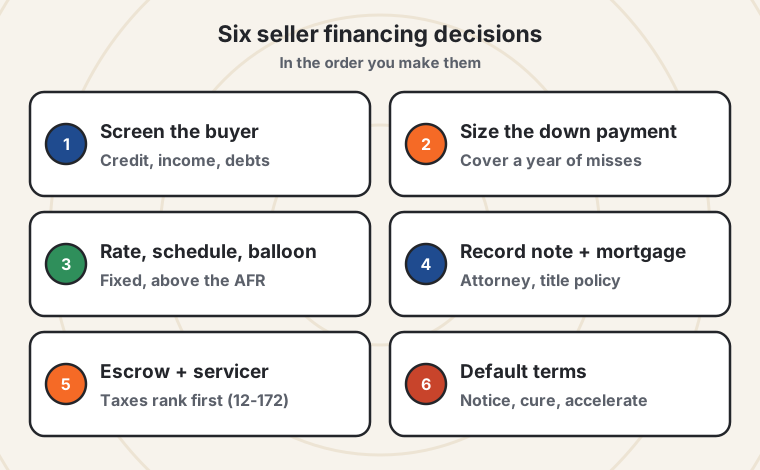
Owner financing turns one event, a sale, into two: a sale that ends at closing and a loan that can last ten years or more. Most of what goes wrong happens in the loan part, and almost all of it can be prevented with decisions you make before you sign. That is what this checklist is for.
We use one house for the numbers: a Haddam single-family home at the town’s median price of $441,500. Every figure below is an example (illustrative), computed from that price and standard loan math. Change the inputs for your own house; the logic stays the same.
Is this page for you if you have already agreed to be the bank?
This page is for you if you have agreed, or are about to agree, to finance the sale of your Connecticut house and you feel responsible for getting the terms right. Most sellers in this spot have never written a loan. Feeling unsure about which numbers are normal is the right instinct, not a weakness.
Maybe a tenant who has rented from you for years wants to buy and cannot get a bank loan yet. Maybe a relative asked. Maybe the house sat on the market and a self-employed buyer offered full price “if you carry the paper.” Your house is probably paid off, and the equity in it may be most of your retirement.
The feelings tend to come in a bundle. You feel responsible, because you want to do it properly. You feel anxious about picking the wrong rate or down payment. You feel protective of money you spent decades building. You may feel loyal to the buyer and worried that asking for a credit report will insult them. And you probably feel out of your depth with words like amortization, balloon and escrow.
Here is one Connecticut fact that should steady you: property taxes come first. A town’s tax lien takes precedence over every other encumbrance, including the mortgage you will hold (CGS 12-172). That single rule explains why half the tips below are about collecting the taxes yourself. Once you see why each tip exists, the checklist stops being jargon and becomes common sense.
How should you screen a buyer before you finance the sale?
You should screen a buyer before you finance the sale the way a bank would: with written permission, pull a credit report, verify income with pay stubs, tax returns and bank statements, list their debts, and work out whether the monthly payment plus taxes and insurance fits their budget. Keep a written record of how you decided.
It feels awkward to ask a buyer you like for their tax returns. Ask anyway. A buyer who will not show you their finances is asking you to lend them hundreds of thousands of dollars on trust alone. The house is security, but getting it back takes a court case, so the house is a poor substitute for a buyer who can pay.
- A signed authorization to pull a credit report (you need a permissible purpose and the buyer’s consent; a tenant-screening or credit service can run it).
- Two years of tax returns and W-2s or 1099s; for self-employed buyers, profit-and-loss statements as well.
- Recent pay stubs and two to three months of bank statements, which also show where the down payment comes from.
- A list of the buyer’s monthly debts: car loans, student loans, credit cards, child support.
- A simple budget: your monthly payment plus property tax plus insurance, against their take-home pay.
- References from a current landlord, and the buyer’s plan for refinancing before any balloon date.
Why the written record matters. If you finance under the federal three-property exclusion, you must determine in good faith that the buyer has a reasonable ability to repay (12 CFR 1026.36(a)(4)). The one-property exclusion for individuals does not require that check, but doing it anyway is the cheapest insurance you will ever buy. The pillar guide explains which exclusion fits you; we will not repeat the table here.
What you may not screen on. You can judge a buyer on income, credit and debts. You may not refuse a buyer, or offer worse terms, because of race, religion, sex, familial status, disability, lawful source of income or another protected class under Connecticut’s fair housing law (CGS 46a-64c). Apply the same written standards to every buyer who asks.
How big should the down payment be on a seller-financed sale?
The down payment on a seller-financed sale in Connecticut should be large enough to cover at least a year of missed payments plus your legal costs, because a foreclosure takes months. On a $441,500 Haddam house, 5% down is $22,075, less than the $33,485 of payments you would miss in 12 months on that loan. Many careful sellers ask for 10% to 20% or more.
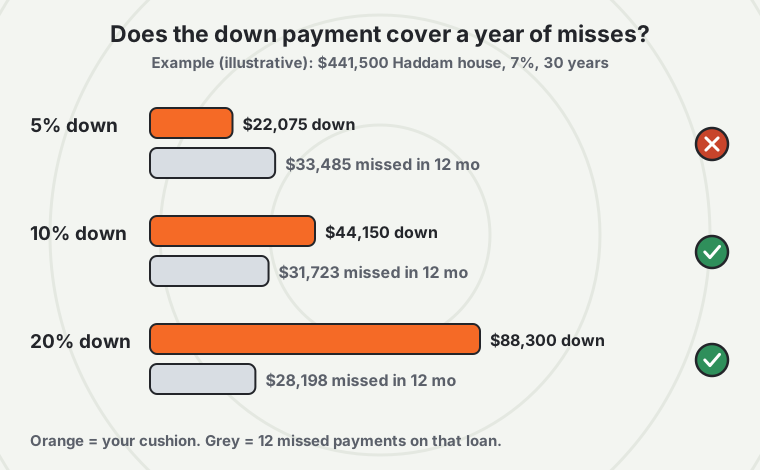
The down payment does two jobs. It gives the buyer something real to lose, so they are less likely to walk away. And it is your cushion if they do: the money you already hold while you go through court to get the house back.
| Down payment on $441,500 | Cash to you at closing (before costs) | Loan you carry | Monthly payment, 7% over 30 years | Covers 12 missed payments? |
|---|---|---|---|---|
| 5% | $22,075 | $419,425 | $2,790.44 | No (12 x $2,790.44 = $33,485) |
| 10% | $44,150 | $397,350 | $2,643.58 | Yes, with about $12,400 to spare (12 x $2,643.58 = $31,723) |
| 20% | $88,300 | $353,200 | $2,349.85 | Yes, about $60,100 to spare (12 x $2,349.85 = $28,198) |
Notice what happens at 5% down: the loan is bigger, so the payment is bigger, so a year of missed payments is bigger too, and the cushion is smaller. Thin down payments make every other risk worse. If a buyer truly cannot put down at least 10%, the honest answer may be a lease with an option to buy while they save, rather than a loan.
Also check where the down payment comes from. Money borrowed from a credit card or a second lender is not a cushion; it is another debt pulling against your payment. Bank statements answer that question.
What interest rate, amortization and balloon should you set?
The interest rate, amortization and balloon you set should give a fixed rate above the IRS applicable federal rate (4.61% mid-term in October 2026), a payment schedule the buyer can afford (often 30 years), and a balloon date realistic for a bank refinance, often 5 to 7 years. Balloons are allowed under the federal one-property exclusion but not under the three-property one.
The rate
Three limits frame the rate. At the bottom, the IRS: if your rate is below the applicable federal rate for the note’s term, part of each payment is treated as interest anyway (IRS Pub 537). For a note of more than 3 and up to 9 years the mid-term rate applies; it was 4.61% (annual) for October 2026 and changes every month. At the top, Connecticut’s 12% cap generally does not apply to a bona fide mortgage of real property over $5,000 (CGS 37-9(3)), so it rarely limits a house loan. In the middle, the market: buyers compare you with bank rates, and a rate far above them makes the buyer more likely to default or to refinance away early.
Keep it fixed. Both federal seller-financer exclusions require a fixed rate, or one that adjusts only after five or more years with reasonable caps (12 CFR 1026.36(a)(4)-(5)). Variable rates also make the buyer’s budget harder to predict, which is the opposite of what you want.
The schedule and the balloon
| Structure on a $353,200 loan at 7% | Monthly payment | Interest paid in 5 years | Still owed after 5 years | Federal exclusion it fits |
|---|---|---|---|---|
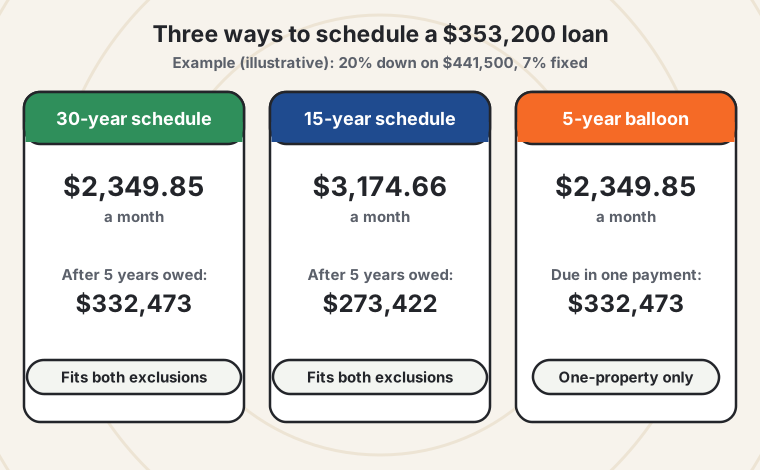
| 30-year schedule, no balloon | $2,349.85 | $120,264 | $332,473 | One-property and three-property |
| 15-year schedule, no balloon | $3,174.66 | $110,702 | $273,422 | One-property and three-property |
| 30-year schedule, balloon at year 5 | $2,349.85 | $120,264 | $332,473 due in one payment | One-property only |
A balloon gets your money back sooner, but only if the buyer can refinance. Before you pick a date, ask the buyer’s would-be lender (or a mortgage broker) what the buyer would need to qualify: credit score, income history, time on the job. Then set the balloon after the date the buyer can realistically hit those marks, and write down in the note what happens if the bank says no: a fixed extension at a higher rate, or a default. Deciding that now is far cheaper than deciding it in a lawsuit.
A shorter schedule builds the buyer’s equity faster, which protects you, but the higher payment raises the default risk. The 15-year line above repays about $59,000 more principal in five years than the 30-year line; whether the buyer can carry $3,174.66 a month is the question your screening answers.
What paperwork makes a seller-financed sale enforceable in Connecticut?
The paperwork that makes a seller-financed sale enforceable in Connecticut is a purchase contract with the financing terms, a promissory note, and a mortgage deed recorded in the town land records at closing (CGS 47-10), backed by a lender’s title insurance policy. A Connecticut attorney should draft and close it; the ordinary sale paperwork, from the disclosure report to the conveyance tax, still applies.
Think of three documents doing three jobs. The note is the promise to pay: amount, rate, schedule, balloon, late fee, default. The mortgage deed pledges the house as security. Recording the mortgage at the town clerk tells the world you have a lien; an unrecorded mortgage does not protect you against later buyers and lenders (CGS 47-10).
- Purchase and sale agreement with the price, down payment, rate, term, balloon and closing date, drafted or reviewed by your attorney.
- Promissory note and mortgage deed in your favor, mortgage recorded in first position at closing.
- A lender’s title insurance policy in your name, so a missed lien or title defect is the insurer’s problem, not yours.
- A due-on-sale clause in your mortgage, so the buyer cannot resell or hand the house to someone else while your loan is outstanding.
- A clause that the buyer may not take a second mortgage or home equity line without your written consent.
- The usual seller paperwork: the property condition disclosure report (CGS 20-327b, or a $500 credit at closing under 20-327c), the signed smoke and carbon monoxide affidavit (CGS 29-453), and lead paint disclosure for a pre-1978 house.
- Conveyance tax paid on the full price, not only the down payment: 1.00% in most towns on a home up to $800,000, $4,415 on the Haddam example (CGS 12-494). Some towns charge more; see the conveyance tax guide.
Connecticut closings are handled by attorneys, so this is not optional paperwork you can download. A Connecticut real estate attorney prices the extra work of a note, mortgage and title policy as part of the closing; ask for a flat fee up front. Compare that fee with the $28,198 that a single year of missed payments costs you on the 20% down loan above.
If you still have a mortgage, your lender’s due-on-sale clause is the first thing to solve, before any of these documents. Read owner financing with an existing mortgage in Connecticut for the four clean ways to handle it, and subject-to real estate for why “keeping your loan in place” is risky.
How do you protect property taxes, insurance and payments?
You protect property taxes, insurance and payments by collecting one-twelfth of the yearly tax and insurance with each monthly payment into an escrow account, requiring homeowner’s insurance that names you as mortgagee, and hiring a loan servicing company to collect, pay the bills and send year-end tax forms. Unpaid town taxes become a lien ahead of your mortgage (CGS 12-172).
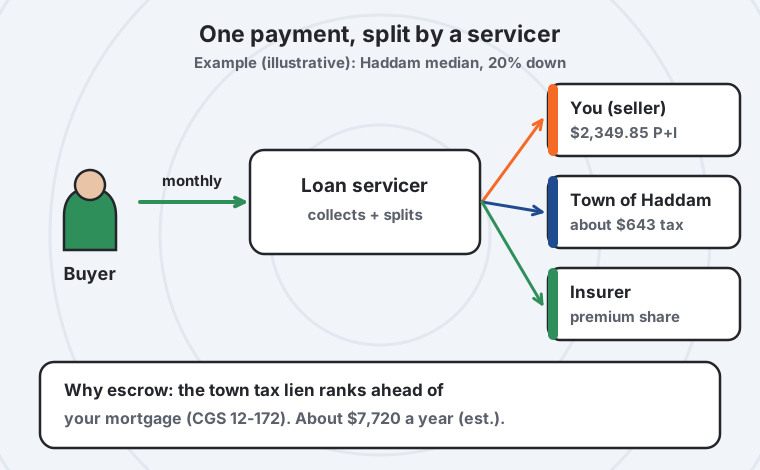
Here is why this matters on the Haddam example. Tax on the median is about $7,720 a year (est.: $441,500 x 70% assessment x 24.98 mills), or about $643 a month. If the buyer quietly skips two years of taxes, the town’s lien grows with interest and sits ahead of your mortgage. You end up paying it to protect your own collateral.
Insurance is the same story. If the house burns and the policy lapsed, your security is a cellar hole. Require a policy with you named as mortgagee, so the insurer must notify you before cancelling and pays you first on a claim, and ask for proof every year.
A servicer does the dull work. A loan servicing company collects the payment, splits it into principal, interest and escrow, pays the town and the insurer, tracks late payments, and sends both of you year-end statements. The IRS expects you to report the interest you receive each year, and when the house is the buyer’s home, you and the buyer exchange names, addresses and Social Security numbers for that reporting (IRS Pub 537). Paying a servicer a modest monthly fee also keeps the relationship businesslike: the servicer sends the late notice, not you.
A well-serviced note with a clean payment history is also the kind you can sell later if you need cash; see selling a private mortgage in Connecticut and selling a real estate note.
What default and payoff clauses should a seller-financing note include?
A seller-financing note in Connecticut should include a grace period and late charge, a clear definition of default (missed payment, lapsed insurance, unpaid taxes, unapproved transfer or second mortgage, letting the house deteriorate), the right to accelerate the whole balance after written notice and a cure period, the right to recover attorney fees, and the payoff and release terms.
When a buyer stops paying, you foreclose in Superior Court like any bank; Connecticut courts usually order strict foreclosure with Law Days (CGS 49-24), and the buyer may ask for foreclosure mediation. The pillar guide walks through what happens when an owner-financed buyer defaults. What you control is how clearly the note says when that process can start.
| Clause | What it says | Why you want it |
|---|---|---|
| Grace period and late charge | A payment is late after a set number of days; a late charge applies | Sets expectations; your attorney keeps the charge within Connecticut limits |
| Events of default | Missed payment, no insurance, unpaid taxes, sale or transfer, unapproved second mortgage, waste | Lets you act on the risks that hurt your collateral, not only missed checks |
| Notice and cure | Written notice and a set number of days to fix the default | Fair to the buyer and makes your case cleaner in court |
| Acceleration | After an uncured default, the full balance becomes due | Needed to foreclose on the whole loan, not one payment at a time |
| Due-on-sale | The balance is due if the buyer sells or transfers the house | Stops your buyer from handing your loan to a stranger |
| Attorney fees and costs | The buyer pays reasonable collection and foreclosure costs on default | Shrinks the cost of enforcing |
| Prepayment | The buyer may pay off early, with or without a fee you agree | Early payoff is usually good news; most sellers allow it |
| Balloon and extension | Balloon date, and whether a one-time extension is available, at what rate | Decides now what happens if the buyer cannot refinance |
When the buyer finally pays off, you must release the mortgage on the land records; a lender that fails to release after a written request can owe damages (CGS 49-8). A good servicer handles that step too.

The sellers who sleep well are the ones who treated it like a loan from day one: a real down payment, a servicer, tax escrow, and a note that says exactly what happens on day 31 without a payment. The terms that feel unfriendly at the kitchen table are the ones that keep a friendly deal friendly for ten years.
When is a listing or a cash sale better than seller financing?
A listing or a cash sale is better than seller financing when you need most of your equity within a year or two, when the buyer cannot make a real down payment or pass a basic credit check, when you still owe on the house, or when you do not want to manage a loan, escrow and a possible foreclosure. A listing usually nets the most at closing for a house in good shape.
List with an agent
Paid in fullUsually the highest price at closing for a house in good condition.
- Buyer brings a bank loan
- Commission and a few months
- No loan to manage afterwards
Seller financing, done right
Down payment + monthlyBest when the house is paid off and you do not need the cash.
- Can bring a higher price and interest
- You carry default and refinance risk
- Attorney, servicer and escrow for years
Cash sale, as-is
About 2 weeksTypical time from first call to closing with us.
- No repairs, no showings
- Paid in full; nothing to collect later
- Lower price; the honest trade-off
We are Jerryll Noorden’s company, We Buy Houses In Connecticut, and we buy houses ourselves, about 10 a year since 2016. A cash offer is below a full retail listing, and why cash offers are lower explains the math. We also buy in more than one way, including on terms in some cases; our page on the ways we buy houses in Connecticut lists each one plainly.
When you should NOT sell to a cash buyer
- Your house is in good shape and you can wait a few months: a listing will likely net you more.
- You have a qualified buyer, a big down payment and no need for the cash: well-structured seller financing may pay you more over time.
- Anyone asks for an upfront fee or for your deed before closing: walk away and read we buy houses scam red flags.
To compare a listing’s net with your financing plan in your own town, use the calculator below.
How much would you walk away with?
Slide the numbers to match your house. It works in your browser; nothing is saved or sent.
Estimates for planning. Conveyance tax per CGS 12-494 (state 0.75% up to $800,000, 1.25% to $2.5M, 2.25% above, plus the town rate). Seller attorney about $1,200 to $1,500; flat-fee MLS about $400; listings include three months of taxes, insurance and utilities, a cash sale about two weeks. Your attorney gives you the final numbers.
How do you set up a seller-financed sale step by step?
You set up a seller-financed sale in Connecticut in six steps: confirm your own mortgage and taxes, screen the buyer, agree the term sheet, have an attorney draft and record the documents, set up the servicer and escrow, and then monitor payments, taxes and insurance until the loan is paid off and released.
Check your side first
Get your mortgage payoff (if any), your tax bills and your insurance. If you still owe, solve the due-on-sale question before talking terms.
Screen the buyer
Credit report with written permission, income, debts, down payment source, references. Write down how you decided.
Agree a one-page term sheet
Price, down payment, rate, schedule, balloon and extension, escrow, late charge, closing date. See a full example in owner financing terms, worked on an Essex house.
Hire a Connecticut attorney
Contract, note, mortgage, title policy, disclosure report, smoke and CO affidavit, conveyance tax, closing and recording.
Set up servicing and escrow
Choose a loan servicing company before closing so the first payment goes to the right place, with tax and insurance escrow from month one.
Monitor until payoff
Check each year that taxes are paid and insurance is in force. Plan for the balloon a year ahead. Release the mortgage when paid (CGS 49-8).
If you want a cash number to put next to your financing plan before you commit, book a short call. No obligation and no pressure; take whatever time you need to compare.
See the house together.
Pick a time that works.
Choose a time for us to walk through the property with you, or ask for a quick call first. We confirm every request personally.
Tuesday, January 13
No open times in the next few weeks. Please call us.
We will confirm by email. Nothing is booked until we do.
View my requestSeller financing tips: questions Connecticut sellers ask
What is a typical down payment for seller financing?
A typical down payment for seller financing is often 10% to 20% of the price, and careful sellers aim for at least enough to cover a year of missed payments plus legal costs. On a $441,500 Haddam house, 10% is $44,150 and 20% is $88,300 (example, illustrative).
What interest rate should I charge on owner financing in Connecticut?
The interest rate you charge on owner financing in Connecticut should be fixed and at least the IRS applicable federal rate for the note’s term (mid-term 4.61% in October 2026), or the IRS treats part of each payment as interest anyway (Pub 537). Connecticut’s 12% cap generally does not apply to a bona fide mortgage over $5,000 (CGS 37-9(3)).
Should a seller-financed loan have a balloon payment?
A seller-financed loan can have a balloon payment if you finance under the federal one-property exclusion, but not under the three-property exclusion, which requires full amortization (12 CFR 1026.36). Set the balloon date for when the buyer can realistically refinance, and write down what happens if they cannot.
Who pays the property taxes in owner financing?
The buyer pays the property taxes in owner financing, because the buyer owns the house from closing. The safe way is for the buyer to pay one-twelfth of the yearly tax with each monthly payment into escrow, so the town’s tax lien, which ranks ahead of your mortgage (CGS 12-172), never builds up.
Do I need a loan servicer for a seller-financed note?
You do not legally need a loan servicer for a seller-financed note, but one is strongly recommended. A servicer collects payments, runs the tax and insurance escrow, tracks late fees, keeps the records a court or a note buyer will want, and sends the year-end interest statements.
Can I run a credit check on a buyer who wants owner financing?
Yes, you can run a credit check on a buyer who wants owner financing, with the buyer’s written authorization. Apply the same written standards to every buyer, and do not decide based on a protected class such as race, disability, familial status or lawful source of income (CGS 46a-64c).
Do I need an attorney to do owner financing in Connecticut?
Yes, you need an attorney to do owner financing in Connecticut in practice: closings are conducted by attorneys, and the note, mortgage, recording and lender’s title policy are legal documents. A flat attorney fee is small next to the cost of a single year of missed payments.
Do I pay conveyance tax if I finance the sale?
Yes, you pay conveyance tax if you finance the sale, on the full price, not only the down payment. In most Connecticut towns that is 1.00% on a home up to $800,000 (CGS 12-494), or $4,415 on a $441,500 Haddam house.
Can the buyer sell the house before paying me off?
The buyer can sell the house before paying you off only by paying your loan at that closing, if your mortgage has a due-on-sale clause. That clause is one of the most important protections in your documents.
What happens if the buyer cannot refinance at the balloon?
If the buyer cannot refinance at the balloon, the note decides: a pre-agreed extension at a set rate, a renegotiation, or a default and foreclosure. Writing the extension terms into the note at the start avoids a forced decision years later.
Can I charge a late fee on a seller-financed loan?
Yes, you can charge a late fee on a seller-financed loan if the note says so. Your Connecticut attorney sets the grace period and the amount so they stay within any limits that apply to your loan.
Can I sell my owner-financing note later?
Yes, you can usually sell your owner-financing note later, usually at a discount from the balance. Notes with a large down payment, a recorded first mortgage, a title policy, escrow and a clean servicer payment history sell for more.
Is rent-to-own safer than seller financing?
Rent-to-own is not automatically safer than seller financing: you stay the owner, a non-paying occupant usually means an eviction, and the option must be handled carefully. It can fit a buyer who needs time to save a down payment; see our lease option and rent-to-own guide.
Related guides
- Owner financing terms, worked example on an Essex house
- Owner financing when you still have a mortgage
- Lease option and rent-to-own for sellers
- Subject-to real estate: how it works and the risks
- Taxes when selling a house in Connecticut
- Ways we buy houses in Connecticut
We buy houses across the state, including Haddam, Killingworth, Essex and Old Saybrook. For every route to a sale, see how to sell a house in Connecticut.
Plain-English information, not legal, tax or financial advice. Talk to a Connecticut real estate attorney and a tax professional before you agree to finance a sale.
Sources (checked on October 27, 2026)
- 12 CFR 1026.36(a)(4) and (a)(5) (federal seller-financer exclusions).
- CGS 37-4 and 37-9 (12% interest limit and the mortgage exemption).
- IRS Revenue Ruling 2026-19 (applicable federal rates, October 2026).
- IRS Publication 537, Installment Sales (unstated interest, reporting interest).
- CGS 47-10 (recording conveyances in the town land records).
- CGS 12-172 (property tax liens and their precedence).
- CGS 49-8 and 49-24 (mortgage release; strict foreclosure and foreclosure by sale).
- CGS 12-494 (real estate conveyance tax).
- CGS 20-327b and 20-327c (property condition report; $500 credit).
- CGS 29-453 (smoke and carbon monoxide affidavit).
- CGS 46a-64c (discriminatory housing practices).
- Connecticut OPM Real Estate Sales dataset (data.ct.gov) and OPM mill rates (Haddam).

Who wrote this
Jerryll Noorden
Jerryll has bought and sold Connecticut houses since 2016 and has sat at more closing tables than he can count, on both sides. Before real estate he was a robotics scientist at NASA, IHMC and IIT. He wrote this guide because the national sites that rank for it skip the Connecticut rules that cost sellers money. When listing or selling it yourself would get you more than a cash offer, he says so.
This guide explains Connecticut rules in plain English. It is not legal or tax advice. Laws change; for your sale, talk to a Connecticut real estate attorney and a tax professional.
