
Key facts at a glance
This guide works one complete set of owner financing terms on a typical Essex house, start to finish, and compares the result with a listing and a cash sale. It is part of our guide on how to sell a house in Connecticut. If you are still deciding whether owner financing is wise at all, start with is owner financing a good idea for the seller in Connecticut; this page is the calculator on paper.
| Fact | Number | Source |
|---|---|---|
| Essex single-family median, sales Oct 2024 to Sep 2025 | $671,000 | Our town data (data.ct.gov sales file) |
| Essex mill rate, fiscal 2027 | 19.26 (about $9,050 a year on the median, est.) | CT OPM mill rates |
| Conveyance tax an Essex seller pays, up to $800,000 | 1.00% ($6,710 on $671,000), on the full price even when financed | CGS 12-494 |
| IRS mid-term applicable federal rate, October 2026 (notes over 3 and up to 9 years) | 4.61% (annual) | IRS Rev. Rul. 2026-19 |
| Home-sale gain exclusion if you lived there 2 of the last 5 years | $250,000 single; $500,000 married filing jointly | IRS Pub 523 |
| Connecticut income tax on gain and interest, top rate | 6.99% | CT DRS |
| Probate court for Essex estates | Saybrook Probate District (PD 33), Old Saybrook | ctprobate.gov; Town of Clinton |
| Court for a foreclosure if a buyer defaults | Middlesex Judicial District, Superior Court in Middletown | jud.ct.gov |
What does a full set of owner financing terms look like on an Essex house?
A full set of owner financing terms on an Essex house at the $671,000 single-family median could be: 20% down ($134,200), a $536,800 note at 7% fixed on a 30-year schedule, a monthly payment of $3,571.34 plus about $754 of tax escrow, and a balloon of $489,279.32 after 7 years. If everything goes right you collect $923,472 over 7 years, of which $252,472 is taxable interest.
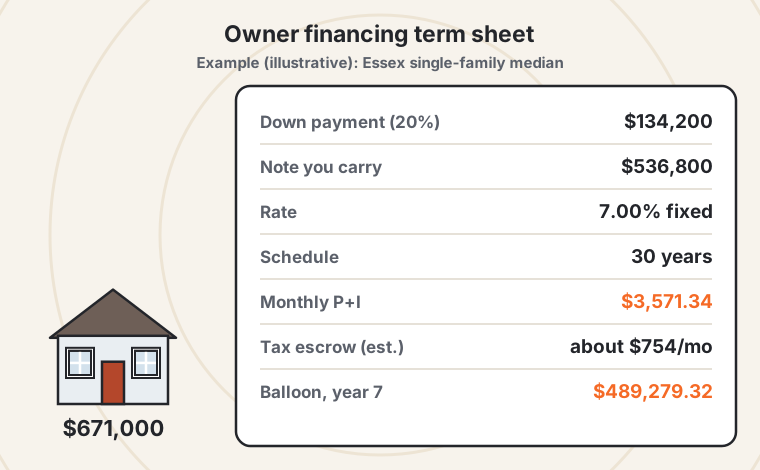
Every number on this page is an example (illustrative), computed from the Essex median and standard loan math. The rate, the 20% down payment, the 7-year balloon and the fees are assumptions chosen to be realistic, not recommendations. Change any input and the logic still holds.
Is this page for you if you want to see the real numbers before deciding?
This page is for you if you own an Essex house, probably paid off, and someone has told you that selling on terms would get you more, and you want to see exactly how much more, when it arrives and what it costs in tax and risk. Wanting numbers before a decision this big is sensible, not stubborn.
Many Essex owners asking this question have lived in their house for decades. The equity is the retirement plan, and the next step might be a smaller place nearby or near family. You may feel curious, because the monthly-income idea is attractive, and cautious, because you have seen what can go wrong with loans. You may be uneasy about taxes on a gain built up over 20 or 30 years, worried about liquidity because you may need money for the next home, and wary that whoever suggested financing has their own interest at heart.
Here is the Essex detail that frames everything: the single-family median is $671,000, under the $800,000 line where Connecticut’s state conveyance tax rate rises (CGS 12-494). So your conveyance tax is 1.00% of the full price, $6,710, due at closing whether the buyer pays you all at once or over seven years. That is the first of several places where financing changes when you get your money, not how much the state takes.
How were these owner financing terms chosen?
These owner financing terms were chosen to protect the seller while staying affordable for a buyer: a 20% down payment for a real cushion, a fixed 7% rate above the IRS minimum, a 30-year schedule to keep the payment manageable, a 7-year balloon to give the buyer time to refinance, and monthly escrow for Essex property tax and insurance.
| Term | Example value | Why |
|---|---|---|
| Price | $671,000 | Essex single-family median, Oct 2024 to Sep 2025 |
| Down payment | 20%, $134,200 | Covers more than 3 years of missed payments ($42,856 a year) |
| Note (loan you carry) | $536,800 | Price minus down payment; secured by a recorded first mortgage |
| Rate | 7.00% fixed | Above the October 2026 mid-term AFR of 4.61%; fixed as the federal seller-financer exclusions require |
| Payment schedule | 30 years | Keeps the payment at $3,571.34 |
| Balloon | Month 84 (year 7): $489,279.32 | Time for the buyer to qualify for a bank refinance |
| Escrow | About $754 a month for tax, plus insurance | $671,000 x 70% assessment x 19.26 mills, about $9,050 a year (est.) |
| Servicing | Third-party loan servicer | Collects, runs escrow, sends year-end statements |
A balloon is allowed when an individual finances one property in 12 months under the federal one-property exclusion; the stricter three-property exclusion requires full amortization (12 CFR 1026.36(a)(4)-(5)). Connecticut’s 12% cap generally does not apply to a bona fide mortgage over $5,000 (CGS 37-9(3)). The pillar guide has the full rule table, and seller financing tips for Connecticut explains how to choose each of these terms for your own buyer.
When does the money arrive, and how much is interest?
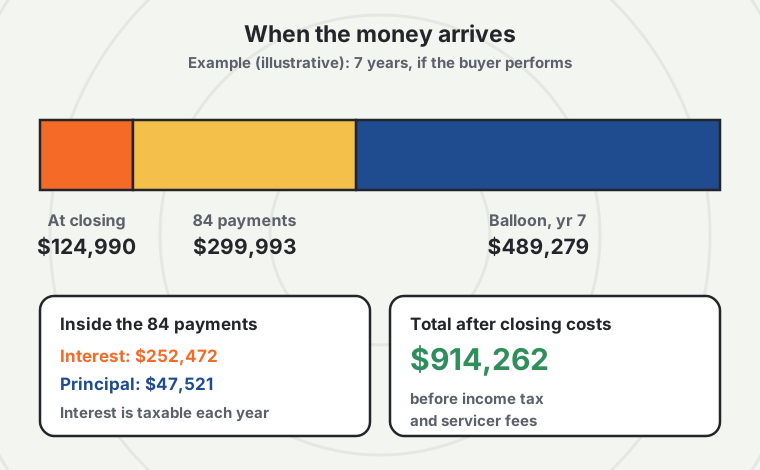
In the Essex example the money arrives in three pieces: $124,990 at closing after conveyance tax and attorney fees, $3,571.34 a month for 84 months ($299,992.88), and the $489,279.32 balloon in year 7. Of the monthly payments, $252,472 is interest and only $47,521 is principal, so the balloon carries most of your equity.
| Year | Payments received | Interest (taxable income) | Balance owed to you at year end |
|---|---|---|---|
| 1 | $42,856 | $37,403 | $531,347 |
| 2 | $42,856 | $37,009 | $525,500 |
| 3 | $42,856 | $36,586 | $519,230 |
| 4 | $42,856 | $36,133 | $512,507 |
| 5 | $42,856 | $35,647 | $505,298 |
| 6 | $42,856 | $35,126 | $497,568 |
| 7 | $42,856 + balloon $489,279 | $34,567 | $0 if the buyer refinances |
The early payments are almost all interest: $37,403 of the $42,856 you receive in year 1. After seven years the buyer still owes $489,279 of the $536,800, which is why the balloon decides whether the deal worked.
The totals if everything goes right:
- At closing: $134,200 down, minus $6,710 conveyance tax and about $2,500 attorney fees (est.) = $124,990.
- Monthly over 7 years: $299,992.88 ($252,472 interest, $47,521 principal).
- Balloon: $489,279.32.
- Total: $914,262 after closing costs ($923,472 before them), before income tax and servicer fees.
How is the Essex installment sale taxed?
The Essex installment sale is taxed in two parts: the interest is ordinary income every year, federally and in Connecticut, and the gain is reported as principal arrives using the gross profit percentage (IRS Pub 537, Form 6252). If the house was your main home, the $250,000 or $500,000 exclusion comes off first; in this example a married couple owes no gain tax at all, and a single owner reports 16.66% of each principal dollar as gain.
Assume (illustrative) the owner bought in 2001 for $260,000 and spent $40,000 on improvements, so the basis is $300,000. Selling expenses are the $6,710 conveyance tax and $2,500 attorney fee.
| Line | Single owner | Married, filing jointly |
|---|---|---|
| Selling price | $671,000 | $671,000 |
| Minus basis and selling expenses ($300,000 + $9,210) | -$309,210 | -$309,210 |
| Gain | $361,790 | $361,790 |
| Home-sale exclusion (IRS Pub 523) | -$250,000 | -$361,790 (up to $500,000) |
| Gain to report | $111,790 | $0 |
| Gross profit percentage (gain to report / $671,000 contract price) | 16.66% | 0% |
| Gain in year of sale on the $134,200 down payment | $22,358 | $0 |
| Gain on principal in the monthly payments, 7 years ($47,521) | $7,917 | $0 |
| Gain in year 7 on the balloon ($489,279) | $81,515 | $0 |
| Interest, ordinary income, 7 years | $252,472 | $252,472 |
What this shows: for many long-time Essex owners, the installment method matters less than people think, because the home-sale exclusion already shelters most or all of the gain. The part that is always taxable is the interest, and it is a lot: $252,472 over seven years, taxed at ordinary rates federally and by Connecticut (top rate 6.99%). Spreading a single owner’s $111,790 gain does help, because most of it lands in year 7 instead of all in the year of sale, but it is still taxed when it arrives.
Two more rules from Pub 537 matter here. If your rate were below the applicable federal rate, the IRS would treat part of each payment as interest anyway; 7% is comfortably above the October 2026 mid-term rate of 4.61%. And because the buyer lives in the house, you and the buyer exchange Social Security numbers for interest reporting. For the rest of the Connecticut tax picture, see taxes when selling a house in Connecticut.
How does owner financing compare with listing or a cash sale for this Essex house?
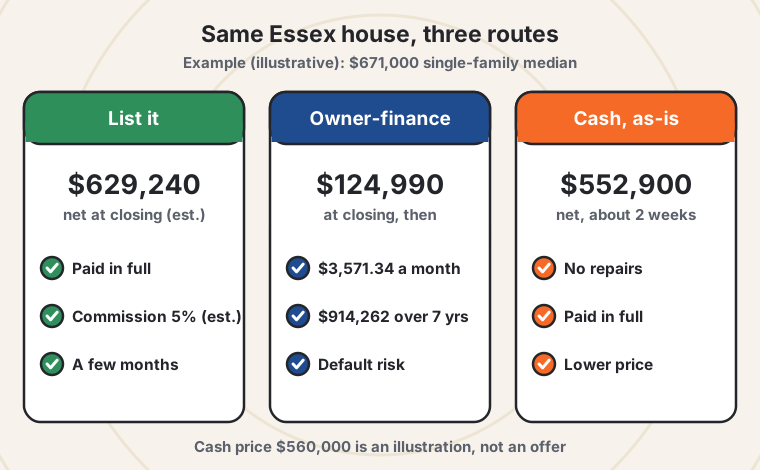
Owner financing pays the most for this Essex house in total, $914,262 over 7 years after closing costs, but only $124,990 at closing. A listing nets about $629,240 at closing (est.) after a 5% commission, conveyance tax and attorney fees. An illustrative cash sale at $560,000 nets about $552,900 in about two weeks with no repairs. The extra from financing is mostly interest for lending $536,800 for seven years.
| Line | List it | Owner-finance it | Cash sale (illustrative) |
|---|---|---|---|
| Price | $671,000 | $671,000 | $560,000 |
| Commission (est. 5%) | -$33,550 | $0 (buyer found directly) | $0 |
| Conveyance tax (1.00%) | -$6,710 | -$6,710 | -$5,600 |
| Attorney (est.) | -$1,500 | -$2,500 | -$1,500 |
| Cash to you at closing | $629,240 | $124,990 | $552,900 |
| Paid later | None | $299,993 monthly + $489,279 balloon | None |
| Total over 7 years, before income tax | $629,240 | $914,262 | $552,900 |
| Repairs, showings | Usually yes | Buyer’s choice | No |
| Risk after closing | None | Default, condition, refinance | None |
The honest reading: the listing and cash numbers are money you can put to work on closing day, for your next home or in a savings account that also earns interest. Owner financing’s larger total is the reward for lending $536,800 to one person for seven years, with the house as security. That can be a good trade if you do not need the money and you trust the buyer’s finances. It is a poor one if you need $400,000 for your next house next spring.
Use the calculator to check the listing column with your own price and payoff.
How much would you walk away with?
Slide the numbers to match your house. It works in your browser; nothing is saved or sent.
Estimates for planning. Conveyance tax per CGS 12-494 (state 0.75% up to $800,000, 1.25% to $2.5M, 2.25% above, plus the town rate). Seller attorney about $1,200 to $1,500; flat-fee MLS about $400; listings include three months of taxes, insurance and utilities, a cash sale about two weeks. Your attorney gives you the final numbers.
We are Jerryll Noorden’s company, We Buy Houses In Connecticut. We buy houses ourselves, about 10 a year since 2016, and a cash price is below a full retail listing; why cash offers are lower shows how that number is built. We also buy in other ways, including on terms in some cases, listed plainly on the ways we buy houses in Connecticut.
What changes if the Essex buyer stops paying or cannot refinance?
If the Essex buyer stops paying, you foreclose in the Superior Court for the Middlesex Judicial District, usually by strict foreclosure (CGS 49-24), and each year of missed payments in this example is $42,856 plus any tax you advance. If the buyer cannot refinance at the balloon, you choose between an extension written into the note, a renegotiation or a default.
Say the buyer pays for two years and stops. They still owe $525,500. If getting the house back takes a year, that is $42,856 of payments you did not receive, plus your attorney, plus about $9,050 of Essex property tax you may pay to keep the town’s lien from growing, plus repairs if the house comes back worn. The $134,200 down payment is your cushion, and in this example it covers that year with room to spare. With 5% down, it would not.
The balloon is the quieter risk. If rates are higher in year 7 or the buyer’s income dropped, the bank may say no. Decide now, in the note, whether you would offer a one-time extension and at what rate. The pillar guide explains what a Connecticut default looks like from the seller’s side.
Everything above assumes the house is paid off. If you still owe, your lender’s due-on-sale clause comes first; read owner financing with an existing mortgage before you agree to terms.
Which route fits which Essex seller, and when should you not sell for cash?
Owner financing fits an Essex seller who owns the house outright, does not need most of the money for years, has a buyer with a real down payment and checked finances, and wants interest income. A listing fits a seller with a house in good shape and a few months. A cash sale fits a seller who values speed, certainty and no repairs over the top price.
When you should NOT sell to a cash buyer
- Your Essex house is updated and you can wait for a listing: a listing will likely net you more, as the table shows.
- You have a strong buyer with 20% down and you want income, not a lump sum: well-documented owner financing may serve you better.
- Someone asks you for a fee to buy your house, or for your deed before closing: walk away and read we buy houses scam red flags.
Write down when you need the money
Next home, care costs, gifts to family. If you need most of it within two years, the balloon is too late.
Price the three routes
Get an agent’s pricing opinion, a written cash offer and a financing model like the one above. Compare with how to compare offers.
Screen the buyer
Credit, income, debts and the down payment’s source, with written permission.
See a tax preparer and a Connecticut attorney
Basis, exclusion, installment method; note, mortgage, title policy, escrow and default terms.
Close and service
A listing takes a few months; a cash sale with us typically about two weeks, on the date you pick. A financed sale closes like a normal sale, then a servicer takes over.
If you want a cash number for your Essex house to put next to your financing plan, book a short call. No obligation; take whatever time you need.
See the house together.
Pick a time that works.
Choose a time for us to walk through the property with you, or ask for a quick call first. We confirm every request personally.
Tuesday, January 13
No open times in the next few weeks. Please call us.
We will confirm by email. Nothing is booked until we do.
View my requestOwner financing terms: questions Essex sellers ask
What is a typical owner financing term in Connecticut?
A typical owner financing term in Connecticut is a fixed rate on a 30-year payment schedule with a balloon after 5 to 7 years, when the buyer refinances with a bank. In our Essex example that is $3,571.34 a month and a $489,279.32 balloon at year 7.
How is a balloon payment calculated?
A balloon payment is the loan balance still owed on the balloon date. On a $536,800 note at 7% with a 30-year schedule, the balance after 84 payments of $3,571.34 is $489,279.32, so that is the balloon.
How much interest does a seller earn on owner financing?
A seller earns the interest built into each payment. In the Essex example, the seller earns $252,472 of interest over 7 years on a $536,800 note at 7%, all of it taxable income each year.
Do I pay capital gains tax all at once with owner financing?
No, you usually do not pay capital gains tax all at once with owner financing. Under the installment method you report gain as principal arrives, using the gross profit percentage (IRS Pub 537), after subtracting any home-sale exclusion. You can elect to report it all in the year of sale.
What is the gross profit percentage?
The gross profit percentage is the share of each principal payment that is taxable gain: gross profit divided by the contract price. In the single-owner Essex example it is $111,790 / $671,000, or 16.66%.
What interest rate is legal for owner financing in Connecticut?
Connecticut’s 12% cap generally does not apply to a bona fide mortgage of real property over $5,000 (CGS 37-9(3)), so it rarely limits a house loan. The practical floor is the IRS applicable federal rate (4.61% mid-term in October 2026); below it, the IRS treats part of each payment as interest.
Who pays property taxes after an owner-financed sale?
The buyer pays property taxes after an owner-financed sale, because the buyer owns the house. Collect about $754 a month into escrow in the Essex example, so unpaid taxes never become a town lien ahead of your mortgage.
Is owner financing better than listing my Essex house?
Owner financing is better than listing your Essex house only if you do not need most of the money for years and you have a well-screened buyer with a real down payment. A listing puts about $629,240 in your account at closing in the example; financing pays more in total, later, with risk.
Can I sell the note if I need cash before the balloon?
Yes, you can usually sell the note before the balloon, at a discount from the balance. A large down payment, a recorded first mortgage, a title policy and a clean servicer payment history make the note worth more; see our guide to selling a real estate note.
Related guides
- Seller financing tips: the six decisions
- Owner financing when you still have a mortgage
- Selling a real estate note
- Lease option and rent-to-own for sellers
- Connecticut conveyance tax by town
- Pros and cons of an open house in Essex
Looking for a cash offer instead? See we buy houses in Essex, CT, or nearby Old Saybrook and Westbrook. For every route to a sale, see how to sell a house in Connecticut.
Plain-English information, not legal, tax or financial advice. Talk to a Connecticut real estate attorney and a tax professional before you agree to finance a sale.
Sources (checked on October 27, 2026)
- Connecticut OPM Real Estate Sales dataset (data.ct.gov) and OPM mill rates (Essex).
- IRS Publication 537, Installment Sales and Form 6252.
- IRS Publication 523, Selling Your Home.
- IRS Revenue Ruling 2026-19 (applicable federal rates, October 2026).
- Connecticut Department of Revenue Services (income tax rates).
- 12 CFR 1026.36(a)(4) and (a)(5) (federal seller-financer exclusions).
- CGS 37-4 and 37-9 (interest limit and mortgage exemption).
- CGS 12-494 (real estate conveyance tax).
- CGS 49-24 (strict foreclosure and foreclosure by sale).
- Connecticut Judicial Branch, Middlesex Judicial District.
- Connecticut Probate Courts (Saybrook Probate District).

Who wrote this
Jerryll Noorden
Jerryll has bought and sold Connecticut houses since 2016 and has sat at more closing tables than he can count, on both sides. Before real estate he was a robotics scientist at NASA, IHMC and IIT. He wrote this guide because the national sites that rank for it skip the Connecticut rules that cost sellers money. When listing or selling it yourself would get you more than a cash offer, he says so.
This guide explains Connecticut rules in plain English. It is not legal or tax advice. Laws change; for your sale, talk to a Connecticut real estate attorney and a tax professional.
