
Key facts at a glance
This New Britain guide is part of our series on how to sell a house in Connecticut and our main guide to selling a mobile home in Connecticut. It answers one question: how does an investor decide what to offer for your mobile home, and is that number fair?
| Fact | Number | Source |
|---|---|---|
| Median of recorded Connecticut sales described as mobile or manufactured homes, Oct 2024 to Sep 2025 | $105,500 (178 sales) | CT OPM Real Estate Sales, data.ct.gov (our query) |
| Middle half of those sales | $74,900 to $150,000 | CT OPM Real Estate Sales (our query) |
| Active mobile home park licenses with a New Britain address | 0 (Berlin 2, Plainville 1, Bristol 4, Southington 5) | DCP license records, data.ct.gov |
| New Britain mill rate, fiscal 2027 | 39.18 mills | CT OPM mill rates |
| Conveyance tax on a New Britain sale | 1.25% (0.75% state + 0.50% city) | CGS 12-494, 12-412c |
| New Britain median single-family sale, Oct 2024 to Sep 2025 | $285,000 | CT OPM Real Estate Sales |
| Days a park has to approve or deny your buyer | 10 days, in writing | CGS 21-79(d) |
Why is it hard to trust an investor’s offer on a mobile home?
It is hard to trust an investor’s offer on a mobile home because there are few public sales to compare against, the park adds rules most people have never read, and the offer usually arrives with no explanation of how it was built. Owners in New Britain at this point often feel suspicious, rushed, a little embarrassed about the home’s condition, and worried that “cash” means “lowball”.
A house in New Britain has hundreds of sales a year to compare against: 768 recorded residential sales from October 2024 to September 2025 (CT OPM). A mobile home has a handful, scattered across parks in neighboring towns. So when someone offers you a number for your home, you have almost nothing to check it against.
I’m Jerryll Noorden. I’ve bought houses in Connecticut since 2016, and we buy mobile homes too. I’m going to show you the math an investor uses, line by line, so you can check any offer, including ours. Sometimes the math shows you should sell to a neighbor or a park resident instead. If you own a mobile home near New Britain and a cash buyer has come up, this page is for you.
How does an investor price a mobile home in New Britain?
An investor prices a mobile home near New Britain by starting with what it would sell for fixed up, then subtracting repairs, months of lot rent and taxes while it’s resold, resale costs including New Britain’s 1.25% conveyance tax, and a profit margin for risk. On a home worth $105,500 fixed, that math lands at about $68,262 in our example, roughly 65% of the fixed-up value.
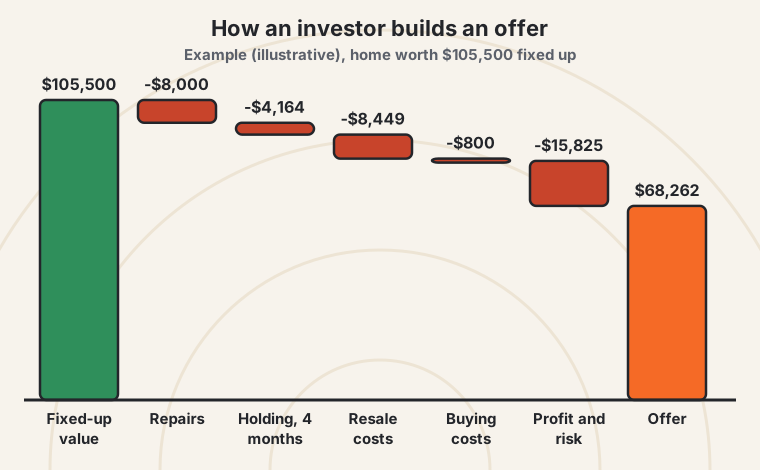
Example (illustrative). A home in a park near New Britain. Fixed up, it would sell for $105,500, the statewide median of recorded mobile home sales. It needs about $8,000 of work (est.). Lot rent is $650 a month (an assumption, not a Connecticut average). Property tax is about $241 a month at New Britain’s 39.18 mills, and insurance and utilities about $150 (est.).
| Line in the investor’s math | Amount | Where it comes from |
|---|---|---|
| Fixed-up resale value | $105,500 | Recent sales of similar homes (CT OPM median) |
| Repairs | -$8,000 | Roof, floors, paint, cleanout (est.) |
| Holding costs, 4 months at $1,041 | -$4,164 | Lot rent, property tax, utilities while fixing and reselling |
| Resale costs | -$8,449 | 6% commission $6,330 (est.), 1.25% conveyance tax $1,319, attorney $800 (est.) |
| Buying costs | -$800 | Attorney and recording (est.) |
| Profit and risk, 15% of resale | -$15,825 | Investor margin (est.) |
| Offer | $68,262 | About 65% of fixed-up value |
The general version of this math for houses is in our explainer on why cash offers are so low. Mobile homes follow the same logic, with two extra lines: lot rent and park approval.
What five things move an investor’s offer on a mobile home?
The five things that move an investor’s offer on a mobile home are its age and HUD label, the park and its rules, the lot rent, the repairs it needs, and recent resale prices in that park. Age and label decide who can finance it; the park and rent decide who will want to live there; repairs and comparable sales set the numbers in the math.

Age and the HUD label
Homes built on or after June 15, 1976 carry a HUD certification label on each section (24 CFR 3280.11). A pre-1976 home, or one with missing labels, mostly sells to cash buyers, which lowers the resale value in the investor’s math. If labels are missing, IBTS can often issue a letter of label verification (HUD); having it ready can raise offers.
The park
The investor’s buyer has to pass the park’s application, and the park can deny for good cause, including a belief the buyer can’t pay the rent (CGS 21-79(d)). A park that is well kept, has a clear application process and answers in writing within its deadlines is worth more to every buyer. A park under a closure notice is worth much less.
Lot rent
A resident buyer compares lot rent plus any loan payment with renting an apartment. Every $100 a month of extra lot rent costs the investor $400 over a four-month resale, and it also shrinks the pool of buyers. Parks can raise rent only at the end of a rental agreement, with 30 days’ notice, in line with comparable lots (CGS 21-80(b)(5)), so ask whether an increase is already scheduled.
Repairs
Investors subtract repairs dollar for dollar and usually pad them, because they can’t see under the floor or above the ceiling. Soft floors, roof leaks and an old furnace hurt most. Our Ansonia guide prices the common mobile home repairs before selling.
Resale comparables
Park resales are recorded on the town land records (CGS 21-67a), so real prices exist. Plainville, just west of New Britain, recorded four sales flagged as mobile homes from October 2024 to September 2025, ranging from $47,900 to $210,000 (CT OPM). That spread is why the investor wants comparables from your own park.
Where are the mobile home parks near New Britain?
The mobile home parks near New Britain are licensed under neighboring towns, not New Britain itself. The Department of Consumer Protection’s license list shows no active mobile home park with a New Britain address; active licenses list addresses in Berlin (2), Plainville (1), Bristol (4) and Southington (5). New Britain’s own numbers still apply if your home is in the city: 39.18 mills and a 1.25% conveyance tax.
New Britain is a dense city of older houses: 78% of its single-family homes were built before 1960, and the median single-family sale was $285,000 from October 2024 to September 2025 (CT OPM). For a buyer priced out of that, a mobile home in a nearby park can be the most affordable way to own a home in central Connecticut, which is the demand an investor is counting on when it resells.
Two cautions on the local data. The license list shows the address each licensee gave, which can be an office rather than the park itself; your park must post its license at the park (CGS 21-65a). And no recorded sale inside New Britain was flagged as a mobile home in the state data for that period, which may reflect how sales are labeled rather than a total absence.
Whether your home is in a park or on land you own changes almost everything, from who can finance it to whether the park’s approval applies. The main guide explains how Connecticut treats a mobile home on leased versus owned land.
How can you tell if an investor’s offer on your mobile home is fair?
You can tell if an investor’s offer on your mobile home is fair by asking for the math behind it and checking each line: the fixed-up value against recorded sales, the repairs against a contractor’s quote, the holding costs against your real lot rent and tax bill. A fair offer comes in writing, with no fee, no deadline pressure, and a contract that depends on the park’s approval.
Questions to ask any buyer, including us:
- What fixed-up value are you using, and which sales is it based on?
- What repairs did you price, and roughly how much for each?
- Is the offer the price I receive, or are there fees or deductions at closing?
- Is the contract subject to park approval of you as the new resident (CGS 21-79(d))?
- Who records the transfer document and pays the conveyance tax return (CGS 21-67a, 12-494)?
- Will you buy the home yourself, or assign the contract to someone else?
- When do I get paid, and can I choose the closing date?
That last question about assignment matters. Some buyers sign a contract and then sell it to another investor for a fee. Our guide on selling to a wholesaler explains what to watch for, and how to check a cash buyer covers the background checks. Never sign over ownership before the park approves the buyer and the transfer is recorded through an attorney.
What are your options besides selling to an investor?
Your options besides selling your mobile home to an investor are to sell it yourself to someone who will live in it, list it with an agent or dealer who handles manufactured homes, or fix it first and then sell. On our New Britain example, fixing and selling yourself nets about $92,258 against about $66,088 from an investor, about $26,170 more, if you can fund the repairs and wait about three months.
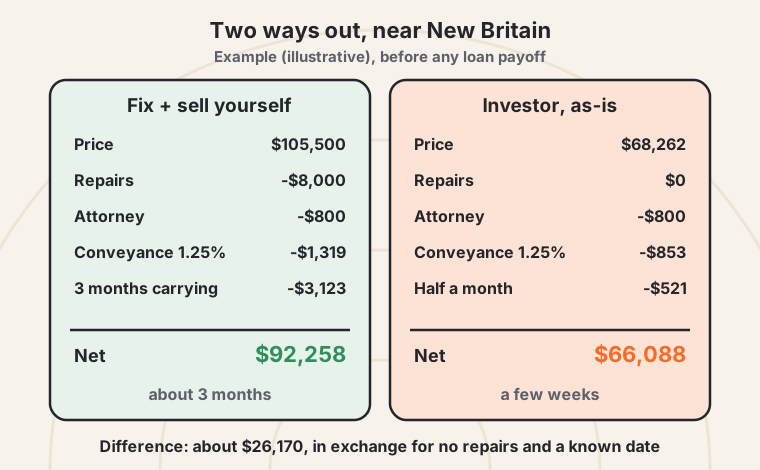
| Line | Fix and sell yourself | Investor, as-is |
|---|---|---|
| Sale price | $105,500 | $68,262 (example) |
| Repairs (est.) | -$8,000 | $0 |
| Attorney (est.) | -$800 | -$800 |
| Conveyance tax, 1.25% | -$1,319 | -$853 |
| Carrying costs at $1,041 a month | -$3,123 (3 months) | -$521 (half a month) |
| Net before any loan payoff or back taxes | $92,258 | $66,088 |
The investor route makes sense when you can’t fund $8,000 of repairs, the home is empty and costing you about $1,041 a month, the park has flagged problems you can’t fix, or you need a firm date. If none of that applies, the open market will usually pay you more.
When should you NOT sell your mobile home to an investor?
You should not sell your mobile home to an investor when it’s in good condition, the park has approved it for resale, and a resident buyer is likely to come along within a few months. In that situation an investor’s discount, about a third of the fixed-up value in our example, buys you speed you don’t need. Also wait if your park has announced a closure, because you may be owed relocation money.
- A neighbor or relative wants it. Have an attorney prepare the transfer document and keep the difference.
- The park is closing or changing use. Owner-residents can be entitled to relocation payments of up to $10,000 (CGS 21-70a) and at least 545 days’ notice (CGS 21-80(b)(1)(E)). Get advice before you sell.
- Anyone asks for an upfront fee or pressures you to sign the same day. See our scam red flags.
How do you sell a mobile home to an investor, step by step?
To sell a mobile home to an investor step by step: gather your papers and tax balance, request the park’s written condition statement, get two or three written offers with the math, sign a contract subject to park approval, and close through an attorney who records the transfer on the land records. Back taxes and any lot rent arrears are usually paid from the sale.
Gather papers
Ownership document, HUD data plate and label numbers, rental agreement, park rules, and the tax collector’s balance (CGS 21-67a(c)).
Ask the park for its condition statement
In writing. The park has 20 days, and silence counts as approval (CGS 21-79(e)). An investor who will rent or resell the home needs to know what the park will require.
Get offers with the math shown
Use the questions above. Compare each offer with what selling it yourself would net.
Sign subject to park approval
The park has 10 days from a complete application to approve or deny the buyer in writing (CGS 21-79(d)).
Close through an attorney
The transfer document names the home, park, lot and taxes owed, and is recorded with the conveyance tax return; taxes due are paid first (CGS 21-67a(c), 12-494).
If you’d like a written offer with the math shown, our New Britain page is the place to start. For all the legal steps of a park sale, see the Connecticut mobile home selling guide.
Questions about selling a mobile home to an investor near New Britain
How much will an investor pay for my mobile home?
An investor will usually pay what your mobile home would sell for fixed up, minus repairs, holding costs, resale costs and a profit margin. In our New Britain example that is about $68,262 on a home worth $105,500 fixed, about 65%. Your home’s age, park, lot rent and condition will move that number.
Do I have to fix my mobile home before selling to an investor?
No, you don’t have to fix your mobile home before selling to an investor; they buy as-is and subtract repairs from the price. The park may still require items fixed before it approves the home for resale in place (CGS 21-79(e)).
Does the park have to approve an investor as the buyer?
Yes, the park generally has to approve the buyer of a home that stays in the park, including an investor, under its entry requirements applied equally to all. It can deny only for good cause and must answer in writing within 10 days of a complete application (CGS 21-79(d)).
What is the conveyance tax on a mobile home sale in New Britain?
The conveyance tax on a mobile home sale in New Britain is 1.25% of the price: 0.75% to the state and 0.50% to the city (CGS 12-494). Resales in licensed parks are taxed as conveyances of realty (CGS 12-412c). On $68,262 that is about $853.
How is a mobile home taxed in New Britain?
A mobile home in New Britain is assessed like residential real property, at 70% of value, in the owner’s name (CGS 12-63a, 12-62a). At 39.18 mills, a home worth $105,500 pays about $2,893 a year (est.).
Can I sell to an investor if I owe back taxes or lot rent?
Yes, you can sell to an investor if you owe back taxes or lot rent. Taxes due must be paid before the buyer can take over the lot (CGS 21-67a(c)), so they are usually paid from the sale proceeds at closing, along with any rent arrears the park requires.
Is it better to sell my mobile home to the park owner?
Selling to the park owner can be convenient, but compare it with other offers. The park can’t take a commission unless you hired it in writing as your agent (CGS 21-79(e)), and you’re free to sell to any buyer the park approves.
How fast can an investor close on a mobile home?
An investor can close on a mobile home as fast as the park approval and the recording allow: up to 10 days for buyer approval (CGS 21-79(d)), plus the attorney’s title and tax checks. Asking for the park’s condition statement early saves time.
Do you buy mobile homes near New Britain?
We buy mobile homes, and we’ll show you the math behind our number. Start on our New Britain page or call (203) 529-4712.
Related guides
The mobile home series
Cash buyers, honestly
Towns in this series
For selling a regular house, see how to sell a house in Connecticut.
Plain-English information, not legal or tax advice. The New Britain example uses public data and labelled estimates; your home and your numbers will differ.
Sources (checked on October 27, 2026)
- CGS chapter 412: §§ 21-65a, 21-67a, 21-70a, 21-79, 21-80.
- CGS §§ 12-62a, 12-63a (assessment of mobile manufactured homes).
- CGS § 12-412c (resale taxed as a conveyance of realty).
- CGS § 12-494 (conveyance tax; New Britain 0.50% municipal rate).
- CT OPM, Real Estate Sales (data.ct.gov dataset 5mzw-sjtu): October 2024 to September 2025.
- State Licenses and Credentials (data.ct.gov): active mobile home park licenses.
- CT OPM mill rates (New Britain, fiscal 2027: 39.18).
- 24 CFR § 3280.11 (HUD certification label).
- HUD, Manufactured home labels.

Who wrote this
Jerryll Noorden
Jerryll has bought and sold Connecticut houses since 2016 and has sat at more closing tables than he can count, on both sides. Before real estate he was a robotics scientist at NASA, IHMC and IIT. He wrote this guide because the national sites that rank for it skip the Connecticut rules that cost sellers money. When listing or selling it yourself would get you more than a cash offer, he says so.
This guide explains Connecticut rules in plain English. It is not legal or tax advice. Laws change; for your sale, talk to a Connecticut real estate attorney and a tax professional.
