
Key facts at a glance
This Derby guide is part of our series on how to sell a house in Connecticut. The legal side of a park sale is in our main guide to selling a mobile home in Connecticut; this page is about presentation: getting the park on board early, the photos, and the paperwork buyers ask for.
| Fact | Number | Source |
|---|---|---|
| Days a park has to approve your home’s condition for resale or explain why not | 20 days | CGS 21-79(e) |
| How long a park’s condition approval stays valid | Up to 6 months | CGS 21-79(e) |
| Days a park has to approve or deny your buyer | 10 days | CGS 21-79(d) |
| Median of recorded sales described as mobile homes in Shelton, next to Derby, Oct 2024 to Sep 2025 | $144,000 (25 sales) | CT OPM Real Estate Sales (our query) |
| Same, statewide | $105,500 (178 sales) | CT OPM Real Estate Sales (our query) |
| Derby mill rate, fiscal 2027 | 38.44 mills | CT OPM mill rates |
| Conveyance tax on a Derby sale | 1% (0.75% state + 0.25% town) | CGS 12-494, 12-412c |
Why is it hard to make a mobile home stand out when you sell?
It is hard to make a mobile home stand out when you sell because buyers compare it with every other home in the park, most of them similar in size and layout, and because the things that worry buyers most, the park, the lot rent, the paperwork and financing, never show up in a photo. Sellers at this point often feel discouraged, unsure what is worth fixing, anxious about the park manager, and tired of waiting.
A Derby-area mobile home is often the most affordable way to own a home in the Valley. The median single-family house in Derby sold for $357,500 from October 2024 to September 2025 (CT OPM), so buyers are out there. The trouble is that they hesitate. They aren’t sure the park will approve them, what the rent will be next year, or whether the home has a HUD label a lender will accept.
I’m Jerryll Noorden. I’ve bought houses in Connecticut since 2016, and we buy mobile homes too. On this page I’ll show you how to answer those doubts before a buyer has to ask, which is what makes a mobile home stand out. If you’re getting your Derby-area home ready to sell, this page is for you.
How do you make a mobile home stand out when selling in Derby?
You make a mobile home stand out when selling in Derby by doing six things other sellers skip: get the park’s written condition approval before you list, show the lot rent and what it covers, prepare a paperwork packet with the HUD label numbers and tax status, take bright photos of every room and the outside, make cheap visible fixes, and price against recent park sales. Buyers pay for certainty.
The six, in the order you should do them:
- Get the park’s condition approval first (CGS 21-79(e)).
- Put the lot rent, what it includes and the rent history in the listing.
- Build a buyer packet: ownership papers, HUD label, park rules, tax bill.
- Do the cheap, visible fixes: clean, skirting, entry steps, light.
- Take a full set of photos, inside and out.
- Price against real recorded sales nearby.
Why should you get the park’s approval before you list?
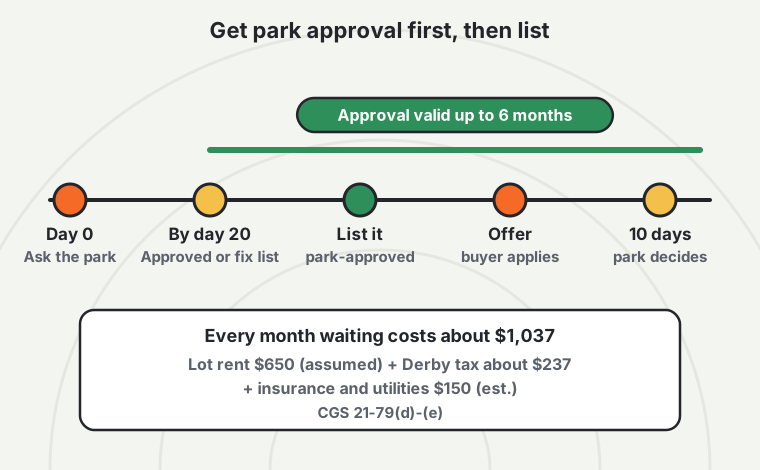
You should get the park’s approval before you list because the park has up to 20 days to approve your home’s condition or tell you in writing what it wants fixed, and an approval lasts up to six months (CGS 21-79(e)). If you list first, a buyer may walk when the park’s repair list arrives. A home that is “park-approved for resale” in the ad removes the biggest unknown.
How to do it:
- Ask in writing. A dated letter or email to the park office asking for a written statement of its intentions regarding the home’s condition for resale. Keep a copy. If the park doesn’t respond within 20 days, the law treats that as approval (CGS 21-79(e)).
- Read the aesthetic standards. The park must have filed its aesthetic standards for resale with the Department of Consumer Protection (CGS 21-70(e)), and it can’t hold your home’s size, original color or original materials against you if changing them would be an undue hardship (CGS 21-79(c)).
- Fix or dispute. If the park lists items, fix the reasonable ones and ask again. If you disagree, you can ask DCP for a declaratory ruling (CGS 21-79(e)).
- Ask for the buyer application now. Find out what the park needs from a buyer: credit, income, references. Put that in your listing so only qualified buyers call. The park must decide within 10 days of a complete application (CGS 21-79(d)).
While you wait, the home keeps costing you. In our Derby example, lot rent of $650 (an assumption), property tax of about $237 at 38.44 mills and $150 of insurance and utilities (est.) come to about $1,037 a month. Every month you shave off the sale is real money.
Why should your listing show the lot rent?
Your listing should show the lot rent because a buyer’s real monthly cost is the rent plus any loan payment and taxes, and a buyer who can’t see it assumes the worst. Showing the current rent, what it includes (water, sewer, trash, plowing), the date of the last increase, and the park’s rule that a new buyer can’t be charged more than the prevailing rent (CGS 21-79(e)) answers the question before it’s asked.
What to include:
- Current lot rent and what it covers. Your rental agreement must itemize every charge (CGS 21-82(d)).
- The rent history. When it last went up and by how much. Parks can raise rent only at the end of a rental agreement, with at least 30 days’ written notice, consistent with comparable lots (CGS 21-80(b)(5)). If you’ve received a notice of an increase, disclose it.
- No entrance fee. Connecticut bars rental agreements that let the park charge an entrance fee to a new resident (CGS 21-83(a)(7)). Saying so reassures buyers who’ve seen fees elsewhere.
- A monthly-cost line. For example: lot rent $650 + property tax about $237 = about $887 a month before utilities and any loan payment (Derby example, est.).
What paperwork do mobile home buyers ask for?
Mobile home buyers ask for proof of ownership, the HUD label and data plate details, the park’s rules and rental agreement, the lot rent history, and the tax status. Having those in one folder, or one PDF, before the first showing makes your home stand out, speeds the buyer’s lender and the park application, and lets your attorney prepare the transfer document required by CGS 21-67a without delays.

| Document | Why the buyer wants it | Where to get it |
|---|---|---|
| Ownership document (title, bill of sale or recorded transfer to you) | Proves you can sell | Your files or the Derby town clerk (CGS 21-67a(b)) |
| HUD data plate details and label numbers | Lenders and insurers check them; pre-1976 homes have none | Data plate near the panel or in a closet; labels outside each section (24 CFR 3280.5, 3280.11) |
| Park rules, aesthetic standards, disclosure statement | The buyer must follow them | The park office (CGS 21-70) |
| Rental agreement and lot rent history | The buyer takes over your agreement | Your copy or the park (CGS 21-79(a)) |
| Property tax bill and balance | Taxes due must be paid before the buyer can assume the lot | Derby tax collector (CGS 21-67a(c)) |
| Park’s written condition approval | Shows the home can stay | The park, within 20 days (CGS 21-79(e)) |
| Lead paint disclosure (homes built before 1978) | Federal requirement for older housing | EPA lead disclosure rule |
| Receipts for roof, furnace, water heater work | Proves the big items were done | Your files |
If the HUD labels are missing, order a letter of label verification from IBTS before you list; HUD itself doesn’t reissue labels (HUD). For the full document list for any Connecticut sale, see our seller documents checklist.
Which quick fixes make a mobile home look better to buyers?
The quick fixes that make a mobile home look better to buyers are the cheap, visible ones: a deep clean, straightened and patched skirting, safe entry steps and railings, working lights and fresh bulbs, a washed exterior and gutters, and a tidy lot. Together they often cost a few hundred dollars (est.), and several are also the items park managers check against their aesthetic standards.
- Deep clean, including windows, carpets and the kitchen ($200 to $500 if hired, est.).
- Pressure-wash the siding and clean the gutters (about $150 to $300, est.).
- Re-attach, straighten or patch loose skirting panels ($150 to $600, est.); full replacement is a bigger job.
- Make the steps, deck boards and railings solid and safe.
- Replace dead bulbs, open the blinds, and add a lamp to dark rooms.
- Clear the lot: mow, trim, remove anything the park rules don’t allow.
- Fix drips and running toilets; buyers read small leaks as big ones.
- Neutralize odors: pets, smoke, and damp under-sink cabinets.
Bigger items, like a roof coating, soft floors or a water heater, are a different decision. Our Ansonia guide prices them and shows which mobile home repairs pay before selling. For houses, our list of 13 low-cost fixes covers more ideas.
What photos should a mobile home listing have?
A mobile home listing should have bright, level photos of every room plus the outside: the front with skirting and steps, the full length of the home, the lot and parking, the kitchen, living room, each bedroom and bathroom, the deck or porch, and close-ups of the HUD label or data plate area and the heating system. Buyers skip listings with three photos; they assume what isn’t shown is bad.

Tips that matter more for a mobile home than for a house:
- Shoot the full length. Stand at a corner so the buyer sees the whole home and its condition along the side.
- Show the skirting and roof line. These are what buyers and parks look at first.
- Include the systems. A clear photo of the furnace and water heater with their labels answers age questions.
- Show the neighborhood. A photo of the park entrance or a tidy street, if the park allows, sells the community.
- Write the facts in the caption. Year built, single- or double-wide, bedrooms, lot rent, what’s included, park-approved for resale.
Check your park’s rules before putting a sign in the window or on the lot; many parks set rules on signs, and a park rule binds you only if you got written notice of it when you signed your rental agreement or when it was adopted (CGS 21-70(d)).
How should you price a mobile home near Derby?
You should price a mobile home near Derby from recent recorded sales of similar homes in the same park and nearby parks, then adjust for age, size, condition and lot rent. In Shelton, next to Derby, 25 recorded sales flagged as mobile homes from October 2024 to September 2025 had a median of $144,000, ranging from $60,000 to $200,000; statewide the median was $105,500 (CT OPM).
Because park resales are recorded on the town land records (CGS 21-67a), the assessor’s office in the park’s town has real sale prices. Ask for sales in your park over the last year or two, and compare size, year and condition. A home priced right with a park approval and a full packet will usually draw more interest than a cheaper one with unanswered questions.
Costs to expect when it sells in Derby: the 1% conveyance tax ($1,055 on $105,500, CGS 12-494), your attorney, and any commission if you use an agent. Our main guide’s Derby net-proceeds example compares selling yourself, listing and a cash sale.
When does listing your mobile home not make sense?
Listing your mobile home doesn’t make sense when the park has flagged repairs you can’t afford, the home is empty and costing about $1,037 a month in our Derby example, you’re behind on lot rent with a deadline, or you live far away and can’t handle showings. In those cases a sale as-is to a cash buyer may leave you better off overall, even at a lower price.
And the honest flip side: when should you NOT sell to a cash buyer? When the home is clean, park-approved and priced right, listing it yourself or through an agent who handles manufactured homes will usually net you thousands more. A cash buyer is a tool for problems, not the default. For the general trade-offs, see selling as-is in Connecticut and why cash offers are lower.
If you want a number to compare against your listing price, our Derby page is where to ask; we buy mobile homes.
How do you get a mobile home ready to list, step by step?
To get a mobile home ready to list, step by step: send the park a written request for its condition statement, gather your buyer packet, make the quick fixes, take a full set of photos, price it from recorded sales, and then publish a listing that states the lot rent and park approval. Most sellers can finish this in about three weeks, mostly waiting on the park’s 20 days.
Send the condition request
In writing, dated. The park has 20 days (CGS 21-79(e)).
Build the packet
Ownership papers, HUD label numbers, park rules, rental agreement, tax bill.
Make the quick fixes
Clean, skirting, steps, lights, lot.
Photograph everything
Daylight, all lights on, every room plus the outside and systems.
Price from recorded sales
Same park first, then nearby parks.
List with the facts up front
Year, size, lot rent and what it covers, “park-approved for resale”, buyer application requirements.
Questions about listing a mobile home near Derby
Do I need the park’s permission to list my mobile home?
You don’t need the park’s permission to list your mobile home, but the park must approve the home’s condition for it to stay in place and must approve your buyer (CGS 21-79). Asking for the condition statement before you list avoids surprises.
How long does a park have to approve my home for resale?
A Connecticut park has 20 days after your written request to approve your home’s condition for resale or give written reasons; silence counts as approval, and an approval lasts up to six months (CGS 21-79(e)).
Can the park make me replace the skirting or siding before I sell?
The park can require your home to meet its filed aesthetic standards, but it can’t enforce standards on size, original color or original materials that can’t be changed without undue financial hardship, and it bears the burden of showing the home falls short (CGS 21-79(c)).
Should I list my mobile home with a real estate agent?
Listing your mobile home with an agent can help if the agent regularly sells manufactured homes in parks and knows chattel lenders. Many park homes sell to neighbors or word-of-mouth buyers without one. Commissions are negotiable.
What should a mobile home listing include?
A mobile home listing should include the year built, size, bedrooms and baths, the lot rent and what it covers, whether the park has approved the home for resale, the buyer application requirements, and a full set of photos inside and out.
Can a buyer get a mortgage on a mobile home in a park?
A buyer usually can’t get a regular mortgage on a mobile home in a park, because the land isn’t included. Most use cash or a chattel (home-only) loan; some lenders offer FHA Title I loans, which allow a leased lot that meets HUD’s lease rules (HUD).
What does it cost to sell a mobile home in Derby?
Selling a mobile home in Derby costs the 1% conveyance tax (CGS 12-494, 12-412c), your attorney, any commission, plus lot rent and taxes while it’s for sale, about $1,037 a month in our example. Back taxes must be paid before the buyer takes over the lot (CGS 21-67a(c)).
Can I put a for-sale sign on my mobile home?
Whether you can put a for-sale sign on your mobile home depends on your park’s rules. Park rules bind you only if you received written notice of them when you signed or when they were adopted (CGS 21-70(d)), so check your copy.
What if my home isn’t selling?
If your home isn’t selling, check the price against recorded sales in the park, make sure the lot rent and approval are in the listing, and ask buyers who passed why. If carrying costs are piling up, compare a cash offer with what another month of listing will cost.
Related guides
The mobile home series
Getting ready to sell
Near Derby
For selling a regular house, see how to sell a house in Connecticut.
Plain-English information, not legal advice. Fix costs are rough estimates; get local quotes.
Sources (checked on October 27, 2026)
- CGS chapter 412: §§ 21-67a, 21-70, 21-79, 21-80, 21-82, 21-83.
- CGS § 12-412c and CGS § 12-494 (conveyance tax).
- CGS §§ 12-62a, 12-63a (assessment).
- CT OPM, Real Estate Sales (data.ct.gov dataset 5mzw-sjtu): October 2024 to September 2025.
- CT OPM mill rates (Derby, fiscal 2027: 38.44).
- 24 CFR §§ 3280.5, 3280.11 (data plate and certification label).
- HUD, Manufactured home labels.
- HUD, Financing manufactured homes (Title I).
- EPA, Real estate disclosures about lead-based paint.
- DCP, Rights and Responsibilities of Residents of Mobile Home Communities.

Who wrote this
Jerryll Noorden
Jerryll has bought and sold Connecticut houses since 2016 and has sat at more closing tables than he can count, on both sides. Before real estate he was a robotics scientist at NASA, IHMC and IIT. He wrote this guide because the national sites that rank for it skip the Connecticut rules that cost sellers money. When listing or selling it yourself would get you more than a cash offer, he says so.
This guide explains Connecticut rules in plain English. It is not legal or tax advice. Laws change; for your sale, talk to a Connecticut real estate attorney and a tax professional.
