
Key facts at a glance
| Fact | Number | Source |
|---|---|---|
| East Hartford mill rate, fiscal 2027 | 47.24 (up from 44.00 in fiscal 2025) | CT OPM mill rates, data.ct.gov |
| East Hartford single-family sales, Oct 2024 to Sep 2025 | 493 sales; median $285,000 | CT OPM real estate sales, data.ct.gov |
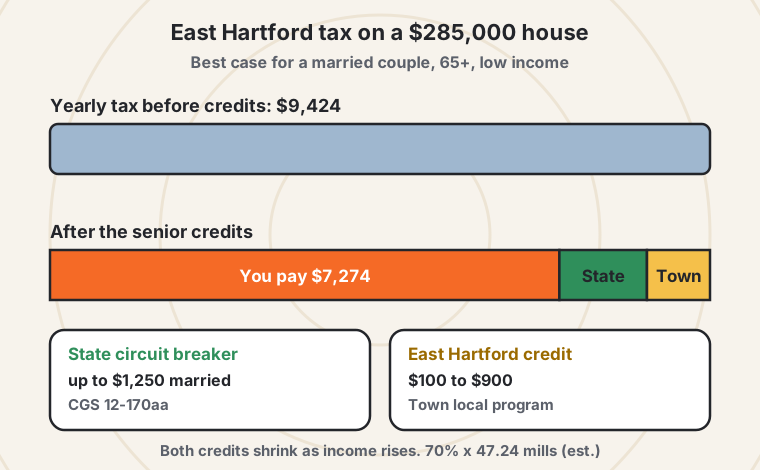
| Yearly property tax on a $285,000 East Hartford house | about $9,424 ($785 a month, est.) | Computed: 70% assessment x 47.24 mills |
| State circuit breaker credit, age 65+ | Up to $1,250 married, $1,000 single; income at or below $56,500 / $46,300 (2025 income) | CGS 12-170aa; OLR Report 2026-R-0027 |
| East Hartford local elderly credit | $100 to $900; town income limits $71,500 married / $61,300 single | East Hartford Assessor, local program page |
| Local option to defer tax above 8% of income | Deferred tax becomes a lien, repaid with interest at sale or death | CGS 12-124a |
| Conveyance tax an East Hartford seller pays | 1.25% (0.75% state + 0.50% town), $3,562.50 on $285,000 | CGS 12-494 |
If you are over 65 and watch your East Hartford tax bill climb every year (the mill rate is 47.24 for fiscal 2027, up from 44.00 two years earlier), you have probably asked: can I afford to stay, or is it time to sell? Connecticut and East Hartford both offer senior relief that takes a real bite out of that bill. This guide walks through each program with East Hartford numbers, then compares staying with selling. It is part of our guide to how to sell a house in Connecticut. If you have already decided to move, our guide to downsizing your home in Connecticut covers the move itself, including Medicaid cautions.
Can you afford to stay in your East Hartford house as you get older?
You may be able to afford to stay in your East Hartford house as you get older if you claim every tax credit you qualify for and the house does not need major repairs. On a typical $285,000 house the tax is about $9,424 a year; the state and town senior credits together can cut up to $2,150 off it, depending on income.
Maybe you bought a cape near Burnside Avenue decades ago, the mortgage is gone, and your income is Social Security and a small pension, but the tax bill keeps growing. People in your spot often feel squeezed by bills that rise faster than their income, proud of a paid-off home, afraid of becoming a burden to their children, confused by programs with different forms, offices and income limits, and suspicious of anyone who calls offering to buy the house.
Those are fair feelings. Selling is not the only answer, and for many East Hartford seniors it is not the best one. This page is for you: the relief you can claim, the ways to put tax off, then an honest stay-or-sell comparison.
What is Connecticut’s circuit breaker credit and who qualifies in East Hartford?
Connecticut’s circuit breaker credit is a state property tax reduction for homeowners aged 65 or older, or totally disabled, with qualifying income at or below $56,500 married or $46,300 single (2025 income). It cuts the tax on the home you live in by up to $1,250 for married couples and $1,000 for single owners (CGS 12-170aa). East Hartford owners apply at the town assessor.
The rules, from the statute and the state’s legislative research office:
| Rule | What it says | Source |
|---|---|---|
| Age | 65+ at the end of the prior year (or your spouse is); a qualifying surviving spouse 50+; or totally disabled | CGS 12-170aa(b) |
| Home | You own (or hold a life estate in) the house and live in it | CGS 12-170aa(b) |
| Residency | Connecticut resident at least one year before applying | OLR 2026-R-0027 |
| Income | All income, including Social Security, at or below $56,500 married or $46,300 single (2025 income); Medicaid payments do not count | CGS 12-170aa(b); OLR 2026-R-0027 |
| Amount | 10% to 50% of the tax depending on income bracket; at least $150; at most $1,250 married or $1,000 single | CGS 12-170aa(c)-(d) |
| When and where | Apply to the East Hartford assessor between February 1 and May 15; file in the first year and every second year after | CGS 12-170aa(e)-(f) |
| Missed it for illness | Ask OPM for an extension before August 15 of the claim year | CGS 12-170aa(f) |
The lowest incomes get the biggest share: a married couple in the lowest bracket gets 50% of the tax, capped at $1,250, which is what applies on a $9,424 East Hartford bill. Couples near the top of the income limit get the minimum, $150. Bring last year’s SSA-1099, pension and interest statements. The state’s program page is on the Office of Policy and Management site.
What local senior tax relief does East Hartford offer?
East Hartford offers its own local tax credit for elderly and totally disabled homeowners, on top of the state circuit breaker. The town’s assessor page lists a credit of $100 to $900, income limits of $71,500 for married couples and $61,300 for single owners ($15,000 above the state limits), and an asset limit of $100,000 not counting the home and tax-deferred retirement accounts.
- Who: owners 65+ by December 31 of the prior year, or totally disabled, living in the house.
- Income and assets: up to $71,500 married or $61,300 single, so some owners who miss the state credit still get this one; assets up to $100,000, not counting the home and tax-deferred retirement accounts.
- The 7% test: your tax must be more than 7% of your income. On the median $9,424 bill, anyone under about $134,600 of income passes.
- The cap: the local credit stops where state and local relief together would pass 75% of your tax; state law lets a town place a lien for relief above that level (CGS 12-129n).
- When: February 1 to May 15, at least every two years, through East Hartford Social Services with the Assessor’s Office.
The Town Council updates these limits, and the town website blocked our automated check. Call the East Hartford Assessor’s Office or Social Services to confirm them.
Also ask about veterans’ exemptions and the $1,000 exemption for owners with a permanent total disability (OLR 2026-R-0027).
Can an East Hartford senior defer property taxes instead of paying them?
An East Hartford senior may be able to defer property taxes only if the town has adopted a deferral option. Connecticut lets towns defer tax that exceeds 8% of an owner’s income; the deferred tax becomes a lien and is repaid with interest when the house is sold or the owner dies (CGS 12-124a). A reverse mortgage is the private-market version of the same trade.
| Option | How it works | The catch |
|---|---|---|
| Town tax deferral (CGS 12-124a) | Defers tax above 8% of income | Lien plus interest, paid at sale or death; only if East Hartford adopted it |
| Local tax freeze (CGS 12-170v) | Freezes tax for owners 65+ under OPM income limits | Optional for each town; may carry a lien plus interest |
| Reverse mortgage (HECM, HUD) | Loan for owners 62+ paid from equity, no monthly payment | Interest and fees build up; taxes, insurance and upkeep still due; counseling first; 2026 limit $1,249,125 |
Deferral is not free money: each deferred year adds to the lien, plus interest, and comes out of the sale price or your estate. If a reverse mortgage is on the table, take the HUD counseling first and have your own attorney read the documents.

Before you decide anything about selling, file for every credit you qualify for. If that makes staying affordable and the house is sound, staying is often right. Selling makes more sense when a big repair is coming or the house has become too much to manage.
Is it cheaper to stay in your East Hartford house or to sell and rent?
For a mortgage-free East Hartford senior, staying in a $285,000 house costs about $1,569 a month (est.), or about $1,390 with the maximum state and town credits. Renting a 1-bedroom at HUD’s Fair Market Rent costs about $1,558 including utilities and insurance, or about $1,483 with the state renters’ rebate. Month to month they are close.
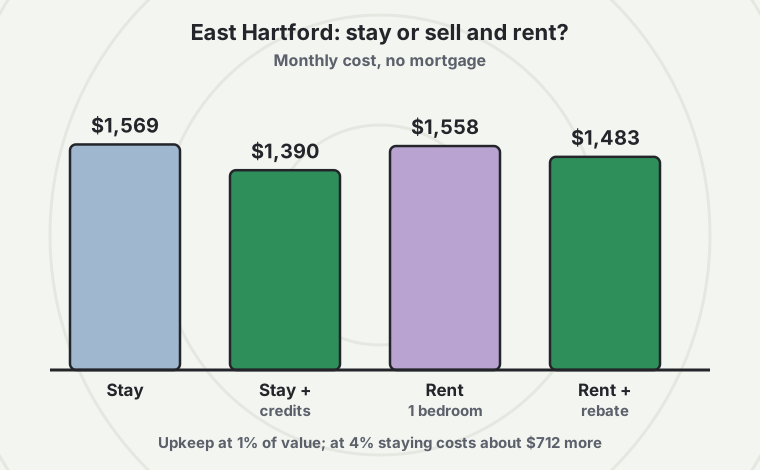
| Monthly cost | Stay: $285,000 house, no mortgage | Sell and rent: 1 bedroom |
|---|---|---|
| Property tax (47.24 mills x 70%) | $785 | in the rent |
| Insurance | $170 | $15 renters policy (est.) |
| Heat | $176 | in the rent |
| Electricity | $200 | in the rent |
| Upkeep (1% of value a year) | $238 | none |
| Rent (HUD Fair Market Rent, includes utilities) | none | $1,543 |
| Total a month | $1,569 | $1,558 |
| With maximum relief (married) | $1,390 (state $1,250 + town $900 a year) | $1,483 (renters’ rebate $900 a year) |
- Upkeep on an older house is lumpy. At Fannie Mae’s 4% for houses over 30 years old, upkeep would be about $950 a month, not $238. One roof or boiler can wipe out a decade of credits.
- The equity works once it is out of the house. The $258,188 net below, at an illustrative 4% (est.), earns about $861 a month before tax. Interest counts as income for the senior credits.
- The tax keeps rising. The mill rate went from 44.00 in fiscal 2025 to 47.24 in fiscal 2027 (OPM), about 7% more tax in two years.
- Renters get relief too. The renters’ rebate pays renters 65+ (or disabled) up to $900 married or $700 single a year, based on income and rent and utilities paid (CGS 12-170d, 12-170e).
What would an East Hartford senior net from selling?
An East Hartford senior selling at the $285,000 median with an agent would net about $258,188 before any mortgage payoff, after a 5% commission (est.), $3,562.50 in conveyance tax at East Hartford’s 1.25% combined rate, a $1,500 attorney fee (est.) and $7,500 of repairs and cleanout (est.). Most long-time owners owe no income tax on the gain.
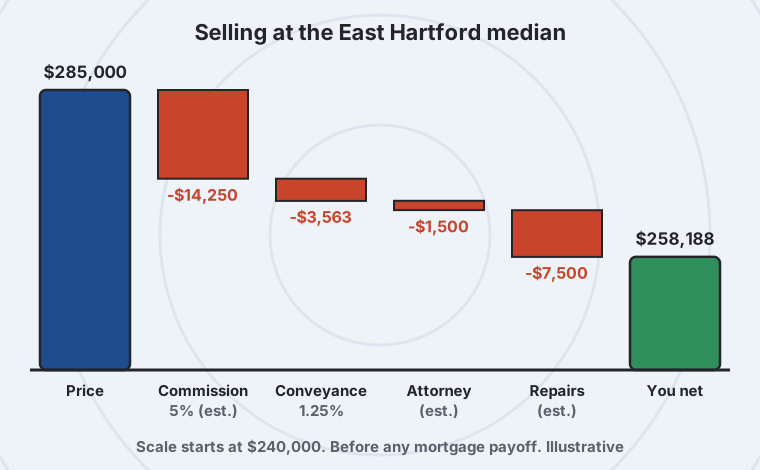
| Line | Amount |
|---|---|
| Sale price (East Hartford single-family median) | $285,000 |
| Commission, 5% (est.) | − $14,250 |
| Conveyance tax, 0.75% state + 0.50% East Hartford | − $3,562.50 |
| Seller’s attorney (est.) | − $1,500 |
| Repairs, cleanout and prep (est.) | − $7,500 |
| Net before mortgage payoff | $258,187.50 |
Most long-time owners owe no income tax: up to $250,000 of gain ($500,000 married) is excluded if you owned and lived in the house 2 of the last 5 years (IRS Publication 523). Run your own numbers here:
How much would you walk away with?
Slide the numbers to match your house. It works in your browser; nothing is saved or sent.
Estimates for planning. Conveyance tax per CGS 12-494 (state 0.75% up to $800,000, 1.25% to $2.5M, 2.25% above, plus the town rate). Seller attorney about $1,200 to $1,500; flat-fee MLS about $400; listings include three months of taxes, insurance and utilities, a cash sale about two weeks. Your attorney gives you the final numbers.
Ask the assessor how interest on the proceeds would count toward qualifying income later. A move into assisted living raises Medicaid questions that our Connecticut downsizing guide covers; see an elder law attorney first if long-term care is likely.
What are an East Hartford senior’s honest options: stay, sell with an agent, or sell as-is?
An East Hartford senior’s honest options are to stay and claim every credit, stay and defer, sell with an agent for the best price, or sell as-is to a direct buyer. Staying wins when the credits make it affordable and the house is sound. Listing wins when the house shows well. A direct sale fits when repairs, a cleanout or a set move date make listing hard.
Stay and claim the credits
Up to $2,150 a year offBest when the house is sound and you want to stay.
- Apply February 1 to May 15
- Re-file every second year
- Repairs are still yours
Sell with an agent
Highest priceBest when the house is in good shape and you have time.
- Commission, repairs, showings
- Buyer financing and inspection
Sell as-is, direct
About 2 weeks, or your dateFits a house that needs work or is full of belongings.
- No repairs, no cleanout, no showings
- Lower price: compare the net
When you should NOT sell to a cash buyer: when you want to stay, the credits make it affordable and the house needs nothing major; or when the house is in good shape and you can wait for a listing, which usually brings more. We buy houses for cash, and we will tell you that. Read why cash offers are so low before comparing, and if anyone pressures you, says the offer expires today, or asks for a fee, see we buy houses scams and red flags.
If you do decide to move, perhaps closer to family out of state, our page for sellers who are relocating from Connecticut explains how a direct sale fits a move date. For a written number on your house, see our East Hartford page. The local market from the buyer’s side is in the East Hartford buyer’s market guide.
What steps should an East Hartford senior take before deciding to stay or sell?
Before deciding to stay or sell, an East Hartford senior should apply for the state and town credits, ask about deferral, price the next five years of repairs, compare staying with renting, and get a written sale number. It costs nothing.
Gather your income papers
Last year’s SSA-1099, pension and interest statements. Both credits count Social Security.
Apply between February 1 and May 15
State credit at the assessor, local credit through Social Services. Ask about veterans’ and disability exemptions and any deferral or freeze.
Price the next five years of repairs
Roof, heating, oil tank, water heater, windows. If two or more are due, add them to the math.
Compare staying with renting
Use the monthly table with your own bills and a real rent quote.
Get a written number, with no deadline
An agent’s pricing opinion and a direct written offer. Our offers do not expire, and a direct sale can close in about 2 weeks or on your date.
See the house together.
Pick a time that works.
Choose a time for us to walk through the property with you, or ask for a quick call first. We confirm every request personally.
Tuesday, January 13
No open times in the next few weeks. Please call us.
We will confirm by email. Nothing is booked until we do.
View my requestIf a move is likely, our guide for owners who are relocating and need to sell a house in Connecticut covers the timeline, and our relocation sale page explains how we buy a house you have already left.
Questions East Hartford seniors ask about property tax relief
What senior property tax relief is available in East Hartford, CT?
Senior property tax relief in East Hartford, CT includes the state circuit breaker (up to $1,250 married or $1,000 single, CGS 12-170aa) and the town’s own elderly credit ($100 to $900). Both are for owners 65+ or disabled who meet income limits.
What are the income limits for the Connecticut circuit breaker in 2026?
The income limits for the Connecticut circuit breaker in the 2026 filing year are $56,500 for married couples and $46,300 for single owners, based on 2025 income, including Social Security (OLR Report 2026-R-0027).
When do I apply for senior tax relief in East Hartford?
You apply for senior tax relief in East Hartford between February 1 and May 15, at the assessor for the state credit and through Social Services for the local credit. After the first year, you file every second year (CGS 12-170aa).
Can I get both the state and the East Hartford credit?
You can get both the state circuit breaker and the East Hartford local credit if you qualify for each, but the local credit stops when the two together would exceed 75% of your tax, and total relief can never exceed the tax (CGS 12-129n).
Can I defer my property taxes in East Hartford?
You may be able to defer property taxes in East Hartford only if the town has adopted the state’s deferral option, which covers tax above 8% of income and becomes a lien repaid with interest at sale or death (CGS 12-124a). Ask the tax collector.
Is a reverse mortgage a good way to pay East Hartford taxes?
A reverse mortgage can pay East Hartford taxes for owners 62+, but interest and fees build against your equity and you must still pay taxes, insurance and upkeep. HUD requires counseling first; the 2026 loan limit is $1,249,125.
How much is the conveyance tax if I sell in East Hartford?
The conveyance tax if you sell in East Hartford is 1.25% for homes up to $800,000: 0.75% to the state and 0.50% to the town (CGS 12-494). On $285,000 that is $3,562.50, paid by the seller.
Do renters in East Hartford get senior tax relief?
Renters in East Hartford aged 65+ or disabled can get the state renters’ rebate, up to $900 married or $700 single a year, based on income and rent and utilities paid (CGS 12-170d, 12-170e).
Related guides
Downsizing and moving
Taxes and costs
Nearby towns
For every route to a sale, the paperwork and the closing, start with how to sell a house in Connecticut.
General education, not legal, tax or financial advice. Program rules and income limits change every year; confirm with the East Hartford Assessor and Social Services, and talk to an elder law attorney before you sell.
Sources (checked on October 27, 2026)
- CGS chapter 204a: § 12-170aa (circuit breaker eligibility, benefit schedule, biennial filing), §§ 12-170d and 12-170e (renters’ rebate), §§ 12-170v and 12-170w (local tax freeze).
- CGS chapter 204: § 12-124a (deferral of tax above 8% of income), § 12-129n (local relief for seniors; 75% lien rule).
- OLR Report 2026-R-0027, Mandatory Property Tax Relief for Homeowners (2026 income limits).
- OLR Report 2026-R-0001, optional property tax relief programs.
- CT OPM, Homeowners Elderly/Disabled Circuit Breaker program.
- East Hartford Assessor, Tax Credit for Elderly and Totally Disabled Homeowners (Local Program).
- HUD Mortgagee Letter 2025-22 (2026 HECM limit).
- CT OPM mill rates, fiscal 2025 to 2027, and CT OPM Real Estate Sales (East Hartford, Oct 2024 to Sep 2025), data.ct.gov.
- CGS § 12-494 (conveyance tax) and OLR Report 2020-R-0020 (0.50% towns).
- HUD Fair Market Rents, FY2027 (Hartford-West Hartford-East Hartford MSA).
- NAIC Homeowners Insurance Report; EIA Winter Fuels Outlook; Fannie Mae maintenance budget guide.
- IRS Publication 523, Selling Your Home.

Who wrote this
Jerryll Noorden
Jerryll has bought and sold Connecticut houses since 2016 and has sat at more closing tables than he can count, on both sides. Before real estate he was a robotics scientist at NASA, IHMC and IIT. He wrote this guide because the national sites that rank for it skip the Connecticut rules that cost sellers money. When listing or selling it yourself would get you more than a cash offer, he says so.
This guide explains Connecticut rules in plain English. It is not legal or tax advice. Laws change; for your sale, talk to a Connecticut real estate attorney and a tax professional.
