
Key facts at a glance
This guide is part of our land series and of our guide to how to sell a house in Connecticut. It covers selling land through the internet: listings, auctions and direct buyers, what each costs, and the scams aimed at land owners.
| Fact | Number | Source |
|---|---|---|
| Connecticut vacant land sales, Oct 2024 to Sep 2025 | 1,020 market-rate sales, median $120,000 | data.ct.gov sales dataset (OPM), our query |
| Conveyance tax on land, paid by the seller | 0.75% state + 0.25% town (0.50% in 16 towns) | CGS 12-494 |
| Who must conduct a Connecticut closing | An attorney | CGS 51-88a |
| FBI warning on fake-owner sales of vacant land | Public service announcement I-061626-PSA, June 16, 2026 | FBI Internet Crime Complaint Center (ic3.gov) |
| Where to report a scam | reportfraud.ftc.gov and ic3.gov | FTC; FBI |
| Free alerts when a document is recorded in your name | Offered by many town clerks, for example Monroe, Vernon, Tolland and South Windsor | Town clerk websites |
| Property Condition Disclosure Report | Covers homes with 1 to 4 dwelling units, so a vacant lot generally falls outside it | CGS 20-327b |
Can you sell land online for free in Connecticut?
You can list land online for free in Connecticut, on free land listing sites, classifieds and social media, and some direct buyers make offers without charging a fee. But the sale itself is never entirely free: the seller pays the conveyance tax of 0.75% to the state plus 0.25% or 0.50% to the town (CGS 12-494), a Connecticut attorney conducts the closing (CGS 51-88a), and many buyers will want a survey.
“Free” is the right goal for the marketing. You do not need to pay anyone to show your land to buyers, and you should never pay a stranger who says they have a buyer waiting. What you cannot avoid are the costs of transferring title, and those are the same whether the buyer found you online or down the street.
The big questions about land, such as who buys it, how it is valued, how developer contracts and approvals work, and the taxes, are in our pillar guide on how to sell land in Connecticut. This page goes deeper on the online part: the routes, the real costs, a listing that sells, and how to stay safe.
Why does selling land online feel risky?
Selling land online feels risky because you are dealing with strangers you may never meet, about a property nobody has to tour, in a market with few comparable sales. Land owners also get a steady stream of letters, texts and emails from buyers they never contacted, and some of those are scams. Feeling cautious is the right instinct; it just needs a checklist.
Maybe you live out of state and the lot is in Connecticut. Maybe you inherited woodland you have never walked. You may feel hopeful that the internet can find a buyer an agent could not, and overwhelmed by the number of sites and offers. You may feel suspicious of every unsolicited letter, embarrassed about not knowing what the land is worth, and afraid of being the person who wires money to a fraud.
This page is for you. It shows you how to put your land in front of real buyers, what each route really costs, and the exact signs that tell a real buyer from a scam.
What are the ways to sell land online in Connecticut?
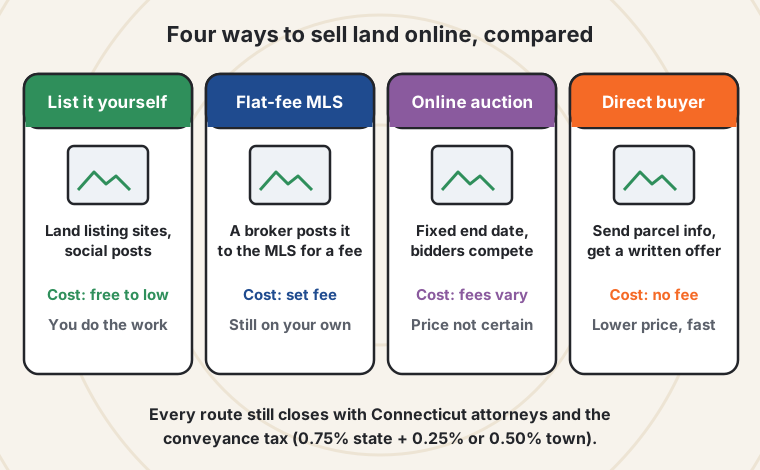
The ways to sell land online in Connecticut are: list it yourself on land listing sites, classifieds and social media; pay a broker a flat fee to put it on the MLS; sell it through an online auction; or send the parcel details to direct buyers for a written offer. They differ in cost, in how much work you do, in how certain the price is and in how long it takes.
1. List it yourself
There are websites that specialize in land, general classifieds and local social media groups. Many let owners post for free or a small fee. You write the listing, take the calls, walk buyers out to the lot and screen them. It costs the least and reaches the buyers who search for land, but you do every job an agent would do.
2. Flat-fee MLS listing
A licensed broker can put your land on the local Multiple Listing Service for a set fee, without full service. Your lot then appears wherever MLS listings are shared. You still handle questions and showings, and if you offer a commission to a buyer’s agent, you pay it at closing.
3. Online auction
Auction platforms sell land with a fixed end date and competing bids. That can work well for unusual parcels that are hard to price. But terms vary a lot: some auctions charge the seller fees, many add a buyer’s premium that bidders subtract from what they will pay, and an “absolute” auction sells to the top bidder whatever the price. Read the terms and have your attorney review them before you agree.
4. Direct buyers
Land investors and some builders take parcel details through an online form and make an offer without a listing. It is quick and costs nothing to ask, and the offer will be below what a builder would pay for a clean lot. We are one of these buyers: we buy land in Connecticut as well as houses, and our offers come in writing with no fee.
What should a Connecticut land listing include?
A Connecticut land listing should include the parcel ID and map, the acreage and road frontage from a survey, the zoning district and what it allows, whether town water and sewer are available or a well and septic would be needed, any wetlands, flood zone or slope notes, clear photos, the price and the terms you accept. Buyers skip land listings that leave the buildability question open.
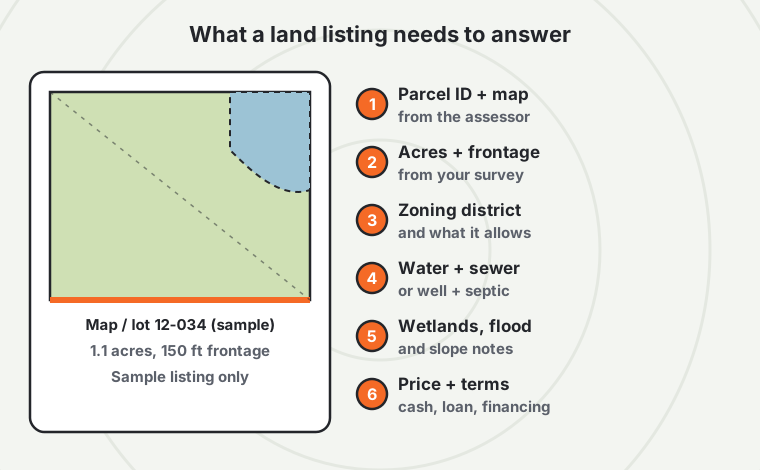
- Parcel ID, map and lot number, from the assessor’s card
- Acreage and frontage, from a survey if you have one
- Zoning district, minimum lot size and frontage, and what the town says about buildability
- Utilities: public water and sewer at the street, or well and septic needed; any perc or test pit results
- Wetlands, watercourses, FEMA flood zone and steep slopes, as far as you know them
- Access: road frontage, or a recorded right-of-way
- Photos from the road and inside the lot, and a marked boundary sketch
- Price, and whether you accept cash only, bank financing or seller financing
- Any PA 490 classification, so buyers know they must reapply
Getting these answers from the town costs little and is the best money you will spend. Our guide to selling a lot by owner in Stratford shows how to get the zoning, wetlands and coastal answers in writing.
What does selling land online really cost?
Selling land online really costs the closing costs every land sale carries: the 1.00% conveyance tax in most Connecticut towns (1.25% in 0.50% towns), a closing attorney and often a survey, plus whatever the route charges. On a $120,000 lot, a free self-listing nets about $114,600 (est.), a flat-fee MLS listing that pays a buyer’s agent about $111,100 (est.), and a direct offer of $109,700 about $107,400.
| Item (lot at $120,000, 0.25% town) | Free self-listing | Flat-fee MLS | Direct buyer |
|---|---|---|---|
| Sale price | $120,000 | $120,000 | $109,700 |
| Listing fee (est.) | $0 | -$500 | $0 |
| Buyer’s agent commission offered (2.5%, est.) | $0 | -$3,000 | $0 |
| Conveyance tax 1.00% (CGS 12-494) | -$1,200 | -$1,200 | -$1,097 |
| Seller’s attorney (est.) | -$1,200 | -$1,200 | -$1,200 |
| Boundary survey if needed (est.) | -$3,000 | -$3,000 | $0 |
| Net before income tax | $114,600 | $111,100 | $107,403 |
| Time | Months, your work | Months, some help | Weeks |
Auctions are harder to put in a table, because the price is whatever the bidding reaches and a buyer’s premium comes out of what bidders are willing to pay. And profit on land is taxable: the home-sale exclusion generally does not cover vacant land, as the pillar guide’s tax section explains.
Online listings help most when the lot is clearly buildable. If the land has open zoning, wetlands or access questions, more exposure may only bring more low offers. Our page on why cash offers are lower explains how any as-is offer is built.
How do online land auctions work in Connecticut?
Online land auctions in Connecticut work by setting a bidding period, often with a minimum (reserve) price or none (absolute), requiring the winning bidder to sign a contract and pay a deposit, and closing with Connecticut attorneys like any other sale. The seller still pays the conveyance tax, and the auction’s own fees and buyer’s premium depend on the platform’s terms.
- Reserve or absolute. With a reserve you can refuse a low top bid. With an absolute auction you cannot.
- Buyer’s premium. Many auctions add a percentage to the winning bid that the buyer pays. Bidders know this and bid less, so it is partly your cost.
- Seller fees. Some platforms charge sellers listing, marketing or success fees. Get every fee in writing, and pay none to anyone you have not checked.
- Contract and deposit. The winner usually signs a set contract with a non-refundable deposit. Have your Connecticut attorney review it before the auction starts.
Auctions fit unusual parcels: large acreage, land with an uncertain use, or a lot where you want a fixed end date. For an ordinary building lot, a good listing is usually simpler.
Which scams target Connecticut land owners?
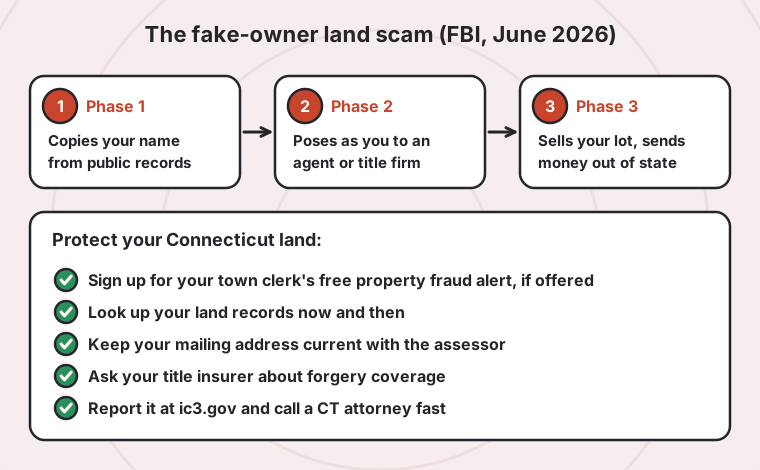
The scams that target Connecticut land owners are fake-owner sales, where a criminal poses as you to sell your vacant land; fake buyers who send a check for more than the price and ask you to wire back the difference; and advance-fee schemes that ask you to pay an “appraisal”, “listing” or “processing” fee before a buyer appears. Vacant land is a favorite target because nobody lives there to notice.
Fake owners selling your land
On June 16, 2026 the FBI warned that criminals impersonate owners of vacant parcels: they take the owner’s details from public records and data brokers, use fake IDs, email accounts and internet phone numbers, contact agents and title companies posing as the owner, and try to send the sale money to an accomplice out of state. Red flags the FBI lists include a “seller” who will only email or text, refuses to meet, pushes to close fast or below market, and knows little about the land.
You protect yourself by watching the records. Many Connecticut town clerks, including Monroe, Vernon, Tolland and South Windsor, offer a free alert that emails you when a document is recorded in your name; ask the clerk in your land’s town. Keep your mailing address current with the assessor, look up your parcel in the land records now and then, and ask your title insurer whether your policy covers forgery. If you spot something, report it at ic3.gov and call a Connecticut attorney at once.
Fake buyers and overpayment
A “buyer” who has never seen the land agrees to your price at once, sends a cashier’s check for more than the price, and asks you to wire back the extra for “fees” or “the surveyor”. The check bounces after your money is gone. The FTC’s advice is not to rely on money from a check unless you know and trust the person. In a Connecticut land sale, money should move through the attorneys at closing, never straight from a stranger to you.
Advance fees for an “appraisal” or “listing”
Another pattern asks you to pay first: an “appraisal fee” to value your land for a buyer, a fee to be “matched” with investors, or a “processing” charge before an offer. Real buyers pay for their own appraisal and inspections. For resale offers on timeshares, the FTC advises dealing with resellers who take their fees after the property is sold, and getting refund policies in writing; the same logic applies to land.
Low “blind offer” letters
Not every unsolicited offer is a scam. Many land investors mail offers to owners in bulk, often at a fraction of market value, because some owners will accept without checking. They are legal, but compare any letter with real land sales before you answer. Our page on why you keep getting offers to buy your property explains where they come from, and we-buy-houses scams and red flags lists the warning signs.
How do you check that an online land buyer is real?
You check that an online land buyer is real by confirming their full name or company in the Connecticut Secretary of the State’s business records, asking for proof of funds or a lender’s letter, insisting that the deposit goes to your attorney or a title company, never paying them a fee, and closing only through Connecticut attorneys. A real buyer accepts all of that without argument.

- Who are they? Get a full name, company name, address and phone. Look up the company in the Secretary of the State’s online business search.
- Can they pay? Ask for a bank letter, a proof-of-funds statement or a lender’s approval for a land loan.
- Where does the money go? The deposit goes to your attorney or a title company, never to the buyer’s “agent” and never by a wire you did not set up.
- What does the contract say? Watch for a buyer who can back out for any reason for months, or who writes “and/or assigns” after their name; read what “and/or assigns” means before you sign.
- Who closes? Your own Connecticut attorney. Our guide on how to check a cash buyer in Connecticut has eight more checks, and legitimate cash buyers in CT explains licensing and registration.
When should you not sell land online, or not to a cash buyer?
You should not sell land online yourself when the lot has open zoning, wetlands, access or title questions you cannot answer, when you cannot screen buyers in person, or when you need certainty by a date. And you should not sell to a cash buyer when the lot is clean, buildable and you can wait a few months, because a builder or a listing will usually pay more.
List it online yourself
Lowest costBest for a clean, buildable lot and an owner who can screen buyers.
- Months is normal
- You answer the technical questions
- Watch for overpayment scams
Agent or flat-fee MLS
Wider reachBest when you want help or exposure to agents’ buyers.
- Fee or commission at closing
- Still needs zoning answers
Direct as-is buyer
Weeks, no prepBest for a hard-to-sell lot, an out-of-state owner, or a fixed deadline.
- No survey or testing on your side
- Written offer, no fee
- Trade-off: below a builder’s price
If the land has a house on it, the rules change; our guide to selling a house as-is in Connecticut covers that. If you would like a written as-is number to compare with your online offers, we will make one, and tell you if listing looks better for your lot.
What are the steps to sell land online in Connecticut?
The steps to sell land online in Connecticut are: protect your parcel with a town clerk fraud alert; gather the deed, map and lot number and any survey; get the town’s zoning, wetlands and utility answers; write a complete listing with photos and a fair price from recent land sales; screen every buyer’s identity and funds; send deposits only to your attorney; and close with Connecticut attorneys, paying the conveyance tax.
Protect the parcel
Sign up for the town clerk’s recording alert if offered, and check that the land records and assessor show your correct mailing address.
Gather the facts
Deed, assessor’s card, map and lot number, any survey, test results and PA 490 certificate.
Get the town’s answers
Zone, legal lot status, utilities, wetlands and flood zone, in writing where possible.
Price and list
Price from land sales in your town and its neighbors on data.ct.gov, then list with every fact a builder needs.
Screen and contract
Check identity and funds, refuse any fee, and have your attorney draft or review the contract.
Close with attorneys
Connecticut closings are conducted by attorneys (CGS 51-88a). The deed is recorded and the conveyance tax paid at closing.
See the house together.
Pick a time that works.
Choose a time for us to walk through the property with you, or ask for a quick call first. We confirm every request personally.
Tuesday, January 13
No open times in the next few weeks. Please call us.
We will confirm by email. Nothing is booked until we do.
View my requestQuestions people ask about selling land online in Connecticut
Can I sell my land online for free in Connecticut?
You can list your land online for free in Connecticut on free listing sites, classifieds and social media, but the sale still has costs: the conveyance tax of 0.75% state plus 0.25% or 0.50% town (CGS 12-494), a closing attorney, and often a survey.
What is the best way to sell land online?
The best way to sell land online depends on the lot. A clean, buildable lot does best with a complete listing that reaches builders; an unusual parcel may suit an auction; a lot with open questions often sells faster to a direct as-is buyer.
Do I need a real estate agent to sell land in Connecticut?
No, you do not need a real estate agent to sell land in Connecticut. You do need an attorney at closing, because Connecticut closings are conducted by attorneys (CGS 51-88a).
How do I avoid land scams when selling online?
To avoid land scams when selling online, never accept a check for more than the price, never wire money back, never pay a buyer an upfront fee, verify the buyer’s identity and funds, and send deposits only to your own attorney or a title company.
Can someone sell my land without me knowing?
Someone can try to sell your land without you knowing by impersonating you, which the FBI warned about in June 2026. A free town clerk recording alert, a current mailing address with the assessor and regular checks of the land records help you catch it early.
Should I pay a fee to get my land appraised for a buyer?
No, you should not pay a fee to a buyer or a stranger to get your land appraised for them. Real buyers pay for their own appraisal; an upfront “appraisal fee” request is a common advance-fee scam.
How much does it cost to sell land in Connecticut?
Selling land in Connecticut usually costs the 1.00% conveyance tax (1.25% in 16 towns), a closing attorney, a survey if needed, and any commission or listing fee. On a $120,000 lot a free self-listing nets about $114,600 (est.).
Do online land auctions charge fees?
Many online land auctions charge fees, either to the seller, to the buyer as a premium added to the winning bid, or both. The terms vary by platform, so get every fee in writing and have your attorney review the contract first.
How long does it take to sell land online?
Selling land online usually takes several months, because land has fewer buyers than houses and buyers check zoning, wetlands and financing. A direct as-is buyer can typically close in a few weeks.
Do I need a survey to sell land online?
You do not always need a survey to sell land online, but listings with a current boundary survey and staked corners sell faster and closer to value, because buyers can see exactly what they are getting.
Do you buy land in Connecticut?
Yes, we buy land in Connecticut as well as houses, as-is and for cash, with a written offer and no fee. If a builder or a listing would net you more for your lot, we will tell you.
Related guides
- How to sell land in Connecticut: buyers, value, approvals and taxes
- How to sell land by owner in Stratford, CT
- How a land investor prices a lot: a Bloomfield example
- How to check a cash buyer in Connecticut
- Connecticut conveyance tax by town
For how a sale works with us from first call to closing, see how selling your property in Connecticut works.
Plain-English information, not legal or tax advice. If you suspect fraud involving your land, contact a Connecticut attorney and report it at ic3.gov.
Sources (checked on October 27, 2026)
- FBI Internet Crime Complaint Center, PSA I-061626-PSA: parcel owner impersonation (June 16, 2026).
- FTC: How to spot, avoid and report fake check scams.
- FTC: Timeshares, vacation clubs and related scams (resale fees).
- FTC ReportFraud.
- Connecticut OPM Real Estate Sales dataset (data.ct.gov): vacant land sales, Oct 2024 to Sep 2025 (our query).
- Connecticut Secretary of the State: business records search.
- CGS 12-494 (conveyance tax).
- CGS 51-88a (closings conducted by attorneys).
- CGS 20-327b (property condition reports).
- Town of Vernon: town clerk fraud alerts for land record filings (one example of a town clerk alert).

Who wrote this
Jerryll Noorden
Jerryll has bought and sold Connecticut houses since 2016 and has sat at more closing tables than he can count, on both sides. Before real estate he was a robotics scientist at NASA, IHMC and IIT. He wrote this guide because the national sites that rank for it skip the Connecticut rules that cost sellers money. When listing or selling it yourself would get you more than a cash offer, he says so.
This guide explains Connecticut rules in plain English. It is not legal or tax advice. Laws change; for your sale, talk to a Connecticut real estate attorney and a tax professional.
